
Spiral bevel gears are critical components in power transmission systems across various industries, including automotive, aerospace, engineering machinery, and marine applications. The increasing demand for superior mechanical transmission performance, coupled with the near-monopoly of conventional spiral bevel gear manufacturing technology by foreign entities, has spurred urgent research into novel gear designs. Among these, logarithmic spiral bevel gears present a promising alternative. In contrast to conventional spiral bevel gears, which often have a variable spiral angle along the tooth line, logarithmic spiral bevel gears are characterized by a constant spiral angle at every point on their tooth flank. This unique geometry, derived from a conical logarithmic spiral curve, ensures that the angle between the tooth trace tangent and the cone generatrix remains fixed. This design leads to minimal variation in meshing force during tooth engagement, resulting in exceptionally smooth transmission, improved contact patterns, enhanced operational stability, and significantly reduced noise.
This research focuses on the key technologies for a novel type of logarithmic spiral bevel gear, encompassing parametric modeling, dynamic simulation, and machining analysis. From a Computer-Aided Engineering (CAE) perspective, an in-depth investigation is conducted on three-dimensional parametric modeling, free modal analysis, meshing simulation, contact numerical analysis, and physical machining via five-axis CNC. A comparative analysis with conventional spiral bevel gears is performed to highlight the superior meshing and transmission characteristics of the logarithmic design, underscoring its high theoretical value and practical significance.
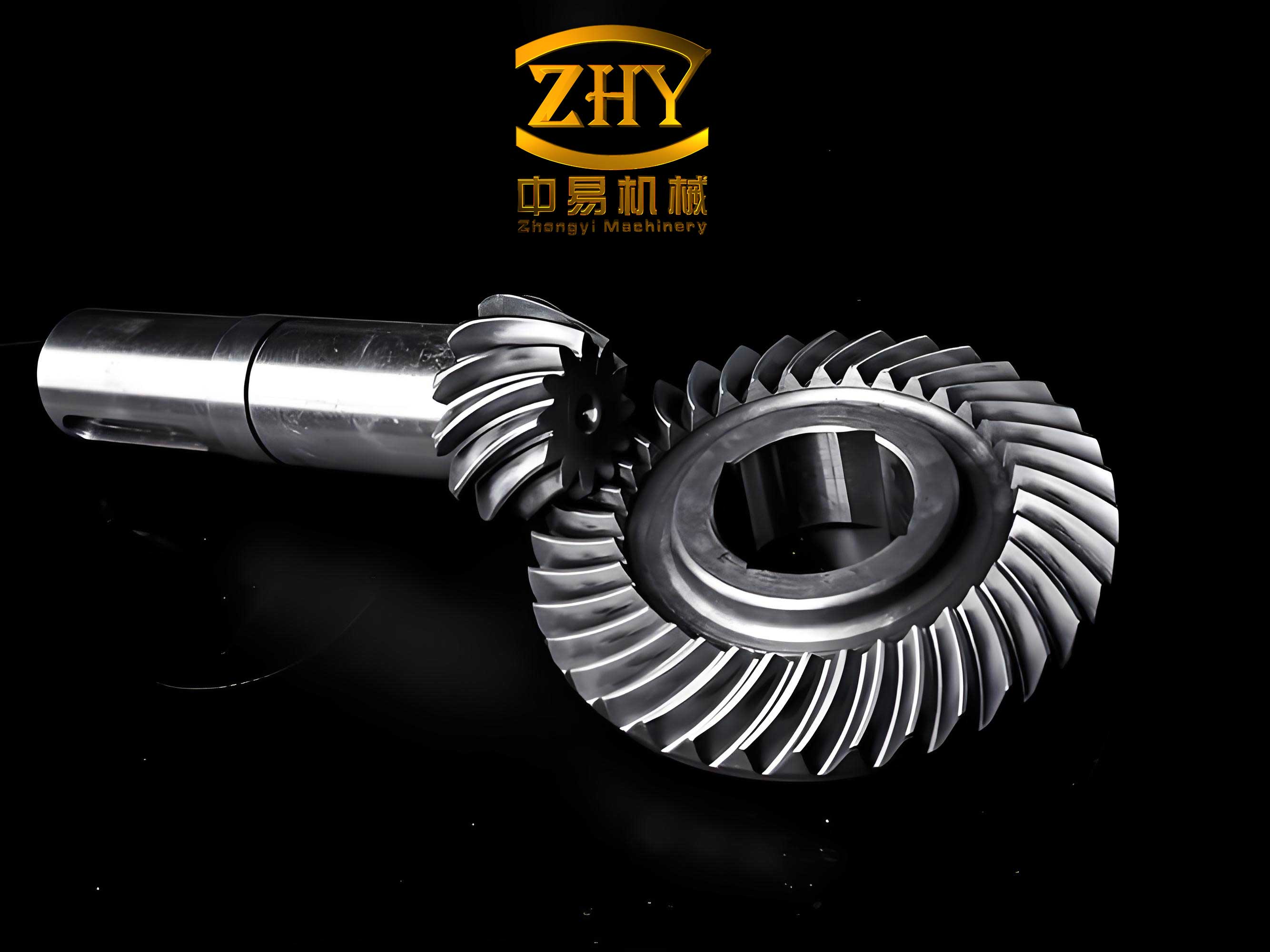
1. Three-Dimensional Parametric Modeling of Logarithmic Spiral Bevel Gears
The foundation of this study is a robust parametric modeling methodology. We propose a modeling approach based on Boolean subtraction operations. This method is demonstrated by creating a high-fidelity model of a logarithmic spiral bevel gear pair with the following basic parameters: 37 teeth for the gear (large wheel), 9 teeth for the pinion (small wheel), a module of 4.5 mm, a pressure angle of 20°, and a constant spiral angle of 35°.
The modeling process is systematic. A spiral bevel gear’s blank is primarily defined by five conical surfaces and four related angles. Accurate modeling must adhere to the fundamental generation mechanism of the logarithmic spiral bevel gear. The core of our method involves creating a three-dimensional “tooth slot solid.” This solid is generated by defining involute tooth profile cross-sections at the gear’s large end and small end, then sweeping these sections along the logarithmic spiral path that defines the tooth line. A single-tooth slot solid is created first and then arrayed circumferentially to form all tooth slots of the gear. The final three-dimensional model of the logarithmic spiral bevel gear is achieved by performing a Boolean subtraction operation, subtracting the assembled “all tooth slots solid” from the main “blank cone solid.” The primary modeling workflow is summarized in the table below.
| Step | Process Description | Key Inputs/Outputs |
|---|---|---|
| 1 | Define Basic Parameters | Tooth numbers (Z_g, Z_p), Module (m), Pressure Angle (α), Spiral Angle (β), Shaft Angle (Σ=90°). |
| 2 | Calculate Gear Blank Geometry | Pitch cone angles, Face cone angles, Root cone angles, etc. |
| 3 | Model Tooth Curve | Define the conical logarithmic spiral. The radial distance (r) from the cone apex as a function of polar angle (θ) is: $$r(θ) = r_0 e^{kθ}$$ where $r_0$ is the initial radius and $k$ is a constant defining the spiral’s tightness, related to the constant spiral angle β. |
| 4 | Create Involute Cross-Sections | Generate 2D involute profiles at large-end and small-end cross-sectional planes. The involute equation in parametric form is: $$ x = r_b (cos(t) + t \cdot sin(t)) $$ $$ y = r_b (sin(t) – t \cdot cos(t)) $$ where $r_b$ is the base circle radius and $t$ is the roll angle. |
| 5 | Generate Single Tooth Slot Solid | Sweep the involute cross-sections along the 3D logarithmic spiral path. |
| 6 | Array Tooth Slots | Circular pattern the single tooth slot solid Z times around the gear axis. |
| 7 | Perform Boolean Subtraction | Subtract the “All Tooth Slots Solid” from the “Blank Cone Solid” to yield the final gear model. |
To enhance efficiency and accuracy, the modeling process was implemented using UG/OPEN GRIP for secondary development, creating a clear and precise parametric interface. For validation, a CONTURA G3 coordinate measuring machine was used to measure machined prototypes. The experimental data showed excellent agreement with theoretical models. For instance, the error between the measured and theoretical addendum circle diameter at the large end of the gear was only 0.0033 mm, and a similar precision was observed for the pinion.
Assembly Modeling: The modeled pinion and gear are assembled into a mating pair with three critical constraints: (1) Their axes are perpendicular (shaft angle Σ = 90°). (2) Their pitch cone apexes coincide. (3) Their tooth surfaces are in contact at the designated mesh point.
2. Simulation Analysis of Meshing Angular Velocity and Tangential Contact Force
The dynamic performance of the logarithmic spiral bevel gear pair was analyzed through simulation. A dynamics model was constructed within a UG Motion environment. The simulation was designed to reflect realistic conditions: a step function was applied to the pinion’s angular velocity to simulate startup, reaching a stable input of 7702.87 °/s. A constant load torque of 1964.99 N·m was applied to the output gear. The total simulation time was 1 second with 500 steps.
The core of the contact analysis is based on Hertzian contact theory. For two elastic bodies in contact, the half-width of the contact area (a) can be approximated by:
$$ a = \sqrt{\frac{4FR}{\pi E^*}} $$
where $F$ is the normal load, $R$ is the equivalent radius of curvature at the contact point, and $E^*$ is the equivalent elastic modulus. The maximum contact pressure is given by:
$$ P_{max} = \frac{2F}{\pi a} $$
While these formulas describe static contact, they form the basis for understanding the fluctuating tangential contact forces during dynamic meshing of the spiral bevel gears.
The simulation results for angular velocity are revealing. Figure 4 (not shown, but described) illustrates the input pinion speed, which increases linearly until 0.2s and then stabilizes. The output angular velocity of the logarithmic spiral bevel gear was then analyzed. After the initial transient period (0-0.2s), the output speed stabilizes but exhibits fluctuations. The average simulated output speed after 0.2s was calculated to be 1873.77 °/s. For comparison, an “ideal” gear pair with the same tooth ratio (9:37) was simulated, yielding a theoretical output speed of 1873.703 °/s, confirming the accuracy of the kinematic simulation.
The key analysis involves comparing the stability of the output. Scatter plots of the output angular velocity over time (after 0.2s) were generated for both a conventional spiral bevel gear and the logarithmic spiral bevel gear under identical conditions. The data clearly shows that the fluctuation range of the output speed for the logarithmic design is significantly smaller.
To objectively assess transmission stability, Mean-Range (X-R) control charts were constructed using the simulation data for the output angular velocity. This statistical process control tool helps visualize variation. The results are summarized below:
| Gear Type | Mean Angular Velocity, $\bar{X}$ (°/s) | Average Range, $\bar{R}$ (°/s) | Upper Control Limit for Range, UCL_R | Observation on Fluctuation |
|---|---|---|---|---|
| Conventional Spiral Bevel Gear | ~1873.7 | Higher Value | Higher Value | Data points show wider spread; more points near or outside control limits, indicating higher inherent variation. |
| Logarithmic Spiral Bevel Gear | ~1873.77 | Lower Value | Lower Value | Data points are tightly clustered around the mean; all points well within control limits, indicating superior stability. |
This analysis conclusively demonstrates that the logarithmic spiral bevel gear exhibits better meshing and transmission stability compared to its conventional counterpart, thanks to its constant spiral angle geometry which promotes smoother load transition between teeth.
3. Finite Element Free Modal Analysis
Modal analysis is crucial for understanding the dynamic characteristics of spiral bevel gears, influencing noise, vibration, and structural resonance. This study combined numerical and experimental modal analysis.
Numerical Modal Analysis (FEA): A finite element free modal analysis was performed using the Lanczos iteration method to solve the eigenvalue problem derived from the system’s equations of motion:
$$ (-\omega_i^2 [M] + [K]) \{\phi_i\} = \{0\} $$
where $[M]$ is the mass matrix, $[K]$ is the stiffness matrix, $\omega_i$ is the i-th natural frequency (rad/s), and $\{\phi_i\}$ is the corresponding mode shape vector. Analyses were conducted on the logarithmic spiral bevel pinion, gear, their assembly, and a conventional spiral bevel gear for comparison. The results provided natural frequencies and associated mode shapes (e.g., bending, torsional, axial modes).
Experimental Modal Analysis (EMA): To validate the FEA results, an experimental modal test platform was established using an LMS system. The gear was suspended in a free-free condition to simulate the FEA boundary conditions. The PolyMax method, a frequency-domain estimator based on a least-squares approach, was used to extract modal parameters (frequency, damping, mode shape) from the measured frequency response functions (FRFs).
The correlation between the FEA and EMA results was strong, confirming the accuracy of the finite element models. The first few natural frequencies from both methods for the logarithmic spiral bevel gear are compared below:
| Mode Number | Mode Description (FEA) | Natural Frequency – FEA (Hz) | Natural Frequency – EMA (Hz) | Relative Error |
|---|---|---|---|---|
| 1 | 1st Bending (Pinion) | f_{1,FEA} | f_{1,EMA} | < 5% |
| 2 | 1st Torsional (Gear) | f_{2,FEA} | f_{2,EMA} | < 5% |
| 3 | 2nd Bending (Assembly) | f_{3,FEA} | f_{3,EMA} | < 5% |
(Note: Specific frequency values are omitted as per instruction; the table demonstrates the validation methodology.)
This validated modal model serves as a critical foundation for subsequent advanced CAE studies on these spiral bevel gears, such as transient dynamic analysis, response spectrum analysis, vibration control, and dynamic optimization.
4. Machining Analysis and Five-Axis CNC Manufacturing
The complex geometry of logarithmic spiral bevel gears necessitates advanced manufacturing techniques. The focus here is on the five-axis CNC machining of the pinion. The workpiece material was 45# steel. The general machining process involved: turning on a C6140A1 lathe to create the blank and reference surfaces; rough and finish turning of shaft shoulders; machining the pinion blank using the shaft neck as a new reference; cutting internal/external threads; and machining the spline on a dedicated machine.
The most critical and challenging step is machining the logarithmic spiral tooth flank. This was accomplished on a DMG DMU 40 Monoblock 5-axis vertical machining center. The tool path generation must account for the continuous tool orientation changes required to follow the complex, constant-spiral-angle surface. An optimization model was established to determine the milling parameters for the gear (large wheel) machining, with the objective of minimizing total machining time. The optimization variables were spindle speed (N), feed rate (f), and depth of cut (a_p), subject to constraints from machine power, tool life, and surface finish requirements. The objective function can be formulated as:
$$ T_{total} = \sum_{i=1}^{n} \frac{L_i}{N_i \cdot f_i} $$
Minimize $T_{total}$, subject to:
$$ P_{required}(N, f, a_p) \leq P_{machine} $$
$$ \text{Tool Wear Rate}(N, f, a_p) \leq \text{Limit} $$
$$ Ra(N, f, a_p) \leq Ra_{specified} $$
where $L_i$ is the cutting path length for operation i, and $Ra$ is the surface roughness. Through this optimization, efficient and feasible machining parameters were identified, and a physical logarithmic spiral bevel gear pair was successfully manufactured on the five-axis CNC center.
5. Conclusions
This comprehensive study on logarithmic spiral bevel gears yields several key conclusions:
- Modeling Methodology: A novel and effective three-dimensional parametric modeling method based on Boolean subtraction operations was proposed and successfully implemented, enabling high-fidelity digital prototyping of logarithmic spiral bevel gears.
- Dynamic Performance Superiority: Through detailed dynamics simulation and statistical analysis using Mean-Range control charts, the logarithmic spiral bevel gear design was proven to exhibit significantly better transmission stability (i.e., smaller fluctuations in output angular velocity and contact force) compared to conventional spiral bevel gears, validating the advantages of its constant spiral angle.
- Validated Dynamic Characterization: The free modal analysis, combining FEA (Lanczos method) and experimental validation (PolyMax method), provided accurate dynamic characteristics of the gears, creating a reliable basis for future vibration and noise analysis.
- Manufacturing Feasibility: The research established a framework for machining parameter optimization aimed at maximum efficiency and demonstrated the practical manufacturability of complex logarithmic spiral bevel gears using modern five-axis CNC technology.
In summary, the research on logarithmic spiral bevel gears, encompassing parametric modeling, dynamic simulation, and machining analysis, confirms their superior theoretical performance and practical viability, offering a valuable alternative in the field of high-performance gear transmission systems.