
In the automotive industry, the limited slip differential (LSD) is a crucial component that enhances vehicle performance on low-traction surfaces such as ice, snow, or mud. Unlike conventional differentials that distribute torque equally, an LSD can transfer most of the torque to the wheel with better grip, thereby improving traction, stability, and safety. Among various LSD designs, helical gears offer distinct advantages due to their smooth operation, high load-bearing capacity, and reduced noise. This article focuses on the parametric modeling and finite element analysis (FEA) of helical gears used in a helical gear limited slip differential. We aim to develop a robust design methodology that ensures reliability and efficiency through advanced computational techniques.
The use of helical gears in differentials has gained popularity due to their inherent benefits. Helical gears engage gradually, resulting in smoother torque transmission and lower vibration compared to spur gears. This makes them ideal for applications where noise reduction and durability are critical. In this study, we leverage parametric design and FEA to optimize helical gear performance, ensuring that the gears can withstand operational stresses without failure. Our approach involves creating a parameterized geometric model using CATIA software, which allows for rapid modifications based on input parameters, significantly enhancing design quality and efficiency. Subsequently, we conduct a detailed finite element analysis to evaluate contact and bending stresses under simulated working conditions.
To begin, we delve into the fundamental principles of helical gear geometry. Helical gears are based on the concept of an involute helicoid, which is a three-dimensional surface generated by a straight line moving along a helical path. This geometry ensures consistent contact and load distribution across the tooth face. The parametric equations for an involute helicoid are derived from the kinematics of gear tooth generation. As shown in the derivation, the surface can be described using parameters such as the base radius, spiral angle, and helix constant. These equations form the basis for our parametric modeling process.
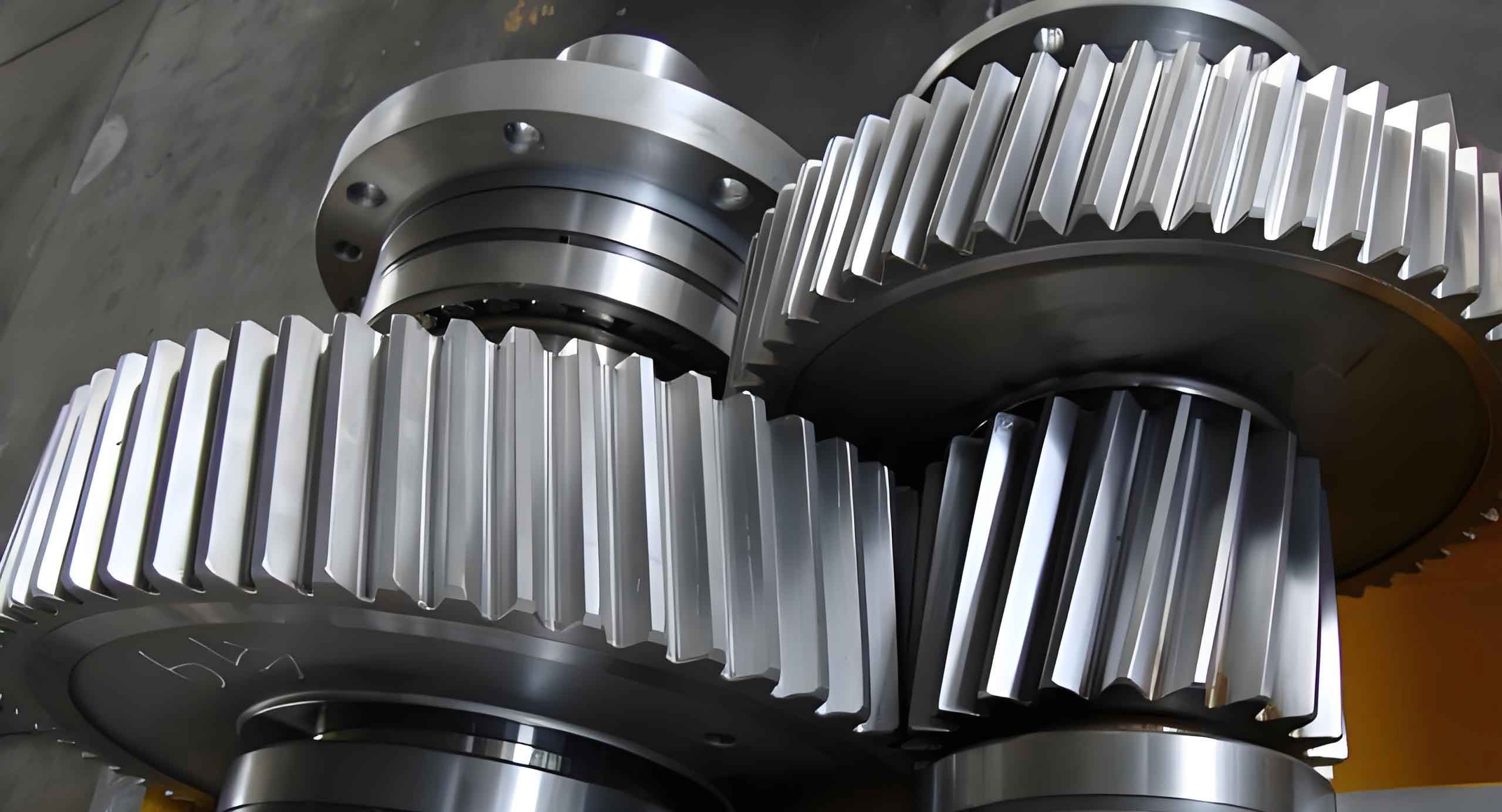
The parametric modeling of helical gears is implemented in CATIA, a powerful CAD software that supports knowledge-based engineering. We define key parameters such as the number of teeth, module, helix angle, and pressure angle as variables in the Formula command. These parameters are linked through mathematical relationships to enable automatic updates when any parameter is changed. For instance, the base radius is calculated from the module and tooth count, while the helix angle influences the tooth orientation. This parametric approach allows us to quickly generate and modify helical gear models, facilitating iterative design improvements. The modeling process involves several steps: first, generating the involute curve using the parametric equations; second, creating the tooth profile by projecting and trimming the curve; third, extruding the profile along a helical path to form the three-dimensional tooth; and finally, assembling the teeth into a complete gear. This methodology ensures accuracy and consistency in the geometric representation of helical gears.
To validate the design, we perform a finite element analysis using ABAQUS software. The FEA model is simplified to reduce computational complexity while maintaining essential features. We remove non-critical details such as splines, bosses, and recesses from the gear geometry, focusing only on the meshing teeth. The simplified model includes a section of the helical gears in contact, representing the planetary and side gears in the differential. Meshing is performed with tetrahedral elements, specifically the C3D10M type, which are suitable for contact analysis. The contact pairs are defined with finite sliding formulation, and boundary conditions are applied via coupling constraints to reference points on the gear axes. This setup simulates the torque transmission and rotational motion under operational loads. The table below summarizes the key parameters used in the FEA model.
| Parameter | Value | Description |
|---|---|---|
| Material | 20CrMnTi | Alloy steel used for gears |
| Torque Applied | 1200 N·m | Input torque on the side gear |
| Element Type | C3D10M | 10-node modified tetrahedron |
| Contact Algorithm | Finite Sliding | Surface-to-surface contact |
| Mesh Density | Refined in contact zone | To capture stress gradients |
The finite element analysis yields detailed insights into the stress distribution within the helical gears. We examine both contact stresses on the tooth surfaces and bending stresses at the tooth roots. The contact stress analysis reveals a band-like pattern along the meshing trajectory, indicating the region of highest pressure. The maximum contact stress is observed at the edges of the teeth due to end effects, but the overall stress levels remain within acceptable limits. The bending stress analysis shows that the highest stresses occur at the tooth fillet, conforming to theoretical expectations. We use mathematical formulas to calculate the allowable stresses for the material and compare them with the FEA results. For helical gears, the contact stress can be estimated using the Hertzian contact theory, while bending stress is derived from beam theory. The equations are as follows:
Contact stress (Hertzian): $$\sigma_c = \sqrt{\frac{F}{2\pi} \cdot \frac{E}{1-\nu^2} \cdot \frac{1}{R}}$$ where \(F\) is the normal load, \(E\) is Young’s modulus, \(\nu\) is Poisson’s ratio, and \(R\) is the effective radius of curvature.
Bending stress (Lewis formula): $$\sigma_b = \frac{F_t}{b m} \cdot Y$$ where \(F_t\) is the tangential force, \(b\) is the face width, \(m\) is the module, and \(Y\) is the Lewis form factor.
In our analysis, we find that the helical gears exhibit a maximum contact stress of approximately 1000 MPa in the steady-state region, with localized peaks up to 2300 MPa at the edges. However, the allowable contact stress for 20CrMnTi material is calculated as 2250 MPa, indicating that the design is safe against contact fatigue. Similarly, the maximum bending stress is around 330 MPa, well below the allowable bending stress of 516 MPa. These results confirm that the helical gears can endure the operational loads without risk of failure. The table below provides a comparative summary of the stress values.
| Stress Type | Maximum Value (MPa) | Allowable Value (MPa) | Safety Factor |
|---|---|---|---|
| Contact Stress | 2300 (peak) | 2250 | ~1.0 (with edge effects) |
| Bending Stress | 330 | 516 | ~1.56 |
The parametric modeling approach significantly enhances the design process for helical gears. By defining parameters and their interdependencies, we can rapidly explore different design configurations. For example, adjusting the helix angle influences the contact ratio and load distribution. A higher helix angle increases the overlap ratio, leading to smoother engagement but may also raise axial thrust. Through parametric studies, we can optimize these factors to achieve a balance between performance and durability. The use of helical gears in limited slip differentials is particularly beneficial due to their ability to handle misalignment and distribute loads evenly. Moreover, the parametric models can be integrated into larger system simulations, enabling comprehensive analysis of the entire differential assembly.
In the finite element analysis, we also investigate the effects of mesh refinement on result accuracy. A coarse mesh may underestimate stress concentrations, while an overly fine mesh increases computational time unnecessarily. We employ adaptive meshing techniques to ensure that critical regions, such as the contact zone and tooth roots, are adequately resolved. The FEA model accounts for nonlinearities due to contact and material behavior, providing a realistic simulation of gear operation. The results indicate that the helical gears exhibit favorable stress patterns, with no signs of premature wear or fracture. This validates the design methodology and underscores the importance of advanced analysis tools in modern engineering.
Furthermore, we explore the implications of gear geometry variations on stress levels. Using the parametric model, we generate multiple iterations of helical gears with different tooth profiles and helix angles. Each iteration is subjected to FEA, and the results are compiled to identify trends. For instance, increasing the number of teeth reduces bending stress but may increase contact pressure due to smaller tooth sizes. The table below summarizes the impact of key geometric parameters on stress performance.
| Geometric Parameter | Effect on Contact Stress | Effect on Bending Stress | Recommendation |
|---|---|---|---|
| Helix Angle Increase | Decreases slightly | Increases moderately | Optimize for balance |
| Tooth Count Increase | Increases marginally | Decreases significantly | Use higher counts for strength |
| Module Increase | Decreases | Decreases | Select based on load |
| Pressure Angle Increase | Increases | Decreases | Trade-off between stresses |
The analysis also highlights the role of material properties in gear performance. The 20CrMnTi steel used in this study is a case-hardening alloy that offers high surface hardness and core toughness. This combination is ideal for helical gears subjected to cyclic loading. We calculate the material properties using standard formulas, such as the endurance limit for fatigue analysis. The allowable stresses are derived from these properties, ensuring a conservative design margin. In practice, additional factors like lubrication and surface finish further enhance gear life, but our FEA focuses on the baseline mechanical stresses.
To deepen the understanding of helical gear behavior, we derive additional mathematical models for dynamic analysis. The meshing of helical gears involves time-varying stiffness due to the changing number of teeth in contact. This can be expressed as: $$k(t) = k_0 + \sum_{n=1}^{\infty} k_n \cos(n\omega t + \phi_n)$$ where \(k_0\) is the mean stiffness, \(k_n\) are harmonic components, \(\omega\) is the meshing frequency, and \(\phi_n\) are phase angles. Such dynamic models help predict vibration and noise characteristics, which are critical for automotive applications. However, in this static FEA, we assume quasi-static conditions, which are sufficient for stress evaluation.
The parametric modeling and FEA process described here can be extended to other gear types and mechanical systems. The principles of involute geometry and contact mechanics are universal, making this methodology widely applicable. For helical gears, in particular, the ability to quickly modify designs and simulate performance is invaluable in achieving optimal solutions. As automotive technology advances toward electrification and lightweighting, the demand for efficient and reliable helical gears will only grow. Our work contributes to this field by providing a robust framework for design and analysis.
In conclusion, we have successfully developed a parametric model for helical gears in a limited slip differential and conducted a comprehensive finite element analysis. The results demonstrate that the helical gears designed with this approach meet all stress requirements, with contact and bending stresses well within material limits. The parametric modeling technique enables rapid iteration and optimization, while the FEA provides detailed insights into stress distributions. This combined methodology enhances design quality, reduces development time, and ensures the reliability of helical gears in demanding applications. Future work may include dynamic analysis, experimental validation, and integration with system-level simulations to further improve performance.