
In the realm of mechanical transmission systems, spur and pinion gears play a pivotal role due to their simplicity, efficiency, and reliability. As a researcher focused on computer-aided design (CAD) and simulation, I have explored advanced methodologies for creating accurate three-dimensional models of spur gears using parametric modeling techniques. This article delves into my comprehensive approach to modeling spur and pinion gears in Pro/ENGINEER (Pro/E), now known as Creo, and simulating their generation process via MATLAB. The goal is to provide a robust framework that enhances design flexibility, supports finite element analysis (FEA), and facilitates computer-aided manufacturing (CAM) integration. By emphasizing parameterization, I aim to streamline the design process for spur and pinion gears, which are fundamental components in various industrial applications, from automotive systems to machinery. Throughout this discussion, I will frequently reference spur and pinion gears to underscore their significance and the adaptability of the proposed methods.
Parametric modeling is a cornerstone of modern CAD systems, allowing designers to define geometric features based on mathematical relationships and variables. In Pro/E, this capability enables the creation of models that can be easily modified by altering key parameters, such as dimensions or constraints. For spur and pinion gears, this is particularly advantageous because gear design involves numerous interdependent parameters, including module, number of teeth, pressure angle, and face width. My work leverages this parametric approach to build precise gear models that automatically update when input variables change. This not only saves time but also reduces errors in complex assemblies where spur and pinion gears must mesh perfectly. The integration of parametric modeling with simulation tools like MATLAB further allows for dynamic visualization of gear generation processes, offering insights into manufacturing techniques like hobbing or shaping.
To begin, I establish the fundamental geometric parameters for spur and pinion gears. These parameters form the basis of the parametric model and are defined in a table for clarity. Below is a summary of the key variables used in my design process, which applies to both spur gears and pinions in a gear pair. Note that for a pinion, which is typically the smaller gear in a pair, the same principles apply, but with adjusted parameters like tooth count to ensure proper meshing.
| Parameter | Symbol | Description | Typical Value (Example) |
|---|---|---|---|
| Number of Teeth | Z | Total teeth on the gear; for a pinion, this is often lower. | 20 (spur), 10 (pinion) |
| Module | M | Ratio of pitch diameter to teeth number; critical for sizing spur and pinion gears. | 25 mm |
| Face Width | B | Axial length of the gear tooth. | 10 mm |
| Pressure Angle | α | Angle between the tooth profile and radial line; standard is 20°. | 20° |
| Addendum Coefficient | HAX | Factor for addendum height; usually 1 for standard spur gears. | 1 |
| Dedendum Coefficient | CX | Factor for dedendum height; often 0.25 for clearance. | 0.25 |
| Addendum | ha | Height from pitch circle to tooth tip; calculated from HAX and M. | Calculated |
| Dedendum | hf | Height from pitch circle to tooth root; calculated from HAX, CX, and M. | Calculated |
| Whole Depth | ht | Total tooth height; sum of ha and hf. | Calculated |
| Pitch Diameter | d | Diameter of the pitch circle; where spur and pinion gears theoretically mesh. | Calculated |
| Tip Diameter | da | Diameter of the addendum circle. | Calculated |
| Root Diameter | df | Diameter of the dedendum circle. | Calculated |
| Base Diameter | db | Diameter of the base circle; essential for involute curve generation. | Calculated |
The relationships among these parameters are governed by standard gear equations. In my parametric model, I define these using Pro/E’s relation tools. For instance, the pitch diameter for a spur gear is given by:
$$ d = M \times Z $$
Similarly, the addendum and dedendum are computed as:
$$ ha = (HAX + X) \times M $$
$$ hf = (HAX + CX – X) \times M $$
where X is the profile shift coefficient (often zero for standard spur and pinion gears). The tip and root diameters follow:
$$ da = d + 2 \times ha $$
$$ df = d – 2 \times hf $$
The base diameter, crucial for the involute profile, is:
$$ db = d \times \cos(\alpha) $$
These formulas ensure that the model adapts dynamically to changes in input variables, making it suitable for designing various spur and pinion configurations. I incorporate these into Pro/E by accessing the “Parameters” and “Relations” dialogs, inputting the equations so that derived parameters like da and df are automatically calculated based on Z, M, α, HAX, and CX.
Next, I create the basic circles that define the gear geometry: the tip circle, pitch circle, base circle, and root circle. In Pro/E, I sketch these on a front plane (e.g., FRONT) as concentric circles. Initially, I draw arbitrary circles and then assign dimensions through relations. For example, if the pitch circle diameter is labeled D1 in the sketch, I set:
$$ D1 = d $$
Likewise, for the tip circle (D2), base circle (D3), and root circle (D4):
$$ D2 = da $$
$$ D3 = db $$
$$ D4 = df $$
This parametric linking ensures that any change in d, da, db, or df automatically updates the sketch, maintaining design consistency for spur and pinion gears. The base circle is particularly important as it forms the foundation for the involute curve, which defines the tooth profile. For spur gears, this involute ensures smooth meshing with pinions, minimizing noise and wear.
The involute curve is generated using a parametric equation based on the geometry of a line rolling on the base circle without slipping. In Pro/E, I use the “Curve from Equation” feature. The equation in Cartesian coordinates is:
$$ \text{ang} = 90 \times t $$
$$ r = \frac{db}{2} $$
$$ s = \frac{\pi \times r \times t}{2} $$
$$ xc = r \times \cos(\text{ang}) $$
$$ yc = r \times \sin(\text{ang}) $$
$$ x = xc + s \times \sin(\text{ang}) $$
$$ y = yc – s \times \cos(\text{ang}) $$
$$ z = 0 $$
Here, t is a parameter ranging from 0 to 1, and the equation traces the involute profile. This curve starts at the base circle and extends outward, forming one side of a tooth. For spur and pinion gears, this involute is symmetric about the tooth centerline, so I create a datum point at the intersection of the involute and pitch circle, then mirror the curve across a plane rotated by an angle of:
$$ \theta = \frac{360}{4 \times Z} $$
This angle ensures proper tooth spacing. In Pro/E, I establish a datum axis through the gear center and a datum plane through this axis and the point. Then, I create another datum plane rotated by θ, using a relation to link it to Z. For example, if the rotation angle is dimensioned as d20, I set:
$$ d20 = \frac{360}{4 \times Z} $$
Mirroring the involute across this plane produces the opposite side of the tooth, completing the tooth profile for both spur gears and pinions.
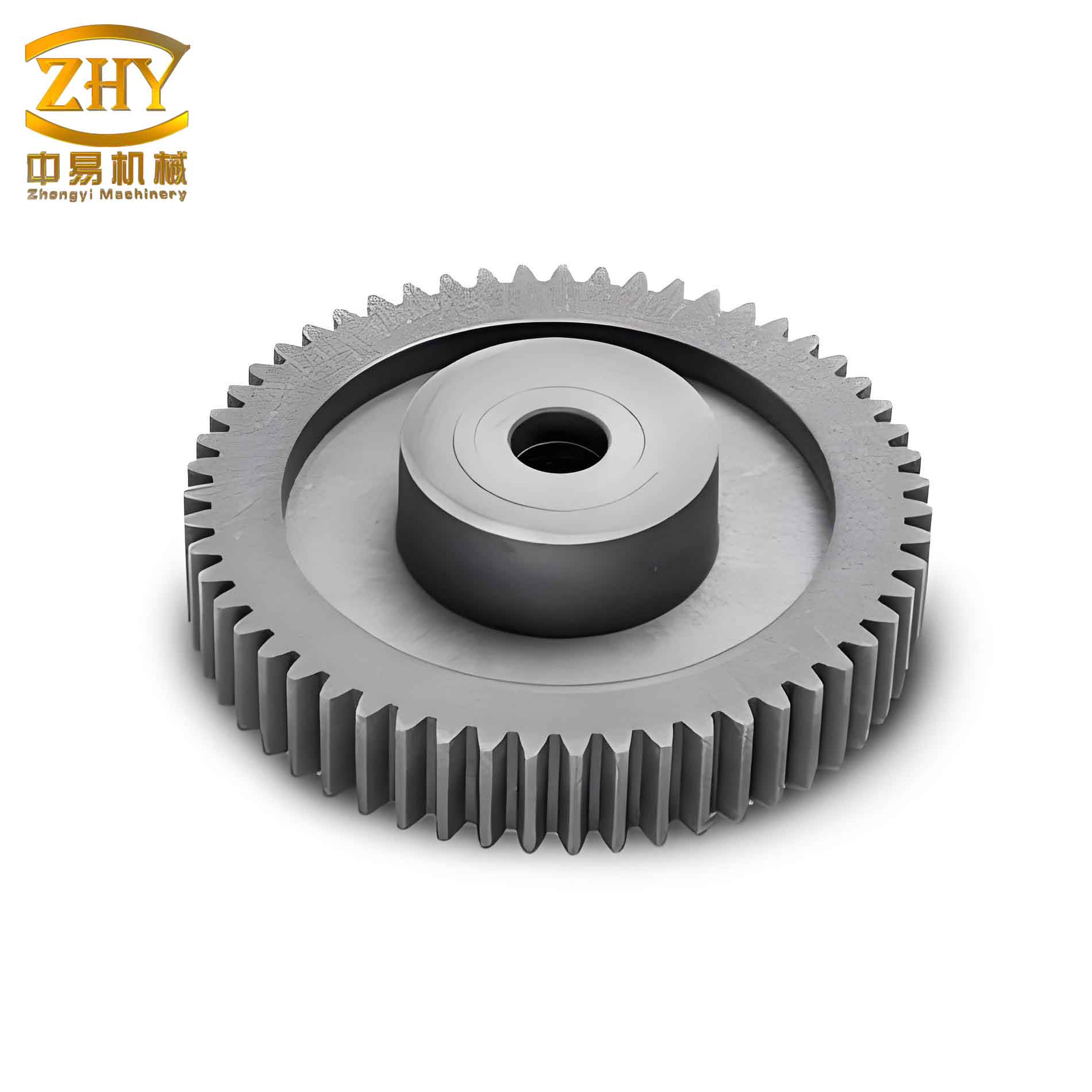
With the tooth profile defined, I proceed to generate a single tooth entity. Using Pro/E’s extrusion tool, I sketch the tooth shape by projecting the involute curves, tip circle, and root circle onto the sketching plane. Since the base circle may be larger than the root circle for some spur and pinion gears, I extend the involute to meet the root circle and add fillets at the tooth root to reduce stress concentrations. The extrusion depth is set to the face width B, and I add a relation to link this dimension to the parameter B. For instance, if the extrusion depth is D5, I define:
$$ D5 = B $$
This ensures the tooth has the correct axial length, which is critical for load distribution in spur and pinion gear pairs. After extruding the tooth as a solid, I create the full gear body by extruding the root circle to the same depth B, forming the gear blank. Then, I replicate the tooth around the circumference using pattern features. First, I copy and paste the tooth feature with a rotational transform, setting the rotation angle to:
$$ \phi = \frac{360}{Z} $$
I add this as a relation to tie it to Z. Finally, I use a circular pattern to array the tooth Z times, completing the spur gear model. For a pinion, the process is identical, but with a smaller Z value to reflect its role as the driving or driven gear in a pair. The parametric nature allows quick adjustments; for example, changing Z from 20 to 10 instantly regenerates a pinion model, facilitating the design of matching spur and pinion sets.
Beyond modeling, I simulate the generation process of spur and pinion gears using MATLAB. Generation machining, such as hobbing or shaping, relies on the principle of enveloping, where a cutting tool (e.g., a rack or another gear) moves relative to a gear blank to produce the tooth profile. This is essential for manufacturing high-precision spur and pinion gears. In MATLAB, I develop a dynamic simulation program that visualizes this process. The simulation treats the tool as a basic rack with an involute-shaped profile and the gear blank as a rotating disk. The mathematical basis involves coordinate transformations and meshing equations. For a spur gear, the tool profile is defined parametrically, and its motion relative to the blank is governed by:
$$ x_t = x_0 + v \times t $$
$$ y_t = y_0 + r_b \times \theta $$
where \( x_t, y_t \) are tool coordinates, \( v \) is the linear velocity, \( r_b \) is the base radius, and \( \theta \) is the angular displacement. The envelope of tool positions generates the involute tooth profile on the blank. I implement this in MATLAB using looped calculations and plotting functions to animate the process. The simulation clearly shows how material is removed incrementally, forming the teeth of spur and pinion gears. This dynamic visualization aids in understanding manufacturing constraints and optimizing tool paths for spur and pinion gear production.
The parametric modeling and simulation approach offers significant benefits for engineering applications. For spur and pinion gears, accurate 3D models enable advanced analyses like finite element analysis (FEA) for stress evaluation, virtual assembly for interference checking, and CAM integration for CNC machining. In Pro/E, the parametric links allow rapid prototyping; for instance, if a design requires a spur gear with a module change from 25 to 30 mm, updating M automatically adjusts all related dimensions, saving hours of manual redesign. This is particularly valuable for custom spur and pinion gear sets used in specialized machinery. Moreover, the MATLAB simulation provides a cost-effective way to test generation processes before physical manufacturing, reducing trial-and-error in tool design. The synergy between CAD and simulation tools supports the trend toward digital twins, where virtual models mirror physical behavior. In my experience, this integrated workflow enhances design accuracy and efficiency for spur and pinion gears, which are ubiquitous in power transmission systems.
To further illustrate the parametric relationships, I summarize key formulas in a centralized manner. These equations are fundamental for designing spur and pinion gears and are embedded in my Pro/E model:
| Formula Name | Equation | Application |
|---|---|---|
| Pitch Diameter | $$ d = M \times Z $$ | Core size for spur and pinion gears. |
| Base Diameter | $$ db = d \times \cos(\alpha) $$ | Involute generation base. |
| Tip Diameter | $$ da = d + 2 \times ha $$ | Outer boundary of teeth. |
| Root Diameter | $$ df = d – 2 \times hf $$ | Inner boundary for tooth roots. |
| Addendum | $$ ha = (HAX + X) \times M $$ | Tooth tip height; X is often 0 for standard spur and pinion gears. |
| Dedendum | $$ hf = (HAX + CX – X) \times M $$ | Tooth root height. |
| Tooth Spacing Angle | $$ \Delta \theta = \frac{360}{Z} $$ | Angle between teeth for patterning. |
| Involute Parameter | $$ x = r_b (\cos(\phi) + \phi \sin(\phi)) $$ $$ y = r_b (\sin(\phi) – \phi \cos(\phi)) $$ |
Alternative involute form; \( \phi \) is the roll angle. |
In addition, I explore the implications of parameter variations on spur and pinion gear performance. For example, increasing the module M results in larger teeth, which can handle higher loads but may require more space. Adjusting the pressure angle α influences the tooth strength and meshing efficiency; a higher α (e.g., 25°) improves load capacity but may increase radial forces. These trade-offs are critical when designing spur and pinion pairs for specific applications, such as high-torque drives or precision instruments. My parametric model allows rapid iteration over these variables, enabling optimization studies. I often run simulations in MATLAB to assess how changes affect the generation process, such as tool wear or cutting forces. This holistic approach ensures that the final design of spur and pinion gears is both functional and manufacturable.
The generation simulation in MATLAB also highlights the differences between manufacturing methods. For spur and pinion gears, generation processes like hobbing use a rotating cutter that simulates a rack meshing with the gear blank. The dynamic simulation shows this meshing action frame by frame, illustrating how each tooth form is gradually revealed. I code this using MATLAB’s graphical capabilities, setting up a loop where the tool position updates based on time steps, and the gear blank rotates correspondingly. The resulting animation provides a clear visual of the enveloping principle, which is key to producing accurate involute profiles for spur and pinion gears. This simulation can be extended to analyze non-standard gears, such as those with profile shifts or modified addenda, further demonstrating the flexibility of parametric design. By integrating these insights back into the Pro/E model, I create a closed-loop design system that bridges conceptual design and manufacturing readiness for spur and pinion gears.
In conclusion, my work on parametric modeling and generation simulation for spur and pinion gears demonstrates a powerful methodology for modern gear design. Using Pro/E’s parametric tools, I build adaptable 3D models that respond instantly to input changes, streamlining the design process for spur gears and pinions alike. The incorporation of MATLAB simulations offers a dynamic view of generation machining, enhancing understanding and optimization. This integrated approach has practical value in engineering, reducing development time and costs while improving accuracy. As industries move toward digitalization, such techniques will become increasingly vital for designing efficient and reliable spur and pinion gear systems. Future directions may include coupling these models with real-time FEA or exploring additive manufacturing constraints, further expanding the applicability of parametric methods for spur and pinion gears in advanced mechanical systems.