
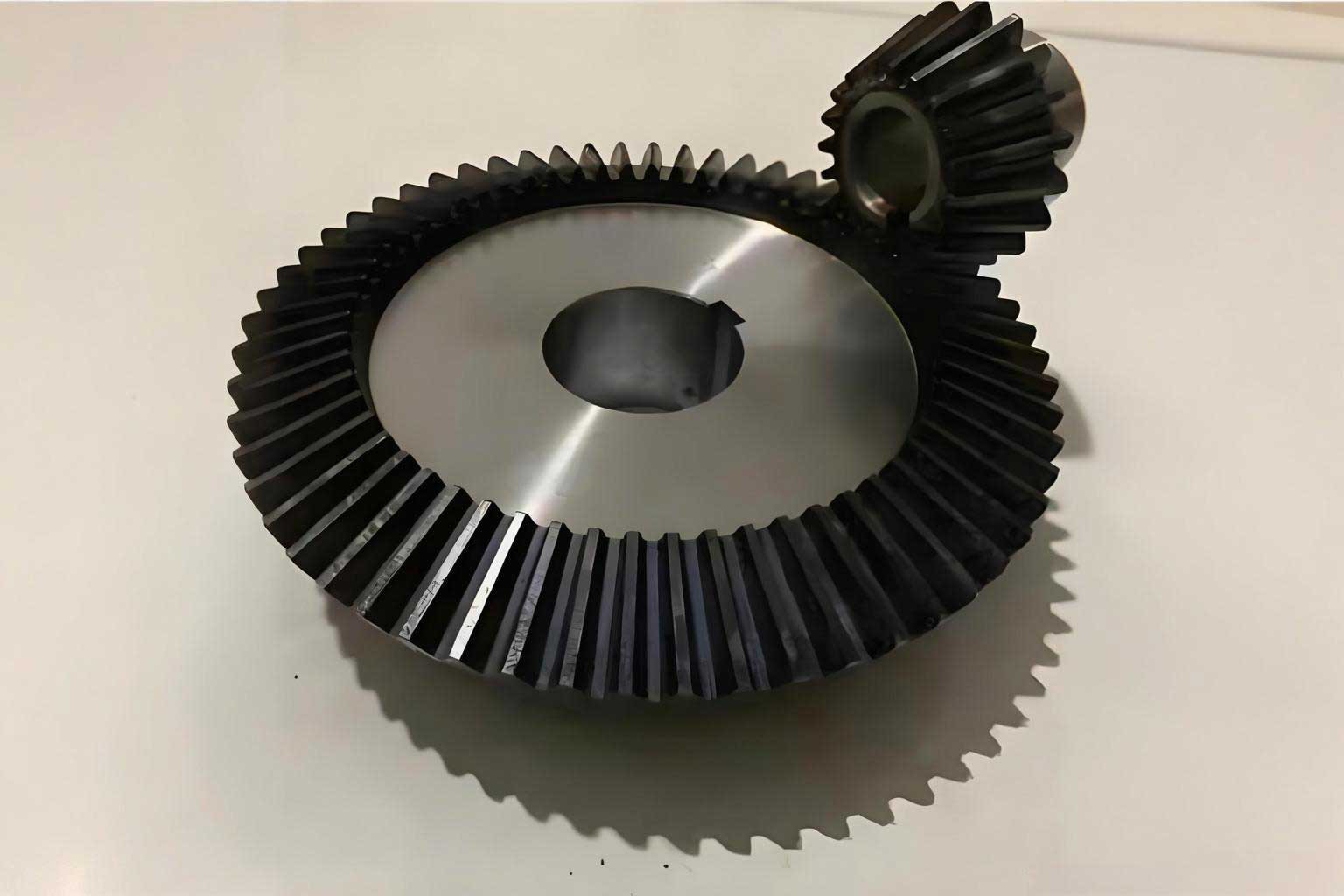
In the field of mechanical design, the development of specialized software for gear modeling and analysis is crucial for enhancing efficiency and accuracy. Currently, there is a lack of dedicated software that offers comprehensive functionalities such as three-dimensional parametric modeling, finite element analysis, simulation, and numerical control code generation for straight bevel gears and spiral bevel gears. The geometric design and mechanical calculations for these gears, particularly miter gears where the shaft angle is 90 degrees, are inherently complex. To facilitate widespread adoption and application, there is a pressing need for targeted software that simplifies these processes. I developed a specialized software solution based on VC++6.0 and OpenGL, which integrates four key modules: three-dimensional parametric solid modeling, meshing characteristic simulation, finite element analysis, and automatic generation of numerical control code. This article delves into the parametric modeling aspect of straight miter gears within the software, emphasizing the mathematical foundations and implementation details.
The core of accurate three-dimensional modeling for miter gears lies in the precise mathematical description of the tooth profile. Theoretically, the tooth flank of a straight bevel gear is a spherical involute. To achieve an exact 3D solid model, it is essential to derive the mathematical equations governing this spherical involute.
Consider a right-handed Cartesian coordinate system (O, X, Y, Z) with its origin at the center of the base cone’s small circle. A spherical involute is generated by a great circle rolling without slipping on a base cone. Let the base cone have a base cone angle $\delta_b$. The radial distance from the cone apex to the large end of the base cone is denoted as $R_b$. During the rolling motion, the generating great circle remains tangent to the base cone. Taking any point P on the great circle, its trajectory forms the spherical involute. The derivation involves parameters such as the rolling angle of the small circle on the base cone, denoted by $\phi$, and the corresponding development angle of the great circle, denoted by $\psi$, where the relationship is given by $\psi = \phi \sin \delta_b$.
Through geometric analysis, the parametric equations for the spherical involute in the coordinate system (O, X, Y, Z) are derived as follows:
$$ x_1 = R_b (\sin \delta_b \cos \phi \cos \psi + \sin \phi \sin \psi) $$
$$ y_1 = R_b (\sin \delta_b \sin \phi \cos \psi – \cos \phi \sin \psi) $$
$$ z_1 = R_b \cos \delta_b (1 – \cos \psi) $$
Here, $R_b$ is the cone distance to the large end of the base cone, $\delta_b$ is the base cone angle, $\phi$ is the rolling angle of the small circle, and $\psi$ is the development angle of the great circle, with $\psi = \phi \sin \delta_b$. When viewing from the positive Z-axis towards the negative direction, if the generating plane rotates counterclockwise along the base circle, $\phi$ is taken as positive, yielding a counterclockwise spherical involute. Conversely, if the rotation is clockwise, $\phi$ is negative, yielding a clockwise spherical involute. This distinction is vital for constructing both sides of a gear tooth.
The tooth surface of a straight miter gear is not defined by a single curve but by a series of spherical involutes generated at varying cone distances between the large end and the small end of the base cone. The initial spherical involute corresponds to the large end cone distance $R_b$, and the final one corresponds to the small end cone distance $r_{bj}$. As the spherical radius varies between these extremes, the spherical involute adapts accordingly. Therefore, the general equation for the tooth flank in the coordinate system (O, X, Y, Z) is expressed as:
$$ x = R_{bi} (\sin \delta_b \cos \phi \cos \psi + \sin \phi \sin \psi) $$
$$ y = R_{bi} (\sin \delta_b \sin \phi \cos \psi – \cos \phi \sin \psi) $$
$$ z = R_{bi} \cos \delta_b (1 – \cos \psi) + H (R_b – R_{bi}) / R_b $$
In this equation, $R_{bi}$ represents any cone distance between $r_{bj}$ and $R_b$, and $H$ is the height of the base cone, calculated as $H = R_b \cos \delta_b$. This formulation allows for the continuous generation of points across the entire tooth surface.
To construct a complete tooth, multiple spherical involutes at different angular positions are required. This is achieved through rotational transformations. In a three-dimensional right-handed coordinate system, rotating a point around the Z-axis by an angle $\theta$ is performed using the transformation matrix:
$$ [X^* \, Y^* \, Z^* \, 1] = [X \, Y \, Z \, 1] \begin{bmatrix} \cos \theta & \sin \theta & 0 & 0 \\ -\sin \theta & \cos \theta & 0 & 0 \\ 0 & 0 & 1 & 0 \\ 0 & 0 & 0 & 1 \end{bmatrix} $$
By applying this transformation to the coordinates of the spherical involute points, we can generate involutes at any desired angular location on the gear blank, which is essential for defining the boundaries of a single tooth.
The design of a standard straight miter gear pair with a shaft angle $\Sigma = 90^\circ$ relies on a set of geometric parameters. The table below summarizes these key parameters and their interrelationships, which are fundamental inputs for the parametric modeling software.
| Parameter Name | Symbol | Description / Formula |
|---|---|---|
| Number of Teeth (Pinion) | $z_1$ | User input (integer) |
| Number of Teeth (Gear) | $z_2$ | User input (integer) |
| Gear Ratio | $i$ | $i = z_2 / z_1$ |
| Module (at Large End) | $m$ | Derived from design |
| Pressure Angle | $\alpha$ | User input (typically 20°) |
| Pitch Cone Angle | $\delta$ | For pinion: $\delta_1 = \arctan(z_1 / z_2)$; For gear: $\delta_2 = 90^\circ – \delta_1$ |
| Base Cone Angle | $\delta_b$ | $\delta_b = \delta – \alpha$ (simplified relation for derivation) |
| Cone Distance to Large End | $R_b$ | User input or calculated: $R_b = m z / (2 \sin \delta)$ |
| Cone Distance to Small End | $r_{bj}$ | $r_{bj} = R_b – B$, where $B$ is face width |
| Face Width | $B$ | $B \leq R_b / 3$ (standard practice, taken as integer) |
| Addendum at Large End | $h_a$ | Standard value: $h_a = m$ |
| Dedendum at Large End | $h_f$ | Standard value: $h_f = 1.25m$ |
| Tip Cone Angle | $\delta_a$ | $\delta_a = \delta + \theta_a$, where $\theta_a$ is addendum angle |
| Root Cone Angle | $\delta_f$ | $\delta_f = \delta – \theta_f$, where $\theta_f$ is dedendum angle |
| Circular Pitch at Large End | $p$ | $p = \pi m$ |
| Backlash | $c$ | Standard clearance value |
Determining the exact angular span for the spherical involutes on a tooth is critical. This span defines the active part of the tooth profile between the root and tip circles. At the large end, the starting point of the involute is its intersection with the root circle, and the ending point is its intersection with the tip circle. The root circle radius $r_f$ and tip circle radius $r_a$ at the large end are calculated from the basic parameters. The condition for a point on the spherical involute to lie on the root circle is $x^2 + y^2 = r_f^2$. Substituting the involute equations into this condition allows solving for the corresponding rolling angle $\phi$, providing the lower limit $\phi_{min}$ for the involute’s parameter range. Similarly, using $r_a$ gives the upper limit $\phi_{max}$. The same logic applies for any intermediate cone distance $R_{bi}$, ensuring the correct length of the spherical involute across the face width of the miter gear.
For constructing a single tooth, we need two sets of spherical involute surfaces: one for the left flank and one for the right flank. Using the general tooth surface equation with $\phi$ taking positive values over its calculated range generates a series of counterclockwise spherical involutes, forming one flank. Then, using $\phi$ with negative values generates the clockwise spherical involutes for the opposite flank. However, these need to be rotationally positioned correctly around the gear axis. The required rotation angle $2\beta$ is determined from the gear geometry at the pitch circle. Specifically, at the pitch cone distance, parameters like the rolling angle $\phi_d$, development angle $\psi_d$, and pressure angle $\alpha$ are related. The angle $\beta$ incorporates half the tooth thickness at the pitch circle. The final transformation involves rotating the clockwise involute set by $2\beta$ around the Z-axis using the rotation matrix, thereby correctly positioning both flanks to form a single tooth space.
The three-dimensional solid modeling of the miter gear within the OpenGL environment follows a systematic, programmatic procedure. The software interface allows users to input basic parameters such as the number of teeth for both gears in the pair, the module, pressure angle, face width, and cone distance. Upon receiving these inputs, the software calculates all derived geometric parameters using the formulas encapsulated in the code, including those in the parameter table.
The modeling process begins by defining the tooth surface. A step length, denoted as $daa$, is set to a sufficiently small value (e.g., 0.1) to ensure high precision. This step length controls the increment between successive cone distances $R_{bi}$ from the small end $r_{bj}$ to the large end $R_b$. For each $R_{bi}$, the software calculates the corresponding parameter range $[\phi_{min}, \phi_{max}]$ for the spherical involute based on the root and tip intersections at that cone distance. It then generates a sequence of points using the tooth surface equations for both positive $\phi$ (counterclockwise involute) and negative $\phi$ (clockwise involute). These point sequences, for a given $R_{bi}$, represent discrete cross-sectional curves of the tooth flank.
To create the solid tooth, these discrete curves are connected. For each incremental step along the face width (i.e., between consecutive $R_{bi}$ values), the corresponding points on the counterclockwise involutes are connected using OpenGL quadrilateral primitives (via the `glBegin(GL_QUADS)` command). This process constructs a mesh representing the left tooth flank. The same is done for the rotated clockwise involute points to construct the right flank. Subsequently, the tooth’s top land (connecting the tip curves from small to large end), the small-end face (connecting the start points of all involutes at $r_{bj}$), and the large-end face (connecting the end points at $R_b$) are filled with quadrilaterals or triangles to create a fully enclosed, watertight solid model of a single miter gear tooth.
Once a single tooth is modeled, the complete miter gear is generated through circular array. Using OpenGL’s rotation command, `glRotatef(360.0/z, 0.0, 0.0, 1.0);`, where $z$ is the number of teeth, the single tooth is duplicated and rotated around the Z-axis $z$ times. This results in a full three-dimensional solid model of the miter gear, ready for visualization, analysis, or export. The entire process is automated, enabling rapid parametric design; changing any input parameter triggers a recalculation and regeneration of the model, showcasing the power of the software for miter gear design.
The software also incorporates a dynamic transmission simulation feature for a pair of correctly meshing miter gears. This simulation validates the mathematical model and checks for interference. The implementation leverages OpenGL’s double-buffering technique for smooth animation.
The assembly and simulation process involves several coordinate transformations. First, the two individual miter gear models, initially defined in their own coordinate spaces, are oriented so that their axes are perpendicular. This is achieved by applying rotation transformations to place each gear’s plane of rotation into one of the principal planes (e.g., the XY-plane and the XZ-plane), ensuring the shaft angle is 90 degrees. Next, translational transformations are applied to both gears so that their base cone apexes coincide at the intersection point of their axes. Additionally, the translation ensures that the pitch cones of the two miter gears are tangent at their point of contact, representing a standard installation. The magnitude of translation is calculated from the cone distance $R_b$ and the pitch cone angles.
For the simulation loop, one gear (e.g., the pinion) is designated as the driver. Its rotation is animated by incrementally applying a rotation transformation around its own axis using `glRotatef()` within a timer-controlled or idle callback function. The rotation of the driven miter gear is calculated based on the gear ratio $i$. If the pinion rotates by an angle $\theta_1$, the gear rotates by $\theta_2 = -\theta_1 / i$ (the sign accounts for the direction of rotation in a 90-degree shaft arrangement). Both rotations are applied relative to their respective assembled positions. The `Invalidate()` function (or its equivalent in the graphics framework) is called to trigger a redraw of the scene for each frame. This process creates a real-time animation of the meshing miter gears, allowing designers to visually inspect the engagement and motion transmission. This simulation module is an integral part of the software, providing immediate feedback on the design’s kinematic correctness.
The mathematical rigor applied in defining the spherical involute ensures the geometric accuracy of the generated miter gear model. Unlike approximation methods that might use simplified curves, direct evaluation of the involute equations guarantees a true theoretical tooth form. This precision is paramount for subsequent engineering analyses. For instance, the solid model generated can be seamlessly exported for Finite Element Analysis (FEA) to evaluate stress distributions, contact patterns, and fatigue life under load. The accurate geometry ensures that FEA results are reliable and reflective of real-world behavior. Furthermore, the model can serve as the basis for generating tool paths and numerical control (NC) code for manufacturing, closing the loop between design and production for miter gears.
The development of this specialized software addresses a significant gap in the toolkit available to gear designers. By integrating parametric modeling, simulation, and analysis for miter gears into a single platform, it drastically reduces the design cycle time. The use of OpenGL provides robust, cross-platform 3D graphics capabilities, ensuring the software’s rendering performance and compatibility. The parameterized approach means that a vast array of miter gear configurations can be modeled by simply altering a few key inputs, promoting standardization and best practices in gear design.
Future enhancements to the software could include extending the modeling capabilities to spiral bevel gears and hypoid gears, which have even more complex geometry. Implementing advanced contact analysis algorithms within the simulation module would provide insights into load-sharing and transmission error. Integration with cloud-based collaboration tools could facilitate team-based design projects. The core framework established for miter gears serves as a strong foundation for these advancements, demonstrating the versatility and potential of targeted CAD/CAM software in mechanical engineering.
In conclusion, the parametric modeling and simulation of miter gears based on OpenGL and precise spherical involute mathematics represent a significant step forward in gear design technology. The software I developed automates the complex process of gear modeling, ensuring accuracy while improving efficiency. The ability to perform dynamic simulation within the same environment allows for immediate validation and optimization of designs. This work underscores the importance of dedicated computational tools in advancing mechanical component design, particularly for specialized elements like miter gears, and paves the way for more integrated and intelligent manufacturing solutions.