
The design of gear elements remains a cornerstone of mechanical engineering, demanding high precision due to their critical role in transmitting motion and power between shafts. Among the various types, the spur gear is one of the most fundamental and widely used configurations due to its simplicity and efficiency in parallel shaft applications. The accuracy of its tooth profile directly dictates performance characteristics such as noise, vibration, stress distribution, and service life. In modern design workflows, Computer-Aided Design (CAD) has become indispensable for creating accurate, modifiable, and analyzable geometric models. This article delves into a methodology for the parametric design and simulation of spur gear tooth profiles using AutoCAD as the foundational platform, focusing on the mathematical derivation of the complete profile and its programmatic generation.
CAD technology has evolved from a niche tool to a pervasive force across all engineering disciplines. Its application in mechanical design has transitioned from basic drafting to sophisticated parametric and associative modeling, enabling rapid iteration and optimization. For gear design, moving beyond approximate drawings to mathematically precise models is essential for subsequent steps like Finite Element Analysis (FEA) and Computer-Aided Manufacturing (CAM). AutoCAD, with its extensive customization capabilities through APIs like AutoLISP and Visual LISP (VLISP), provides a robust environment for developing specialized applications, such as a parameter-driven spur gear generator. This approach allows designers to input basic parameters (module, number of teeth, pressure angle) and automatically obtain a precise geometric model, significantly enhancing productivity and accuracy.
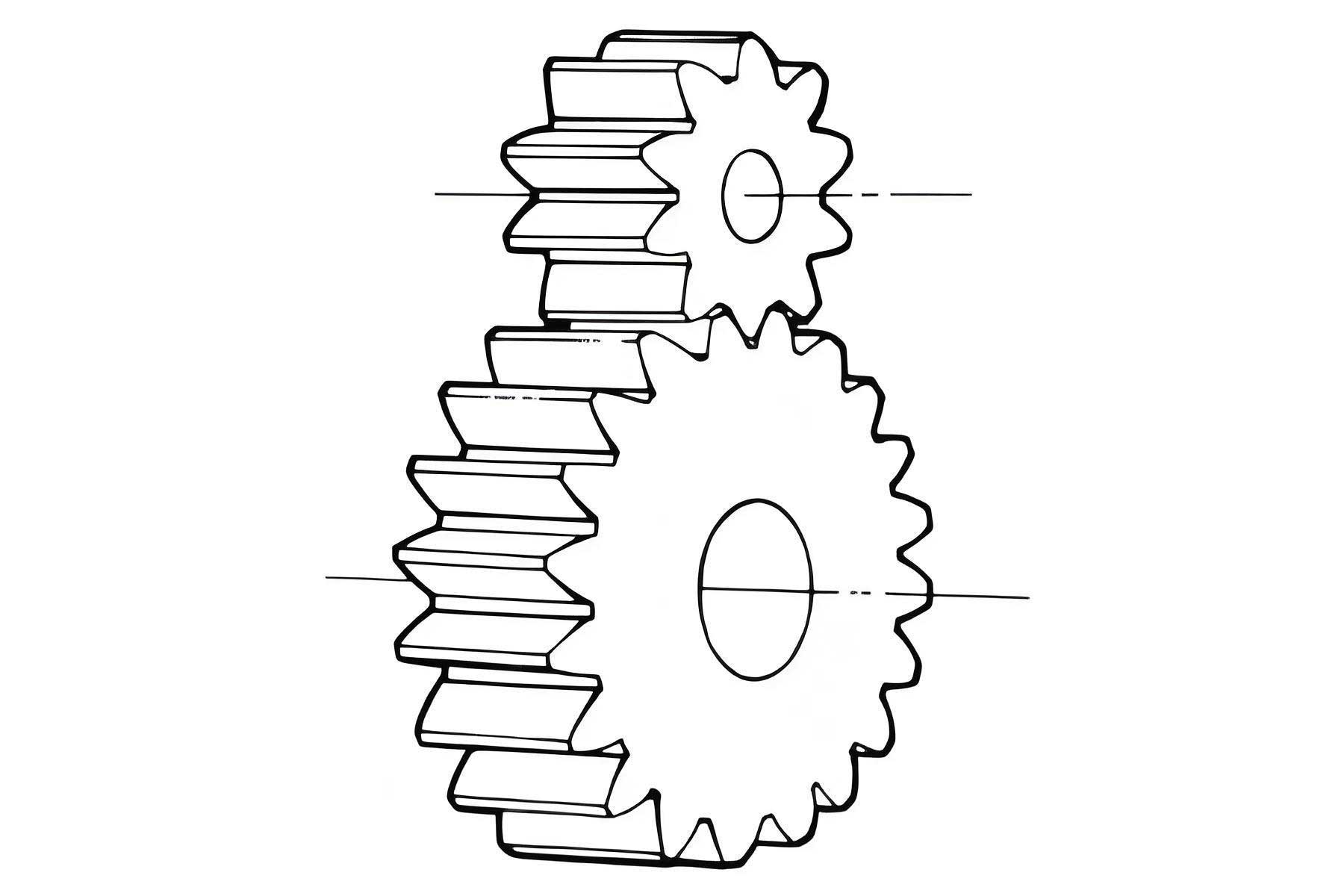
Fundamental Theory of Gear Tooth Action
The design of a functional gear pair is governed by the fundamental laws of gearing. The primary requirement for two meshing tooth profiles to maintain a constant angular velocity ratio is encapsulated in the Law of Gearing. This law states that for a pair of teeth to remain in contact, the common normal line at their point of contact must always pass through a fixed point on the line of centers, known as the pitch point. This condition ensures that the driving and driven gears rotate in a perfectly timed relationship, preventing interference or separation during operation.
Mathematically, this is expressed using the condition on relative velocity. Consider two gear bodies 1 and 2 rotating with angular velocities $\vec{\omega_1}$ and $\vec{\omega_2}$ about centers $O_1$ and $O_2$, with a contact point $M$ between tooth profiles. Their relative velocity at $M$, $\vec{v}_{12}$, must lie along the common tangent to avoid separation or penetration. If $\vec{n}$ is the common unit normal vector at $M$, the condition is:
$$\vec{v}_{12} \cdot \vec{n} = 0$$
For the simple case of a spur gear pair with parallel axes, this condition directly leads to the conclusion that the line of action—the path of contact points—is a straight line passing through the pitch point, inclined at the pressure angle $\alpha$. This forms the basis for the involute profile, which naturally satisfies this law.
Mathematical Modeling of the Complete Tooth Profile
The most common method for manufacturing spur gears is the generating process, such as using a hob cutter. Modeling the final gear tooth profile, therefore, involves finding the envelope of successive positions of the cutter relative to the gear blank. Here, we model the process using a rack cutter (which represents the basic profile of a hob) to generate an involute spur gear. The complete tooth profile of the generated gear consists of three distinct segments: the involute flank, the fillet (or trochoid) at the root, and the tip rounding (if any).
1. Rack Cutter Profile Geometry
The standard basic rack profile, defined by parameters like module $m_n$, pressure angle $\alpha_n$, addendum coefficient $h_{a}^*$, and dedendum (or clearance) coefficient $c^*$, is shown in its coordinate system $S_1(x_1, O_1, y_1)$. Its working side can be segmented as follows:
| Segment | Description | Mathematical Equation in $S_1$ | Parameter Range |
|---|---|---|---|
| Straight Line (Flank) | Corresponds to the involute-generating part. | $y_1 = k x_1 + b_{ab}$ where $k = \tan(\pi/2 – \alpha_n)$ and $b_{ab} = -k \pi m_n / 4$. | $x_1$ from start of active profile to pitch line. |
| Circular Arc (Fillet) | Generates the root fillet on the gear. | $(x_1 – x_{oc})^2 + (y_1 – y_{oc})^2 = \rho^2$ or in parametric form: $x_1 = x_{oc} + \rho \sin\theta$, $y_1 = y_{oc} – \rho \cos\theta$. Here, $x_{oc} = \frac{- (h_{a}^* + c^*) m_n + b_{ab}}{k} – \rho \tan\left(\frac{\pi/2 – \alpha_n}{2}\right)$, $y_{oc} = – (h_{a}^* + c^*) m_n + \rho$. | $\theta$ varies across the arc. |
| Straight Line (Bottom Land) | Horizontal line forming the bottom of the rack space. | $y_1 = – (h_{a}^* + c^*) m_n$. | $x_1$ across the rack tooth space bottom. |
2. Generation of the Conjugate Gear Profile
The coordinate system for generation is established with the gear blank in system $S_2(x_2, O_2, y_2)$, which rotates as the rack translates. The fundamental coordinate transformation and meshing condition are applied. For a generating process where the rack (cutter) translates and the gear rotates with a rolling-without-slipping condition at the pitch line, the relationship is defined by the parameter $\phi_2$, the rotation angle of the gear.
The general equation for transforming a point $(x_1, y_1)$ on the cutter to its corresponding envelope point $(x_2, y_2)$ on the gear in the gear’s rotating coordinate system is given by:
$$
\begin{aligned}
x_2 &= x_1 \cos\phi_2 + y_1 \sin\phi_2 + R_2 (\sin\phi_2 – \phi_2 \cos\phi_2) \\
y_2 &= -x_1 \sin\phi_2 + y_1 \cos\phi_2 + R_2 (\cos\phi_2 + \phi_2 \sin\phi_2)
\end{aligned}
$$
where $R_2$ is the pitch radius of the generated spur gear, $R_2 = \frac{m_n Z}{2}$, and $Z$ is the number of teeth. The key is to find the correct $\phi_2$ for each point on the cutter that corresponds to a point of contact. This is derived from the meshing condition $\vec{v}_{12} \cdot \vec{n} = 0$, which yields a specific functional relationship $\phi_2 = f(x_1, y_1)$ for each segment of the cutter.
| Cutter Segment | Meshing Function $\phi_2$ | Resulting Gear Curve |
|---|---|---|
| Straight Flank (ab) | $\phi_2 = \frac{x_1 + y_1 k}{R_2}$ | Involute curve ($C_{ab}$) from base circle to tip circle. |
| Circular Fillet (bc) | $\phi_2 = \frac{x_1 + y_1 \tan\theta}{R_2}$ where $\theta$ is the arc parameter. | Trochoidal (epicycloidal) fillet curve ($C_{bc}$). |
| Bottom Land (cd) | $\phi_2 = \frac{x_1}{R_2}$ | Root circle arc ($C_{cd}$), subject to undercut considerations. |
By substituting the rack profile equations $x_1(\xi)$, $y_1(\xi)$ (where $\xi$ is the segment’s parameter) and the corresponding $\phi_2(\xi)$ into the general transformation equations, we obtain the precise parametric equations for the entire tooth profile of the generated spur gear. The resulting curves $C_{ab}$, $C_{bc}$, and $C_{cd}$ join smoothly (if no undercutting occurs) to form a single, continuous profile from the root to the tip of the gear tooth. This model accurately accounts for the involute geometry, the exact shape of the root fillet generated by the rack cutter’s corner radius $\rho$, and the theoretical root circle.
Parametric Implementation in AutoCAD Environment
Translating the mathematical model into a working CAD model requires a parametric and programmatic approach. AutoCAD’s built-in programming interface, Visual LISP (VLISP), is an ideal tool for this task. VLISP provides an Integrated Development Environment (IDE) with a compiler, debugger, and editor, allowing for the efficient creation of robust AutoLISP routines that extend AutoCAD’s functionality.
The core of the implementation is an AutoLISP program that performs the following steps:
- Parameter Input: Prompts the user to enter key spur gear parameters:
Module ($m_n$) Number of Teeth ($Z$) Pressure Angle ($\alpha_n$) Addendum Coefficient ($h_a^*$) Clearance Coefficient ($c^*$) Fillet Radius Coefficient ($\rho^*$, where $\rho = \rho^* m_n$) - Geometric Calculation: Computes derived dimensions:
- Pitch Diameter: $d = m_n Z$
- Base Diameter: $d_b = d \cos\alpha_n$
- Addendum: $h_a = h_a^* m_n$
- Dedendum: $h_f = (h_a^* + c^*) m_n$
- Tip Diameter: $d_a = d + 2h_a$
- Root Diameter: $d_f = d – 2h_f$
- Point-by-Point Profile Construction: For each of the three profile segments, the program loops through the defining parameter (e.g., $x_1$ for the flank, $\theta$ for the fillet) with a defined angular or linear step $\Delta\xi$. A small step (e.g., corresponding to 0.01° increments on the involute) ensures high precision. For each value of $\xi$:
- Calculate the corresponding point $(x_1, y_1)$ on the rack cutter.
- Calculate the associated gear rotation angle $\phi_2 = f(x_1, y_1, \xi)$.
- Apply the coordinate transformation to get the point $(x_2, y_2)$ in the gear’s initial position.
- Store this point in a list.
- Entity Creation: Uses the AutoLISP `command` function or `entmake` to create a polyline or spline through the calculated sequence of points, forming one side of a tooth.
- Tooth Completion: Mirrors the single flank curve about the tooth centerline to create the symmetrical opposite flank.
- Pattern Generation: Uses the `array` command to circularly array the complete tooth profile around the gear center, creating the full set of teeth for the spur gear.
- Solid Modeling: Optionally, the 2D profile can be extruded using the `extrude` command to create a 3D solid model of the gear, ready for assembly or analysis.
The parametric nature of the script means that changing any of the input parameters and re-running the command will instantly generate a new, geometrically correct spur gear model. This is far superior to manual drawing or using approximate geometric constructions.
Simulation and Verification of the Model
The term “simulation” in this context refers to the execution of the parametric program to visually generate and inspect the tooth profile. The VLISP environment facilitates this through its debugging tools, allowing the developer to step through the code, inspect variable values (like calculated point coordinates), and ensure the mathematical logic is functioning correctly before generating the final AutoCAD entities.
The simulation process validates several critical aspects of the spur gear design:
- Profile Accuracy: The generated curve is a true involute and its conjugate fillet, not a polygonal approximation or a series of circular arcs. This is verified by checking that points lie exactly on the theoretical base circle for the start of the involute and that tangency conditions are met.
- Undercut Visualization: A major advantage of this precise modeling technique is the automatic and accurate depiction of undercutting. If the number of teeth is below the minimum required to avoid interference ($Z < \frac{2}{\sin^2\alpha_n}$), the trochoidal fillet curve $C_{bc}$ will cut into and remove part of the involute flank $C_{ab}$. The model clearly shows this eroded profile, alerting the designer to the need for profile shifting or a design change.
- Mesh Simulation (Kinematic): By generating two spur gears with prescribed center distance and rotating one incrementally while applying the corresponding rotation to the other (using AutoCAD’s `rotate` command about their respective centers), a simple kinematic simulation of meshing can be performed. This visual check helps verify correct tooth action and contact.
- Dimensional Verification: The resulting model’s key diameters (tip, root, pitch) can be measured within AutoCAD to confirm they match the calculated values from the input parameters.
This simulation capability, powered by the underlying mathematical model, turns AutoCAD from a passive drafting tool into an active design validation tool for spur gears.
Applications and Design Workflow Integration
The creation of a precise parametric spur gear model is rarely an end in itself. It serves as the critical first step in a comprehensive digital engineering workflow:
- Finite Element Analysis (FEA): The 2D profile or 3D solid generated can be exported or directly used in FEA software to perform stress analysis (bending and contact stresses), modal analysis, or thermal analysis. An accurate root fillet geometry is particularly important for predicting fatigue life.
- Manufacturing (CAM): The digital model provides the exact geometry needed for generating toolpaths in CAM software for processes like milling, wire EDM, or grinding. The parametric nature allows for quick generation of family parts (different tooth counts with the same module).
- Tolerance and Inspection Analysis: The theoretical model serves as the nominal geometry for defining Geometric Dimensioning and Tolerancing (GD&T) and for programming coordinate measuring machines (CMM).
- System-Level Simulation: The gear model can be imported into multi-body dynamics software to simulate the dynamic behavior of an entire gearbox, accounting for effects like variable loading, backlash, and efficiency.
Conclusion and Future Directions
The parametric design of spur gear tooth profiles based on precise generative manufacturing principles represents a significant advancement over traditional approximate methods. By deriving and implementing the mathematical model of the rack-generation process, a complete and accurate profile—including the critical root fillet—can be automatically created within the AutoCAD environment. This approach leverages the computational power and customization capabilities of modern CAD systems to bridge the gap between design theory and practical, manufacturable geometry.
The methodology ensures that the model is not just a visual representation but a true digital twin of the physical gear, suitable for advanced engineering analysis. Future enhancements could integrate this core modeling routine with a graphical user interface (GUI) within AutoCAD, link it directly to strength calculation standards (like AGMA or ISO), or extend the logic to other gear types such as helical gears, bevel gears, or worm gears. The foundational principle remains: a rigorous mathematical model, coupled with a powerful parametric CAD platform, is key to efficient, reliable, and optimized mechanical component design, with the humble yet essential spur gear being a perfect exemplar.