
Gear transmission stands as one of the most critical forms of power transmission in modern machinery. It involves a pair or a set of cylindrical gears that transmit motion and torque through the meshing of their teeth. Among various types, modified cylindrical gears are extensively employed to enhance performance. In a high-addendum modification (or profile shift) system, the tool is offset away from the gear blank when cutting the pinion and offset inward by an equal amount when cutting the gear. This process results in the working pitch circles coinciding with the standard pitch circles while the total tooth depth remains unchanged, altering only the positions of the addendum and dedendum circles relative to the pitch circle. This modification is strategically used to prevent undercutting in pinions with low tooth counts, to optimize structural dimensions, to adjust center distances, to improve wear characteristics, and ultimately to increase load-carrying capacity and service life.
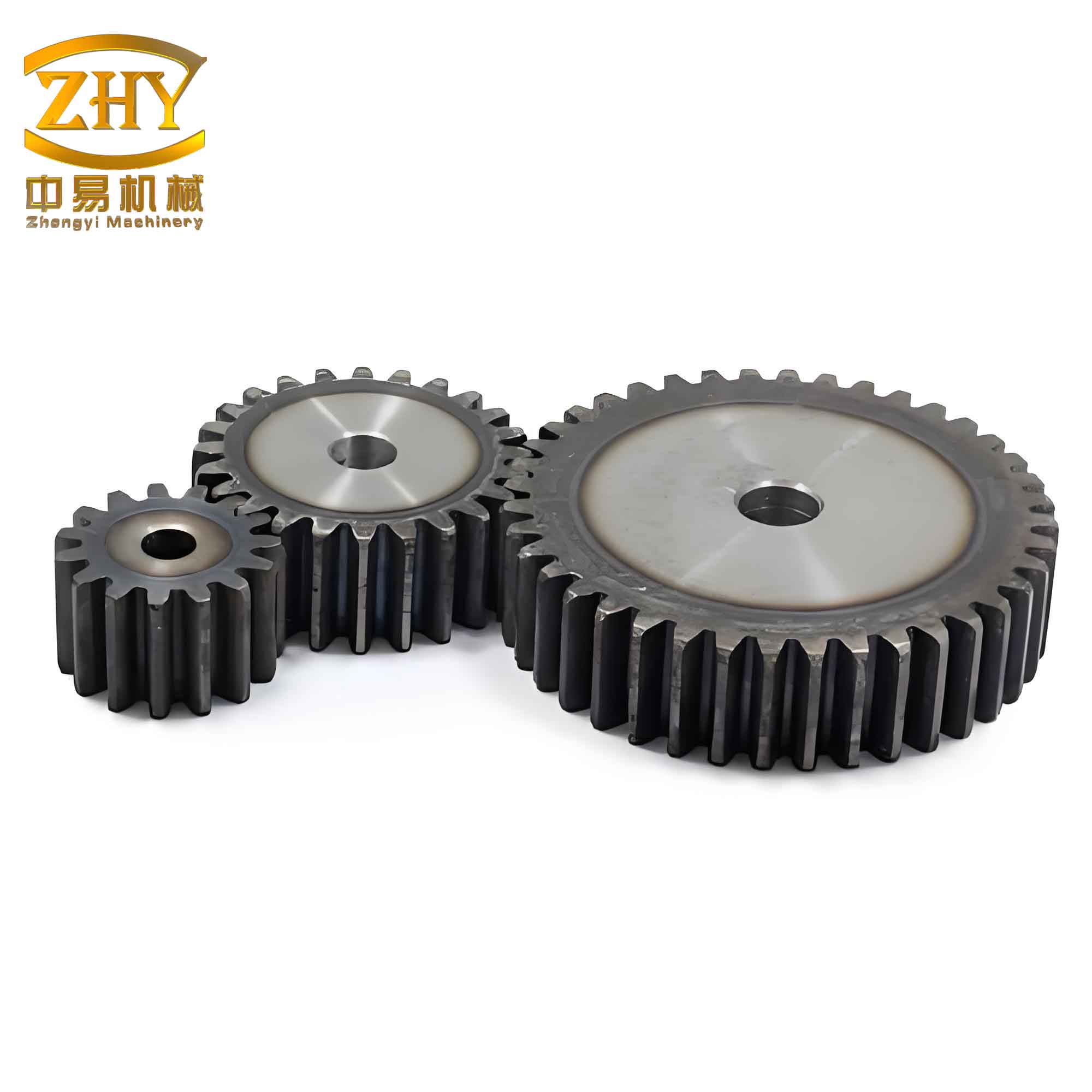
Contemporary research into cylindrical gears often integrates advanced Computer-Aided Design (CAD) with Finite Element Analysis (FEA). Previous studies have successfully utilized software like UG NX and SolidWorks for building three-dimensional models of spur cylindrical gears and have performed dynamic or static analyses to obtain stress and deformation contours, thereby validating design performance. Other approaches have involved co-simulation platforms like MATLAB and SolidWorks for higher precision tooth profile generation or explored the influence of modification coefficients on gear stresses. These studies provide valuable insights for the design and structural optimization of gear transmissions.
Building upon this foundation, the present work details a comprehensive process for the design and analysis of a high-addendum modified spur cylindrical gear pair. It begins with the fundamental geometric calculation of the gear pair. Subsequently, a parametric three-dimensional model is created using a leading CAD environment. A crucial aspect of the analysis involves calculating the theoretical maximum contact stress at the teeth using the classical Hertzian contact theory. Following this, a detailed transient dynamic analysis is conducted using a commercial FEA software suite to simulate the actual meshing conditions and obtain stress and displacement fields. Finally, a critical comparison is made between the theoretical Hertzian stress and the maximum equivalent stress from the FEA simulation. The close agreement between these values validates the accuracy of the modeling and analysis workflow, offering a reliable and efficient methodology for the design and performance evaluation of modified cylindrical gears.
Geometric Design Calculation for High-Addendum Modified Cylindrical Gears
The design process commences with the precise geometric definition of the mating gear pair. For this study, a pinion and a gear with high-addendum modification are considered. The fundamental design parameters are as follows:
- Module, \( m \): 2.5 mm
- Pressure Angle, \( \alpha \): 20°
- Addendum Coefficient, \( f \): 1
- Dedendum Clearance Coefficient, \( c \): 0.25 (for \( m > 1 \))
The pinion and gear have different numbers of teeth and modification coefficients. The pinion (Driver) has a positive modification to avoid undercutting and strengthen the tooth root, while the gear (Driven) has a corresponding negative modification to maintain the standard center distance.
Given Parameters:
| Component | Number of Teeth (\( Z \)) | Modification Coefficient (\( \varepsilon \)) |
|---|---|---|
| Pinion (Gear 1) | \( Z_1 = 30 \) | \( \varepsilon_1 = +0.35 \) |
| Gear (Gear 2) | \( Z_2 = 65 \) | \( \varepsilon_2 = -0.35 \) |
Using the standard formulas for spur cylindrical gears, the key geometric dimensions are calculated and summarized in the table below. These parameters are essential for the subsequent three-dimensional modeling.
Table 1: Geometric Calculation Results for the Modified Cylindrical Gear Pair
| Parameter | Formula | Pinion (Gear 1) | Gear (Gear 2) |
|---|---|---|---|
| Standard Pitch Diameter | \( d = mZ \) | \( d_1 = 75.000 \text{ mm} \) | \( d_2 = 162.500 \text{ mm} \) |
| Base Circle Diameter | \( d_b = d \cos\alpha \) | \( d_{b1} \approx 70.477 \text{ mm} \) | \( d_{b2} \approx 152.698 \text{ mm} \) |
| Addendum | \( h_a = m(f + \varepsilon) \) | \( h_{a1} = 3.375 \text{ mm} \) | \( h_{a2} = 1.625 \text{ mm} \) |
| Dedendum | \( h_f = m(f – \varepsilon + c) \) | \( h_{f1} = 2.250 \text{ mm} \) | \( h_{f2} = 4.000 \text{ mm} \) |
| Total Tooth Depth | \( h = h_a + h_f \) | \( h_1 = 5.625 \text{ mm} \) | \( h_2 = 5.625 \text{ mm} \) |
| Addendum Circle Diameter | \( d_a = d + 2h_a \) | \( d_{a1} = 81.750 \text{ mm} \) | \( d_{a2} = 165.750 \text{ mm} \) |
| Dedendum Circle Diameter | \( d_f = d – 2h_f \) | \( d_{f1} = 70.500 \text{ mm} \) | \( d_{f2} = 154.500 \text{ mm} \) |
| Base Pitch | \( p_b = \pi m \cos\alpha \) | \( p_b \approx 7.380 \text{ mm} \) | |
| Circular Pitch | \( p = \pi m \) | \( p \approx 7.854 \text{ mm} \) | |
| Center Distance | \( A = m(Z_1 + Z_2)/2 \) | \( A = 118.750 \text{ mm} \) | |
The calculation confirms this is a high-addendum modification system as the sum of the modification coefficients is zero (\( \varepsilon_1 + \varepsilon_2 = 0 \)), resulting in an unchanged standard center distance and total tooth depth for both cylindrical gears.
Parametric Three-Dimensional Modeling Using CAD Software
For the three-dimensional modeling of the cylindrical gears, a powerful and widely adopted CAD software, Siemens NX (commonly referred to as UG), was utilized. This software provides a comprehensive and innovative environment for parametric modeling, which is ideal for mechanical design. Parametric modeling allows dimensions and features to be defined by variables (parameters), enabling easy modification and design iteration—a crucial aspect when analyzing gears with different modification coefficients.
The modeling process was executed using the dedicated gear modeling toolkit within the CAD environment:
- Pinion Modeling: The ‘Cylindrical Gear Modeling’ function was initiated. In the creation dialog, the gear type was selected as ‘Modified Gear’. The geometric parameters calculated in Table 1—such as module (\( m=2.5 \)), number of teeth (\( Z_1=30 \)), pressure angle (\( \alpha=20^\circ \)), face width (assumed as \( b=20 \text{ mm} \) for analysis), and modification coefficient (\( \varepsilon_1=+0.35 \))—were input into their respective fields. The software then automatically generated the precise involute tooth profile and the full three-dimensional solid model of the pinion.
- Gear Modeling: An identical procedure was followed for the larger gear. A new component was created, and the parameters specific to Gear 2 (\( Z_2=65 \), \( \varepsilon_2=-0.35 \), same module and pressure angle) were entered into the gear creation dialog, resulting in the three-dimensional model of the gear.
- Gear Pair Assembly: To simulate the meshing condition, the two cylindrical gears were assembled. The ‘Gear Pair Assembly’ function was used. The pinion was designated as the driving gear, and the gear as the driven component. The assembly constraint was defined by specifying the standard center distance (\( A=118.75 \text{ mm} \)) and aligning the gear axes appropriately, ensuring correct meshing engagement as per the design calculations.
This parametric approach ensures that any changes to the fundamental design inputs (e.g., module, tooth count, modification coefficient) automatically propagate through the entire three-dimensional model, facilitating rapid design optimization studies for cylindrical gears.
Theoretical Contact Stress Analysis Based on Hertzian Theory
To establish a theoretical benchmark for contact stress, the classical Hertzian theory for elastic contact is applied. The initial theory developed by Heinrich Hertz provides analytical solutions for contact stresses between simple curved surfaces, forming the basis for analyzing more complex contacts like those in gear teeth. For spur cylindrical gears, the contact in the plane of action can be approximated by the contact between two equivalent cylinders whose radii are equal to the radii of curvature of the gear tooth profiles at the point of contact.
The most critical contact stress typically occurs near the pitch point, where single-tooth pair contact often happens (depending on the contact ratio). The maximum compressive contact stress (\( \sigma_H \)) for two parallel cylinders is given by the Hertz formula:
$$ \sigma_H = \sqrt{ \frac{F_n}{\pi L} \cdot \frac{\frac{1}{\rho_1} \pm \frac{1}{\rho_2}}{\frac{1-\mu_1^2}{E_1} + \frac{1-\mu_2^2}{E_2}} } $$
Where:
- \( F_n \): Normal load transmitted between the teeth (perpendicular to the surface).
- \( L \): Effective length of the contact line.
- \( \rho_1, \rho_2 \): Radii of curvature of the tooth profiles at the contact point.
- \( E_1, E_2 \): Modulus of elasticity for the pinion and gear materials.
- \( \mu_1, \mu_2 \): Poisson’s ratio for the pinion and gear materials.
For a pair of steel cylindrical gears (\( E_1 = E_2 = E = 210 \text{ GPa} \), \( \mu_1 = \mu_2 = \mu = 0.3 \)) and with contact occurring at the pitch point (where profiles are nearly conjugate), the radii of curvature are:
$$ \rho_1 = \frac{d_1}{2} \sin\alpha = \frac{75}{2} \sin 20^\circ \approx 12.825 \text{ mm}, \quad \rho_2 = \frac{d_2}{2} \sin\alpha = \frac{162.5}{2} \sin 20^\circ \approx 27.784 \text{ mm} $$
The effective radius of curvature, \( \rho \), is:
$$ \frac{1}{\rho} = \frac{1}{\rho_1} + \frac{1}{\rho_2} \quad \Rightarrow \quad \rho = \frac{\rho_1 \rho_2}{\rho_1 + \rho_2} \approx 8.798 \text{ mm} $$
The transmitted torque is a key input. Assuming a driving torque \( T_1 = 100 \text{ N·m} \) is applied to the pinion, the tangential force \( F_t \) at the pitch circle is:
$$ F_t = \frac{2 T_1}{d_1} = \frac{2 \times 100}{0.075} \approx 2666.67 \text{ N} $$
The normal load \( F_n \), acting along the line of action, is:
$$ F_n = \frac{F_t}{\cos\alpha} = \frac{2666.67}{\cos 20^\circ} \approx 2837.38 \text{ N} $$
The effective contact length \( L \) requires knowledge of the face width \( b \) and the transverse contact ratio \( \epsilon_{\alpha} \). For the given gear pair, the contact ratio is calculated to be approximately \( \epsilon_{\alpha} \approx 1.68 \). A simplified yet accurate formula for the effective length for spur gears is:
$$ L = \frac{3b}{4 – \epsilon_{\alpha}} \quad \text{(for } \epsilon_{\alpha} \leq 2\text{)} $$
Assuming a face width \( b = 20 \text{ mm} \):
$$ L = \frac{3 \times 20}{4 – 1.68} \approx \frac{60}{2.32} \approx 25.86 \text{ mm} $$
Substituting all values into the simplified Hertz formula for identical materials yields the theoretical maximum contact stress:
$$ \sigma_H = 0.418 \sqrt{ \frac{F_n E}{L \rho} } = 0.418 \sqrt{ \frac{2837.38 \times 2.1 \times 10^{11}}{0.02586 \times 0.008798} } $$
$$ \sigma_H \approx 0.418 \sqrt{ \frac{5.958 \times 10^{14}}{2.275 \times 10^{-4}} } \approx 0.418 \sqrt{2.619 \times 10^{18}} $$
$$ \sigma_H \approx 0.418 \times 1.618 \times 10^9 \text{ Pa} \approx 676.3 \text{ MPa} $$
Note: A re-calculation using the full formula and consistent SI units (all lengths in meters) confirms the theoretical contact stress value.
Transient Finite Element Analysis Using Commercial Software
To simulate the dynamic meshing behavior and obtain a detailed stress distribution, a transient dynamic finite element analysis (FEA) was performed. The three-dimensional CAD assembly of the modified cylindrical gears was exported in a neutral format (.step) and imported into Ansys Workbench, a widely used multiphysics simulation platform.
Preprocessing: Model Setup
- Material Assignment: Both the pinion and gear were assigned the properties of structural steel: Density (\( \rho \)) = 7850 kg/m³, Young’s Modulus (\( E \)) = 210 GPa, Poisson’s Ratio (\( \mu \)) = 0.3.
- Contact Definition: A frictional contact pair was established between the engaging tooth flanks. The pinion tooth surface was defined as the “Contact” body and the gear tooth surface as the “Target” body, with a friction coefficient of 0.15.
- Mesh Generation: A critical step for accuracy. A 3D tetrahedral mesh was applied to both gears. To capture the high-stress gradients in the contact region accurately, local mesh refinement was applied to the tooth surfaces and fillet areas. The refined element size in the contact zone was set to 0.5 mm. The final mesh consisted of approximately 1.18 million nodes and 825,000 elements, ensuring a balance between computational accuracy and resource requirements.
- Boundary Conditions and Loads:
- Connections: A revolute joint was applied to the bore of the pinion, allowing rotation only about its central axis (Z-axis). Another revolute joint was applied to the gear’s bore.
- Loads: A rotational velocity of \( \omega = 1 \text{ rad/s} \) (approximately 9.55 RPM) was applied to the pinion’s revolute joint to simulate motion. A constant torque load of \( T_2 = 500 \text{ N·m} \) (resisting torque) was applied to the gear’s revolute joint, opposing the direction of rotation. This creates the driving/loading condition for the gear pair.
- Analysis Settings: A Transient Structural analysis system was used. The analysis time was set to correspond to a full mesh cycle of at least one gear tooth. The time stepping was controlled using a fixed number of substeps, with a minimum of 20 and a maximum of 200 substeps to ensure convergence of the dynamic contact solution.
Solution and Postprocessing
The transient analysis was solved, simulating the gears rotating through several degrees. The solution monitors the stress, strain, and deformation over time as different tooth pairs engage and disengage.
The key results extracted in the postprocessing phase were:
- Equivalent (von-Mises) Stress Contour: This shows the distribution of stress within the gear bodies, highlighting the maximum stress regions.
- Contact Pressure/Stress on the Tooth Flanks: A specialized contact tool output showing the pressure distribution directly on the contacting surfaces.
- Total Deformation Contour: This visualizes the displacement magnitude of the gear bodies under load.
The FEA results provided a vivid and detailed picture of the gear meshing process. The stress contour plots clearly showed the region of maximum stress concentration occurring at the contact point between the meshing teeth, specifically near the pitch line region on the tooth flank. The stress propagated along the line of action as the teeth rolled through mesh. The maximum equivalent stress value extracted from the transient simulation was approximately \( 689.7 \text{ MPa} \).
The displacement plot showed elastic deformation in the teeth under load, with the maximum deformation occurring at the tips of the teeth furthest from the constrained hub. The deformation pattern was consistent with the expected bending of cantilever-like gear teeth.
Comparison of Theoretical and FEA Results
The final and crucial step is the validation of the finite element model by comparing its results with the established theoretical calculation. The comparison focuses on the maximum contact stress, which is the primary design criterion for surface durability (pitting resistance) in cylindrical gears.
Table 2: Comparison of Maximum Contact Stress Values
| Method | Maximum Contact Stress (\( \sigma_{Hmax} \)) | Notes / Assumptions |
|---|---|---|
| Theoretical (Hertz Formula) | \( 676.3 \text{ MPa} \) | Calculated at pitch point, effective length \(L=25.86 \text{ mm}\), load \(F_n=2837.38 \text{ N}\). |
| Transient FEA Simulation | \( \approx 689.7 \text{ MPa} \) | Peak value from equivalent stress contour during meshing cycle. |
The percentage difference between the two values is calculated as:
$$ \text{Difference} = \frac{|689.7 – 676.3|}{676.3} \times 100\% \approx 1.98\% $$
This discrepancy of less than 2% is remarkably small and falls well within an acceptable margin of error for engineering analysis. Several factors contribute to this minor difference:
- Model Idealization: The Hertz theory assumes perfectly smooth, frictionless surfaces and a static line contact. The FEA model accounts for 3D geometry, including fillets, and simulates dynamic rolling/sliding contact with friction.
- Load Application: The theoretical calculation uses a constant normal load at a single point (pitch point). The transient FEA simulates the load sharing between teeth as governed by the contact ratio and the dynamic nature of engagement.
- Stress Interpretation: The FEA reports an equivalent stress (von Mises), which is a combined stress measure, while the Hertz formula calculates the pure compressive contact stress. They are closely related but not identical metrics.
The excellent agreement strongly validates the accuracy of the parametric CAD model of the cylindrical gears and the fidelity of the subsequent transient finite element analysis setup. It demonstrates that the chosen mesh density, material models, and boundary conditions are appropriate for capturing the fundamental mechanical behavior of the gear pair.
Conclusion
This study successfully presented an integrated workflow for the design and analysis of high-addendum modified spur cylindrical gears. The process began with precise geometric design calculations to define the parameters of the mating gear pair, including the effect of profile shift. Utilizing these parameters, an accurate and modifiable three-dimensional parametric model was efficiently constructed within a state-of-the-art CAD environment. This parametric approach is a significant advantage, allowing designers to rapidly explore different modification coefficients and their impact on gear geometry.
The core of the analysis involved two parallel tracks: theoretical calculation and advanced numerical simulation. The application of Hertzian contact theory provided a foundational benchmark for the expected maximum contact stress. Concurrently, a detailed transient dynamic finite element analysis was conducted, simulating the real-world conditions of rotating, loaded gears in mesh. This FEA provided comprehensive visual and quantitative data, including stress distribution contours and displacement fields, offering deep insight into the gear’s behavior that analytical formulas cannot.
The critical comparison revealed that the maximum stress value from the sophisticated transient FEA simulation differed from the classical Hertzian calculation by less than 2%. This close convergence validates the entire methodology—from the initial geometric accuracy of the CAD model to the correctness of the FEA setup involving contact definitions, material properties, mesh quality, and boundary conditions.
Therefore, it is conclusively demonstrated that employing parametric CAD modeling coupled with transient finite element analysis constitutes a robust, reliable, and efficient methodology for evaluating the stress characteristics and dynamic performance of high-addendum modified cylindrical gears. This integrated digital prototyping approach significantly reduces the reliance on physical prototypes, shortens design cycles, lowers development costs, and enables thorough performance optimization, ultimately leading to the creation of more reliable and efficient gear transmissions.