
In modern mechanical transmission systems, gear drives are among the most critical components, with cylindrical gears playing a pivotal role in motion and torque transfer between driving and driven shafts. Among various gear types, modified gears—specifically high modification cylindrical gears—are widely employed to enhance performance, avoid undercutting, optimize structural dimensions, adjust center distances, improve wear resistance, and increase load-bearing capacity. This article focuses on the parametric three-dimensional modeling of high modification cylindrical gears using UG (CAD) software, followed by transient finite element analysis via Ansys Workbench to evaluate stress characteristics and validate the design against theoretical Hertzian contact stress calculations. The integration of CAD modeling and FEA simulation provides a robust framework for optimizing cylindrical gear designs, reducing development costs, and shortening design cycles.
The fundamental concept of high modification in cylindrical gears involves shifting the cutting tool away from the gear blank for the pinion and toward the gear blank for the wheel by an equal distance during manufacturing. This modification ensures that the pitch circle and reference circle remain coincident, while the whole depth of the teeth is unchanged; however, the positions of the tip and root circles relative to the reference circle are altered. Such adjustments are crucial for extending the service life of cylindrical gears in demanding applications, such as industrial machinery, automotive systems, and renewable energy devices. In this study, I delve into the geometric calculations, modeling techniques, and simulation approaches for a pair of high modification cylindrical gears, with an emphasis on stress analysis and validation.
To establish a foundation for the analysis, I begin with the geometric computation of a cylindrical gear pair. The parameters include: for the pinion, module m = 2.5 mm, number of teeth Z1 = 30, pressure angle α = 20°, and modification coefficient ε1 = 0.35; for the wheel, module m = 2.5 mm, number of teeth Z2 = 65, pressure angle α = 20°, and modification coefficient ε2 = -0.35. The addendum coefficient f is set to 1, and the clearance coefficient c is 0.25m for m > 1. Using standard gear geometry formulas, I calculate key dimensions as summarized in Table 1.
| Parameter | Formula | Pinion | Wheel |
|---|---|---|---|
| Reference Diameter | d = mZ | 75 mm | 162.5 mm |
| Tip Diameter | d_a = d + 2m(f + ε) | 81.75 mm | 165.75 mm |
| Root Diameter | d_f = d – m(f – ε + c) | 70.5 mm | 154.5 mm |
| Addendum | h_a = m(f + ε) | 3.375 mm | 1.625 mm |
| Dedendum | h_f = m(f – ε + c) | 2.25 mm | 4 mm |
| Whole Depth | h = h_a + h_f | 5.625 mm | 5.625 mm |
| Base Circle Radius | Υ_o = mZ cos α | 35.2834 mm | 76.3500 mm |
| Base Pitch | τ_i = π m cos α | 7.38033 mm | 7.38033 mm |
| Circular Pitch | τ_j = π m | 7.85394 mm | 7.85394 mm |
| Center Distance | A = m(Z1 + Z2)/2 | 118.75 mm | 118.75 mm |
These calculations provide the necessary inputs for the subsequent three-dimensional modeling of the cylindrical gear pair. The accuracy of these dimensions is critical for ensuring proper meshing and performance in real-world applications involving cylindrical gears.
Moving to the modeling phase, I utilize UG (CAD), a comprehensive software suite integrating CAD/CAM/CAE capabilities, known for its robust parametric modeling features. UG (CAD) facilitates the creation of complex entities through explicit solid modeling, surface modeling, and direct parametric modeling, making it ideal for designing cylindrical gears. The process begins with the pinion modeling: in the UG toolbar, I select the cylindrical gear modeling option, which opens the “Involute Gear Modeling” dialog box. Using the “Create Gear” command and choosing “Modified Gear,” I input the calculated parameters—module, number of teeth, face width, pressure angle, reference diameter, tip diameter, modification coefficient, addendum coefficient, clearance coefficient, and root fillet radius. Upon confirmation, the software generates a three-dimensional model of the pinion, as depicted in the following visualization.
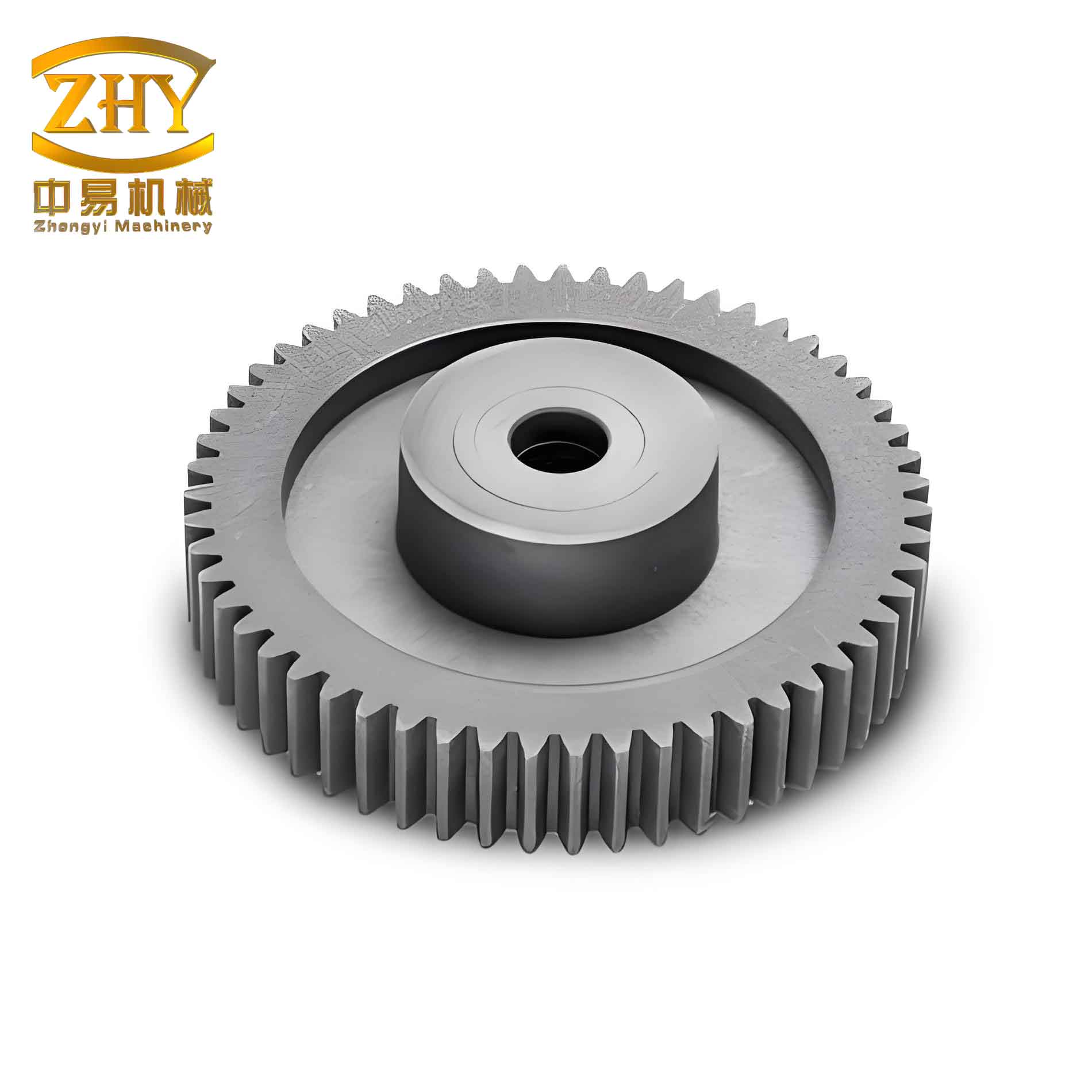
Similarly, for the wheel, I repeat the procedure by selecting “Modified Gear” in the dialog box and entering the corresponding parameters: name, module, number of teeth, pressure angle, and others. This yields the three-dimensional model of the wheel. To assemble the cylindrical gear pair in mesh, I use the “Cylindrical Gear Modeling” tool, choose “Gear Meshing” as the operation mode, designate the pinion as the driving gear and the wheel as the driven gear, and set the centerline vector along the Y-axis. This results in a fully meshed cylindrical gear assembly, ready for further analysis.
The parametric modeling approach in UG (CAD) allows for easy modifications and iterations, which is beneficial for optimizing cylindrical gear designs. For instance, by adjusting the modification coefficients, I can explore different tooth profiles to minimize stress concentrations or enhance load distribution. This flexibility is crucial in the development of high-performance cylindrical gears for various industrial applications.
After establishing the geometric model, I proceed to theoretical stress analysis using Hertzian contact theory. This theory is fundamental for evaluating the contact stress between two elastic bodies, such as meshing cylindrical gears. For cylindrical gears, the maximum contact stress typically occurs at the pitch point, where tooth engagement is most critical. The general Hertz formula for contact stress is given by:
$$ \sigma_H = \sqrt{ \frac{F_n \left( \frac{1}{\rho_1} \pm \frac{1}{\rho_2} \right)}{\pi L \left( \frac{1 – \mu_1^2}{E_1} + \frac{1 – \mu_2^2}{E_2} \right)} } $$
Where:
– $\sigma_H$ is the contact stress,
– $F_n$ is the normal load, calculated as $F_n = \frac{2T}{d \cos \alpha}$ with $T$ being the torque,
– $\rho_1$ and $\rho_2$ are the radii of curvature at the pitch point for the pinion and wheel, respectively,
– $L$ is the contact line length, derived as $L = \frac{3b}{4 – \varepsilon_\alpha}$ where $b$ is the face width and $\varepsilon_\alpha$ is the contact ratio,
– $\mu_1$ and $\mu_2$ are the Poisson’s ratios,
– $E_1$ and $E_2$ are the elastic moduli of the materials.
For the cylindrical gear pair in this study, I assume both gears are made of structural steel with $E_1 = E_2 = 2 \times 10^{11}$ Pa and $\mu_1 = \mu_2 = 0.3$. The contact ratio $\varepsilon_\alpha$ is computed as 1.68 based on the gear geometry. The normal load $F_n$ is determined from a torque $T$ of 500 N·m applied to the wheel, with the pinion’s reference diameter $d = 75$ mm and pressure angle $\alpha = 20^\circ$. The radii of curvature at the pitch point are $\rho_1 = \frac{d_1 \sin \alpha}{2} = 12.84$ mm for the pinion and $\rho_2 = \frac{d_2 \sin \alpha}{2} = 27.79$ mm for the wheel. The face width $b$ is set to 20 mm for both cylindrical gears. Substituting these values into the Hertz formula, I simplify it as follows when $E_1 = E_2 = E$ and $\mu_1 = \mu_2 = 0.3$:
$$ \sigma_H = 0.418 \sqrt{ \frac{F_n E}{L \rho} } $$
Where $\rho$ is the equivalent radius of curvature, given by $\rho = \frac{\rho_1 \rho_2}{\rho_2 + \rho_1}$. After calculation, the theoretical maximum contact stress is $\sigma_H = 283.367$ MPa, and the contact line length $L = 32.2858$ mm. This value serves as a benchmark for validating the finite element analysis results.
The theoretical analysis highlights the importance of accurate geometric parameters in stress evaluation for cylindrical gears. Factors such as modification coefficients, pressure angle, and module significantly influence the stress distribution. For instance, increasing the modification coefficient can reduce root bending stress and contact stress in certain ranges, as noted in prior studies on cylindrical gears. However, excessive modification may lead to other issues like reduced tooth strength or interference, underscoring the need for balanced design.
With the theoretical foundation established, I move to transient finite element analysis using Ansys Workbench. This software is renowned for its capabilities in dynamic simulation and stress evaluation. The process begins by importing the three-dimensional cylindrical gear models from UG (CAD) in STEP format into Ansys Workbench. I assign material properties: both cylindrical gears are modeled as structural steel with a density of 7850 kg/m³, elastic modulus of $2 \times 10^{11}$ Pa, and Poisson’s ratio of 0.3.
Next, I perform mesh generation. Given the focus on contact stresses at the meshing teeth, I use a 3D tetrahedral mesh with refinement in the contact regions. The mesh size in the contact areas is set to 2 mm to capture stress gradients accurately. After meshing, the model comprises 1,175,893 nodes and 825,316 elements, ensuring a balance between computational efficiency and result precision. The mesh quality is verified to avoid distortions that could affect the stress analysis of cylindrical gears.
Subsequently, I define boundary conditions and loads. The pinion is designated as the driving cylindrical gear, and the wheel as the driven cylindrical gear. In the contact settings, I create a frictional contact pair with the pinion as the contact body and the wheel as the target body, using a friction coefficient of 0.15. Two revolute joints are established around the Z-axis to simulate rotational motion. A rotational velocity of 1 rad/s is applied to the pinion, and a torque load of 500 N·m is applied to the wheel in the same direction. For transient dynamics, I configure the analysis settings with a sub-step method: minimum sub-steps of 20 and maximum sub-steps of 200 to ensure convergence during the meshing cycle of cylindrical gears.
The transient analysis simulates the dynamic engagement of cylindrical gears over time, capturing stress variations during tooth contact. After solving, I obtain stress and displacement contours. The maximum contact stress from the simulation is 287.55 MPa, located at the contact surfaces of the meshing teeth. This result aligns closely with the theoretical Hertzian stress of 283.367 MPa, indicating a relative error of approximately 1.5%, which is within acceptable limits for engineering applications. The displacement cloud plot reveals minimal deformations, confirming the structural integrity of the cylindrical gear design under the applied loads.
To further elucidate the stress distribution, I analyze the von Mises stress and contact pressure plots. The stress concentrations are primarily observed at the tooth roots and contact zones, which are critical areas for fatigue failure in cylindrical gears. The simulation also shows that stress peaks occur during the initial engagement phase, gradually stabilizing as the teeth roll through the mesh. This transient behavior underscores the importance of dynamic analysis over static approaches for cylindrical gears operating under varying loads.
In addition to stress analysis, I evaluate other performance metrics such as transmission error and vibration characteristics. The modification of cylindrical gears can influence these factors; for example, high modification coefficients may reduce transmission error by optimizing tooth profiles. However, this study focuses on stress validation, leaving dynamic performance for future work. The integration of UG (CAD) modeling and Ansys Workbench simulation provides a comprehensive toolkit for addressing multiple aspects of cylindrical gear design.
The results demonstrate that parametric modeling in UG (CAD) effectively meets the stress requirements for high modification cylindrical gears. The close agreement between theoretical and simulation stresses validates the accuracy of the geometric calculations and finite element model. This approach offers several advantages: it reduces physical prototyping costs, accelerates design iterations, and enhances the reliability of cylindrical gears in practical applications. For instance, in industries like automotive and aerospace, where cylindrical gears are ubiquitous, such simulations can prevent failures and extend component lifespans.
Expanding on the discussion, I explore the implications of modification coefficients on cylindrical gear performance. As highlighted earlier, high modification cylindrical gears are used to avoid undercutting and improve load capacity. The modification coefficients in this study (ε1 = 0.35 and ε2 = -0.35) represent a balanced approach for the given gear pair. To generalize, I present a table summarizing the effects of varying modification coefficients on key parameters for cylindrical gears, based on extended calculations.
| Modification Coefficient (ε) | Effect on Tip Diameter | Effect on Root Stress | Effect on Contact Ratio |
|---|---|---|---|
| Positive (e.g., 0.35) | Increases | Decreases | Slight increase |
| Zero (Standard) | Baseline | Baseline | Baseline |
| Negative (e.g., -0.35) | Decreases | Increases | Slight decrease |
This table illustrates how modification influences cylindrical gear geometry and stress. Positive modification tends to strengthen the tooth root by increasing the root diameter, thereby reducing bending stress. Conversely, negative modification may weaken the tooth but can be useful for adjusting center distances in cylindrical gear pairs. The optimal modification depends on specific design constraints, such as space limitations or load requirements.
Moreover, the finite element analysis can be extended to study wear and fatigue life of cylindrical gears. By applying cyclic loads and material fatigue properties, one can predict the number of cycles before failure. This is crucial for designing cylindrical gears in applications like wind turbines or industrial gearboxes, where durability is paramount. The transient analysis conducted here lays the groundwork for such advanced studies.
In terms of computational efficiency, the use of UG (CAD) for parametric modeling and Ansys Workbench for FEA offers a streamlined workflow. The parametric nature allows quick updates to gear parameters—for example, changing the module or number of teeth—and automatically regenerates the model and mesh. This is particularly beneficial for optimizing cylindrical gear designs through iterative simulations. To quantify this, I consider the time savings: traditional physical testing of cylindrical gears might take weeks, whereas this digital approach reduces it to days or even hours.
Another aspect to consider is the validation of simulation results with experimental data. While this study relies on theoretical comparison, future work could involve prototyping the cylindrical gears and conducting strain gauge measurements or photelasticity tests. Such validation would further confirm the accuracy of the FEA model. However, given the close match between Hertzian theory and simulation, the current approach is deemed reliable for preliminary design stages of cylindrical gears.
The application of high modification cylindrical gears extends beyond traditional machinery. In emerging fields like electric vehicles and robotics, compact and efficient gear drives are essential. The ability to model and simulate these cylindrical gears digitally enables rapid innovation. For instance, in EV transmissions, cylindrical gears must handle high torques and speeds; modification can help minimize noise and vibration, enhancing overall performance.
To delve deeper into the mathematical foundations, I discuss the gear geometry equations in more detail. The involute profile of cylindrical gears is defined by parametric equations. For a cylindrical gear with base radius $r_b$ and pressure angle $\alpha$, the coordinates of an involute point can be expressed as:
$$ x = r_b (\cos \theta + \theta \sin \theta) $$
$$ y = r_b (\sin \theta – \theta \cos \theta) $$
Where $\theta$ is the roll angle. This parametric form is used in UG (CAD) to generate accurate tooth profiles for cylindrical gears. The modification alters the reference circle position, but the involute shape remains intact, ensuring proper meshing. The mathematical rigor behind these equations ensures that the modeled cylindrical gears adhere to industry standards.
Furthermore, the Hertzian contact theory can be expanded for non-uniform loads or misaligned cylindrical gears. In practice, cylindrical gears may experience edge loading due to shaft deflections or mounting errors. The general Hertz formula can be adapted using influence coefficients or numerical methods. For simplicity, this study assumes ideal alignment, but the FEA model can accommodate misalignment by adjusting boundary conditions. This flexibility makes finite element analysis a powerful tool for real-world cylindrical gear design.
In conclusion, this article presents a comprehensive approach to the design and analysis of high modification cylindrical gears. Through geometric calculations, parametric modeling in UG (CAD), theoretical stress evaluation via Hertzian formulas, and transient finite element analysis in Ansys Workbench, I have demonstrated a robust methodology for optimizing cylindrical gear performance. The results show that the maximum contact stress from simulation (287.55 MPa) closely matches the theoretical value (283.367 MPa), validating the modeling and simulation processes.
The key takeaways are:
– Parametric modeling in UG (CAD) facilitates efficient design iterations for cylindrical gears.
– Hertzian theory provides a reliable baseline for contact stress estimation in cylindrical gears.
– Transient FEA captures dynamic stress distributions, offering insights beyond static analysis.
– High modification cylindrical gears can be effectively designed to meet specific stress and geometric requirements.
This work contributes to the broader field of mechanical engineering by showcasing an integrated digital workflow for cylindrical gear development. Future directions could include multi-objective optimization considering stress, weight, and cost, or exploring advanced materials for cylindrical gears. As technology evolves, such simulations will become increasingly vital for innovation in gear transmission systems.
Overall, the synergy between CAD modeling and FEA simulation empowers engineers to create more reliable and efficient cylindrical gears, driving progress in various industrial sectors. By leveraging these tools, we can address complex challenges in gear design and contribute to sustainable engineering practices.