
In modern mechanical transmission systems, cylindrical gears play a pivotal role as one of the most critical components for motion and torque transmission between driving and driven shafts. Among various gear types, high-profile shift cylindrical gears, where the cutting tool is offset during manufacturing to avoid undercutting, optimize tooth engagement, and enhance load capacity, have gained widespread application. These cylindrical gears are essential in industries such as automotive, aerospace, and heavy machinery, where efficiency and durability are paramount. This study focuses on the parametric three-dimensional modeling of high-profile shift cylindrical gears using UG (CAD) software, followed by a transient finite element analysis (FEA) in Ansys Workbench to evaluate their dynamic performance under operational conditions. By integrating theoretical calculations based on Hertz contact theory with simulation results, we aim to validate the modeling approach and provide insights into the stress distribution and displacement characteristics of these cylindrical gears, thereby supporting design optimization and reliability assessment.
The design and analysis of cylindrical gears require precise geometric computations to ensure proper meshing and performance. For high-profile shift cylindrical gears, the modification coefficients alter the tooth profile, affecting parameters such as addendum, dedendum, and center distance. In this study, we consider a pair of meshing cylindrical gears: a pinion with 30 teeth and a gear with 65 teeth, both with a module of 2.5 mm, a pressure angle of 20°, and profile shift coefficients of +0.35 and -0.35, respectively. The geometric calculations are derived from standard gear equations, and the results are summarized in Table 1. These parameters form the foundation for the subsequent three-dimensional modeling and finite element analysis of the cylindrical gears.
| Parameter | Formula | Pinion (Small Gear) | Gear (Large Gear) |
|---|---|---|---|
| Module (m) | Given | 2.5 mm | 2.5 mm |
| Number of Teeth (z) | Given | 30 | 65 |
| Pressure Angle (α) | Given | 20° | 20° |
| Profile Shift Coefficient (ε) | Given | +0.35 | -0.35 |
| Pitch Diameter (d) | d = m × z | 75 mm | 162.5 mm |
| Addendum Diameter (d_a) | d_a = d + 2m(f + ε) | 81.75 mm | 165.75 mm |
| Dedendum Diameter (d_f) | d_f = d – m(f – ε + c) | 70.5 mm | 154.5 mm |
| Addendum Height (h_a) | h_a = m(f + ε) | 3.375 mm | 1.625 mm |
| Dedendum Height (h_f) | h_f = m(f – ε + c) | 2.25 mm | 4 mm |
| Tooth Height (h) | h = h_a + h_f | 5.625 mm | 5.625 mm |
| Base Circle Radius (r_b) | r_b = (m × z × cos α) / 2 | 35.2834 mm | 76.3500 mm |
| Base Pitch (p_b) | p_b = π m cos α | 7.38033 mm | 7.38033 mm |
| Circular Pitch (p) | p = π m | 7.85394 mm | 7.85394 mm |
| Center Distance (A) | A = m (z1 + z2) / 2 | 118.75 mm | |
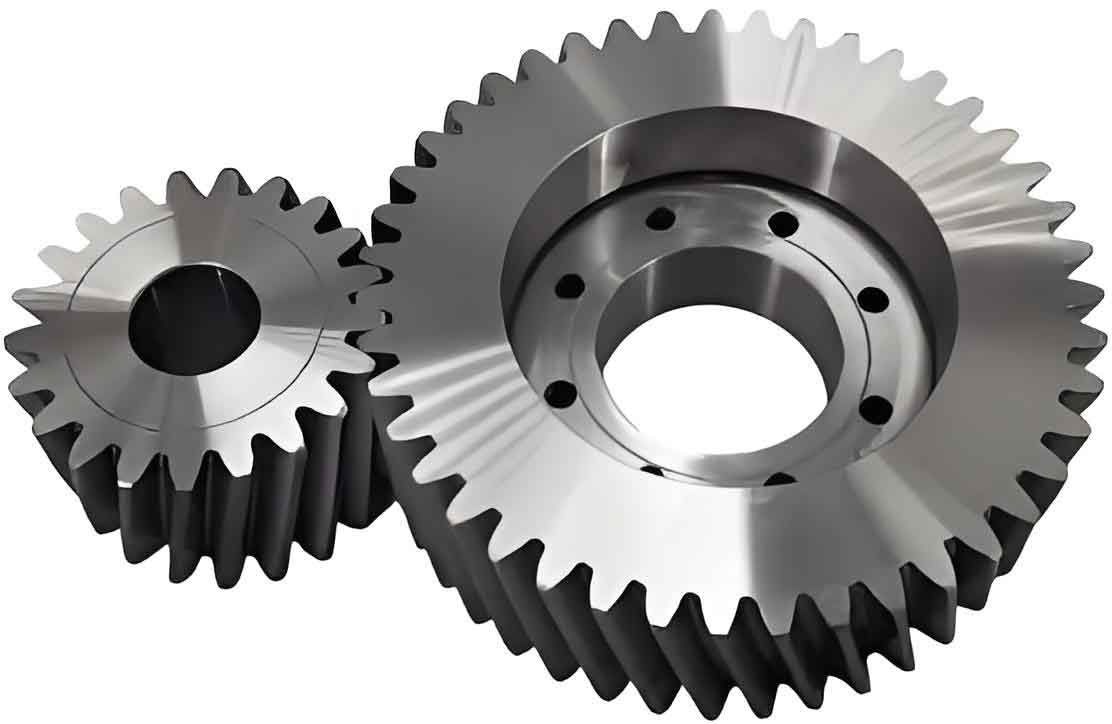
The three-dimensional modeling of cylindrical gears is a critical step in virtual prototyping and simulation. UG (CAD), a comprehensive software suite for computer-aided design, manufacturing, and engineering (CAD/CAM/CAE), offers robust parametric modeling capabilities that facilitate the creation of complex geometries like cylindrical gears. In this work, we utilized UG’s gear modeling toolkit to generate the high-profile shift cylindrical gears based on the calculated parameters. The process involves accessing the cylindrical gear modeling dialog, selecting the “profile shift gear” option, and inputting key parameters such as module, number of teeth, pressure angle, profile shift coefficient, addendum coefficient (f = 1), and tip clearance coefficient (c = 0.25). For the pinion, with a positive shift coefficient, the tool offsets away from the gear blank, while for the gear, with a negative shift coefficient, the tool moves closer, maintaining the same total tooth height. This parametric approach ensures accuracy and repeatability, allowing for easy modifications if design changes are required. The resulting three-dimensional models of the pinion and gear are then assembled in UG to simulate meshing, with the pinion as the driving component and the gear as the driven component, aligned along the Y-axis. The visualization of these cylindrical gears aids in verifying geometric integrity before proceeding to finite element analysis.
To assess the mechanical performance of cylindrical gears under load, theoretical contact stress calculations are essential. The Hertz contact theory provides a foundational framework for estimating the maximum contact stress between two elastic bodies, such as meshing cylindrical gears. For cylindrical gears, the contact at the pitch point is often critical, as it experiences high loads and is prone to pitting. The Hertz formula for maximum contact stress (σ_H) between two parallel cylinders is given by:
$$ \sigma_H = \sqrt{ \frac{F_n}{\pi L} \cdot \frac{1}{\rho} \cdot \frac{1 – \mu^2}{E} } $$
where F_n is the normal load, L is the contact length, ρ is the composite radius of curvature, μ is Poisson’s ratio, and E is the elastic modulus. For a pair of cylindrical gears, the normal load can be derived from the transmitted torque (T) and pitch diameter (d), expressed as:
$$ F_n = \frac{2T}{d \cos \alpha} $$
The contact length L accounts for the face width (b) and contact ratio (ε_α), calculated as:
$$ L = \frac{3b}{4 – \epsilon_\alpha} $$
The composite radius of curvature (ρ) at the pitch point is determined from the curvatures of the two gear teeth:
$$ \frac{1}{\rho} = \frac{1}{\rho_1} + \frac{1}{\rho_2} $$
with ρ_1 and ρ_2 being the radii of curvature for the pinion and gear, respectively. For cylindrical gears with standard involute profiles, these can be computed from the base circle radii. Assuming both gears are made of structural steel with an elastic modulus E = 2 × 10^11 Pa and Poisson’s ratio μ = 0.3, and given a torque of 500 N·m applied to the gear, the theoretical maximum contact stress is calculated. Using the geometric parameters from Table 1 and a face width b = 20 mm, with a contact ratio ε_α = 1.68, the computed contact stress is approximately 283.367 MPa. This value serves as a benchmark for comparing with finite element simulation results, ensuring the accuracy of the modeling approach for cylindrical gears.
Transient finite element analysis (FEA) is employed to simulate the dynamic behavior of cylindrical gears under operational conditions, providing detailed insights into stress distribution and deformation. In this study, we used Ansys Workbench, a powerful simulation platform, to perform a transient structural analysis on the three-dimensional models of the high-profile shift cylindrical gears. The models, initially created in UG, were exported in STEP format and imported into Ansys Workbench. The material properties were assigned as structural steel, with a density of 7850 kg/m³, elastic modulus of 2 × 10^11 Pa, and Poisson’s ratio of 0.3, consistent with the theoretical calculations. Meshing is a crucial step in FEA; we applied a 3D tetrahedral mesh to both cylindrical gears, with refinement in the contact regions to capture stress concentrations accurately. The mesh resulted in approximately 1,175,893 nodes and 825,316 elements, balancing computational efficiency and accuracy.
Boundary conditions and loads were applied to simulate realistic gear operation. The pinion was defined as the driving component with a rotational velocity of 1 rad/s, while the gear was subjected to a resisting torque of 500 N·m. Contact pairs were established between the meshing teeth, with the pinion teeth set as contact surfaces and the gear teeth as target surfaces, using a frictional contact type with a coefficient of 0.15. Two revolute joints were created around the Z-axis to allow rotational motion. The transient analysis was configured with sub-step controls, setting a minimum of 20 and a maximum of 200 sub-steps to ensure convergence and capture dynamic effects over time. This setup enables the simulation of the cylindrical gears’ engagement process, accounting for inertial and contact forces.
The results of the transient finite element analysis reveal the stress and displacement patterns in the cylindrical gears. The contact stress distribution, obtained from the simulation, shows that the maximum von Mises stress occurs at the tooth contact surfaces, with a peak value of 287.55 MPa. This is closely aligned with the theoretical Hertz contact stress of 283.367 MPa, indicating a relative error of less than 1.5%, which is within acceptable limits for engineering applications. The stress concentration at the meshing interface highlights the critical regions where fatigue failure might initiate, emphasizing the importance of accurate modeling for cylindrical gears. Additionally, the displacement cloud diagram illustrates the deformation of the gear teeth under load, with minimal displacement in the gear bodies but noticeable elastic deformation at the contact points. These insights validate the parametric modeling approach and demonstrate the efficacy of UG and Ansys Workbench in analyzing cylindrical gears.
Further discussion on the performance of cylindrical gears can be extended by considering factors such as load distribution, thermal effects, and material nonlinearities. For instance, the contact ratio of cylindrical gears influences the number of teeth in contact simultaneously, affecting load sharing and stress levels. In this analysis, a contact ratio of 1.68 ensures that at least one pair of teeth is always in contact, reducing impact loads and wear. Moreover, the use of high-profile shift in cylindrical gears can improve tooth strength by increasing the root thickness and optimizing the tooth profile for better load capacity. Comparing our results with prior studies on cylindrical gears, the consistency between theoretical and simulated stresses reinforces the reliability of finite element methods for gear design. However, it is important to note that real-world conditions, such as manufacturing tolerances and lubrication, may introduce variations, necessitating further experimental validation for cylindrical gears used in critical applications.
In conclusion, this study successfully demonstrates the parametric modeling and transient finite element analysis of high-profile shift cylindrical gears. Through detailed geometric calculations, we established the parameters for a pair of cylindrical gears and used UG (CAD) to create accurate three-dimensional models. The theoretical contact stress, calculated using Hertz formula, provided a benchmark for evaluating simulation results. The transient finite element analysis in Ansys Workbench yielded stress and displacement distributions that closely matched theoretical predictions, with a maximum contact stress of 287.55 MPa compared to the theoretical 283.367 MPa. This close agreement validates the modeling methodology and highlights the potential of integrating CAD and FEA tools for optimizing cylindrical gears. Future work could explore dynamic loading scenarios, different materials, or advanced tooth profiles to further enhance the performance and longevity of cylindrical gears in mechanical systems.