
In the evolving landscape of automotive technology, hydraulic rack and pinion power steering systems have become prevalent in passenger vehicles, leading to a proliferation of steering gear types and models. To accelerate the design process, particularly for critical components like gear shafts, our company has leveraged the Pro/ENGINEER (Pro/E) platform to implement CAD techniques based on parametric modeling. This approach has significantly enhanced design efficiency, improved product quality, and shortened design cycles. In this article, I will delve into the methodology and implementation of parametric modeling for gear shafts, emphasizing the use of formulas and tables to encapsulate key concepts. The focus will remain on gear shafts, a pivotal element in these systems, and I will ensure that the term ‘gear shafts’ is reiterated throughout to underscore their importance.
Parametric modeling refers to a design paradigm where geometric models are defined by parameters and relationships, allowing for automatic updates when parameters change. For gear shafts, this involves capturing dimensions such as tooth number, module, pressure angle, and helix angle as variables. By doing so, we can rapidly generate and modify three-dimensional models of gear shafts without manual redesign. This is particularly beneficial for gear shafts used in hydraulic rack and pinion power steering, where customization and variant management are common. The core idea is to create a flexible model that adapts to new specifications through parameter adjustments, thereby streamlining the entire design workflow for gear shafts.
The parametric modeling process for gear shafts begins with defining relevant parameters. In Pro/E, we establish a set of user-defined parameters that govern the geometry of the gear shaft. These parameters include fundamental gear properties and derived quantities. Below is a table summarizing the primary parameters used in our modeling approach for gear shafts:
| Parameter Name | Symbol | Description | Example Value |
|---|---|---|---|
| Number of Teeth | Z | Number of teeth on the gear shaft | 7 |
| Normal Module | Mn | Module in the normal plane | 1.94 mm |
| Normal Pressure Angle | αn | Pressure angle in the normal plane | 20° |
| Helix Angle | β | Angle of helix for the helical gear | 20.5° |
| Normal Addendum Coefficient | ha* | Coefficient for addendum height in normal plane | 0.8 |
| Normal Dedendum Coefficient | c* | Coefficient for dedendum height in normal plane | 0.25 |
| Profile Shift Coefficient | x | Shift coefficient for tooth profile modification | 0.625 |
| Face Width | B | Width of the gear along its axis | 45 mm |
From these basic parameters, we derive additional quantities essential for gear shaft modeling. The relationships are expressed using mathematical formulas, which are embedded within Pro/E’s parametric system. For instance, the transverse module (mt) is calculated from the normal module (mn) and helix angle (β) using the formula:
$$m_t = \frac{m_n}{\cos(\beta)}$$
Similarly, the transverse pressure angle (αt) is derived as:
$$\alpha_t = \arctan\left(\frac{\tan(\alpha_n)}{\cos(\beta)}\right)$$
Other derived parameters include the transverse addendum coefficient (hat*) and transverse dedendum coefficient (ct*), given by:
$$h_{at}^* = h_a^* \cdot \cos(\beta)$$
$$c_t^* = c^* \cdot \cos(\beta)$$
These formulas ensure that the gear shaft geometry accurately reflects helical gear characteristics. Key diameters for the gear shaft are then computed as follows:
- Pitch diameter: $$d = m_t \cdot Z$$
- Base diameter: $$d_b = d \cdot \cos(\alpha_t)$$
- Root diameter: $$d_f = d – 2 \cdot m_t \cdot (h_{at}^* + c_t^*)$$
- Addendum diameter: $$d_a = d + 2 \cdot h_{at}^* \cdot m_t$$
These diameters form the basis for constructing the gear tooth profile on the gear shaft. To illustrate the interrelationships, here is a table that consolidates the derived parameters for a typical gear shaft:
| Derived Parameter | Formula | Example Calculation |
|---|---|---|
| Transverse Module (mt) | mt = mn / cos(β) | mt = 1.94 / cos(20.5°) ≈ 2.07 mm |
| Transverse Pressure Angle (αt) | αt = arctan(tan(αn) / cos(β)) | αt = arctan(tan(20°) / cos(20.5°)) ≈ 21.2° |
| Pitch Diameter (d) | d = mt · Z | d = 2.07 · 7 ≈ 14.49 mm |
| Base Diameter (db) | db = d · cos(αt) | db = 14.49 · cos(21.2°) ≈ 13.52 mm |
| Root Diameter (df) | df = d – 2 · mt · (hat* + ct*) | df ≈ 14.49 – 2 · 2.07 · (0.75 + 0.23) ≈ 10.33 mm |
| Addendum Diameter (da) | da = d + 2 · hat* · mt | da ≈ 14.49 + 2 · 0.75 · 2.07 ≈ 17.60 mm |
With parameters defined, the next step in modeling gear shafts is to create the tooth profile curve. We start by generating an involute curve, which is fundamental for gear tooth geometry. In Pro/E, we use a parametric equation to define this curve. The involute equations in Cartesian coordinates, based on the base circle radius (rb = db/2), are:
$$x = r_b \cdot \cos(\theta) + r_b \cdot \sin(\theta) \cdot \theta \cdot \frac{\pi}{180}$$
$$y = r_b \cdot \sin(\theta) – r_b \cdot \cos(\theta) \cdot \theta \cdot \frac{\pi}{180}$$
$$z = 0$$
Here, θ varies from 0 to a suitable angle (e.g., 85°) to span the active involute portion. This curve is created as a spline via the “From Equation” feature in Pro/E. Subsequently, we sketch concentric circles representing the root, base, pitch, and addendum circles on a plane, linking their diameters to the parameters (e.g., Sd7 = df for the root circle). These circles provide reference geometry for constructing the gear tooth slot on the gear shaft.
To form a complete tooth slot, the involute curve is mirrored across a symmetry plane. This plane is defined based on half the tooth space width, which is derived from the circular pitch. The circular pitch (p) is calculated as:
$$p = \pi \cdot m_t$$
And the tooth space width (s) at the pitch circle is:
$$s = \frac{p}{2} + 2 \cdot x \cdot m_t \cdot \tan(\alpha_t)$$
This ensures accurate tooth geometry for the gear shaft. After mirroring, we connect the involute segments with fillets at the root to create a closed profile for the tooth slot. This profile is then used as a cross-section for further operations.
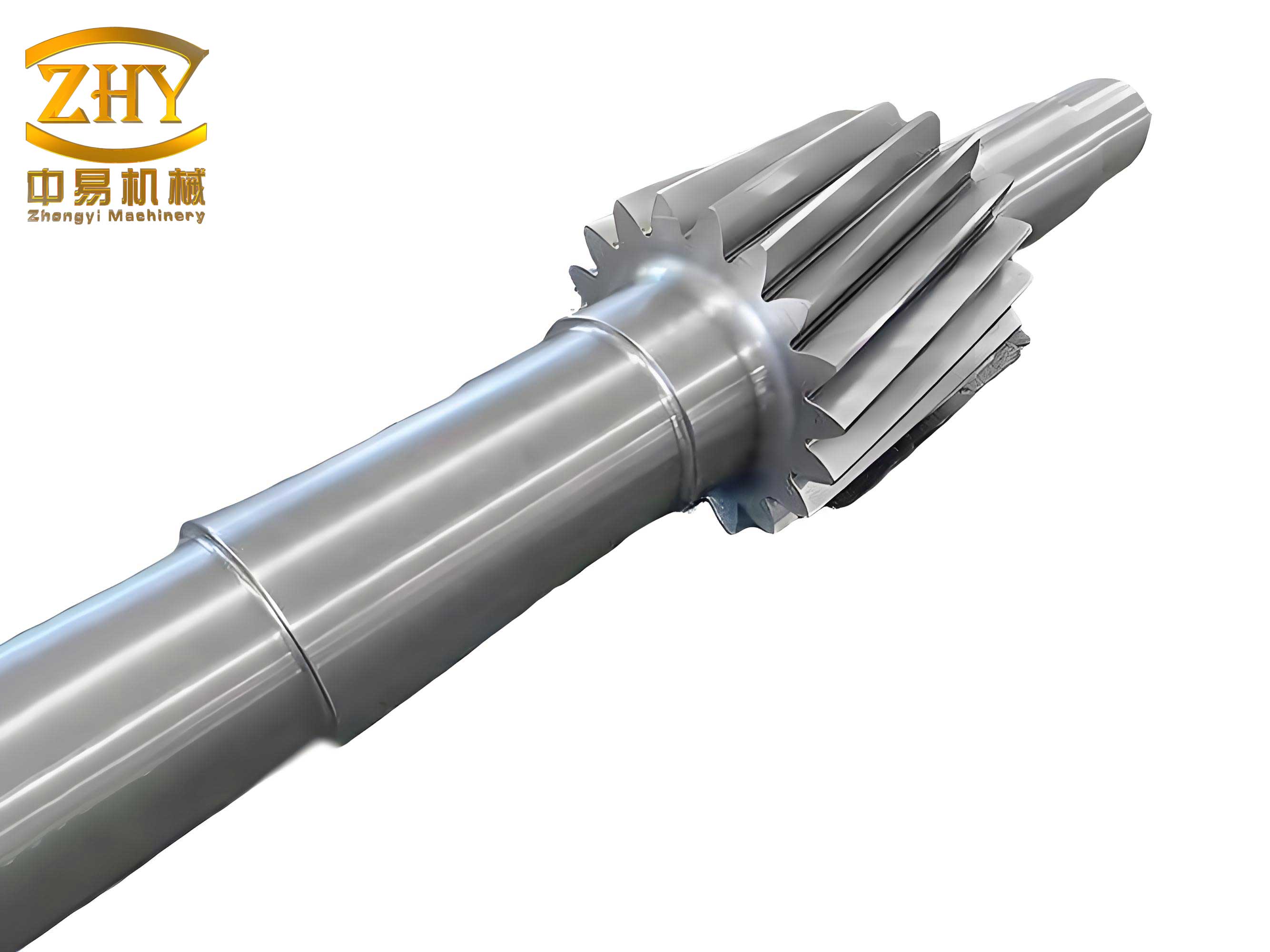
For helical gear shafts, the tooth profile must be swept along a helical path. This requires defining a helical sweep trajectory. We compute the lead (L) of the helix based on the base circle and helix angle. The lead is given by:
$$L = \frac{\pi \cdot d_b}{\tan(\beta)}$$
In Pro/E, we create a helical sweep surface by specifying this lead and using a trajectory curve. The trajectory is constructed by combining a straight line along the gear shaft axis with a curved segment that represents the run-out or end of the gear teeth, simulating the manufacturing process with a hobbling tool. The curved segment is an arc with a radius equal to the hob tool radius, positioned at an angle relative to the axis. This composite trajectory ensures that the helical sweep accurately models the gear teeth on the gear shaft.
Once the helical sweep surface is generated, we use it to create the tooth slot surfaces via a swept blend operation. The sweep path follows the edge of the helical surface, and cross-sections are defined by the tooth slot profile at multiple sections. This results in a three-dimensional surface representing a single tooth gap on the gear shaft. To complete the gear teeth, we array this tooth gap surface around the axis. The number of instances equals the tooth count (Z), spaced evenly at an angular pitch of:
$$\theta_p = \frac{360^\circ}{Z}$$
This array generates all tooth slots on the gear shaft simultaneously.
With the tooth slots defined, we proceed to build the solid body of the gear shaft. This involves creating a rotational solid based on the addendum diameter and other shaft features, such as limits and grooves. In Pro/E, we use the revolve feature to generate a cylindrical body representing the overall shape of the gear shaft. Then, we subtract the tooth slot surfaces from this solid using the “Solidify” or “Cut” operations, resulting in a fully detailed gear shaft model. Additional features like chamfers, fillets, and mounting details are added through extrude and cut features, all parameter-driven to maintain associativity.
A key advantage of parametric modeling for gear shafts is the ability to regenerate the model with new parameters. For example, if we change the tooth number from Z=7 to Z=8, normal module from Mn=1.94 to Mn=1.85, helix angle from β=20.5° to β=25°, addendum coefficient from ha*=0.8 to ha*=0.9, and profile shift coefficient from x=0.625 to x=0.8, the model updates automatically. All related dimensions and features adjust based on the formulas, producing a new gear shaft design without manual intervention. This flexibility is crucial for adapting gear shafts to different steering system requirements.
To further illustrate the parametric relationships, here is a comprehensive table summarizing the impact of parameter changes on gear shaft geometry. This table highlights how variations in key parameters affect derived dimensions, emphasizing the interdependencies in gear shaft design:
| Parameter Change | Effect on Pitch Diameter (d) | Effect on Base Diameter (db) | Effect on Tooth Strength | Implications for Gear Shaft Performance |
|---|---|---|---|---|
| Increase Tooth Number (Z) | Increases linearly: d = mt·Z | Increases proportionally | May improve load distribution | Higher torque capacity for gear shafts |
| Increase Normal Module (Mn) | Increases via mt | Increases | Enhances tooth rigidity | Larger gear shafts with better durability |
| Increase Helix Angle (β) | Increases mt, thus d | Increases slightly | Improves smoothness and contact ratio | Reduced noise in gear shafts |
| Increase Profile Shift (x) | No direct effect on d | Unaffected | Adjusts tooth thickness and root stress | Customized meshing for gear shafts |
Moreover, the parametric approach enables optimization of gear shafts for specific applications. For instance, we can define performance metrics such as bending stress (σb) and contact stress (σH) using standard gear formulas. The bending stress at the tooth root can be approximated as:
$$\sigma_b = \frac{F_t \cdot K_a \cdot K_v \cdot K_s \cdot K_m \cdot K_B}{b \cdot m_n \cdot Y_J}$$
Where Ft is the tangential load, K factors account for application, dynamic effects, size, load distribution, and rim thickness, b is the face width, and YJ is the geometry factor. Similarly, contact stress is given by:
$$\sigma_H = Z_E \cdot \sqrt{\frac{F_t \cdot K_a \cdot K_v \cdot K_s \cdot K_H}{d \cdot b} \cdot \frac{u+1}{u}}$$
With ZE as the elasticity factor, KH as the pitting resistance factor, and u as the gear ratio. By linking these formulas to parameters, we can perform iterative analyses to refine gear shaft designs for minimal stress and maximum lifespan.
In practice, the parametric modeling of gear shafts is not without limitations. Large changes in parameters can alter the topological structure of the model, potentially causing regeneration failures. For example, if the tooth number is drastically reduced, the tooth slots might overlap, leading to geometric conflicts. Therefore, we implement validation checks within Pro/E using conditional relations. These relations ensure that parameters remain within feasible ranges. A simple check for gear shaft validity might be:
$$ \text{IF } (d_f > 0) \text{ AND } (d_a > d_f) \text{ THEN proceed ELSE error} $$
This safeguards against invalid designs. Additionally, we define families of gear shafts by creating tables of parameter sets, known as family tables in Pro/E. Each row in the table represents a variant of the gear shaft, allowing for quick configuration management.
The integration of parametric modeling with simulation tools further enhances the design process for gear shafts. We can export the Pro/E model to finite element analysis (FEA) software to evaluate structural integrity under loads. The parametric links ensure that any design update automatically propagates to simulation models, enabling rapid iteration. This synergy reduces prototyping costs and accelerates time-to-market for gear shafts in hydraulic steering systems.
From a broader perspective, the parametric methodology extends beyond gear shafts to entire assemblies. In a rack and pinion steering system, the gear shaft meshes with a rack. We can model the rack parametrically as well, with parameters like rack length and tooth profile derived from the gear shaft parameters. The mesh relationship is governed by the fundamental law of gearing, expressed as:
$$\frac{d\theta_{\text{gear}}}{dt} \cdot r_p = \frac{dx_{\text{rack}}}{dt}$$
Where rp is the pitch radius of the gear shaft, and xrack is the rack displacement. This ensures kinematic consistency in the parametric model of the overall system.
In conclusion, parametric modeling using Pro/E has revolutionized the design of gear shafts for hydraulic rack and pinion power steering. By encapsulating gear geometry in formulas and parameters, we achieve a high degree of automation and flexibility. The key benefits include reduced design time, improved accuracy, and easier customization. As automotive technology advances, such parametric techniques will become increasingly vital for developing efficient and reliable gear shafts. Future work may involve integrating machine learning algorithms to optimize parameters automatically, further pushing the boundaries of gear shaft design. Ultimately, the focus on gear shafts underscores their critical role in steering systems, and parametric modeling ensures they meet the evolving demands of the industry.
To summarize the core formulas in a consolidated manner, here is a final table that lists essential equations for gear shaft parametric modeling. This table serves as a quick reference for engineers working on similar projects:
| Equation Purpose | Formula | Variables Description |
|---|---|---|
| Transverse Module | $$m_t = \frac{m_n}{\cos(\beta)}$$ | mn: normal module, β: helix angle |
| Transverse Pressure Angle | $$\alpha_t = \arctan\left(\frac{\tan(\alpha_n)}{\cos(\beta)}\right)$$ | αn: normal pressure angle |
| Pitch Diameter | $$d = m_t \cdot Z$$ | Z: number of teeth |
| Base Diameter | $$d_b = d \cdot \cos(\alpha_t)$$ | d: pitch diameter |
| Involute Parametric Equations | $$x = r_b (\cos\theta + \theta \sin\theta \cdot \pi/180)$$ $$y = r_b (\sin\theta – \theta \cos\theta \cdot \pi/180)$$ |
rb: base radius, θ: parameter |
| Helical Lead | $$L = \frac{\pi \cdot d_b}{\tan(\beta)}$$ | L: lead of helix |
| Tooth Bending Stress | $$\sigma_b = \frac{F_t \cdot K_a \cdot K_v \cdot K_s \cdot K_m \cdot K_B}{b \cdot m_n \cdot Y_J}$$ | Ft: tangential load, b: face width, YJ: geometry factor |
Through this detailed exploration, I have highlighted the intricacies of parametric modeling for gear shafts. The repeated emphasis on gear shafts throughout this article reinforces their significance in automotive design. By leveraging parametric tools, we can ensure that gear shafts are not only precisely engineered but also adaptable to future innovations, solidifying their role in the advancement of hydraulic power steering systems.