
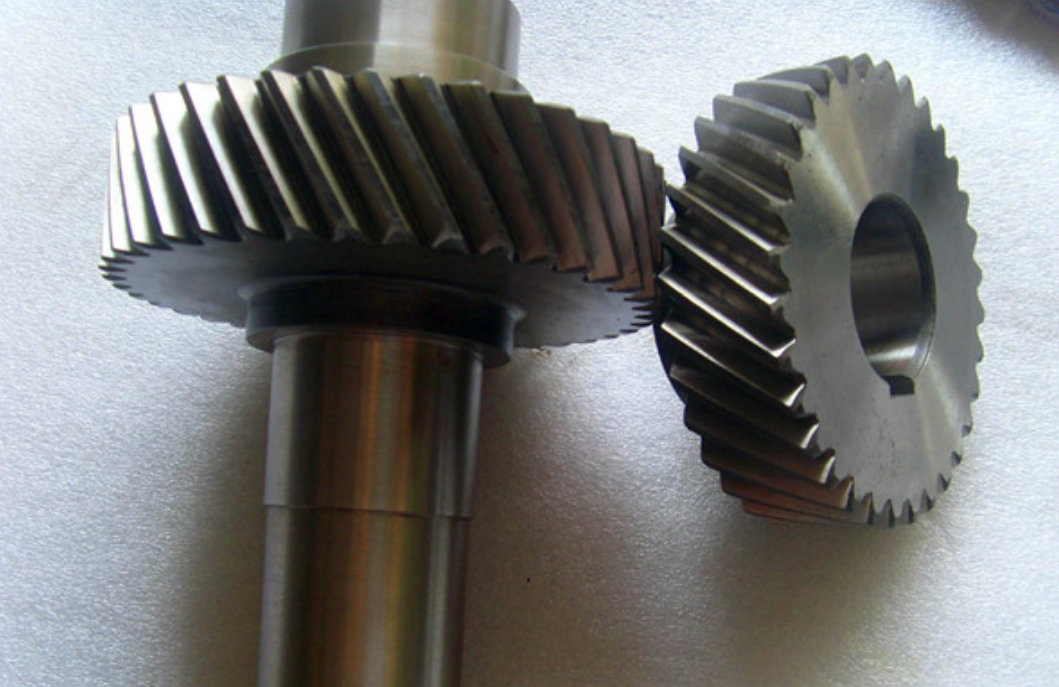
The advancement of Computer-Aided Design (CAD) and virtual prototyping technologies has fundamentally transformed the product development lifecycle in mechanical engineering. Prior to physical manufacturing, components now undergo rigorous virtual design, assembly, and motion simulation. Among the most ubiquitous mechanical elements, helical gears are critical for power and motion transmission across countless systems. Therefore, establishing precise, parameterized three-dimensional CAD models of helical gears is not merely convenient but essential for creating accurate digital twins and virtual prototypes. These models serve as the foundational geometry for Finite Element Analysis (FEA) in software like ANSYS for stress and fatigue studies, for computational fluid dynamics simulations investigating lubrication regimes, and crucially, for generating toolpaths in Computer-Aided Manufacturing (CAM) for processes such as precision grinding. This article presents a detailed, first-principles methodology for the parametric modeling of both standard and profile-shifted (modified) helical gears using industry-standard CAD techniques. The goal is to create intelligent, feature-based models where altering key design parameters—such as module, number of teeth, helix angle, and profile shift coefficient—automatically regenerates a geometrically accurate three-dimensional model.
The tooth flank of a helical gear is a complex three-dimensional surface known as an involute helicoid. Its generation can be visualized using the concept of a taut string unwrapping from a base cylinder. Consider a plane tangent to a base cylinder. A line segment (KK) lies on this plane at an angle $\beta_b$ to the cylinder’s axis. This angle is the base helix angle. As this plane rolls without slipping over the base cylinder, the line KK traces out the involute helicoid surface. The intersection of this surface with any plane perpendicular to the gear’s axis (the transverse plane) yields a standard involute curve. Consequently, while the transverse tooth profile is a true involute, the profile in the normal plane (perpendicular to the tooth trace) is not. This fundamental understanding of the tooth flank as a generated ruled surface is key to developing robust parametric models for helical gears.
The geometry of helical gears is defined by two sets of parameters: normal and transverse. The normal parameters $(m_n, \alpha_n)$ are standard values, aligned with the direction of tool movement during cutting (e.g., hobbling). However, geometric calculations for diameters and centers are performed using transverse parameters derived from the normal ones and the helix angle $\beta$ at the reference (standard) pitch diameter. The essential geometric relationships and derived parameters necessary for parametric modeling are summarized in the table below.
| Parameter Name | Symbol | Unit | Formula / Description |
|---|---|---|---|
| Normal Module | $m_n$ | mm | Standard, input parameter. |
| Number of Teeth | $z$ | – | Integer, input parameter. |
| Helix Angle (at Ref. Pitch Dia.) | $\beta$ | deg | Input parameter. Sign determines hand. |
| Normal Pressure Angle | $\alpha_n$ | deg | Typically 20°, input parameter. |
| Profile Shift Coefficient (Normal) | $x_n$ | – | Input parameter. $x_n=0$ for standard gears. |
| Face Width | $b$ | mm | Gear axial length, input parameter. |
| Transverse Module | $m_t$ | mm | $$m_t = \frac{m_n}{\cos(\beta)}$$ |
| Transverse Pressure Angle | $\alpha_t$ | deg | $$\alpha_t = \arctan\left(\frac{\tan(\alpha_n)}{\cos(\beta)}\right)$$ |
| Reference Pitch Diameter | $d$ | mm | $$d = m_t \cdot z = \frac{m_n \cdot z}{\cos(\beta)}$$ |
| Base Diameter | $d_b$ | mm | $$d_b = d \cdot \cos(\alpha_t)$$ |
| Profile Shift Coefficient (Transverse) | $x_t$ | – | $$x_t = x_n \cdot \cos(\beta)$$ |
| Addendum | $h_a$ | mm | $$h_a = m_n \cdot (1 + x_n)$$ |
| Dedendum | $h_f$ | mm | $$h_f = m_n \cdot (1.25 – x_n)$$ (Common practice) |
| Tip Diameter | $d_a$ | mm | $$d_a = d + 2 \cdot h_a$$ |
| Root Diameter | $d_f$ | mm | $$d_f = d – 2 \cdot h_f$$ |
Parametric modeling of helical gears capitalizes on the power of feature-based CAD systems. The core strategy involves defining the primary design parameters (Table 1) and their interrelationships as named variables and formulas within the CAD software. Two principal modeling approaches are effective for constructing the involute helicoid tooth form.
Approach 1: Sweep-Based Method
This method directly mimics the generation of the involute helicoid. The process begins in the transverse plane. A precise tooth profile, comprising an involute curve from the base circle to the tip circle and a defined fillet (trochoid or circular arc) from the base circle to the root circle, is constructed. For a standard gear $(x_n=0)$, the tooth is symmetric about a line from the gear center through the midpoint of the circular pitch. The symmetric tooth space profile is then trimmed using the tip and root circles. This closed profile is the “cross-section” or “generator.” Next, the helix on the reference cylinder is created. This is achieved by drawing a line in an axial plane with a length of $b/\cos(\beta)$ at an angle $\beta$ to the axis, and then projecting/wrapping this line onto the reference cylinder surface. Finally, the closed transverse tooth profile is swept along this 3D helical path using the “Sweep” or “Helical Sweep” function. The swept body represents a single tooth. The complete gear is formed by patterning this tooth body around the axis with a circular count equal to the number of teeth $z$. This method is highly intuitive and directly constructs the continuous helical surface.
Approach 2: End Profile Rotation & Loft Method
This alternative method exploits the angular offset between a tooth’s profile on the gear’s two end faces. Consider a single tooth. Due to the helix, the transverse profile on the back face is rotated relative to the profile on the front face. The magnitude of this rotation angle $\gamma$ (in radians) is derived from the helix lead $L = \pi \cdot d / \tan(\beta)$ and the face width $b$:
$$\gamma = \frac{2 \pi \cdot b}{L} = \frac{2 \pi \cdot b \cdot \tan(\beta)}{\pi \cdot d} = \frac{2 b \cdot \tan(\beta)}{d}$$
Where $d$ is the reference pitch diameter. Modeling proceeds by constructing the precise 2D tooth profile on the front transverse plane. An identical profile is then created on the back transverse plane but rotated by the angle $\gamma$ about the gear axis. These two offset profiles become guide curves. The three-dimensional tooth body is generated by creating a lofted surface (or solid) between these two profiles, often with optional guide curves defining the fillet transition. Subsequent patterning completes the gear. This method is computationally efficient and explicitly defines the tooth boundaries.
Regardless of the approach, the accurate generation of the 2D transverse involute tooth profile is the critical first step. This requires a parametric definition of the involute curve. The Cartesian coordinates $(x_{inv}, y_{inv})$ of a point on an involute generated from a base circle of radius $r_b$ are given as a function of the roll angle $\varepsilon$ (in radians):
$$ x_{inv} = r_b (\cos(\varepsilon) + \varepsilon \sin(\varepsilon)) $$
$$ y_{inv} = r_b (\sin(\varepsilon) – \varepsilon \cos(\varepsilon)) $$
For CAD implementation, a normalized parameter $t$ ranging from 0 to 1 is often used, where the roll angle $\varepsilon$ is defined as $\varepsilon = \varepsilon_{start} + t \cdot (\varepsilon_{end} – \varepsilon_{start})$. The start angle $\varepsilon_{start}$ corresponds to the point where the involute begins at the base circle. The end angle $\varepsilon_{end}$ is calculated such that the resulting point lies on the tip circle ($r_a$). This is found by solving $r_b \sqrt{1+\varepsilon_{end}^2} = r_a$, yielding $\varepsilon_{end} = \sqrt{(r_a/r_b)^2 – 1}$. The coordinates become functions of $t$, enabling the creation of a spline through a series of calculated points.
| Modeling Step | Governing Parameters & Formulas | Purpose |
|---|---|---|
| 1. Define Parameters | $m_n, z, \beta, \alpha_n, x_n, b$ (Table 1). Stored in CAD parameters table or linked Excel file. | Establish the parametric foundation. |
| 2. Calculate Derived Geometry | $m_t, \alpha_t, d, d_b, d_a, d_f, h_a, h_f$ (Formulas in Table 1). | Compute all necessary dimensions for sketching. |
| 3. Sketch Transverse Tooth Profile | Involute Eq. (with $r_b$, $\varepsilon_{end}$). Root fillet definition. Transverse tooth thickness $s_t = m_t(\pi/2 + 2 x_t \tan(\alpha_t))$. | Create the 2D generator shape. |
| 4. Create 3D Helical Path | Helix lead: $L_h = \pi \cdot d / \tan(\beta)$. Or, sketch line of length $b/\cos(\beta)$ at angle $\beta$. | Define the sweep path for Approach 1 or calculate $\gamma$ for Approach 2. |
| 5. Generate Single Tooth Solid | Approach 1: Sweep profile along helix. Approach 2: Rotate back profile by $\gamma = 2b\tan(\beta)/d$ and loft. |
Form the 3D tooth geometry. |
| 6. Pattern Teeth | Number of instances = $z$. Angular spacing = $360^\circ / z$. | Create the full set of helical gear teeth. |
| 7. Complete Gear Body | Add web, hub, bore, keyway, etc., using parameters linked to $d_f$ or $b$. | Finalize the manufacturable gear model. |
Profile-shifted helical gears (also called modified or corrected gears) use the same fundamental modeling workflow. The primary difference lies in the construction of the transverse tooth profile. The profile shift coefficient $x_n$ directly affects the tooth thickness $s_t$ and the diameters $d_a$ and $d_f$. A positive $x_n$ increases tooth thickness at the reference circle, moves the tip circle outward, and uses a portion of the involute further from the base circle, often resulting in a stronger tooth root. The involute curve itself is generated from the same base circle $d_b$; only the segment of the involute used and the related circular dimensions change. Therefore, in the parametric model, introducing $x_n$ as an input variable automatically adjusts all dependent formulas (Table 1) and regenerates the correct profile and subsequent 3D geometry. This seamlessly accommodates both standard and modified gears within a single, flexible model template.
For a robust CAD implementation, especially in systems like CATIA, Siemens NX, or Creo, it is advantageous to externalize the primary parameters and their formulas. This can be done by creating a dedicated spreadsheet (e.g., Microsoft Excel) with columns for Parameter Name, Value, Unit, and Formula. The CAD model is then linked to this spreadsheet. To modify the gear design—for instance, to change from a standard to a high-profile-shift gear or to alter the helix angle—one simply updates the values in the spreadsheet. Upon refreshing the CAD model, the entire 3D geometry updates automatically, maintaining all geometric constraints and relationships. This process is invaluable for design iteration, creating families of similar gears, and ensuring design intent is preserved.
The validity and precision of the parametric model must be verified. A critical check involves measuring modeled dimensions against theoretical calculations. A key verification metric is the chordal tooth thickness at the reference diameter. For example, consider a standard helical gear with $m_n=4 \text{ mm}$, $z=24$, $\beta=12^\circ$, and $\alpha_n=20^\circ$. The theoretical transverse tooth thickness $s_t$ is calculated. Using the CAD software’s measurement tool, the chordal distance between the two involute flanks at the reference diameter in the transverse plane can be measured and compared.
Theoretical transverse tooth thickness: $s_t = m_t (\pi/2) = (m_n/\cos(\beta)) \cdot (\pi/2) \approx 6.4236 \text{ mm}$.
The corresponding chordal thickness is $d \cdot \sin(s_t / d) \approx 6.4180 \text{ mm}$.
A measurement on the high-precision CAD model should yield a value extremely close to this, with the discrepancy primarily due to the model’s internal tessellation or approximation tolerance. Setting the CAD system’s geometric resolution to a fine value (e.g., 0.0001 mm) ensures modeling errors are far below typical manufacturing tolerances (which are on the order of microns for precision gears). This confirms that the parametric model accurately embodies the intended theoretical geometry of the helical gears.
In conclusion, the parametric modeling methodology for helical gears, encompassing both standard and profile-shifted variants, provides a powerful and efficient framework for modern mechanical design. By grounding the model in the fundamental geometry of the involute helicoid and establishing a robust network of parametric relationships, designers can generate precise 3D representations with minimal effort. The ability to rapidly iterate designs by changing a handful of key parameters accelerates the development cycle, facilitates optimization, and ensures consistency. These accurate digital models are indispensable downstream assets, serving as the direct input for engineering analysis (FEA, CFD), digital assembly and interference checking, and the generation of CNC code for manufacturing processes like hobbing, shaping, or grinding. Mastering this parametric approach is therefore essential for the efficient and accurate design of transmission systems utilizing helical gears.