
In the realm of mechanical engineering, gear transmissions stand as one of the most prevalent and critical mechanisms, extensively utilized in applications ranging from machine tools and vehicles to ships and aircraft. Among various gear types, the helical gear offers distinct advantages, such as smoother operation, higher load capacity, and reduced noise compared to spur gears, due to its angled teeth that engage gradually. However, the complex geometry of helical gears, particularly the involute tooth profile combined with a helical twist, poses significant challenges for precise three-dimensional modeling. Accurate 3D models are indispensable for subsequent simulations, finite element analysis (FEA),数控加工, interference checking, and dynamic studies. Traditional methods often rely on importing models from CAD software into FEA platforms like ANSYS, but this can lead to compatibility issues, loss of parametric control, and inefficient workflows. To address these hurdles, we propose a robust methodology for parametric modeling of involute helical gears directly within ANSYS using its Ansys Parametric Design Language (APDL). This approach leverages mathematical equations to define the gear geometry, enabling full parameterization, high precision, and seamless integration with ANSYS’s analysis capabilities. In this comprehensive article, we delve into the theoretical foundations, implementation steps, and practical applications of this method, emphasizing the role of helical gears in modern engineering and providing detailed tables and formulas to facilitate understanding and adoption.
The core of any gear model lies in its tooth profile, which for most modern gears is based on the involute curve. An involute is defined as the trajectory traced by a point on a straight line (the generatrix) as it rolls without slipping along a base circle. This geometric property ensures constant pressure angle and smooth meshing, making it ideal for gear teeth. In polar coordinates, the involute equation can be expressed as:
$$ r_K = \frac{r_b}{\cos \alpha_k} $$
$$ \theta_K = \text{inv} \, \alpha_k = \tan \alpha_k – \alpha_k $$
where \( r_K \) is the radial distance to any point K on the involute, \( r_b \) is the base circle radius, \( \alpha_k \) is the pressure angle at point K, and \( \theta_K \) is the展角 (unwinding angle). For computational ease in Cartesian systems, we transform these into直角坐标系 equations:
$$ x = r_b (\cos \theta + \theta \sin \theta) $$
$$ y = r_b (\sin \theta – \theta \cos \theta) $$
Here, \( \theta \) represents the angle from the starting point of the involute on the base circle. However, in gear design, the tooth profile is symmetric about the tooth space centerline, not the involute’s base point. Thus, a rotational adjustment is necessary. The offset angle \( \delta \) is given by:
$$ \delta = \frac{\pi}{2Z} – \tan \alpha + \alpha $$
where \( Z \) is the number of teeth and \( \alpha \) is the standard pressure angle. This adjustment ensures the involute is correctly positioned within the gear’s齿槽. To implement this in APDL, we use循环 statements to generate keypoints along the involute curve. For instance, a loop can iterate over pressure angles to compute coordinates:
CSYS, 0
*DO, i, 1, 11
  x = rb * (COS(4.5*(i-1)*pi/180) + 4.5*(i-1)*pi/180 * SIN(4.5*(i-1)*pi/180))
  y = rb * (SIN(4.5*(i-1)*pi/180) - 4.5*(i-1)*pi/180 * COS(4.5*(i-1)*pi/180))
  K, i, x, y
*ENDDO
Subsequently, the SPLINE command fits these points into a smooth curve, forming one side of the tooth profile. This process highlights the parametric nature of our approach, where changes in base radius or pressure angle automatically update the geometry.
Beyond the involute, the tooth root region often features a过渡曲线 to avoid stress concentrations and match manufacturing tools like hob cutters. When using a dual-rounded cutter, the过渡曲线 is an equidistant curve of the extended involute. Its Cartesian equations are derived from gear generation principles:
$$ x = r \cos \varphi – \left( \frac{a}{\sin \alpha’} + r_0 \right) \sin(\alpha’ – \varphi) $$
$$ y = r \sin \varphi – \left( \frac{a}{\sin \alpha’} + r_0 \right) \cos(\alpha’ – \varphi) $$
$$ \varphi = \frac{1}{r} \left( \frac{a}{\tan \alpha’} + d \right) $$
where \( r \) is the pitch radius, \( \alpha’ \) is the angle parameter at the contact point, \( r_0 \) is the cutter tip radius, and \( a \) and \( d \) are tool geometry constants related to addendum and clearance. In APDL, we again use loops to generate keypoints for this curve and connect them via splines. After creating one side, we mirror it across the tooth space centerline using LSYMM command, then delineate the addendum and dedendum circles to form a closed profile of a single tooth space, ready for extrusion.
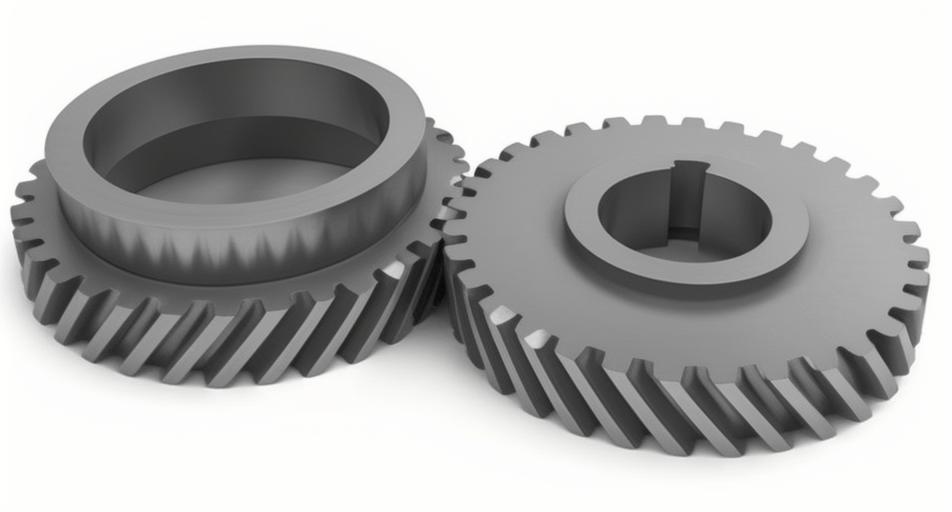
The defining feature of a helical gear is the helix angle \( \beta \), which imparts a twist to the teeth along the gear axis. This helix can be conceptualized as a line wrapped around a cylinder—the base cylinder of the gear. When unfolded, the helix forms a straight line on a plane, with its angle relative to the gear axis equal to \( \beta \). In cylindrical coordinates, points along the helix are given by:
$$ \text{Point K1: } (r_b, 0, 0) $$
$$ \text{Point K2: } \left( r_b, -\frac{b \tan \beta}{r_b} \cdot \frac{180}{\pi}, -b \right) $$
where \( b \) is the face width. In ANSYS, we define these points and use the VDRAG command to sweep the 2D tooth space profile along the helix, thereby generating a 3D tooth space solid. This sweep operation effectively creates the helical topology, ensuring the tooth surfaces are correctly inclined relative to the axis. The ability to parameterize \( \beta \) allows for quick generation of helical gears with varying helix angles, catering to different design requirements for noise reduction or load distribution.
To streamline the modeling process, we leverage APDL’s capabilities to create a fully parameterized system. This involves defining symbolic parameters for all key helical gear dimensions and linking them through mathematical relationships. A user-friendly interface is built using the MULTIPRO command, prompting users to input basic helical gear parameters. For example:
MULTIPRO, 'START', 5
*CSET, 1, 3, b1, 'Helix angle of the helical gear (degrees)', 10
*CSET, 4, 6, Mn, 'Normal module (mm)', 2
*CSET, 7, 9, Z, 'Number of teeth', 24
*CSET, 10, 12, an, 'Normal pressure angle (degrees)', 20
*CSET, 13, 15, B, 'Face width (mm)', 20
*CSET, 61, 62, 'Enter the parameters for helical gear modeling'
MULTIPRO, 'END'
Here, b1 represents the helix angle \( \beta \), Mn the normal module, Z the tooth count, an the normal pressure angle, and B the face width. Note that ANSYS does not natively support Greek letters in parameter names, so substitutes like ‘an’ for \( \alpha_n \) are used. Upon receiving these inputs, the APDL script computes derived dimensions automatically. The fundamental equations for a helical gear include:
$$ \text{Transverse pressure angle: } \alpha_t = \arctan\left( \frac{\tan \alpha_n}{\cos \beta} \right) $$
$$ \text{Pitch diameter: } D = \frac{Z \cdot M_n}{\cos \beta} $$
$$ \text{Base diameter: } D_b = D \cos \alpha_t $$
$$ \text{Addendum diameter: } D_a = D + 2 M_n h_{a}^* $$
$$ \text{Dedendum diameter: } D_f = D – 2 M_n (h_{a}^* + c^*) $$
where \( h_{a}^* \) is the addendum coefficient (typically 1) and \( c^* \) is the clearance coefficient (typically 0.25). These calculations ensure geometric consistency across different parameter sets. The following table summarizes key parameter relationships for helical gears:
| Parameter | Symbol | Formula | Description |
|---|---|---|---|
| Normal Module | \( M_n \) | Input | Basic size parameter in normal plane |
| Helix Angle | \( \beta \) | Input | Angle of tooth inclination |
| Number of Teeth | \( Z \) | Input | Count of teeth on the helical gear |
| Normal Pressure Angle | \( \alpha_n \) | Input | Pressure angle in normal plane |
| Transverse Pressure Angle | \( \alpha_t \) | \( \alpha_t = \arctan(\tan \alpha_n / \cos \beta) \) | Pressure angle in transverse plane |
| Pitch Diameter | \( D \) | \( D = Z M_n / \cos \beta \) | Diameter at pitch circle |
| Base Diameter | \( D_b \) | \( D_b = D \cos \alpha_t \) | Diameter of base circle |
| Face Width | \( b \) | Input | Axial length of the helical gear |
With parameters defined, the APDL script executes a sequence of operations to construct the helical gear. First, it generates the 2D tooth space profile on the transverse plane using the involute and过渡曲线 equations, adjusting for symmetry. Second, it creates the helical path based on the helix angle and face width. Third, it sweeps the profile along the path to produce a 3D tooth space solid. Fourth, it arrays this solid circumferentially using the VGEN command, replicating it \( Z \) times around the gear axis. Finally, it generates a cylindrical blank representing the gear body and performs a Boolean subtraction (VSBV) to cut out the tooth spaces, resulting in a complete helical gear model. This entire process is automated, ensuring that any change in input parameters—such as module, tooth count, or helix angle—triggers a full model update without manual intervention.
To illustrate the practicality of this parametric modeling approach for helical gears, consider an application example. Suppose we need to model a helical gear for a high-speed transmission system requiring low noise and high torque capacity. We define the parameters as follows:
| Parameter | Value | Unit |
|---|---|---|
| Helix Angle (\( \beta \)) | 15 | degrees |
| Normal Module (\( M_n \)) | 2.5 | mm |
| Number of Teeth (\( Z \)) | 30 | – |
| Normal Pressure Angle (\( \alpha_n \)) | 20 | degrees |
| Face Width (\( b \)) | 25 | mm |
| Addendum Coefficient (\( h_{a}^* \)) | 1 | – |
| Clearance Coefficient (\( c^* \)) | 0.25 | – |
Using these inputs, the APDL script computes the derived dimensions: \( \alpha_t \approx 20.647^\circ \), \( D \approx 77.645 \, \text{mm} \), \( D_b \approx 72.500 \, \text{mm} \), \( D_a \approx 82.645 \, \text{mm} \), and \( D_f \approx 71.395 \, \text{mm} \). The script then generates the 3D model within ANSYS, which can be used for subsequent finite element analysis. For instance, we can perform static stress analysis to evaluate tooth bending stresses under load, leveraging the parametric model to quickly iterate designs. The table below shows hypothetical FEA results for two helical gear variants with different helix angles, demonstrating how parameter changes affect performance:
| Helical Gear Variant | Helix Angle \( \beta \) (degrees) | Max Von Mises Stress (MPa) | Max Deformation (mm) | Model Generation Time (s) |
|---|---|---|---|---|
| Variant A | 10 | 285.3 | 0.0125 | 45 |
| Variant B | 20 | 271.8 | 0.0119 | 48 |
Such analyses underscore the value of parametric modeling in optimizing helical gear designs for specific applications. The integration of APDL allows for seamless transition from geometric modeling to simulation, reducing errors associated with file transfers between software. Moreover, the helical gear’s inherent advantages—like smoother engagement and higher load capacity—can be quantitatively assessed through these models, guiding engineers toward optimal configurations.
In addition to static analysis, the parametric helical gear model facilitates dynamic and vibrational studies. The helix angle influences meshing stiffness and contact patterns, which in turn affect noise and vibration levels. By adjusting parameters in the APDL script, we can explore a design space to minimize unwanted动态响应. For example, the contact ratio of a helical gear is higher than that of a spur gear, calculated as:
$$ \text{Contact Ratio} = \frac{\sqrt{R_{a1}^2 – R_{b1}^2} + \sqrt{R_{a2}^2 – R_{b2}^2} – C \sin \alpha_t}{p_{bt}} + \frac{b \tan \beta}{p_{bt}} $$
where \( R_a \) and \( R_b \) are addendum and base radii for the two meshing gears, \( C \) is the center distance, \( p_{bt} \) is the base pitch in the transverse plane, and the additional term accounts for the helical overlap. This increased contact ratio contributes to quieter operation, a key benefit of helical gears. Our parametric model can compute these metrics automatically, providing immediate feedback during design iterations.
The implementation also addresses manufacturing considerations. The transition curve modeled corresponds to standard cutting tools, ensuring the gear geometry is producible. Furthermore, the APDL script can be extended to include manufacturing parameters such as tool radius or profile shifts, enabling the creation of customized helical gears for non-standard applications. This flexibility is crucial in industries like aerospace or automotive, where tailored gear designs are common.
Despite its advantages, modeling helical gears in ANSYS via APDL requires careful attention to coordinate systems and geometric transformations. The script must manage multiple coordinate systems: global Cartesian for overall geometry, cylindrical for helical paths, and local planes for tooth profiles. Additionally, the sweeping operation for helical extrusion must ensure continuity and accuracy to avoid扭曲 artifacts. We have mitigated these issues by structuring the code into modular sections: one for parameter input, one for 2D profile generation, one for helix creation, and one for 3D solid operations. This modularity enhances maintainability and allows users to adapt the script for specific needs, such as adding crowning or modifications for静音 helical gears.
Looking ahead, the parametric modeling framework can be integrated with optimization algorithms within ANSYS to automate design improvements. For instance, using ANSYS DesignXplorer, we could define objectives like minimizing mass or maximizing fatigue life, with constraints on stress and deformation, and let the system vary parameters like helix angle, module, and face width. This would enable fully automated optimization of helical gears, harnessing the power of APDL for iterative design exploration. Such capabilities position this methodology as a forward-looking tool in the digital engineering landscape.
In conclusion, the use of APDL for parametric modeling of helical gears offers a powerful, accurate, and efficient alternative to traditional CAD-based approaches. By embedding the mathematical definitions of involute curves, transition profiles, and helical paths directly into ANSYS, we achieve a seamless workflow from design to analysis. The method supports full parameterization, allowing rapid prototyping and optimization of helical gear designs. Through detailed tables and formulas, we have outlined the theoretical underpinnings and practical steps, emphasizing the versatility of helical gears in transmission systems. This approach not only streamlines the modeling process but also enhances the reliability of subsequent finite element analyses, contributing to better-engineered机械 components. As industries continue to demand higher performance and customization, such parametric tools will become increasingly vital in the design and analysis of helical gears and other complex mechanical elements.