
In modern mechanical transmission systems, spiral bevel gears play a critical role due to their ability to transmit motion and power between intersecting or skew axes with high efficiency, smooth operation, and reduced noise. Among various types, logarithmic spiral bevel gears are particularly noteworthy because they maintain a constant helix angle along the tooth width, leading to uniform load distribution and enhanced performance. As an engineer focused on gear design and analysis, I have explored advanced modeling techniques to improve the accuracy and efficiency of designing these gears. This article presents a comprehensive parametric modeling method for logarithmic spiral bevel gears using CATIA software and VB macro commands, emphasizing mathematical derivations, implementation steps, and practical applications. The goal is to provide a robust foundation for finite element analysis, dynamic simulation, and modification studies of spiral bevel gears.
Spiral bevel gears are widely used in automotive, aerospace, and industrial machinery for their superior characteristics compared to straight bevel gears. The logarithmic spiral variant offers unique advantages: the helix angle is constant across the tooth face, which simplifies manufacturing processes and reduces stress concentrations. However, creating precise three-dimensional models of these gears is challenging due to their complex geometry. Traditional methods often rely on machining simulation or manual modeling, which can be time-consuming and error-prone. To address this, I have developed a parameter-driven approach that leverages CAD software capabilities, enabling rapid generation of accurate gear models for further engineering analysis.
The core of this modeling method lies in the mathematical representation of gear tooth profiles. For spiral bevel gears, the tooth flank is defined by a spherical involute curve, and the tooth trace follows a conical helix path. By deriving equations for these curves and integrating them into a CAD environment, I can automate the modeling process. This article details the derivations, the integration with CATIA via VB macros, and the step-by-step procedure to build a complete gear model. Throughout the discussion, I will highlight the importance of spiral bevel gears in transmission systems and how parametric modeling enhances their design lifecycle.
Mathematical Foundations of Logarithmic Spiral Bevel Gears
To model logarithmic spiral bevel gears accurately, it is essential to understand the underlying geometry. The tooth profile is based on a spherical involute, which is the trace of a point on a great circle rolling without slipping on a base cone. This differs from planar involutes, as it occurs on a spherical surface. Similarly, the tooth spiral is defined by a conical helix with a constant helix angle. Below, I derive the equations for both curves.
Spherical Involute Equation
Consider a base cone with apex at point P and base angle $\delta_b$. A great circle of radius r (equal to the cone distance) rolls on this cone, with its center coincident with P. In a coordinate system where the great circle plane is the XY-plane and its center is the origin, the initial contact point is A. As the circle rolls, point A traces a spherical involute curve to position K. Let $\psi$ be the generating angle of the small circle (related to the roll), and $\phi$ be the corresponding angle on the great circle, where $\phi = \psi \sin \delta_b$. The parametric equations for the spherical involute are derived through coordinate transformations as follows:
$$
x = r(\cos\psi \cos\phi \sin\delta_b + \sin\psi \sin\phi)
$$
$$
y = r(\sin\psi \cos\phi \sin\delta_b – \cos\psi \sin\phi)
$$
$$
z = r \cos\phi \cos\delta_b
$$
Here, $r$ is the cone distance, $\delta_b$ is the base cone angle, $\psi$ is the generating angle, and $\phi = \psi \sin\delta_b$. These equations describe the exact path of a point on the tooth profile in three-dimensional space. For practical modeling, I discretize this curve by sampling multiple $\psi$ values to generate points, which are then connected using spline curves in CAD software.
Conical Helix Equation
The tooth trace of logarithmic spiral bevel gears follows a conical helix, where the helix angle $\beta$ is constant along the tooth width. Based on the generalized definition of helix angle, which considers axial, radial, and tangential velocity components, I derive the equation for a conical helix. For a cone with apex half-angle $\alpha$, the radial distance $\rho$ from the axis is related to the axial coordinate $Z$ by $\rho(Z) = Z \tan \alpha$. The helix angle $\beta$ satisfies the differential equation:
$$
\cot \beta = \frac{Z’ \sqrt{1 + \tan^2 \alpha}}{Z \tan \alpha} = \frac{Z’}{Z \sin \alpha}
$$
where $Z’ = dZ/d\theta$ and $\theta$ is the angular parameter. Solving this equation yields the parametric form of the conical helix:
$$
x = Z_0 e^{(\sin \alpha \cot \beta) \theta} \sin \alpha \cos \beta
$$
$$
y = Z_0 e^{(\sin \alpha \cot \beta) \theta} \sin \alpha \sin \beta
$$
$$
z = Z_0 e^{(\sin \alpha \cot \beta) \theta} \cos \alpha
$$
Here, $Z_0$ is the initial axial coordinate, $\alpha$ is the cone apex half-angle, $\beta$ is the constant helix angle, and $\theta$ is the angular parameter. This equation ensures that the helix angle remains uniform, which is a key feature of logarithmic spiral bevel gears. These mathematical models form the basis for the parametric design of spiral bevel gears.
Parametric Modeling Approach Using CATIA and VB
To implement the above equations into a practical modeling tool, I use CATIA V5, a powerful CAD software, combined with VB (Visual Basic) macro commands for automation. CATIA provides robust surface and solid modeling capabilities, while VB macros enable parameter-driven design and customization. This approach allows for quick generation of spiral bevel gear models by inputting key parameters such as tooth number, module, pressure angle, and helix angle.
CATIA Secondary Development with VB Macros
CATIA supports several secondary development methods, including Automation API, Knowledge Ware, and CAA. I chose Automation API via VB macros due to its simplicity and effectiveness for parameterization. Through VB, I can control CATIA objects, create geometry, and automate repetitive tasks. I developed a user-friendly interface where users input gear parameters, and the macro generates the corresponding 3D model. This interface includes fields for gear pair data, as shown in the table below summarizing key parameters for spiral bevel gears.
| Parameter | Symbol | Description |
|---|---|---|
| Number of Teeth | $z$ | Count of teeth on the gear |
| Module (at Large End) | $m$ | Standard size parameter |
| Pressure Angle | $\alpha_n$ | Angle between tooth profile and tangent |
| Helix Angle | $\beta$ | Constant angle along tooth width |
| Spiral Direction | Left/Right | Handedness of the spiral |
| Cone Distance | $r$ | Distance from apex to pitch circle |
| Base Cone Angle | $\delta_b$ | Angle of base cone |
The VB macro reads these parameters and calculates derived dimensions, such as pitch diameter, face width, and cone angles. It then calls CATIA functions to create curves, surfaces, and solids. This parameterization ensures that any changes in input automatically update the gear model, saving time and reducing errors.
Step-by-Step Modeling Procedure
The modeling process involves three main steps: creating the tooth profile curve, generating the spiral path, and constructing the solid gear. I describe each step in detail below, emphasizing how the mathematical equations are integrated.
Step 1: Creating the Spherical Involute Tooth Profile
Using the spherical involute equations, I generate points on the curve by varying $\psi$ over a range (e.g., from 0 to $\pi/2$ with small increments). In VB, I write a loop to compute $(x, y, z)$ coordinates for each $\psi$ and then use CATIA’s HybridShapeSpline method to connect these points into a smooth curve. This approximates the exact spherical involute; with dense sampling, the error becomes negligible. The curve is created at the mid-point of the tooth width, representing the reference profile. Subsequently, I mirror and trim this curve to form a complete tooth shape, including addendum and dedendum sections based on gear geometry formulas.
Step 2: Generating the Conical Helix Path
Similarly, I use the conical helix equation to create the spiral path. By discretizing $\theta$, I compute points along the helix and create a spline in CATIA. This helix defines the tooth direction and ensures the constant helix angle property of logarithmic spiral bevel gears. The helix is oriented according to the cone geometry and spiral direction (left or right).
Step 3: Constructing the Solid Gear Model
With the tooth profile and helix path, I build the gear body through a series of CAD operations. First, I create a tooth slot by sweeping the tooth profile along the helix using multi-section surfaces. Then, I use commands like Join, CloseSurface, and Fill to form a closed volume for the tooth slot. This slot is then patterned circularly around the gear axis using the tooth number. Finally, I subtract the slot volumes from a blank cone (the gear blank) via Boolean operations to generate the complete gear. The process is summarized in the table below.
| Step | Action | CATIA Command/Function |
|---|---|---|
| 1 | Compute spherical involute points | VB macro with mathematical equations |
| 2 | Create spline curve from points | HybridShapeSpline |
| 3 | Generate conical helix points | VB macro with helix equation |
| 4 | Form tooth profile and helix path | Mirror, Trim |
| 5 | Sweep profile along helix | Multi-sections Surface |
| 6 | Create closed tooth slot volume | Join, Close Surface, Fill |
| 7 | Pattern slots around axis | Circular Pattern |
| 8 | Subtract slots from gear blank | Boolean Remove |
This method ensures an accurate and parameterized model of logarithmic spiral bevel gears. The entire process is automated, allowing for rapid iteration and design optimization.
Implementation and Results
I implemented the above approach in CATIA V5 using VB macros. The software interface prompts users to enter gear parameters, and upon execution, it generates the 3D model within minutes. For example, inputting a tooth number of 20, module of 4 mm, pressure angle of 20°, helix angle of 35°, and right-hand spiral direction produces a precise gear model. The model includes all geometric features, such as tooth flanks, fillets, and mounting surfaces, ready for simulation or manufacturing.
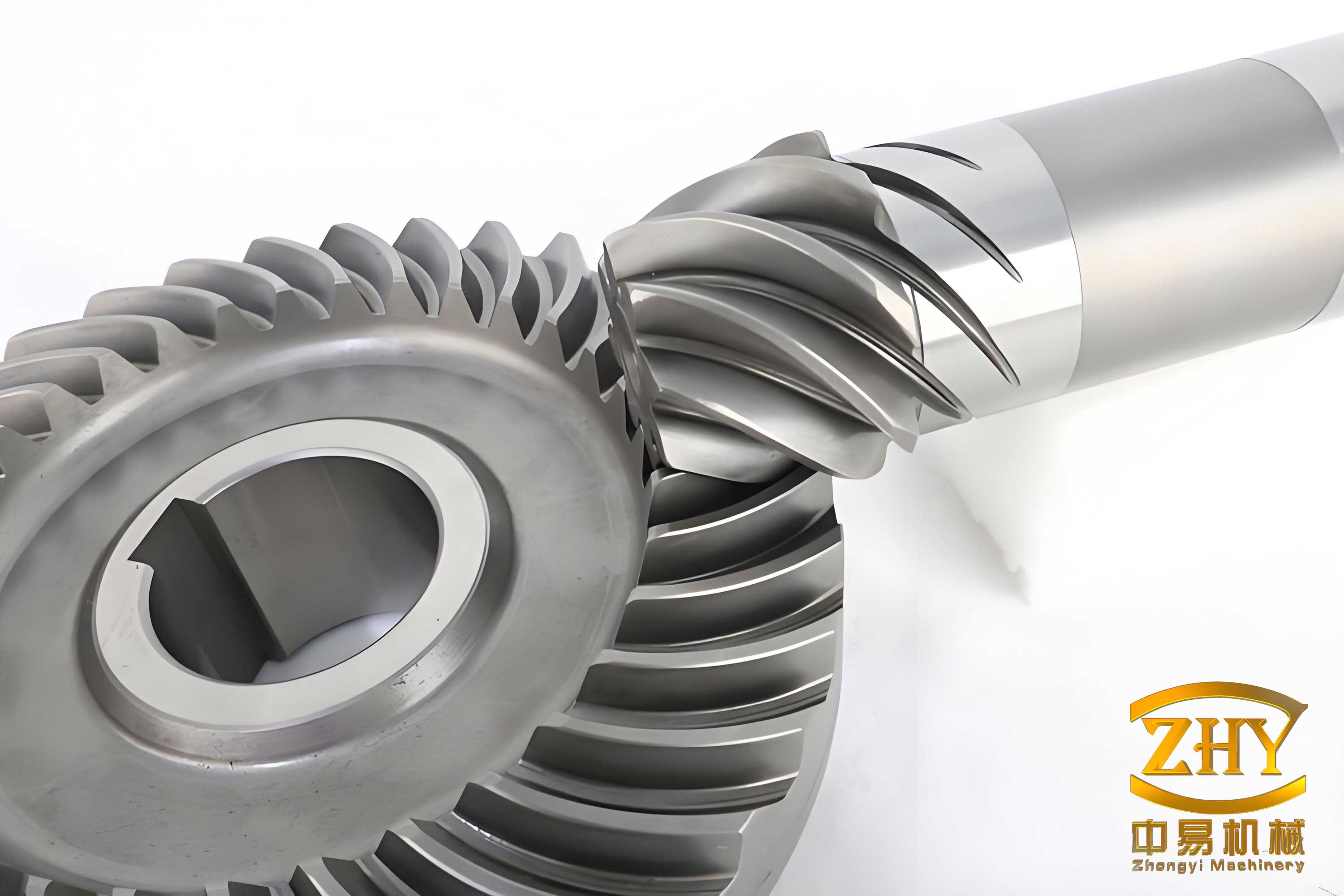
The image above shows an example of a spiral bevel gear model created using this parametric method. The gear exhibits smooth tooth surfaces and consistent spiral geometry, validating the accuracy of the mathematical equations and CAD operations. Such models are essential for advanced analyses, including finite element method (FEM) simulations to assess stress distribution and dynamic performance. Moreover, the parametric nature allows easy modification for design studies, such as investigating the effect of helix angle changes on gear behavior.
To further demonstrate the flexibility, I tested various configurations of spiral bevel gears, from small precision gears to large industrial ones. The table below compares different gear sets generated by the system, highlighting key dimensions and parameters.
| Gear Set | Teeth (Pinion/Gear) | Module (mm) | Helix Angle (°) | Cone Distance (mm) |
|---|---|---|---|---|
| Set A | 15/30 | 3.0 | 30 | 75.5 |
| Set B | 10/40 | 5.0 | 25 | 112.2 |
| Set C | 25/25 | 2.5 | 40 | 62.8 |
Each set was modeled successfully, proving the method’s robustness. The constant helix angle in all cases ensures uniform contact patterns, which is crucial for high-performance applications of spiral bevel gears.
Discussion
Parametric modeling of logarithmic spiral bevel gears offers significant advantages over traditional methods. First, it reduces design time by automating repetitive tasks, allowing engineers to focus on optimization and analysis. Second, the integration of mathematical equations ensures geometric accuracy, which is vital for simulation fidelity. Third, the use of CAD software like CATIA enables seamless transition from design to manufacturing, as models can be exported for CNC programming or 3D printing.
Compared to other modeling approaches, such as those based on machining simulation or generic CAD tools, this method provides a balance between precision and ease of use. For instance, machining-based methods require detailed cutter paths and machine settings, which can be complex for logarithmic spiral bevel gears. In contrast, our parametric approach directly uses gear geometry principles, making it accessible to designers without specialized manufacturing knowledge. Additionally, the VB macro framework allows customization for specific needs, such as adding crowning or profile modifications to enhance gear performance.
The constant helix angle of logarithmic spiral bevel gears contributes to their superior performance in transmission systems. By maintaining even load distribution, these gears minimize noise and vibration, extend service life, and improve efficiency. Parametric modeling facilitates the exploration of these benefits through virtual testing. For example, I can conduct finite element analysis to compare stress levels between logarithmic and traditional spiral bevel gears under the same operating conditions. Such studies inform design decisions and lead to more reliable gear systems.
Moreover, this modeling method supports educational and research initiatives. Students and researchers can quickly generate gear models for experiments or simulations, accelerating innovation in gear technology. The ability to parameterize key variables like helix angle or pressure angle enables systematic studies of their effects on gear dynamics, contact mechanics, and fatigue life.
Conclusion
In this article, I have presented a detailed parametric modeling method for logarithmic spiral bevel gears using CATIA and VB macros. The approach is grounded in rigorous mathematical derivations of spherical involute and conical helix equations, which define the gear tooth geometry. By automating curve generation and solid modeling through VB scripts, I have created a tool that efficiently produces accurate 3D models of spiral bevel gears. This method not only saves design time but also ensures consistency and precision, essential for high-performance applications.
The parametric models serve as a foundation for advanced engineering analyses, including finite element simulation, dynamic response evaluation, and design optimization. As spiral bevel gears continue to be critical components in various industries, such modeling techniques will play a key role in enhancing their design and performance. Future work may involve extending the method to include advanced features like tooth modifications, integration with optimization algorithms, or compatibility with other CAD systems. Overall, this contribution aims to advance the field of gear design and support the development of more efficient and reliable transmission systems.
Through this exploration, I have demonstrated how combining mathematical modeling with CAD automation can streamline the design process for complex mechanical components like spiral bevel gears. The constant helix angle characteristic of logarithmic spiral bevel gears is particularly beneficial, and parametric modeling allows designers to fully exploit this advantage. I encourage further research and application of these methods to drive innovation in gear technology and mechanical engineering as a whole.