
In the field of mechanical engineering, reducers are critical components that serve as transmission devices between prime movers and working machinery. They are designed to transmit power and increase torque, making them indispensable in a wide range of applications requiring mechanical传动. Traditional design methods often rely on fixed dimensions to describe part geometries, leading to inefficiencies when尺寸 changes necessitate complete redraws. This is particularly cumbersome for complex parts like spur and pinion gears, where the tooth profile generation process is intricate and time-consuming. To address these challenges, parametric design capabilities within CAD software, such as Pro/ENGINEER (Pro/E), offer a powerful solution. By allowing simple modifications to dimensions to generate new three-dimensional solid models, parametric modeling enhances the overall design process, enabling better consideration of product integrity, accelerating development cycles, and improving design efficiency and effectiveness. In this paper, I will详细阐述 the parametric modeling of an involute spur and pinion gear reducer, focusing on the齿轮 as the most complex element, while also covering other components and virtual assembly.
The core of any spur and pinion gear reducer lies in its齿轮 pairs. Parametric modeling of these gears begins with the definition of fundamental parameters that dictate their几何尺寸. For a standard involute spur gear, five basic parameters are essential: the number of teeth (z), module (m), pressure angle (α), addendum coefficient (ha*), and dedendum or clearance coefficient (c*). These parameters are interrelated through standard gear design equations. A summary is provided in Table 1.
| Parameter Name | Symbol | Typical Value/Expression |
|---|---|---|
| Number of Teeth | z | User-defined (e.g., 25 for pinion, 50 for gear) |
| Module | m | User-defined (e.g., 2 mm) |
| Pressure Angle | α | 20° (standard) |
| Addendum Coefficient | ha* | 1 (for standard full-depth teeth) |
| Clearance Coefficient | c* | 0.25 (for standard full-depth teeth) |
From these, key gear diameters can be calculated. The pitch diameter (d), addendum diameter (da), dedendum diameter (df), and base diameter (db) are given by:
$$ d = m \cdot z $$
$$ d_a = d + 2 \cdot h_a^* \cdot m $$
$$ d_f = d – 2 \cdot (h_a^* + c^*) \cdot m $$
$$ d_b = d \cdot \cos(\alpha) $$
where α is in radians for calculation. In Pro/E, these relationships are embedded as parameters and relations. The modeling process starts by sketching the four key circles (pitch, addendum, dedendum, and base circles) on a datum plane. Using the “Relation” function in Pro/E, each circle’s diameter dimension (e.g., D0, D1, etc.) is linked to the corresponding parameter (d, da, df, db). This establishes the parametric foundation; altering the basic parameters like module or tooth count automatically updates all related diameters.
The next critical step is generating the involute tooth profile. The involute curve is fundamental to the function of spur and pinion gears, ensuring smooth conjugate action. Its Cartesian parametric equations, based on the base circle, are implemented in Pro/E using the “Curve from Equation” tool. The equations are:
$$ r = \frac{d_b}{2 \cdot \cos(\delta)} $$
$$ \theta = t \cdot 60 $$
$$ x = r \cdot \cos(\theta) + r \cdot \sin(\theta) \cdot \theta \cdot \frac{\pi}{180} $$
$$ y = r \cdot \sin(\theta) + r \cdot \cos(\theta) \cdot \theta \cdot \frac{\pi}{180} $$
$$ z = 0 $$
Here, ‘t’ is a Pro/E system variable ranging from 0 to 1, and δ is an angle parameter often set to 0 for simplicity, making r = db/2. This defines one flank of a tooth. The curve is mirrored about the gear’s centerline to create the symmetric opposing flank. The tooth profile is then completed by tracing along the involute curves from the base circle to the addendum circle and connecting the root with a fillet radius, often approximated as 0.38*m. The generated profile for a single tooth is shown in the following visualization, which illustrates the precise involute form critical for the spur and pinion gear pair’s performance.
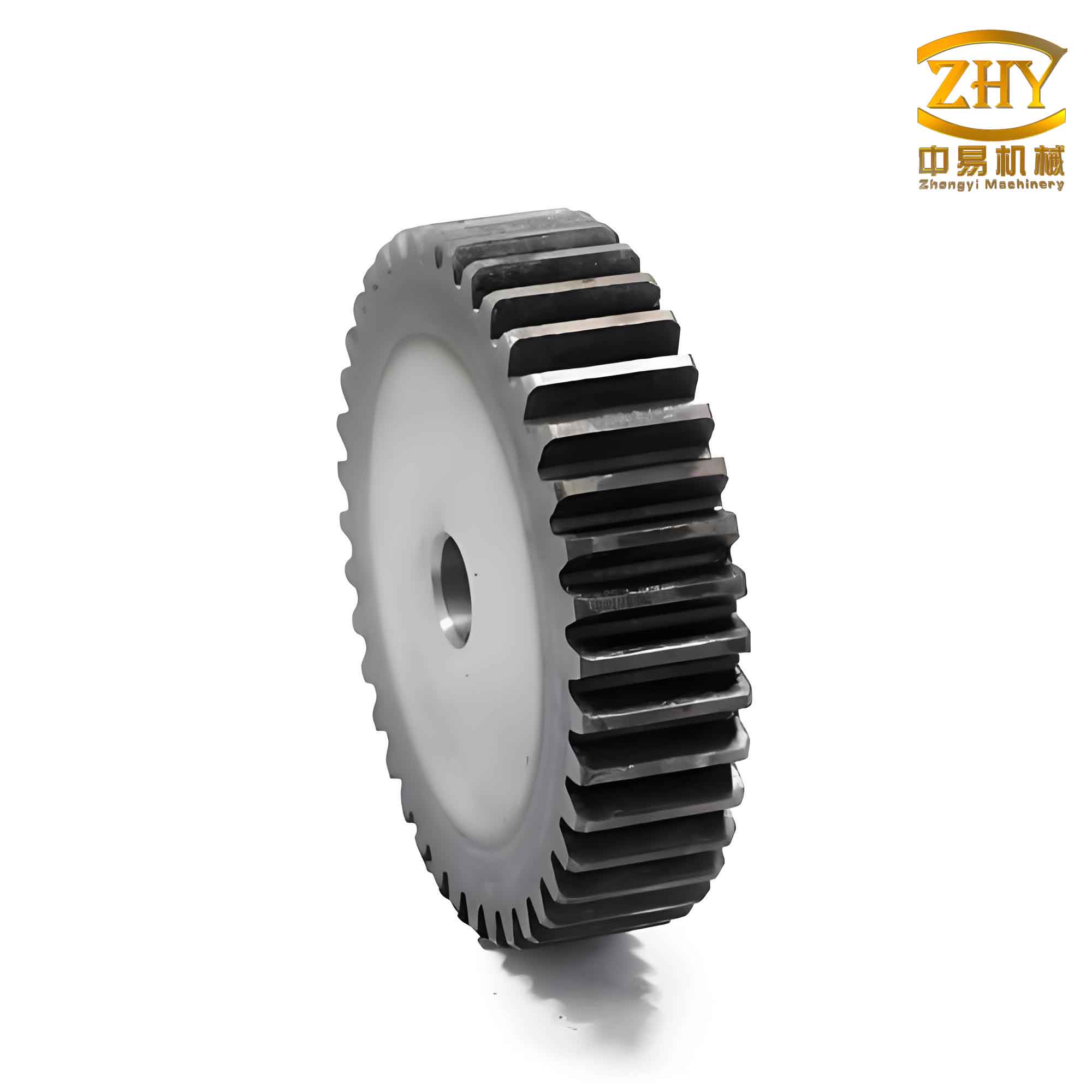
With a single tooth profile defined, the solid model of the complete spur or pinion gear is created through extrusion and pattern operations. The tooth profile sketch is extruded along the axis to the desired face width (b), typically b = 10*m. Subsequently, the “Pattern” feature is used with an axial pattern type. The number of instances equals the number of teeth (z), and the angular increment between teeth is $$ \Delta\theta = \frac{360^\circ}{z} $$. This generates the full set of teeth around the gear blank. The gear body, including the hub and web, can be added using rotational protrusions or extrusions. For a pinion gear, which is often integrated with a shaft, the modeling extends to create the shaft features directly, resulting in a pinion shaft component. The entire process is driven by parameters; modifying, for instance, the module from 2 mm to 3 mm and updating the tooth count will propagate changes through the relations, automatically regenerating a new valid spur or pinion gear model. This parametric flexibility is paramount for designing families of spur and pinion gear reducers with different reduction ratios.
To further illustrate the interdependencies in spur and pinion gear design, Table 2 summarizes the key geometric calculations derived from the basic parameters. These formulas are essential for setting up a robust parametric system.
| Geometric Feature | Symbol | Calculation Formula |
|---|---|---|
| Circular Pitch | p | $$ p = \pi \cdot m $$ |
| Base Pitch | pb | $$ p_b = p \cdot \cos(\alpha) $$ |
| Tooth Thickness on Pitch Circle | s | $$ s = \frac{p}{2} = \frac{\pi \cdot m}{2} $$ |
| Center Distance (for a pair) | a | $$ a = \frac{m \cdot (z_1 + z_2)}{2} $$ |
| Contact Ratio | ε | $$ \epsilon = \frac{\sqrt{d_{a1}^2 – d_{b1}^2} + \sqrt{d_{a2}^2 – d_{b2}^2} – a \cdot \sin(\alpha)}{p_b} $$ |
The contact ratio (ε) is a critical performance指标 for any spur and pinion gear mesh, indicating the average number of teeth in contact during operation. A higher contact ratio generally leads to smoother and quieter transmission. Parametric modeling allows for easy recalculation and optimization of this parameter by adjusting the basic gear data.
Beyond the spur and pinion gears themselves, the reducer housing or gearbox is a major component. The housing supports and locates the bearing assemblies for the gear shafts, maintains precise alignment of the meshing spur and pinion gears, and provides containment for lubricant. Its design must consider stiffness, weight, manufacturability, and cost. In Pro/E, housing components like the upper and lower casings are modeled using basic solid features such as “Extrude,” “Revolve,” “Rib,” and “Shell.” The process often begins with sketching the main profile and extruding it to create the base body. Features like mounting flanges, bearing housings, ribs for stiffness, and bolt holes are added sequentially. Since the housing dimensions are intrinsically linked to the gear center distance and overall envelope of the internal components, these can also be parameterized. For example, the distance between bearing bore centers can be set equal to the calculated center distance ‘a’ from Table 2. Wall thicknesses, rib patterns, and hole placements can be defined relative to key parameters, enabling the housing to adapt automatically when the spur and pinion gear sizes change.
Shafts, bearings, bolts, and seals constitute the remaining components. Shafts for spur gears or integrated pinion shafts are typically modeled by revolving a cross-sectional sketch that includes diameters for bearing seats, gear location, and shoulders. Rolling element bearings, though often used as standard parts from libraries, can be parametrically modeled for specific studies. A simplified bearing model involves revolving profiles for the inner and outer rings and using a spherical or cylindrical pattern to create the rolling elements. Bolts, nuts, and washers can be created using extruded profiles for heads and threaded sections, with thread features sometimes simplified for performance. The key in a parametric assembly is to define interface dimensions logically. For instance, the diameter of a shaft bearing seat should be linked to the inner diameter parameter of the bearing model, and the housing bore diameter linked to the bearing’s outer diameter.
The culmination of the component modeling phase is the virtual assembly. Pro/E provides a robust assembly module where components are brought together with constraints that define their spatial relationships. For a spur and pinion gear reducer, two primary connection philosophies exist: “constraint” and “joint.” Constraint-based assembly fully fixes all degrees of freedom between components, akin to a welded or glued connection. This is suitable for parts like housing halves bolted together. However, for kinematic analysis of the gear train, “joint” connections are preferred. They allow defined relative motion. For example, a shaft can be connected to the housing via a “pin” joint, permitting only rotation about its axis. The meshing of the spur and pinion gears themselves can be defined using a “gear” pair connection, which establishes a velocity ratio based on their tooth numbers. The assembly sequence typically starts with fixing the lower housing as the ground component. Then, bearings are assembled into their bores using constraints (e.g., insert and align). Shaft sub-assemblies (with gears pre-mounted) are placed using pin joints relative to the bearing inner rings. Finally, the upper housing is assembled and fastened. This virtual prototype allows for interference checking, clearance verification, and even basic motion analysis to ensure the spur and pinion gears mesh correctly without collision.
The advantages of this parametric approach are manifold. First, it dramatically accelerates the design iteration process. Exploring different reduction ratios for a spur and pinion gear reducer becomes a matter of changing a few parameters (z1, z2, m) and regenerating the entire assembly. Second, it enforces design consistency and reduces errors, as relationships ensure that dependent dimensions update correctly. Third, it facilitates the creation of product families. A single master model can spawn countless variants, each a valid design. Fourth, it seamlessly integrates with downstream processes like finite element analysis (FEA) and computational fluid dynamics (CFD) for stress, vibration, or thermal analysis of the spur and pinion gear system. The parametric model can be used to automate the generation of manufacturing drawings with updated dimensions, and it serves as the digital twin for the product lifecycle.
To delve deeper into the mathematical rigor behind the spur and pinion gear interaction, the fundamental law of gearing dictates that the common normal at the point of contact between two teeth must always pass through a fixed point on the line of centers, the pitch point. This ensures a constant velocity ratio. The involute curve satisfies this law perfectly. The transmission of force and torque can be analyzed using the following relationships. The tangential force (Ft) at the pitch circle is related to the transmitted torque (T) and pitch diameter (d):
$$ F_t = \frac{2T}{d} $$
This force acts along the line of action, which is tangent to the base circles of the mating spur and pinion gears. The radial force (Fr) and the resultant normal force (Fn) are given by:
$$ F_r = F_t \cdot \tan(\alpha) $$
$$ F_n = \frac{F_t}{\cos(\alpha)} $$
These force calculations are crucial for subsequent stress analysis on gear teeth (bending and contact stresses) and bearing selection. Parametric models can be extended to include these engineering calculations as part of the relations, providing instant feedback on performance metrics when design parameters change.
In terms of modeling efficiency, creating user-defined parameters and relations in Pro/E is straightforward. A typical parameter set for a spur and pinion gear pair in a reducer might look like this in a consolidated table within the software’s parameter editor:
| Parameter Name | Type | Value/Expression | Description |
|---|---|---|---|
| M | Real Number | 2.0 | Module (mm) |
| ALPHA | Real Number | 20.0 | Pressure Angle (deg) |
| HA_STAR | Real Number | 1.0 | Addendum Coefficient |
| C_STAR | Real Number | 0.25 | Clearance Coefficient |
| Z_PINION | Integer | 25 | Number of Teeth on Pinion |
| Z_GEAR | Integer | 50 | Number of Teeth on Spur Gear |
| FACE_WIDTH | Real Number | 10*M | Gear Face Width (mm) |
| D_PINION | Real Number | M*Z_PINION | Pitch Dia. of Pinion (mm) |
| D_GEAR | Real Number | M*Z_GEAR | Pitch Dia. of Spur Gear (mm) |
| CENTER_DIST | Real Number | (D_PINION + D_GEAR)/2 | Center Distance (mm) |
| HOUSING_WALL_THK | Real Number | 8.0 | Housing Wall Thickness (mm) |
These parameters control not only the gears but also related assembly features. For instance, the distance between two parallel axes in the housing sketch would be driven by the CENTER_DIST parameter. This holistic parameterization is the essence of top-down design, where critical design intent flows from a few master parameters down to the finest details of every component, ensuring the entire spur and pinion gear reducer assembly remains coherent and easily modifiable.
In conclusion, the parametric modeling of spur and pinion gear reducers using Pro/E represents a significant advancement over traditional drafting methods. It transforms the design process from a static, sequential activity into a dynamic, responsive one. By capturing design intent through parameters and relations, engineers can rapidly explore the design space, optimize performance characteristics like strength, weight, and efficiency, and generate accurate manufacturing data. The ability to perform virtual assembly and interference checking further reduces physical prototyping costs and time to market. As CAD software continues to evolve with more sophisticated simulation and optimization tools integrated, the value of a fully parameterized digital model of complex assemblies like spur and pinion gear reducers will only increase. Future work may involve linking these models directly with optimization algorithms to automatically find the best combination of module, tooth counts, and face width for given load and space constraints, or integrating them with additive manufacturing processes for creating custom gearboxes on demand. The methodology outlined here provides a solid foundation for efficient, reliable, and innovative design in the realm of power transmission systems centered on spur and pinion gears.