
In modern mechanical engineering, the design and manufacturing of spur and pinion gears play a critical role in various applications, from automotive transmissions to industrial machinery. As a mechanical engineer with extensive experience in CAD modeling, I have found that parameterization is key to enhancing design efficiency, especially for components like spur and pinion gears that share similar geometric structures but require frequent dimensional adjustments. This article delves into the process of establishing a parametric model for standard spur and pinion gears using Pro/ENGINEER (Pro/E) software, emphasizing the use of tables and formulas to summarize key concepts. The goal is to create a flexible model where modifications to parameters such as module, number of teeth, and width automatically regenerate the gear, saving time and reducing errors. Throughout this discussion, I will highlight the importance of spur and pinion gears in mechanical systems and demonstrate how parametric design can streamline their development.
The foundation of parametric modeling lies in defining feature parameters that drive the geometry of spur and pinion gears. In Pro/E, I typically start by setting up a parameter table that includes all essential variables. Below is a table summarizing the primary parameters used for a standard spur gear model, which can be easily adapted for pinion gears as well:
| Parameter | Symbol | Initial Value | Description |
|---|---|---|---|
| Module | m | 2 mm | Defines the size of the gear teeth, crucial for spur and pinion gear meshing. |
| Pressure Angle | ANGLE | 20° | Standard angle for gear tooth profiles, ensuring smooth operation in spur and pinion gear systems. |
| Number of Teeth | z | 25 | Determines the gear ratio and size, a key factor in spur and pinion gear design. |
| Face Width | B | 10 mm | Width of the gear along its axis, affecting strength and load capacity in spur and pinion gears. |
| Addendum Circle Diameter | d_a | Calculated | Outer diameter of the gear, derived from module and teeth count for spur and pinion gears. |
| Dedendum Circle Diameter | d_f | Calculated | Root diameter of the gear, essential for tooth strength in spur and pinion gears. |
| Base Circle Diameter | d_b | Calculated | Foundation for the involute curve, critical in spur and pinion gear geometry. |
| Pitch Circle Diameter | d | Calculated | Reference diameter for gear meshing, central to spur and pinion gear functionality. |
| Keyway Width | W | User-defined | Width of the key slot for mounting, often customized in spur and pinion gear applications. |
| Bore Diameter | K1 | User-defined | Inner diameter for shaft fitting, common in spur and pinion gear assemblies. |
These parameters are interlinked through mathematical relationships, which I define using Pro/E’s relation tool. For instance, the addendum circle diameter for a spur gear is calculated as $$d_a = m \cdot (z + 2)$$, while the dedendum circle diameter is $$d_f = m \cdot (z – 2.5)$$. The pitch circle diameter, vital for spur and pinion gear meshing, is given by $$d = m \cdot z$$. The base circle diameter, which underpins the involute tooth profile, is derived from the pressure angle: $$d_b = d \cdot \cos(\text{ANGLE})$$, where ANGLE is typically 20° for standard spur and pinion gears. By establishing these formulas as relations in Pro/E, any change to a primary parameter like module or tooth count automatically updates all dependent dimensions, ensuring consistency in the spur and pinion gear model.
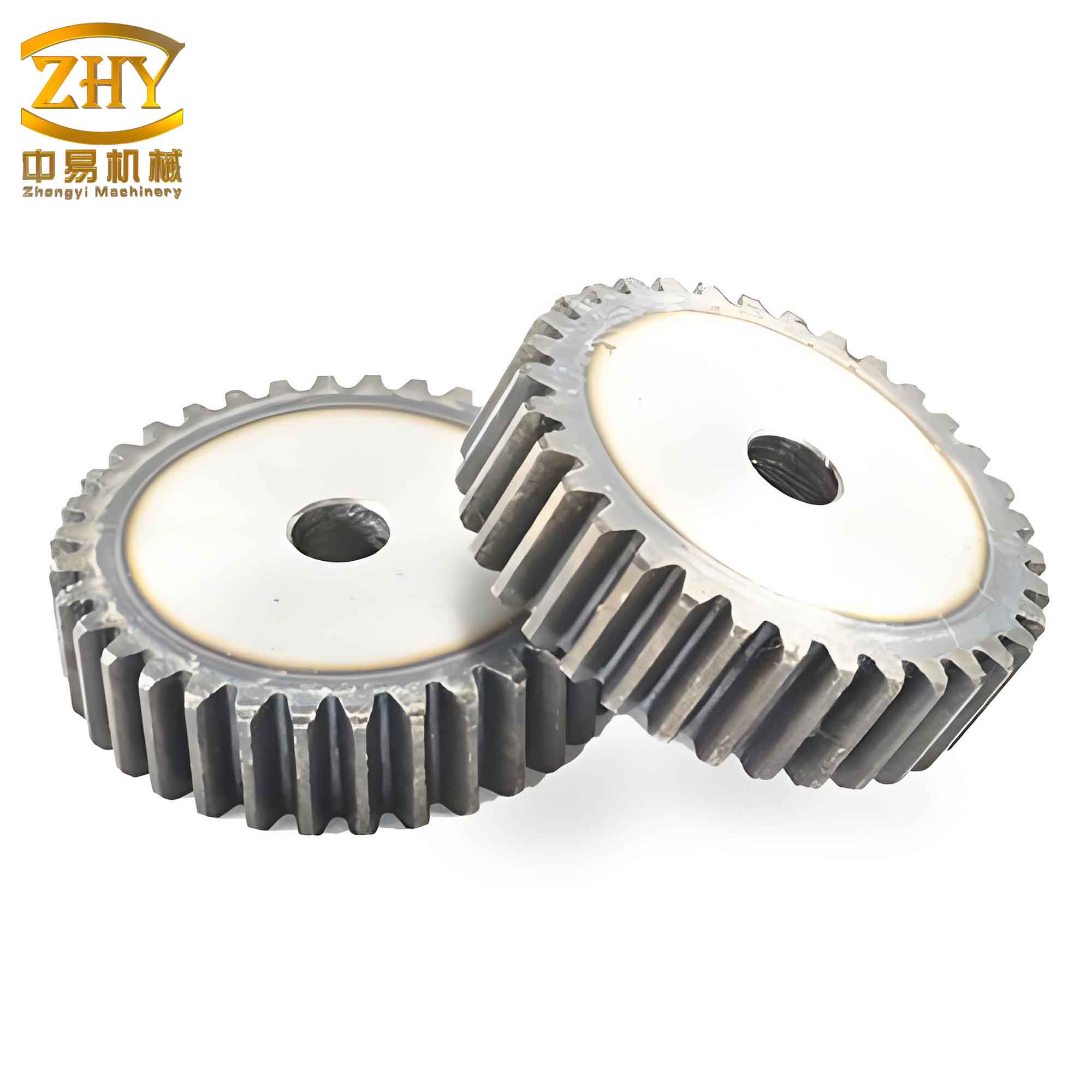
To visualize a typical spur and pinion gear setup, which often involves multiple gears in transmission systems, I find it helpful to incorporate imagery. Below is an example that illustrates the meshing of spur and pinion gears, highlighting their straight teeth and parallel axes:
The core of parametric modeling for spur and pinion gears involves creating the tooth profile using an involute curve. In Pro/E, I use a Cartesian coordinate system to define this curve with the following parametric equations, which are essential for accurate spur and pinion gear design:
$$x = r_b \cdot \cos(\theta) + r_b \cdot \sin(\theta) \cdot \theta \cdot \frac{\pi}{180}$$
$$y = r_b \cdot \sin(\theta) – r_b \cdot \cos(\theta) \cdot \theta \cdot \frac{\pi}{180}$$
$$z = 0$$
Here, $$r_b = \frac{d_b}{2}$$ is the base circle radius, and $$\theta$$ ranges from 0 to 90 degrees, representing the angular parameter. This curve forms the basis for generating tooth surfaces in spur and pinion gears. I then extrude this curve to create a surface with a thickness equal to the face width B, and through operations like mirroring, rotating, and patterning, I develop a complete gear tooth. For a spur gear with z teeth, the angular spacing between teeth is $$\frac{360^\circ}{z}$$, which I use in Pro/E’s pattern feature to array the tooth surfaces around the gear axis. This process ensures that the spur and pinion gear model is fully parametric, as changes to z automatically adjust the tooth count and spacing.
In addition to the tooth profile, I incorporate features like holes and keyways into the spur and pinion gear model. These are also driven by parameters such as K1 for bore diameter and W for keyway width. For example, the bore diameter might be set based on shaft requirements, with a relation like $$K1 = 0.3 \cdot d$$ for standard spur and pinion gears. The keyway depth S can be defined as $$S = 0.5 \cdot W$$ to maintain proportions. By linking these to the main parameters, the entire gear model updates cohesively. Below is a table summarizing common secondary parameters and their relationships for spur and pinion gears:
| Feature | Parameter | Typical Relation | Purpose in Spur and Pinion Gears |
|---|---|---|---|
| Bore Hole | K1 | $$K1 = m \cdot (z / 4)$$ | Provides mounting for shafts in spur and pinion gear assemblies. |
| Keyway Width | W | $$W = 0.25 \cdot m$$ | Ensures secure torque transmission in spur and pinion gear systems. |
| Keyway Depth | S | $$S = 0.5 \cdot W$$ | Enhances structural integrity for spur and pinion gears under load. |
| Flange Thickness | T_f | $$T_f = 0.1 \cdot B$$ | Supports additional components in complex spur and pinion gear setups. |
Once the basic model is established, I leverage Pro/Program for secondary development to enable dynamic parameter modifications. This tool allows me to embed logic into the Pro/E model, so users can input new values and regenerate the spur and pinion gear automatically. For instance, I add an INPUT section in the program that prompts for key parameters. A simplified code snippet might look like this:
INPUT
  m NUMBER "Enter the module for the spur and pinion gear:"
  z NUMBER "Enter the number of teeth for the spur and pinion gear:"
  B NUMBER "Enter the face width for the spur and pinion gear:"
END INPUT
When these values are changed—say, setting m=3, z=30, and B=15—Pro/E recalculates all related dimensions using the predefined relations, producing an updated spur and pinion gear model. This approach is particularly useful for designing families of spur and pinion gears, where slight variations are needed for different applications. To illustrate the impact of parameter changes, consider the following table showing how different module values affect gear dimensions for a spur and pinion gear with z=25:
| Module (m) in mm | Pitch Diameter (d) in mm | Addendum Diameter (d_a) in mm | Dedendum Diameter (d_f) in mm | Application in Spur and Pinion Gears |
|---|---|---|---|---|
| 2 | 50 | 54 | 45 | Light-duty spur and pinion gear systems. |
| 3 | 75 | 81 | 67.5 | Medium-duty spur and pinion gear transmissions. |
| 4 | 100 | 108 | 90 | Heavy-duty spur and pinion gear machinery. |
The parametric model also facilitates advanced analyses, such as finite element analysis (FEA) and motion simulation, for spur and pinion gears. By exporting the model to simulation software, I can evaluate stress distributions and kinematic behavior under various loads. For example, the bending stress on a spur gear tooth can be approximated using the Lewis formula: $$\sigma = \frac{F_t}{b \cdot m \cdot Y}$$, where $$F_t$$ is the tangential force, b is the face width, m is the module, and Y is the Lewis form factor for spur and pinion gears. This formula highlights how parameter changes—like increasing m or B—can reduce stress, optimizing the spur and pinion gear for durability. Additionally, the contact stress between meshing spur and pinion gears is given by the Hertzian contact formula: $$\sigma_c = \sqrt{\frac{F_t \cdot E^*}{\pi \cdot b \cdot \rho}}$$, where $$E^*$$ is the effective modulus and $$\rho$$ is the relative curvature radius. These equations underscore the importance of parametric tuning in spur and pinion gear design to prevent failure and enhance performance.
In practice, the design of spur and pinion gears often involves iterative optimization. With a parametric model, I can quickly explore design alternatives by adjusting parameters and observing outcomes. For instance, to minimize weight while maintaining strength, I might define an objective function for a spur gear as $$W_{\text{gear}} = \rho_{\text{material}} \cdot V$$, where V is the volume calculated from parameters like d_a, B, and bore size. Using Pro/E’s relations, I can link this to cost or performance metrics, enabling automated design sweeps. This iterative process is crucial for developing efficient spur and pinion gear systems in applications like automotive differentials or industrial conveyors, where space and weight constraints are tight. Moreover, the parametric approach supports standardization; by creating a library of spur and pinion gear models with predefined parameters, companies can accelerate product development and ensure consistency across projects.
Another advantage of parametric modeling for spur and pinion gears is its integration with manufacturing processes. Once the design is finalized, the model can drive CNC machining or 3D printing directly. For example, the tooth profile coordinates derived from the involute equations can be exported to G-code for milling spur and pinion gears. The parametric relations ensure that any design change automatically updates the manufacturing instructions, reducing lead times. In additive manufacturing, parameters like tooth thickness and root fillets can be optimized for material usage, using formulas such as $$t = \pi \cdot m / 2$$ for the circular tooth thickness of a spur gear. This seamless flow from design to production highlights the value of parametric methods in modern spur and pinion gear fabrication.
To further illustrate the versatility of parametric spur and pinion gear models, consider a case study involving a gear pair for a power transmission system. Suppose we have a spur gear (driver) and a pinion gear (driven) with a speed ratio of 3:1. Using the parametric model, I can set the number of teeth for the spur gear as $$z_1 = 30$$ and for the pinion as $$z_2 = 10$$, with a common module m=2.5 mm. The center distance a between the spur and pinion gears is calculated as $$a = \frac{m \cdot (z_1 + z_2)}{2} = 50 \text{ mm}$$. By adjusting these parameters in Pro/E, I can regenerate both gears simultaneously, ensuring proper meshing. The table below summarizes key dimensions for this spur and pinion gear pair:
| Gear Type | Number of Teeth (z) | Pitch Diameter (d) in mm | Face Width (B) in mm | Role in Spur and Pinion Gear System |
|---|---|---|---|---|
| Spur Gear | 30 | 75 | 15 | Driver gear, transmitting motion in the spur and pinion gear assembly. |
| Pinion Gear | 10 | 25 | 15 | Driven gear, reducing speed in the spur and pinion gear mechanism. |
This example demonstrates how parametric models enable rapid prototyping and testing of spur and pinion gear configurations, which is essential for optimizing performance in real-world applications. Additionally, by incorporating tolerance parameters, such as backlash defined as $$b_l = 0.04 \cdot m + 0.01 \text{ mm}$$ for spur and pinion gears, the model can simulate manufacturing variations and ensure reliable operation.
In conclusion, parametric modeling of spur and pinion gears using Pro/E offers a powerful approach to design automation and optimization. By setting feature parameters, defining mathematical relations, and utilizing secondary development tools like Pro/Program, engineers can create flexible models that adapt to changing requirements. The extensive use of formulas, such as those for involute curves and gear geometry, ensures accuracy, while tables summarize key data for quick reference. As mechanical systems evolve, the ability to quickly modify spur and pinion gear designs will remain crucial for innovation and efficiency. I encourage fellow engineers to embrace parametric methods to enhance their spur and pinion gear projects, leveraging the integration with analysis and manufacturing tools for end-to-end solutions. Ultimately, this methodology not only speeds up development but also improves the reliability and performance of spur and pinion gears across diverse industries.