
In this study, I investigate the parametric vibration characteristics of a multi-degree-of-freedom straight spur gear system. The gear pair is subjected to time-varying mesh stiffness, support stiffness and damping from shafts, bearings, and housing, transmission error, and a nonlinear input torque that depends on the square of the rotational speed. I establish a four-degree-of-freedom dynamic model that captures both torsional and translational vibrations. By transforming the equations into modal coordinates and applying the method of multiple scales, I derive the stability criteria for principal and subharmonic parametric resonances. The analytical stability boundaries are then compared with numerical simulations using the Runge-Kutta method. The results reveal that when the mesh frequency approaches the sum-type combination frequency, unbounded parametric resonance occurs. In contrast, difference-type resonances remain stable. The steady-state responses in non-parametric resonance regions are quasi-periodic, containing multiple combination frequency components such as those involving the mesh frequency and the natural frequencies. The findings provide important insights for avoiding unstable vibrations in straight spur gear drive systems.
1. Dynamic Model of Straight Spur Gear Pair
I consider a typical straight spur gear pair as shown schematically in Figure below. The model includes four degrees of freedom: the rotational displacements of the pinion and gear, \(\theta_p\) and \(\theta_g\), and the vertical translational displacements of their centers, \(y_p\) and \(y_g\). The pinion and gear have base radii \(R_p\) and \(R_g\), moments of inertia \(I_p\) and \(I_g\), masses \(m_p\) and \(m_g\), support damping coefficients \(c_{py}, c_{gy}\), and support stiffnesses \(k_{py}, k_{gy}\). The mesh interface is characterized by a time-varying mesh stiffness \(k_m(t)\), a constant mesh damping \(c_m\), and a periodic transmission error \(e(t)\). The input torque \(T_p\) is assumed to be proportional to the square of the rotational speed, which is a typical nonlinearity in wind turbine gearboxes. The output torque \(T_g\) is taken as constant.
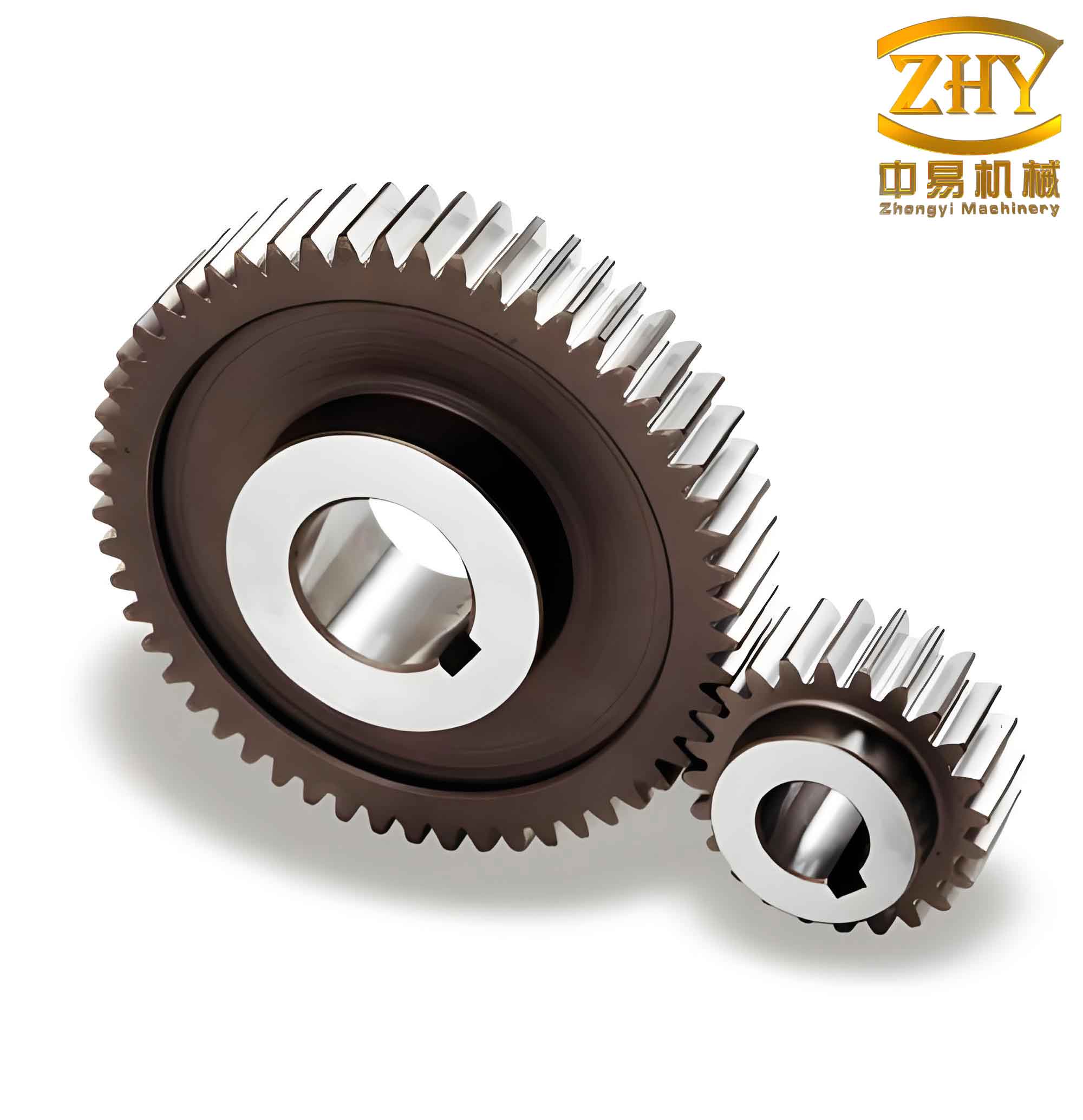
Note: The figure above illustrates the straight spur gear pair and the coordinate system used in this work.
1.1 Equations of Motion
Using Newton’s second law, the equations of motion for the straight spur gear system are written as:
\[
\begin{aligned}
m_p \ddot{y}_p + c_{py} \dot{y}_p + k_{py} y_p &= -F_k – F_c, \\
I_p \ddot{\theta}_p &= -F_k R_p – F_c R_p – T_p, \\
m_g \ddot{y}_g + c_{gy} \dot{y}_g + k_{gy} y_g &= F_k + F_c, \\
I_g \ddot{\theta}_g &= -F_k R_g – F_c R_g – T_g,
\end{aligned}
\tag{1}
\]
where the elastic mesh force \(F_k\) and viscous mesh force \(F_c\) are given by:
\[
\begin{aligned}
F_k &= k_m(t) \left( y_p + R_p \theta_p – y_g + R_g \theta_g – e(t) \right), \\
F_c &= c_m \left( \dot{y}_p + R_p \dot{\theta}_p – \dot{y}_g + R_g \dot{\theta}_g – \dot{e}(t) \right).
\end{aligned}
\tag{2}
\]
I express Eq. (1) in matrix form:
\[
\mathbf{M} \ddot{\mathbf{q}} + \mathbf{C} \dot{\mathbf{q}} + \mathbf{K}(t) \mathbf{q} = \mathbf{F}(t),
\tag{3}
\]
where \(\mathbf{q} = [y_p, \theta_p, y_g, \theta_g]^T\) is the displacement vector.
1.2 Time-Varying Mesh Stiffness, Transmission Error, and Nonlinear Input Torque
The mesh stiffness of the straight spur gear varies periodically as a rectangular wave due to the alternation between single- and double-tooth contact zones. I approximate it as:
\[
k_m(t) = k_0 + k_v(t), \qquad k_v(t) = \sum_{n=1}^{\infty} A_n \cos(n \Omega t),
\tag{4}
\]
where \(\Omega = 2\pi/T\) is the mesh frequency, and \(A_n\) are Fourier coefficients. In this work I retain the first two harmonics for analytical convenience.
The transmission error is modeled as a sinusoidal function:
\[
e(t) = e_r \sin(\Omega t + \varphi),
\tag{5}
\]
with amplitude \(e_r\) and phase \(\varphi\). For the wind turbine application, the input torque is nonlinear:
\[
T_p = \frac{1}{2} \rho C_{T,\max} R^3 \frac{\dot{\theta}_p^2}{\lambda_{\text{opt}}^2},
\tag{6}
\]
where \(\rho\) is air density, \(C_{T,\max}\) is the maximum torque coefficient, \(R\) is the rotor radius, and \(\lambda_{\text{opt}}\) is the optimal tip-speed ratio. The square term introduces quadratic nonlinearity into the system.
1.3 Nondimensionalization
To simplify the analysis, I introduce a time scale \(\tau = \omega_1 t\), where \(\omega_1\) is the natural frequency of the pinion translational mode, and a displacement scale \(\eta = y / e_r\). The nondimensional equations become:
\[
\ddot{\boldsymbol{\eta}} + \mathbf{C} \dot{\boldsymbol{\eta}} + \left( \mathbf{K}_0 + \Delta \mathbf{K}(t) \right) \boldsymbol{\eta} = \mathbf{F}_{\text{nd}},
\tag{7}
\]
where \(\boldsymbol{\eta} = [\eta_p, \theta_p, \eta_g, \theta_g]^T\) (note: \(\theta\) already dimensionless), \(\mathbf{K}_0\) is the constant part of the stiffness matrix, \(\Delta \mathbf{K}(t)\) contains the time‑varying part, and \(\mathbf{F}_{\text{nd}}\) includes the nonlinear torque and transmission error excitations. The explicit forms of these matrices are presented in Table 1.
Table 1. Nondimensional matrices and vectors for the straight spur gear system
| Symbol | Expression |
|---|---|
| \(\mathbf{M}\) | \(\text{diag}(1,1,1,1)\) |
| \(\mathbf{C}\) | \(\begin{bmatrix} \frac{c_{py}+c_m}{m_p\omega_1} & \frac{c_m R_p}{m_p\omega_1} & -\frac{c_m}{m_p\omega_1} & \frac{c_m R_g}{m_p\omega_1} \\ \frac{c_m R_p}{I_p\omega_1} & \frac{c_m R_p^2}{I_p\omega_1} & -\frac{c_m R_p}{I_p\omega_1} & \frac{c_m R_p R_g}{I_p\omega_1} \\ -\frac{c_m}{m_g\omega_1} & -\frac{c_m R_p}{m_g\omega_1} & \frac{c_{gy}+c_m}{m_g\omega_1} & -\frac{c_m R_g}{m_g\omega_1} \\ \frac{c_m R_g}{I_g\omega_1} & \frac{c_m R_p R_g}{I_g\omega_1} & -\frac{c_m R_g}{I_g\omega_1} & \frac{c_m R_g^2}{I_g\omega_1} \end{bmatrix}\) |
| \(\mathbf{K}_0\) | \(\begin{bmatrix} \frac{k_{py}+k_0}{m_p\omega_1^2} & \frac{k_0 R_p}{m_p\omega_1^2} & -\frac{k_0}{m_p\omega_1^2} & \frac{k_0 R_g}{m_p\omega_1^2} \\ \frac{k_0 R_p}{I_p\omega_1^2} & \frac{k_0 R_p^2}{I_p\omega_1^2} & -\frac{k_0 R_p}{I_p\omega_1^2} & \frac{k_0 R_p R_g}{I_p\omega_1^2} \\ -\frac{k_0}{m_g\omega_1^2} & -\frac{k_0 R_p}{m_g\omega_1^2} & \frac{k_{gy}+k_0}{m_g\omega_1^2} & -\frac{k_0 R_g}{m_g\omega_1^2} \\ \frac{k_0 R_g}{I_g\omega_1^2} & \frac{k_0 R_p R_g}{I_g\omega_1^2} & -\frac{k_0 R_g}{I_g\omega_1^2} & \frac{k_0 R_g^2}{I_g\omega_1^2} \end{bmatrix}\) |
| \(\Delta\mathbf{K}(t)\) | Same as \(\mathbf{K}_0\) with \(k_0\) replaced by \(k_v(t)\) |
| \(\mathbf{F}_{\text{nd}}\) | \( \begin{bmatrix} \frac{c_m \dot{e} + k_m e}{m_p \omega_1 e_r} + \frac{T_p}{m_p \omega_1^2 e_r} \\ \frac{R_p(c_m \dot{e} + k_m e)}{I_p \omega_1 e_r} \\ -\frac{c_m \dot{e} + k_m e}{m_g \omega_1 e_r} \\ -\frac{R_g(c_m \dot{e} + k_m e)}{I_g \omega_1 e_r} – \frac{T_g}{I_g \omega_1^2} \end{bmatrix}\) |
2. Dynamics Stability of the Straight Spur Gear System
I first study the stability of the homogeneous linear part of Eq. (7) since the stability of the parametric excitation system is determined by its corresponding linearized equation. Neglecting the excitation and nonlinear terms gives:
\[
\ddot{\boldsymbol{\eta}} + \mathbf{C} \dot{\boldsymbol{\eta}} + \left( \mathbf{K}_0 + \Delta \mathbf{K}(t) \right) \boldsymbol{\eta} = \mathbf{0}.
\tag{8}
\]
2.1 Modal Decoupling
The undamped natural frequencies \(\omega_i\) and mode shapes \(\boldsymbol{\zeta}_i\) of the straight spur gear system are obtained from:
\[
\left( \mathbf{K}_0 – \omega_i^2 \mathbf{M} \right) \boldsymbol{\zeta}_i = \mathbf{0}, \quad i=1,\dots,4.
\tag{9}
\]
I compute the normalized modal matrix \(\boldsymbol{\Phi}\) and introduce the modal coordinate transformation \(\boldsymbol{\eta} = \boldsymbol{\Phi} \mathbf{x}\). Substituting into Eq. (8) and premultiplying by \(\boldsymbol{\Phi}^T\) yields the modal equations:
\[
\ddot{\mathbf{x}} + \mathbf{C}_n \dot{\mathbf{x}} + \left( \boldsymbol{\Omega}^2 + \sum_{n} \mathbf{H}_n \cos(n\Omega t) \right) \mathbf{x} = \mathbf{0},
\tag{10}
\]
where \(\boldsymbol{\Omega}^2 = \text{diag}(\omega_1^2, \omega_2^2, \omega_3^2, \omega_4^2)\), \(\mathbf{C}_n = \boldsymbol{\Phi}^T \mathbf{C} \boldsymbol{\Phi}\), and \(\mathbf{H}_n = \boldsymbol{\Phi}^T \Delta \mathbf{K}_n \boldsymbol{\Phi}\). Retaining the first two harmonics, I write the \(i\)-th modal equation as:
\[
\ddot{x}_i + \omega_i^2 x_i + \varepsilon \left[ \sum_{r=1}^4 H_{1,ir} \cos(\Omega t) x_r + H_{2,ir} \cos(2\Omega t) x_r + \sum_{r=1}^4 C_{n,ir} \dot{x}_r \right] = 0,
\tag{11}
\]
where \(\varepsilon\) is a small bookkeeping parameter indicating that the periodic terms and damping are small.
2.2 Stability Analysis Using the Method of Multiple Scales
I apply the method of multiple scales to analyze parametric instability. Letting \(T_0 = t\) and \(T_1 = \varepsilon t\), the solution is expanded as:
\[
x_i(t) = x_{i0}(T_0, T_1) + \varepsilon x_{i1}(T_0, T_1) + \cdots.
\tag{12}
\]
Substituting into Eq. (11) and equating coefficients of \(\varepsilon^0\) and \(\varepsilon^1\) yields:
\[
\begin{aligned}
D_0^2 x_{i0} + \omega_i^2 x_{i0} &= 0, \\
D_0^2 x_{i1} + \omega_i^2 x_{i1} &= -2 D_0 D_1 x_{i0} – \sum_{r} \left[ H_{1,ir} \cos(\Omega T_0) x_{r0} + H_{2,ir} \cos(2\Omega T_0) x_{r0} \right] – \sum_{r} C_{n,ir} D_0 x_{r0}.
\end{aligned}
\tag{13}
\]
The zeroth-order solution is \(x_{i0} = A_i(T_1) e^{i\omega_i T_0} + cc\). Secular terms appear in the first-order equation when the mesh frequency \(\Omega\) satisfies certain combinations of the natural frequencies. The most critical case for straight spur gears is the sum-type combination resonance:
\[
\Omega = \omega_i + \omega_j + \varepsilon \sigma,
\tag{14}
\]
where \(\sigma\) is a detuning parameter. Substituting this condition into the solvability equations leads to the amplitude equations:
\[
\begin{aligned}
2 i \omega_i A_i’ + H_{1,ij} e^{i\sigma T_1} \bar{A}_j &= 0, \\
2 i \omega_j A_j’ + H_{1,ji} e^{i\sigma T_1} \bar{A}_i &= 0.
\end{aligned}
\tag{15}
\]
Writing \(A_i = a_i e^{\lambda T_1}\) and \(A_j = a_j e^{(\lambda – \sigma) T_1}\) and requiring nontrivial solutions gives the characteristic equation:
\[
\lambda^2 + \sigma \lambda + \left( \frac{\sigma^2}{4} – \frac{H_{1,ij} H_{1,ji}}{4 \omega_i \omega_j} \right) = 0.
\tag{16}
\]
The instability condition corresponds to \(\lambda\) having a positive real part. Therefore, the system is unstable when:
\[
\sigma^2 < \frac{H_{1,ij} H_{1,ji}}{\omega_i \omega_j}.
\tag{17}
\]
Similarly, for the subharmonic case \(l=2\) (\(\Omega \approx 2\omega_i\)), I obtain the stability condition:
\[
\sigma^2 < \frac{H_{2,ii}^2}{4 \omega_i^2}.
\tag{18}
\]
2.3 Stability Boundaries
I compute the natural frequencies and modal coupling coefficients for a representative straight spur gear set. The results are listed in Table 2.
Table 2. Natural frequencies and modal coupling terms for the straight spur gear system
| Natural frequency (Hz) | \(\omega_1 = 0.1533\) | \(\omega_2 = 1.1871\) | \(\omega_3 = 1.2892\) | \(\omega_4 = 2.4651\) |
|---|---|---|---|---|
| \(H_{1,ir}\) | 0.014, 0.6676, 0.4785, −0.8665 | 0.0111, 1.0675, 1.1462, 0.02 | 0.0068, 0.9719, 1.2653, 1.4223 | −0.0033, 0.0045, 0.3888, 3.6047 |
| \(H_{2,ir}\) | 0.0076, 0.3336, 0.2043, −0.7115 | 0.0055, 0.5981, 0.6197, −0.5054 | 0.0029, 0.5254, 0.6754, 0.3727 | −0.0027, −0.1173, 0.1018, 2.2538 |
From Table 2, I observe that all \(H_{1,ir}\) and \(H_{1,ri}\) have the same sign for \(i \neq r\). Consequently, according to Eq. (17), the sum-type combination resonance (\(\Omega \approx \omega_i + \omega_j\)) can produce instability. For the difference-type resonance (\(\Omega \approx |\omega_i – \omega_j|\)), the analogous products would be negative, leading to unconditional stability.
The stability boundaries for \(l=1\) and \(l=2\) are given by:
\[
\Omega = \omega_i + \omega_j \pm \varepsilon \sqrt{\frac{H_{1,ij} H_{1,ji}}{\omega_i \omega_j}}, \qquad \text{for } l=1,
\tag{19}
\]
\[
\Omega = \omega_i + \omega_j \pm \frac{\varepsilon}{2} \sqrt{\frac{H_{1,ij} H_{1,ji}}{\omega_i \omega_j}}, \qquad \text{for } l=2.
\tag{20}
\]
Figure below shows the stable (white) and unstable (shaded) regions in the parameter plane for the straight spur gear system. I have chosen representative values to illustrate the first few instability tongues.
The figure above depicts the stability diagram; when the mesh frequency \(\Omega\) falls within the shaded regions, parametric resonance occurs.
3. Numerical Simulation and Discussion
To verify the analytical results, I numerically integrate the full nonlinear nondimensional equations (Eq. (7)) using a fourth-order Runge-Kutta method. The parameters of the straight spur gear system are chosen as listed in Table 3.
Table 3. Baseline parameters used for numerical simulation
| Parameter | Value |
|---|---|
| \(m_p, m_g\) | 1 kg |
| \(I_p, I_g\) | 0.001 kg·m² |
| \(R_p, R_g\) | 0.02 m |
| \(k_{py}, k_{gy}\) | 5000 N/m |
| \(c_{py}, c_{gy}\) | 1 N·s/m |
| \(k_0\) | 10000 N/m |
| \(c_m\) | 0.5 N·s/m |
| \(e_r\) | 0.001 m |
| \(\varphi\) | 0 |
| \(\rho\) | 1.2 kg/m³ |
| \(C_{T,\max}\) | 0.48 |
| \(R\) | 0.5 m |
| \(\lambda_{\text{opt}}\) | 7 |
3.1 Steady-State Responses in Stable Regions
I select three mesh frequencies \(\Omega = 0.7, 1.2, 3.2\) that lie in the stable zones of Figure above. After discarding transients, the steady-state responses are obtained. The time histories show a beating pattern, the phase plots exhibit a dense band of trajectories, and the Poincaré maps form closed curves. The frequency spectra contain discrete peaks corresponding to \(\Omega\), the natural frequencies \(\omega_i\), and various combination frequencies such as \(\Omega \pm \omega_i\) and \(2\Omega \pm \omega_j\). This confirms that the non-parametric resonance response of the straight spur gear system is quasi-periodic, arising from the incommensurate frequency components.
Table 4 summarizes the dominant frequency components observed for each case.
Table 4. Dominant frequency components in the steady-state response for straight spur gear
| \(\Omega\) | Dominant frequency components (rad/s) |
|---|---|
| 0.7 | 0.153, 0.7, 0.847, 1.187, 1.289, 2.465, … |
| 1.2 | 0.153, 1.2, 1.347, 1.187, 1.289, 2.465, … |
| 3.2 | 0.153, 1.187, 1.289, 2.465, 3.2, 3.347, … |
3.2 Parametric Resonance and Unbounded Response
When the mesh frequency is set inside the unstable tongues, e.g., \(\Omega = 1.1, 2.8, 3.82\), the vibration amplitudes grow exponentially with time. The time history shows a divergent oscillation, as illustrated schematically in Figure below. This unbounded response is analogous to the Mathieu instability and must be avoided in practical gear design. The numerical results match well with the analytical stability boundaries derived in Section 2.
The figure above illustrates the divergent response observed during parametric resonance of the straight spur gear system.
4. Conclusion
In this work, I have performed a comprehensive parametric vibration analysis of a straight spur gear system incorporating time-varying mesh stiffness, nonlinear input torque, and transmission error. Through modal decomposition and the method of multiple scales, I derived the stability conditions for sum-type and subharmonic parametric resonances. The main conclusions are:
- When the mesh frequency of the straight spur gear approaches the sum of two natural frequencies, the system becomes parametrically unstable, leading to unbounded vibrations. In contrast, difference-type resonances do not produce instability.
- In the stable operating zones, the steady-state response is quasi-periodic and contains multiple combination frequency components, including the mesh frequency, natural frequencies, and their sums/differences. The beating phenomenon is observed in time histories.
- Numerical simulations using a Runge-Kutta integrator confirm the analytical stability boundaries. The unbounded growth of vibration amplitudes during parametric resonance highlights the need to avoid mesh frequencies that satisfy sum-type combination conditions.
- These findings provide practical guidance for the design and operation of straight spur gear drives, especially in wind turbine applications where the input torque nonlinearity further enriches the dynamic behavior.
Future work will extend the analysis to include tooth separation and backlash, as well as experimental validation on a dedicated straight spur gear test rig.