
In the pursuit of enhanced performance, longevity, and reliability of mechanical transmission systems, the demand for gears with superior surface integrity has become paramount. Among various finishing technologies, spindle-type barrel finishing stands out due to its ability to effectively reduce surface roughness, refine surface texture, improve residual stress profiles, and process components with complex geometries, all at a relatively low cost. This process is particularly valuable for finishing cylindrical gear surfaces to reduce noise, improve transmission efficiency, and achieve isotropic surface characteristics. The core mechanism of this finishing process relies on the complex interactions between a turbulent mass of abrasive media (particles) and the workpiece surface. However, the granular nature of the media and the obscured contact interface inside the processing vessel make direct observation and quantification of the fundamental action behavior—namely, contact forces and relative velocities at the gear tooth surface—extremely challenging. This gap hinders the predictive modeling of surface outcomes. Therefore, this work employs the Discrete Element Method (DEM) to simulate the spindle finishing process for a spur cylindrical gear, aiming to elucidate the granular flow dynamics and the particle-tooth surface interaction mechanisms. The effects of key process parameters are analyzed, and the simulation findings are validated through experimental strain testing and surface roughness measurement.
The fundamental principle of spindle-type barrel finishing involves a rotating cylindrical vessel (drum) filled with abrasive media and a workpiece mounted on a central spindle that rotates independently. The simultaneous rotation of the drum and the workpiece, often at a specific speed ratio, generates a complex relative motion between the media mass and the workpiece surface. This interaction, comprising a combination of sliding, rolling, and low-velocity impacts, results in the gradual micro-machining of the surface. For a cylindrical gear, the semi-enclosed geometry of the tooth spaces significantly influences the local media flow and the resulting action on the flank surfaces.
The theoretical relative velocity (V) between a particle and a point on a rotating cylindrical gear workpiece in a rotating drum can be described by the following kinematic equation:
$$ V = 2\pi n_1 \left[ r^2 \left(1 – \frac{n_2}{n_1}\right)^2 + R^2 + 2Rr \left(1 – \frac{n_2}{n_1}\right) \cos\theta \right]^{\frac{1}{2}} $$
where \( n_1 \) is the drum rotational speed, \( n_2 \) is the gear (spindle) rotational speed, \( R \) is the center distance between the drum and gear axes, \( r \) is the distance from the gear axis to a point on the tooth surface, and \( \theta \) is the angle between the line connecting this point to the gear center and the line connecting the two centers. This equation highlights that the relative velocity is influenced by both rotational speeds and the gear’s geometry.
The material removal during finishing is often correlated with the energy imposed on the surface. A widely used model is based on the Archard wear equation, where the wear depth (\(\Delta h\)) is proportional to the normal pressure (P) and the relative sliding velocity (v) at the contact interface over a time interval (\(\Delta t\)):
$$ \Delta h = \frac{K P v}{H} \Delta t $$
Here, \(K\) is a dimensionless wear coefficient and \(H\) is the hardness of the workpiece material. This relationship underscores that both contact force (related to pressure) and relative motion velocity are critical factors determining the finishing effectiveness on a cylindrical gear tooth surface.
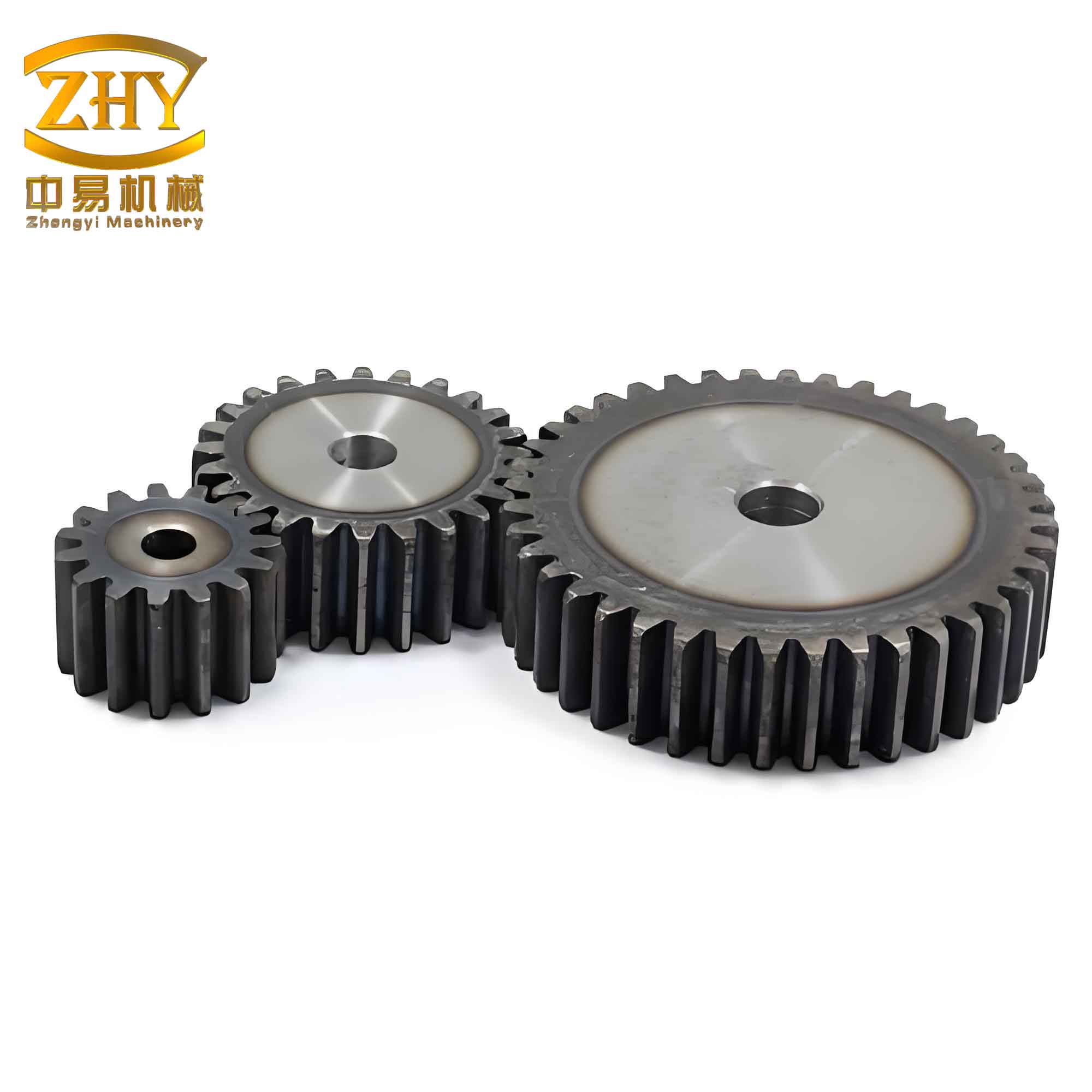
To probe these inaccessible interface phenomena, a three-dimensional DEM simulation was developed. The model comprised a rotating drum, a spur cylindrical gear (module m=5 mm, teeth z=23, face width b=40 mm, pressure angle 20°) mounted on a central shaft, and a large assembly of spherical brown alumina abrasive particles with a diameter of 3 mm. The Hertz-Mindlin (no-slip) contact model was employed to calculate the inter-particle and particle-boundary forces. The material intrinsic and contact parameters required for the DEM simulation are summarized in the tables below.
| Material | Density, ρ (kg/m³) | Poisson’s Ratio, ε | Shear Modulus, G (MPa) |
|---|---|---|---|
| Drum (Steel) | 7850 | 0.300 | 7940 |
| Particle (Brown Alumina) | 2675 | 0.360 | 1260 |
| Cylindrical Gear (40Cr Steel) | 7870 | 0.277 | 8080 |
| Interaction Pair | Coefficient of Restitution | Static Friction Coefficient | Rolling Friction Coefficient |
|---|---|---|---|
| Particle-Drum | 0.50 | 0.35 | 0.10 |
| Particle-Cylindrical Gear | 0.43 | 0.36 | 0.10 |
| Particle-Particle | 0.46 | 0.39 | 0.10 |
A series of single-factor simulation experiments were designed to investigate the influence of two primary process parameters: (1) the gear burial depth (\(h_1\)), defined as the distance from the gear’s top face to the stationary media upper surface, and (2) the rotational speeds of the drum (\(n_1\)) and gear (\(n_2\)). Based on the kinematic equation and preliminary understanding, the burial depth is expected to predominantly affect the contact pressure on the cylindrical gear by altering the media head pressure above it, while the rotational speeds should primarily govern the relative motion velocity. The speed ratio was kept constant at \(n_1 : n_2 = 5:4\). The specific parameter sets are listed below.
- Gear Burial Depth, \(h_1\): 80 mm, 110 mm, 140 mm
- Drum Speed, \(n_1\): 12 rpm, 21 rpm, 30 rpm
The DEM simulation results first reveal the macroscopic disturbance of the media flow field caused by the immersed cylindrical gear. In the absence of the workpiece, the media upper surface forms a paraboloid. Upon insertion of the gear, this flow is disrupted. A significant media pile-up occurs in front of the gear (in the direction of media flow driven by drum rotation), while a lower-density “wake” region forms behind it. For instance, at \(h_1 = 80\) mm and \(n_1 = 30\) rpm, the maximum pile-up height reached approximately 192 mm, compared to the stationary fill height of 140 mm, creating a height differential of up to 70 mm across the gear. Velocity vector analysis on different cross-sectional planes shows that particles impacting the gear are diverted upward, flow over the top of the gear and along its sides at relatively higher speeds, and subsequently accelerate downward into the wake region. This flow pattern dictates how media enters, fills, and exits the tooth spaces of the cylindrical gear.
A closer examination of the particles within a single tooth space over one complete gear rotation cycle reveals a distinct periodic action behavior. This cycle can be segmented into three consecutive phases:
- Particle Ingress/Filling Phase: As the tooth space rotates out of the wake region, surrounding media begins to flow into the gap from the gear top and the tooth tip. Particle velocity vectors are primarily directed downward into the slot, with relatively higher speeds.
- Stable Filling and Action Phase: Once the tooth space becomes filled with media and enters the main impact zone in front of the gear, the particle motion transitions. The dominant flow direction shifts to an upward sliding motion along the tooth flank, driven by the bulk media being forced against the gear. During this phase, the number of particles in contact with the tooth surface stabilizes, and their relative sliding velocities are lower but sustained. This phase is identified as the primary period of effective finishing action on the cylindrical gear surface.
- Particle Egress Phase: As the tooth space rotates away from the main impact zone and re-enters the wake, the media inside, under the influence of centrifugal force and gravity, flows out primarily toward the tooth tip and the gear’s bottom. Contact forces diminish rapidly during this phase.
The analysis of the normal contact force (\(F\)) on a defined patch of the tooth flank over one gear rotation period quantitatively confirms this periodicity. The force remains near zero during initial filling, rises sharply to a sustained peak during the stable filling phase, and then drops rapidly to near zero during the egress phase. Crucially, the average normal contact force during the stable filling phase was found to be approximately 22 to 26 times greater than the average force during the ingress and egress phases, respectively, solidifying its role as the dominant processing stage for the cylindrical gear.
The influence of process parameters was evaluated by extracting the average normal contact force and the average particle-to-surface relative velocity during the stable filling phase. The key findings are:
- Effect of Burial Depth (\(h_1\)): Increasing the burial depth from 80 mm to 140 mm (a 75% increase) resulted in a substantial 76% increase in the average normal contact force on the tooth flank. In contrast, its effect on the average relative sliding velocity was minimal, causing only about a 4% increase. This confirms that burial depth is the dominant parameter for controlling the contact pressure/force on the cylindrical gear surface.
- Effect of Rotational Speeds (\(n_1, n_2\)): Increasing the drum speed (and correspondingly the gear speed) from 12 rpm to 30 rpm (a 150% increase) led to a dramatic 148% increase in the average relative sliding velocity. The corresponding increase in the average normal contact force was only about 18%. This validates that rotational speeds are the primary control parameters for the kinematic intensity of the process.
Furthermore, the simulation uncovered inherent spatial non-uniformity in the action on the cylindrical gear tooth surface. The contact force and relative velocity were not uniformly distributed from the tooth root to the tooth tip or from the upper to the lower part of the tooth flank (relative to the gear’s vertical axis in the drum). Specifically:
$$ \frac{F_{\text{upper-flank}}}{F_{\text{lower-flank}}} \approx 1.5 – 1.8 \quad \text{and} \quad \frac{v_{\text{upper-flank}}}{v_{\text{lower-flank}}} \approx 1.35 – 1.45 $$
This asymmetry is attributed to the semi-enclosed tooth space geometry and the direction of the primary media flow. Interestingly, increasing the burial depth was found to reduce the axial (top-to-bottom) non-uniformity of the contact force distribution across the gear face width, suggesting a strategy for achieving more uniform finishing along the axis of the cylindrical gear.
To validate the DEM simulation findings, a physical experimental platform was constructed. A spur cylindrical gear identical to the simulation model was instrumented with strain gauges at three locations: on a tooth flank, on the gear’s top face, and on the gear’s bottom face. The gear was processed in a spindle finishing machine under the same parameter sets used in the simulation. The dynamic strain signals, which correlate with the contact forces, were recorded and processed. The experimental results showed strong agreement with the simulation trends:
- The strain (force) signal on the tooth flank exhibited clear periodicity corresponding to the gear rotation, while the signals on the top and bottom faces did not, matching the simulated contact behavior.
- The measured stress (from strain) increased significantly with burial depth (e.g., ~59% increase on the flank for depth change from 80mm to 140mm) and showed a much weaker increase with rotational speed (e.g., ~17% increase on the flank for speed change from 12rpm to 30rpm). This pattern aligns perfectly with the simulated contact force trends.
- Surface roughness (\(R_a\)) measurements after 2 hours of processing were conducted. The results confirmed that higher rotational speeds led to greater roughness reduction, particularly on the gear’s bottom face. More importantly, increasing the burial depth significantly improved the axial uniformity of finishing. At a shallow depth (80 mm), the roughness reduction rate varied from 17% (top region of flank) to 36% (bottom region). At a greater depth (140 mm), this variation was minimized, with reduction rates of 62% and 55% for the top and bottom regions, respectively, corroborating the simulation prediction that deeper burial promotes more uniform action across the face width of the cylindrical gear.
In conclusion, this integrated DEM simulation and experimental study provides a detailed, first-person perspective into the granular action behavior during spindle-type barrel finishing of a cylindrical gear. The principal findings are:
- The interaction between the abrasive media and a cylindrical gear tooth space is fundamentally periodic, comprising distinct filling, stable-action, and egress phases, with the stable-action phase being responsible for the majority of the finishing effect.
- Process parameters exert differentiated control: the gear burial depth is the dominant factor influencing the normal contact force/pressure on the tooth surface, while the rotational speeds of the drum and gear are the dominant factors influencing the relative sliding velocity.
- Inherent spatial non-uniformity exists in the finishing action on a cylindrical gear tooth flank, with the upper flank typically experiencing greater contact force and relative velocity than the lower flank.
- Increasing the gear burial depth is an effective strategy to mitigate axial non-uniformity in finishing across the gear’s face width, leading to a more consistent surface outcome along the length of the cylindrical gear teeth.
These insights contribute to a more mechanistic understanding of the process, moving beyond empirical knowledge. They provide a foundation for optimizing process parameters to achieve desired surface integrity targets for cylindrical gears and for developing predictive models for surface roughness evolution in spindle-type barrel finishing.