
In the evolving landscape of manufacturing, the shift towards intelligent production systems has been accelerated by governmental policies and market demands, fostering advancements in precision machinery. Among these, the rotary vector (RV) reducer stands out as a critical component in robotics and automation due to its compact design, high torque capacity, low backlash, and smooth transmission characteristics. Traditional RV reducers are predominantly fabricated from metals, but recent explorations into polymer-based materials offer potential benefits such as reduced weight, corrosion resistance, and lower manufacturing costs via techniques like 3D printing. This study investigates the feasibility of using plastic materials for RV reducers, focusing on polylactic acid (PLA) and acrylonitrile-butadiene-styrene (ABS) resin. Through finite element analysis (FEA) using ANSYS, we compare the mechanical performance of these materials under operational conditions, aiming to update material libraries and guide future RV reducer design. The RV reducer’s role in precision applications necessitates rigorous analysis, and this work contributes by evaluating polymer alternatives that could revolutionize lightweight and cost-effective减速器 production.
The RV reducer operates on a two-stage reduction mechanism. The first stage involves a sun gear transmitting high-speed, low-torque input from a servo motor to planetary gears, which then drive crankshafts. The second stage utilizes the crankshafts to actuate two cycloidal gears with a 180-degree phase difference, performing cycloidal motion against pin gears, ultimately outputting low-speed, high-torque through a rigid disk. This dual-stage design ensures minimal vibration and high positional accuracy, making the RV reducer ideal for robotic joints. Understanding this传动原理 is essential for modeling and analysis, as it defines the load distribution and stress concentrations within the RV reducer assembly.
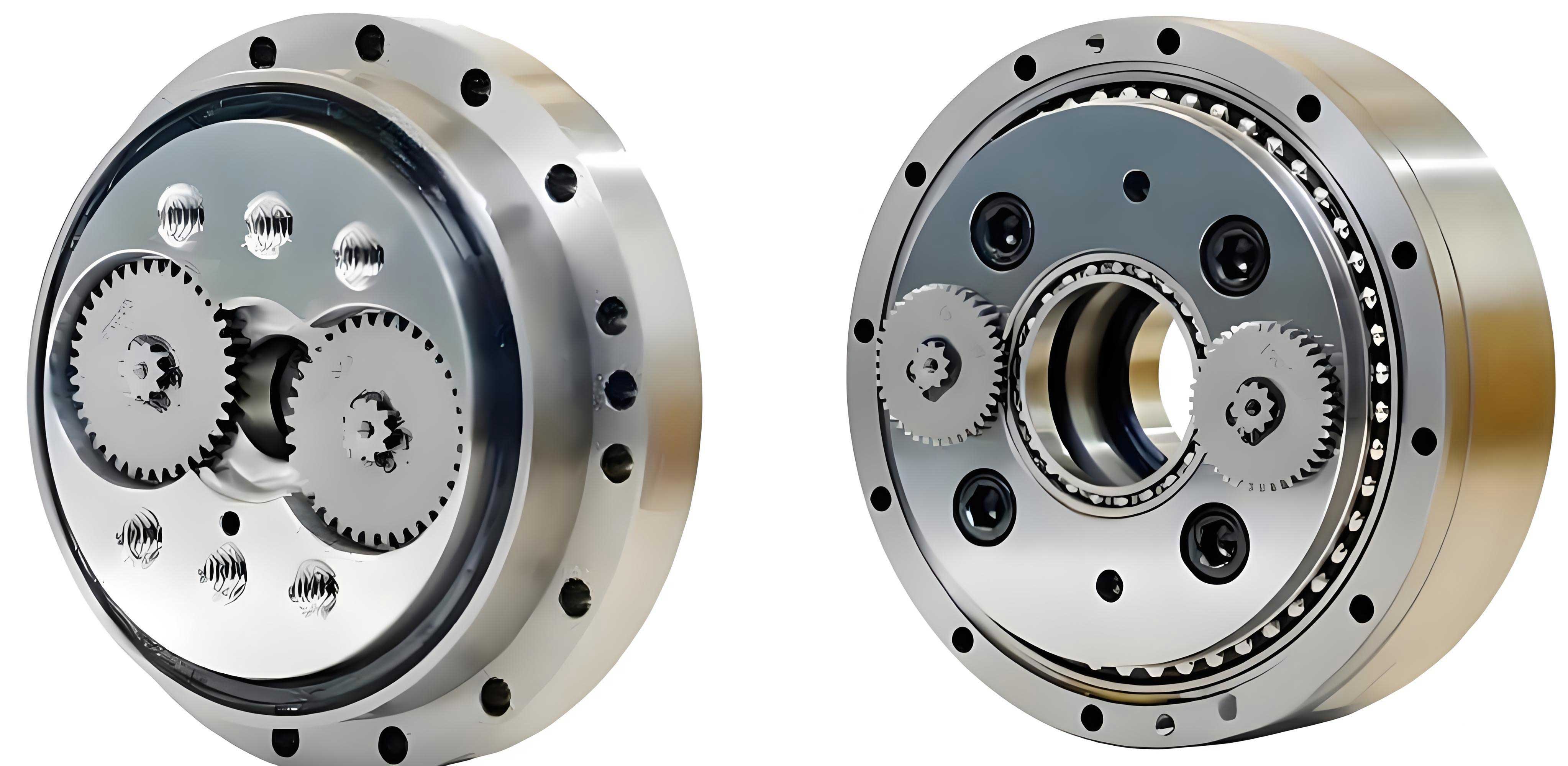
To facilitate finite element analysis, a detailed three-dimensional model of the RV reducer was developed using SolidWorks software. The modeling process involved creating individual components such as the sun gear, planetary gears, cycloidal gears, pin gears, crankshafts, and housing, ensuring accurate几何 representation for subsequent simulations. The model was optimized by simplifying non-critical features to enhance mesh quality and computational efficiency in ANSYS. After completion, the assembly was exported in Parasolid (.x_t) format, compatible with ANSYS Workbench for finite element analysis. This step is crucial, as an accurate model directly influences the reliability of FEA results, particularly for complex systems like the RV reducer where interactions between components drive performance.
Material selection plays a pivotal role in the performance of plastic RV reducers. Polymers offer distinct advantages over metals, including lower density, inherent corrosion resistance, and ease of fabrication through additive manufacturing. However, their mechanical properties, such as modulus and strength, are generally inferior to metals, necessitating careful evaluation. In this study, we focus on PLA and ABS, both common in 3D printing, to assess their suitability for RV reducer applications. PLA is a biodegradable polyester derived from lactic acid, known for good tensile strength and thermal stability, while ABS is a thermoplastic terpolymer with excellent impact resistance and durability. The properties of these materials are summarized in Table 1, providing a basis for comparison in finite element simulations. These properties are input into ANSYS to define material behavior under load, influencing the RV reducer’s stress and deformation responses.
| Material | Density (g/cm³) | Young’s Modulus (MPa) | Shear Modulus (MPa) | Bulk Modulus (MPa) | Poisson’s Ratio |
|---|---|---|---|---|---|
| PLA | 1.26 | 3200 | 3333 | 1111 | 0.35 |
| ABS | 1.04 | 2200 | 3459 | 789 | 0.32 (assumed) |
Finite element analysis is a powerful tool for predicting the mechanical behavior of the RV reducer under operational loads. In ANSYS Workbench, the imported 3D model was assigned material properties for PLA and ABS separately, with all other conditions kept identical to ensure a fair comparison. The analysis involved several steps: meshing, applying boundary conditions, defining contacts, and solving for static structural responses. Meshing was performed using tetrahedral elements with a global size of 2 mm, resulting in 592,450 nodes and 217,996 elements after refinement at critical regions like gear teeth and bearings. This discretization balances computational accuracy and efficiency, as finer meshes capture stress gradients better but increase resource demands. For the RV reducer, key contacts included frictional interactions between gears and bonded connections for fixed components, simulating real assembly conditions.
Boundary conditions were applied to replicate the RV reducer’s operational environment. The housing was fixed with zero displacement constraints, while the sun gear was assigned a rotational velocity as the input source, driving the planetary and cycloidal stages. Joints were defined for rotational degrees of freedom, and inertial effects were considered to model dynamic behavior. The governing equations for stress and deformation in the finite element analysis are derived from linear elasticity theory, expressed as:
$$ \nabla \cdot \sigma + \mathbf{f} = \rho \mathbf{a} $$
where $\sigma$ is the stress tensor, $\mathbf{f}$ is the body force vector, $\rho$ is the density, and $\mathbf{a}$ is the acceleration. For static analysis, acceleration terms are neglected, simplifying to equilibrium equations. The material constitutive关系 for isotropic polymers is given by Hooke’s law:
$$ \sigma = \mathbf{C} : \epsilon $$
with $\mathbf{C}$ as the stiffness matrix and $\epsilon$ as the strain tensor. These equations are solved numerically in ANSYS to obtain stress distributions and deformations across the RV reducer assembly.
The simulation results for the PLA-based RV reducer revealed critical insights into its performance. The equivalent stress distribution, shown through cloud plots, indicated maximum stresses of 377.36 MPa, primarily localized at the interface between the cycloidal gear and crankshaft, as well as at the tooth contacts with pin gears. This concentration arises from high啮合 forces during torque transmission, which can lead to wear and potential failure over time. Similarly, the total deformation reached 3.364 mm, with significant displacement observed in the planetary gear region due to lower stiffness. The nonlinear mechanical convergence curve for PLA exhibited oscillations before stabilizing, indicating some numerical sensitivity but overall convergence within tolerance limits. These findings suggest that while PLA offers moderate strength, its deformation under load may compromise the precision of the RV reducer in high-torque applications.
In contrast, the ABS-based RV reducer demonstrated superior performance in several aspects. The maximum equivalent stress was 262.81 MPa, substantially lower than PLA by approximately 114.55 MPa, as summarized in Table 2. This reduction in stress implies better load-bearing capacity and potential for longer service life. The total deformation was 3.3673 mm, comparable to PLA, but the stress distribution was more均匀, minimizing localized failure risks. The convergence curve for ABS showed smoother and faster stabilization, reflecting better numerical robustness and material stability under simulated conditions. These results highlight ABS’s enhanced durability and suitability for the RV reducer, attributed to its higher shear modulus and impact resistance. The RV reducer’s efficiency relies on minimal deformation and stress, making ABS a promising candidate for polymer-based designs.
| Parameter | PLA RV Reducer | ABS RV Reducer | Difference |
|---|---|---|---|
| Maximum Equivalent Stress (MPa) | 377.36 | 262.81 | 114.55 (PLA higher) |
| Total Deformation (mm) | 3.364 | 3.3673 | 0.0033 (similar) |
| Convergence Behavior | Oscillatory, slower | Smooth, faster | ABS more stable |
Further analysis of the stress patterns in the RV reducer components provides deeper understanding. For both materials, the cycloidal gear and pin gear interfaces experienced the highest stresses, aligning with theoretical expectations due to the eccentric motion and force transmission in the cycloidal stage. The stress concentration factor $K_t$ for these regions can be estimated using empirical formulas for gear teeth, such as:
$$ K_t = 1 + \frac{2t}{r} $$
where $t$ is the tooth thickness and $r$ is the fillet radius. In polymers, stress concentrations are more critical due to lower fracture toughness, necessitating design optimizations like rounded edges or reinforced geometries. Additionally, the planetary gear stage showed moderate stresses, but deformation here could affect backlash and transmission accuracy. The RV reducer’s overall performance hinges on minimizing these effects, and material choice directly influences them. The use of ABS mitigates stress peaks, potentially reducing wear and maintenance needs in practical RV reducer applications.
The deformation analysis also considered the effect of material anisotropy, though both PLA and ABS are treated as isotropic in this study. For future work, accounting for打印-induced anisotropy in 3D-printed RV reducer parts could refine predictions. The deformation equation under load is given by:
$$ \delta = \frac{FL}{AE} $$
where $\delta$ is deformation, $F$ is force, $L$ is length, $A$ is area, and $E$ is Young’s modulus. Given similar forces, ABS’s lower modulus might suggest higher deformation, but the simulation shows comparable values due to its better stress distribution. This underscores the importance of holistic FEA over simplified formulas for complex RV reducer assemblies.
Discussion of the results emphasizes the trade-offs in material selection for RV reducers. PLA, while biodegradable and with higher Young’s modulus, suffers from brittleness and higher stress concentrations, making it less ideal for dynamic loads. ABS, with lower modulus but superior toughness and impact resistance, offers a more balanced profile for the RV reducer’s operational demands. The convergence behavior further supports ABS’s reliability, as smoother curves indicate stable numerical solutions, essential for design validation. These insights align with industry trends where ABS is favored for functional prototypes and end-use parts in mechanical systems. The RV reducer’s role in robotics requires materials that withstand cyclic loading, and ABS’s performance in this analysis suggests it can meet such requirements when used in plastic RV reducers.
To enhance the analysis, we can incorporate fatigue life predictions using stress-life approaches. For the RV reducer under cyclic operation, the number of cycles to failure $N_f$ can be estimated from maximum stress $\sigma_{max}$ and material endurance limit $\sigma_e$. For polymers, this is often modeled as:
$$ N_f = \left( \frac{\sigma_a}{\sigma_e} \right)^{-b} $$
where $\sigma_a$ is the stress amplitude and $b$ is a material constant. Given ABS’s lower stress, it would likely exhibit longer fatigue life, crucial for RV reducer durability. This aspect warrants further experimental testing but is beyond this FEA scope.
In conclusion, this finite element analysis demonstrates that ABS resin outperforms PLA as a material for plastic RV reducers in terms of stress resistance and numerical stability. The maximum equivalent stress for ABS was 30% lower than PLA, with similar deformation levels, indicating better load distribution and potential for enhanced lifespan. The convergence curves further validated ABS’s robustness in simulations. These findings support updating material libraries for RV reducer design to include ABS as a viable polymer option, especially for applications prioritizing weight reduction and cost savings without compromising mechanical integrity. Future work should explore hybrid composites or advanced polymers to further optimize RV reducer performance. This study lays a foundation for polymer-based RV reducers, contributing to the advancement of lightweight automation components.
The implications of this research extend beyond academic exercise, offering practical guidance for engineers designing next-generation RV reducers. By leveraging FEA, we can iterate designs rapidly, testing various materials and geometries virtually before physical prototyping. For the RV reducer industry, adopting plastics like ABS could reduce manufacturing costs and enable customizations via 3D printing, though considerations like thermal expansion and long-term creep must be addressed. Overall, the RV reducer’s evolution towards polymer-based systems is promising, and this analysis provides a step in that direction, emphasizing the critical role of material science in mechanical engineering innovations.