
The rotary vector reducer, commonly known as the RV reducer, has emerged as a critical component in high-precision motion control systems, most notably within industrial robotics. Its superior characteristics—including exceptional torsional stiffness, minimal backlash, high reduction ratios, compactness, and excellent load-bearing capacity—make it indispensable for robotic joint articulation. Despite its widespread application, the underlying design and manufacturing technologies remain highly specialized. A thorough understanding of its kinematic and dynamic principles, particularly its nature as a planetary closed differential system, is fundamental for successful forward design and development. This analysis delves into the essential concepts of differential mechanisms, establishes the evolutionary link to cycloidal drives, and employs equivalent modeling to reveal the power flow distribution within the rotary vector reducer.
1. Fundamental Concepts: Differential vs. Closed Differential Mechanisms
To grasp the operational essence of the rotary vector reducer, one must first distinguish between two related but distinct planetary configurations: the simple differential and the closed differential mechanism.
1.1 Planetary Differential Mechanism
A classic planetary differential mechanism possesses two or more degrees of freedom. Its primary function is to either split a single input motion into two or more output motions or combine multiple input motions into a single output. The specific motion of each output branch is not kinematically predetermined but is governed by the external load or torque acting upon it. Common examples include the automotive differential and basic NGW-type planetary gear trains configured as differentials. In these systems, with one member fixed, the mechanism gains a single degree of freedom and acts as a standard speed reducer. However, when all central members (sun gear, carrier, ring gear) are free to rotate, it becomes a two-degree-of-freedom differential. The following table summarizes the structural and mobility characteristics of typical differentials.
| Mechanism Type | Number of Moving Links (n) | Number of Lower Pairs (PL) | Number of Higher Pairs (PH) | Degrees of Freedom (F=3n-2PL-PH) |
|---|---|---|---|---|
| Automotive Differential | 5 | 5 | 3 | F = 3×5 – 2×5 – 1×3 = 2 |
| NGW Planetary Differential | 4 | 4 | 2 | F = 3×4 – 2×4 – 1×2 = 2 |
1.2 Planetary Closed Differential Mechanism
In contrast, a planetary closed differential mechanism has only one degree of freedom. It features an internal power loop where the input power is inherently split into two or more parallel kinematic paths within the single, integrated gear train. These power paths undergo different speed transformations before being recombined to produce a single, definitive output. This structure is prevalent in complex, high-ratio transmissions like certain wind turbine gearboxes. The key distinction from a simple differential is that the motion relationship is fixed by the gear geometry; the system cannot freely adapt to external load differences across paths. Instead, the load and power distribution are internally determined by the kinematics. Examples include specialized configurations from manufacturers like Bosch Rexroth and MAAG. Their mobility analysis confirms their single-degree-of-freedom nature.
| Mechanism Type | Number of Moving Links (n) | Number of Lower Pairs (PL) | Number of Higher Pairs (PH) | Degrees of Freedom (F=3n-2PL-PH) |
|---|---|---|---|---|
| Rexroth Wind Turbine Gearbox | 8 | 8 | 7 | F = 3×8 – 2×8 – 1×7 = 1 |
| MAAG Wind Turbine Gearbox | 6 | 6 | 5 | F = 3×6 – 2×6 – 1×5 = 1 |
This fundamental understanding sets the stage for analyzing the rotary vector reducer, which, as will be shown, is a prime example of a single-degree-of-freedom planetary closed differential system.
2. Evolutionary Link: From Cycloidal Drive to the Rotary Vector Reducer
The rotary vector reducer is a direct evolution of the single-tooth-difference cycloidal pin-wheel speed reducer. Understanding this lineage is crucial for its kinematic analysis.
2.1 The Single-Tooth-Difference Cycloidal Drive
A cycloidal drive is a type of planetary gear train with a small tooth difference. It consists of an eccentric input shaft (crank), one or two cycloid disks (planet gears with lobed profiles), a stationary ring of cylindrical pins (ring gear), and an output mechanism that captures the oscillating rotation of the cycloid disk, typically via pins and holes, to produce slow, continuous output. In the single-tooth-difference version, the number of pins on the stationary ring ($$z_4$$) exceeds the number of lobes on the cycloid disk ($$z_3$$) by exactly one: $$z_4 – z_3 = 1$$. For one full revolution of the input eccentric, the cycloid disk undergoes a reverse rotation of one lobe relative to the pins, leading to a high reduction ratio.
2.2 Structural Evolution into the RV Reducer
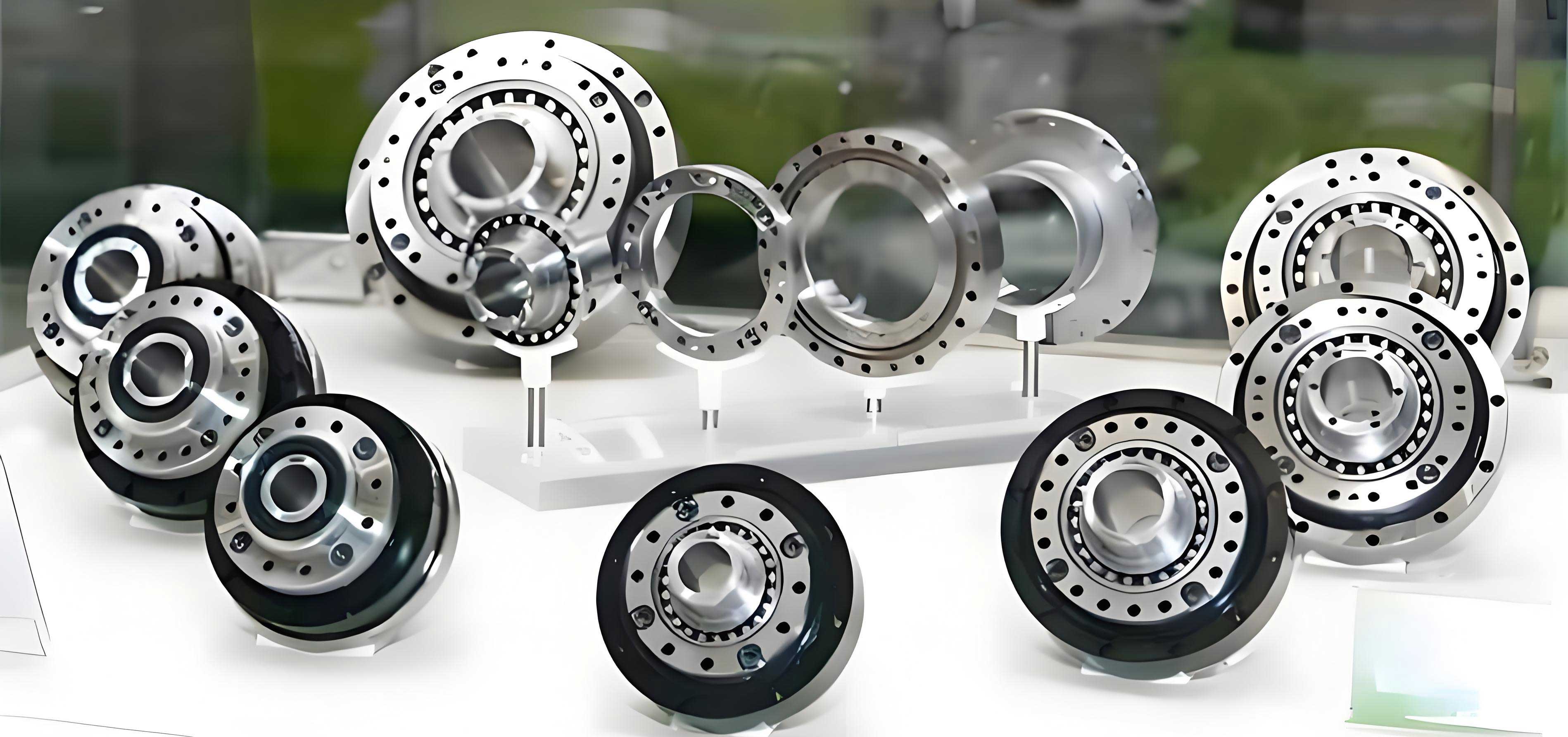
The rotary vector reducer ingeniously modifies and enhances the basic cycloidal drive. First, the single input eccentric shaft is replaced by two or three crankshafts, which are offset from the main centerline and are themselves driven by a first-stage planetary gear train. This modification distributes the load across multiple cranks, drastically reducing bearing loads and increasing torsional stiffness and longevity. Second, a sun gear drives several planetary gears mounted on these crankshafts. The cycloid disk(s) are mounted on the eccentric portions of these crankshafts, and the output is taken from a flange connected to the crankshaft supports (the planet carrier of the first stage). This creates a two-stage, closed-loop system.
2.3 Equivalent Transmission Ratio Calculation: The “-1 Tooth Sun Gear” Concept
A pivotal insight for analyzing the rotary vector reducer is to treat the cycloidal stage itself as an ordinary planetary gear train. In this等效 model:
- The input crank (eccentric shaft) acts as the sun gear.
- The rotating cycloid disk acts as the planet gear.
- The stationary pin ring acts as the fixed ring gear.
- The output carrier (which holds the crank bearings and extracts the cycloid’s motion) acts as the planet carrier.
The unique kinematic relationship in a single-tooth-difference pair (one crank revolution causes one lobe of reverse cycloid rotation) is equivalent to an external gear mesh where the “sun gear” has a negative tooth count. Specifically, the crank is等效 to a sun gear with $$z_5 = -1$$ teeth.
For a standard NGW planetary train with a fixed ring gear, input sun, and output carrier, the speed ratio is:
$$ i_{planet} = \frac{\omega_{sun}}{\omega_{carrier}} = 1 + \frac{z_{ring}}{z_{sun}} $$
Applying this to the等效 cycloidal stage, with $$z_5 = -1$$ and ring gear teeth $$z_4$$:
$$ i_{cycloid} = \frac{\omega_{crank}}{\omega_{output carrier}} = 1 + \frac{z_4}{z_5} = 1 + \frac{z_4}{-1} = 1 – z_4 = -(z_4 – 1) $$
Since $$z_4 – z_3 = 1$$, we have $$z_4 – 1 = z_3$$. Therefore:
$$ i_{cycloid} = -z_3 $$
The negative sign indicates the output carrier rotates in the opposite direction to the input crank, which is consistent with the cycloidal drive’s motion. This等效 method proves to be a powerful tool for integrating the cycloidal stage into overall传动比 calculations for the复合rotary vector reducer.
3. Planetary Closed Differential Nature of the Rotary Vector Reducer
The complete rotary vector reducer integrates the first-stage parallel-shaft/planetary gear train with the second-stage cycloidal drive in a feedback loop, forming a closed differential system. Its mobility calculation confirms this: with 4 moving links, 4 lower pairs, and 3 higher pairs, its degrees of freedom are $$F = 3 \times 4 – 2 \times 4 – 1 \times 3 = 1$$.
3.1 Equivalent Mechanism and Power Flow Model
The motion and power transmission within an rotary vector reducer can be conceptually decomposed into two parallel kinematic paths that converge at the output planet carrier (the main output flange).
| Power Flow Branch | Kinematic Path Description | Key Feature |
|---|---|---|
| Branch 1 (Direct Drive) | Input Sun Gear → First-Stage Planetary Gears (mounted on cranks) → Direct force transmission through crankshaft bearings to the Planet Carrier. | This path transmits power mechanically without speed reduction between the planetary gears and the carrier. |
| Branch 2 (Cycloidal Drive) | Input Sun Gear → First-Stage Planetary Gears → Crankshaft Eccentric → Cycloid Disk → Reaction against Fixed Pin Ring → Transmitted back to the Planet Carrier via the output pins. | This path transmits power through the speed-reducing cycloidal mechanism before delivering it to the same carrier. |
These two branches form a closed loop. The first-stage planetary gears and their crankshafts are the key elements where power splits. They rotate relative to the carrier (providing input to the cycloid) while also driving the carrier directly.
3.2 Total Reduction Ratio and Power Distribution
A fundamental theorem for planetary closed differential systems states: The total transmission ratio is the sum of the standalone ratios of each power flow branch. Furthermore, the percentage of total power flowing through a given branch is equal to the ratio of its standalone transmission ratio to the total ratio.
Let:
- $$z_1$$: Number of teeth on the input sun gear.
- $$z_2$$: Number of teeth on the first-stage planetary gears.
- $$z_3$$: Number of lobes on the cycloid disk.
- $$z_4$$: Number of pins in the fixed ring ($$z_4 = z_3 + 1$$).
- $$n_1$$: Input speed (sun gear).
- $$n_H$$: Output speed (planet carrier).
- $$n_4 = 0$$: Speed of fixed pin ring.
The standalone ratio for Branch 1 (considering the planetary train with carrier as output) is $$i_1 = 1 + \frac{z_2}{z_1}$$.
The standalone ratio for Branch 2 is the product of the first-stage ratio (sun to planet gear) and the cycloidal stage ratio (crank to carrier). Using the等效 model:
$$ i_2 = \left( \frac{z_2}{z_1} \right) \times (-z_3) $$
The total ratio $$i_{RV} = n_1 / n_H$$ is the sum of $$i_1$$ and $$i_2$$ (considering sign conventions for direction):
$$ i_{RV} = i_1 + i_2 = \left(1 + \frac{z_2}{z_1}\right) + \left( \frac{z_2}{z_1} \times z_3 \right) $$
Simplifying:
$$ i_{RV} = 1 + \frac{z_2}{z_1} + \frac{z_2}{z_1}z_3 = 1 + \frac{z_2}{z_1}(1 + z_3) = 1 + \frac{z_2}{z_1}z_4 $$
This is the classic reduction ratio formula for the rotary vector reducer and matches the result derived from direct kinematic analysis, validating the等效 closed differential model.
Let $$P$$ be the total input power, $$P_1$$ the power through Branch 1, and $$P_2$$ the power through Branch 2. The power distribution ratios are:
$$ Q_1 = \frac{P_1}{P} = \frac{i_1}{i_{RV}} = \frac{1 + \frac{z_2}{z_1}}{1 + \frac{z_2}{z_1}z_4} $$
$$ Q_2 = \frac{P_2}{P} = \frac{i_2}{i_{RV}} = \frac{\frac{z_2}{z_1} z_3}{1 + \frac{z_2}{z_1}z_4} $$
And naturally, $$Q_1 + Q_2 = 1$$.
This reveals a critical design insight for the rotary vector reducer: the cycloid disk does not transmit the full input power. A significant portion ($$Q_1$$) flows directly through the first-stage planet gears and cranks to the carrier. This inherent power splitting contributes to the reducer’s high efficiency and allows the cycloid stage to be sized for a fraction of the total torque, improving compactness.
3.3 Verification via Force Analysis
The power distribution formulas can be verified through static force equilibrium. Consider the tangential force $$F_t$$ exerted by the sun gear on a planetary gear. This force creates two reaction components at the planetary gear bearing (on the crank):
- A force $$F_t$$ acting on the crank, which is reacted by the planet carrier (Branch 1 contribution).
- A torque on the crank due to the eccentric offset, which drives the cycloidal stage and eventually produces a reaction force on the carrier via the output pins (Branch 2 contribution).
The torque delivered to the carrier directly from this force is $$T_1 = F_t \times (r_1 + r_2)$$, where $$r_1$$ and $$r_2$$ are the pitch radii of the sun and planet gear, respectively. The power via Branch 1 is $$P_1 = T_1 \cdot \omega_H = F_t (r_1 + r_2) \omega_H$$. The total input power is $$P = T_{in} \cdot \omega_1 = (F_t r_1) \cdot \omega_1$$. Therefore,
$$ \frac{P_1}{P} = \frac{F_t (r_1 + r_2) \omega_H}{F_t r_1 \omega_1} = \frac{r_1 + r_2}{r_1} \cdot \frac{1}{i_{RV}} $$
Since pitch radii are proportional to tooth numbers, $$\frac{r_1 + r_2}{r_1} = 1 + \frac{z_2}{z_1}$$. Substituting this and the expression for $$i_{RV}$$ yields:
$$ \frac{P_1}{P} = \frac{1 + \frac{z_2}{z_1}}{1 + \frac{z_2}{z_1}z_4} $$
This matches the result from the等效 power flow theorem ($$Q_1$$), providing a rigorous mechanical confirmation of the model.
4. Summary and Design Implications
The rotary vector reducer is a sophisticated single-degree-of-freedom planetary closed differential mechanism. Its kinematic analysis is greatly facilitated by:
- Recognizing its evolutionary basis in the cycloidal drive.
- Employing the等效 “-1 tooth sun gear” concept to model the cycloidal stage as a standard planetary train.
- Applying the principles of power flow summation and distribution inherent to closed differential systems.
The derived formulas for total reduction ratio $$i_{RV}$$ and power分配 ratios $$Q_1$$ and $$Q_2$$ are fundamental for forward design.
| Design Parameter | Formula / Implication |
|---|---|
| Total Reduction Ratio | $$ i_{RV} = 1 + \frac{z_2}{z_1} \times z_4 $$ Determines the primary speed transformation. |
| Power through Direct Path (Q₁) | $$ Q_1 = \left(1 + \frac{z_2}{z_1}\right) / i_{RV} $$ Affects bearing and gear load calculations in the first stage. |
| Power through Cycloidal Path (Q₂) | $$ Q_2 = \left(\frac{z_2}{z_1} \times z_3\right) / i_{RV} $$ Crucial for sizing the cycloid disk, pins, and crankshaft eccentric bearings. |
This analytical framework reveals that the exceptional compactness and high torque density of the rotary vector reducer stem not only from the high-ratio cycloidal stage but also from its intelligent power-sharing architecture. Understanding this planetary closed differential essence is indispensable for optimizing gear geometries, performing accurate load and stress analysis, predicting efficiency, and ultimately achieving successful国产化 and innovative design of this critical component in precision robotics and automation.