
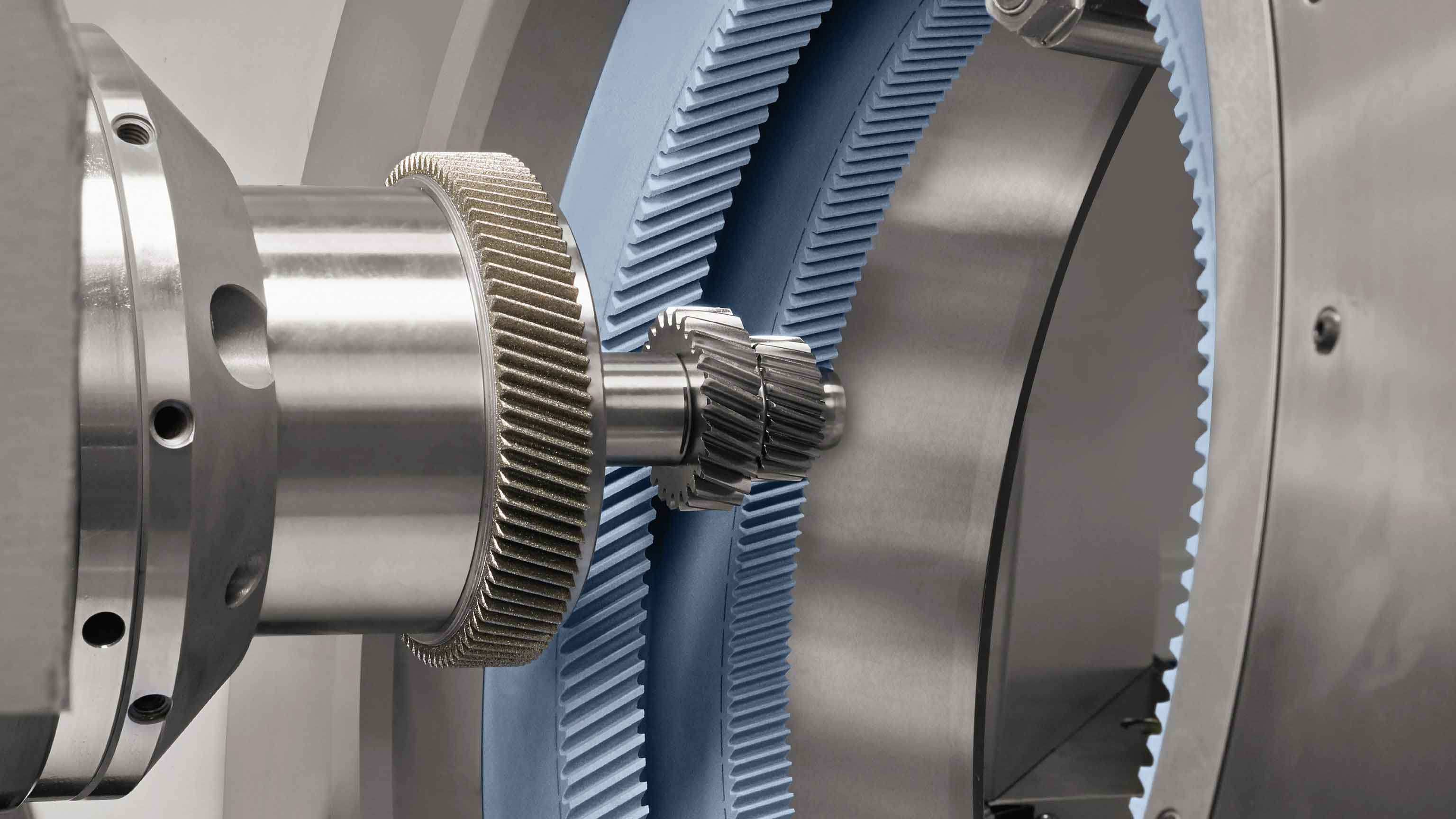
The evolution of manufacturing precision components demands continuous improvement in machine tool control systems. Gear honing, a critical finishing process for gear teeth, exemplifies this need. This process utilizes a gear-shaped honing tool in free-meshing engagement with the workpiece gear. The relative sliding motion and pressure between the contacting tooth surfaces result in a fine abrading action. Gear honing offers significant advantages, including a multi-point cutting effect, a low probability of generating thermal damage such as burns or cracks on the gear surface, and the ability to achieve an exceptionally fine surface finish with low roughness values. Among the various methods, external gear honing, where a external honing gear processes an external workpiece gear, is widely employed in practical production. The Y4632A honing machine, designed for a maximum workpiece diameter of 320 mm and a maximum module of 6 mm, is a prominent example of this technology.
Traditionally, the electrical control system for such machines relied on relay-contactor logic. This approach involved numerous physical components—relays, contactors, timers, and counters—leading to complex wiring, a high number of failure-prone contact points, and significant maintenance overhead. The requirement for accurate control of the worktable’s reciprocating stroke count further complicated the relay-based design. To address these limitations and enhance reliability, flexibility, and diagnostic capability, a modernization based on a Programmable Logic Controller (PLC) presents an optimal solution. This article details the design pathway and methodology for implementing a PLC-based control system for a gear honing machine, covering system hardware selection, software programming, and providing new perspectives for machine tool modernization.
Control Requirements Analysis for Gear Honing
The core electrical control functions of a gear honing machine can be systematically derived from its operational sequence. The primary objectives are to manage motor drives, orchestrate the semi-automatic work cycle, and ensure operational safety.
The machine is driven by three main motors:
- Hydraulic Pump Motor (M1): Provides power for the hydraulic system. It requires simple unidirectional start/stop control.
- Honing Wheel Motor (M2): Drives the honing gear. For effective gear honing, it must be capable of bidirectional rotation. To limit inrush current, it employs a reduced-voltage start using series resistance, transitioning to full voltage after a timed delay.
- Coolant Pump Motor (M3): Supplies coolant during the honing operation, requiring unidirectional control.
The operational mode is selected via a manual/semi-automatic selector. In manual mode, individual functions (honing wheel, worktable, coolant, tailstock) can be operated independently for setup and adjustment. The semi-automatic cycle is the primary production mode. This cycle sequence is crucial for efficient gear honing:
- After the hydraulic system is active and pressure is established, the workpiece is loaded onto the fixture.
- Closing the safety guard automatically triggers the tailstock to clamp the workpiece and starts the coolant pump.
- Initiating the cycle starts the honing wheel motor (with directional control defined by a selector).
- The worktable begins a reciprocating motion, carrying the workpiece gear past the rotating honing wheel.
- A counter tracks the number of worktable strokes. When the pre-set number of honing strokes is reached, the honing wheel and coolant pump stop.
- The worktable returns to its home position, the tailstock retracts, and the guard can be opened to unload the finished part.
Various selector switches are needed for process flexibility: Worktable Deceleration Stop, Honing Direction (e.g., climb vs. conventional), Stroke Count Preset (e.g., 2, 4, 6 strokes), Honing Wheel Rotation Direction, Tailstock Adjust, Honing Mode, and Worktable Manual Jog. Safety and sequence control are enforced by limit switches for guard position, tailstock clamp confirmation, worktable left/right travel limits, and a final over-travel safety limit. The hydraulic system’s pressure must be monitored, and all motors require standard short-circuit and overload protection. The control of actuators like solenoid valves for tailstock (YV1) and worktable feed (YV2, YV3) is defined by an action table.
| Actuator | Function | State for Action |
|---|---|---|
| YV1 | Tailstock Advance/Retract | Energized to retract, De-energized to advance/clamp. |
| YV2 | Worktable Move Left | Energized to command left movement. |
| YV3 | Worktable Move Right | Energized to command right movement. |
PLC System Hardware Design for Gear Honing Control
The hardware design prioritizes cost-effectiveness, reliability, and adequate room for future expansion. The core task is selecting an appropriate PLC model and configuring its I/O system based on the analyzed control requirements for the gear honing process.
The first step is estimating the required number of Input/Output (I/O) points. All switches, sensors, and pushbuttons constitute inputs, while contactors, solenoid valves, and indicator lamps are outputs. A strategic approach is employed to minimize I/O count and cost:
- Mutually exclusive selectors (e.g., Manual/Semi-Auto) are assigned a single input point, with logic handled in the PLC program.
- Simple, high-power circuits (e.g., the main hydraulic motor contactor) can be controlled externally via a single PLC output to avoid using expensive high-current output modules.
- Non-critical indicators (e.g., main power) can be implemented directly in the main electrical cabinet.
- Safety interlocks like the final over-travel limit can be hardwired into the motor starter circuit for guaranteed safety independent of the PLC.
After optimization, the system requires approximately 19 digital inputs and 8 digital outputs. Including a standard 15-20% spare capacity for future modifications leads to a requirement of ~24 inputs and ~10 outputs.
PLC memory size is often estimated based on I/O count and program complexity. A common rule of thumb is:
$$ \text{Estimated Memory Words} = (\text{Number of I/O Points}) \times 10 $$
For this system: $ (24 + 10) \times 10 = 340 $ words. Adding a 30-50% margin suggests a requirement of about 0.5 – 1 KB of user program memory, which is modest by modern standards.
Based on these estimates, a compact PLC system is suitable. A configuration like the Siemens S7-200 series CPU 222, paired with an expansion module such as the EM223 (16 DI/16 DO), provides 24 digital inputs and 22 digital outputs with a program capacity of 4KB. This configuration comfortably exceeds the estimated needs for controlling this gear honing machine. The chosen I/O modules are 24V DC for inputs (for noise immunity) and relay type for outputs (for versatility in switching AC/DC loads like contactor coils and solenoid valves). The resulting PLC external wiring diagram maps all field devices (limit switches SQ1-SQ5, selector switches SA1-SA9, pushbuttons, pressure switch KP) to specific PLC input addresses (I0.0, I0.1, …) and all controlled devices (contactors KM2-KM4, solenoid valves YV1-YV3, cycle status lamps) to specific PLC output addresses (Q0.0, Q0.1, …).
Control Logic and Software Design
The intelligence of the gear honing control system resides in its software. The program must implement both manual and semi-automatic operational modes, with the latter being a sequential process. A state-based or sequential function chart (SFC) design methodology is highly effective for this purpose.
The core of the semi-automatic cycle for gear honing can be represented by the following high-level algorithm, which translates directly into PLC ladder logic or structured text:
- Initialization & Hydraulic Start: System checks for safe conditions. Operator starts hydraulic pump (M1). PLC monitors pressure switch (KP). When pressure is OK, tailstock solenoid (YV1) is energized to retract the tailstock, and an indicator turns on.
- Workpiece Load & Clamp: Operator loads gear workpiece and closes safety guard. Guard closed limit switch (SQ1) activates. PLC de-energizes YV1, causing tailstock to advance and clamp the workpiece. Simultaneously, it starts the coolant pump motor (M3).
- Cycle Start & Honing Wheel Run-Up: Operator presses cycle start button. PLC energizes the forward honing wheel contactor (KM2) for a reduced-voltage start. A timer (T1) is started.
$$ \text{Timer T1 Preset} = 3 \text{ seconds} $$
After T1 times out, PLC energizes the run contactor (KM4) to apply full line voltage to motor M2. - Reciprocating Honing Motion: Based on the initial position (e.g., right limit SQ4 active), the PLC energizes the “move left” solenoid (YV3). The worktable moves left until it triggers the left limit switch (SQ5). The PLC then de-energizes YV3 and energizes the “move right” solenoid (YV2). This reciprocation continues. A critical function of gear honing control is counting these strokes to ensure consistent finishing. Each time the worktable returns to the rightmost position (SQ4 triggered), a counter is incremented.
- Stroke Counting & Cycle Termination: The preset stroke count (N) is selected via switch SA4. The PLC program implements a comparison:
$$ \text{Current Stroke Count} \geq \text{Preset Count (N)} $$
When this condition becomes true, the PLC de-energizes the honing wheel motor contactors (KM2/KM4) and the coolant pump contactor. A short timer (T2, 2 seconds) is started to allow the wheel to coast down before possibly reversing for deburring. - Deburring Reverse (Optional) & Worktable Return: If configured, after T2 expires, the PLC energizes the reverse honing wheel contactor (KM3) for a brief period (e.g., 1 second controlled by timer T3) to assist in deburring. Finally, the PLC commands the worktable to return to its rightmost “home” position (by pulsing YV2 until SQ4 is true).
- Unclamp & Unload: The cycle complete indicator is lit. Opening the guard automatically energizes YV1 to retract the tailstock, allowing the finished honed gear to be unloaded.
The manual mode simply bypasses this sequential logic, allowing direct control of each output via dedicated buttons, with necessary safety interlocking (e.g., guard must be closed for honing wheel operation).
Implementation of Key Functions: Stroke Counting
The stroke counting logic is a pivotal element for achieving precise and repeatable gear honing results. The PLC program must allow the operator to select a preset number of strokes (e.g., 2, 4, or 6) and accurately count the worktable’s reciprocations until this number is reached. This can be elegantly implemented using the PLC’s counter functions and internal logic. The selector switch (SA4) status defines the preset value.
| SA4 Position | Input Addresses | Selected Preset (N) |
|---|---|---|
| Position 1 (2 Strokes) | I1.4=ON, I1.5=OFF | 2 |
| Position 2 (4 Strokes) | I1.4=OFF, I1.5=ON | 4 |
| Position 3 (6 Strokes) | I1.4=ON, I1.5=ON | 6 |
The core counting function can be modeled. A counter (C) increments its current value (CV) on each rising edge of a count pulse (CP), derived from the worktable reaching its rightmost position (signal from SQ4, processed as internal flag M0.3). The counter resets (R) when the cycle starts or when manual mode is selected. The logic for enabling the count pulse must also consider the “deceleration stop” selector (SA1 at I0.0). The functional operation can be expressed as:
$$ CV_{new} = \begin{cases}
0 & \text{if } R = 1 \\
CV_{old} + 1 & \text{if } R = 0 \text{ and } CP = 1 \text{ and } CP_{prev}=0 \text{ and } I0.0 = 1 \\
CV_{old} & \text{otherwise}
\end{cases} $$
Where $CP = M0.3 \cdot (I1.4 \oplus I1.5 \text{ [for specific counter]})$. In the ladder logic implementation, three separate up-counters (C0, C1, C2) might be used, each with a preset of 2, 4, and 6 respectively. Their count enable circuits are gated by the corresponding selector switch combination from SA4. The output from the active counter, when its current value reaches its preset, triggers the internal flag (M1.0) that commands the cycle to proceed to the termination phase. This structured approach ensures accurate and reliable control over the gear honing duration.
Conclusions and System Advantages
The implementation of a PLC-based control system for a gear honing machine demonstrates a highly effective path for modernizing conventional machine tool electrical systems. The transition from relay-logic to programmable control delivers substantial benefits specifically tailored to the demands of precision gear honing:
- Enhanced Reliability and Maintainability: The drastic reduction in electromechanical components (relays, hard-wired timers/counters) eliminates a major source of failures—physical contacts and complex wiring. Troubleshooting is simplified through the PLC’s diagnostic capabilities and program monitoring.
- Improved Control Precision and Flexibility: The stroke counting and timing functions are executed in software with digital accuracy, eliminating the drift and wear associated with mechanical counters and pneumatic timers. Process parameters like stroke count, motor start timing, and deburring reverse time can be modified easily through the program without any hardware changes, offering great flexibility for different gear honing applications.
- Cost-Effectiveness and Energy Efficiency: By carefully selecting a compact PLC model with an optimal I/O configuration and externalizing simple high-power circuits, the system achieves a favorable balance between performance and cost. The reduction in the number of constantly energized relay coils also contributes to lower overall energy consumption.
- Safety Integration: Safety interlocks (guard door, over-travel limits) can be seamlessly integrated into the control logic while maintaining the option for critical hardwired safety circuits, ensuring a safe operating environment for the gear honing process.
The design methodology outlined—involving detailed requirement analysis, strategic I/O minimization, appropriate PLC selection, and structured software development using sequential flowcharts and function-specific logic blocks—provides a robust framework. This approach is not only applicable to gear honing machines but also to the retrofit and upgrade of a wide range of industrial machinery, offering a reliable pathway to improve performance, adaptability, and operational efficiency in manufacturing environments.