
In the manufacturing of spiral bevel gears, carburizing and quenching are critical processes that enhance surface hardness and wear resistance. However, these processes often induce significant dimensional distortion due to the complex geometry of spiral bevel gears, leading to reduced precision, increased noise, lower fatigue life, and higher scrap rates. As a practitioner in gear production, I have extensively explored methods to mitigate these distortions. This article details our first-hand experiences and strategies, focusing on practical techniques that have proven effective in industrial settings. Spiral bevel gears are widely used in automotive and machinery applications, such as tractors, loaders, and differential systems, where their performance hinges on precise heat treatment control.
The distortion in spiral bevel gears during heat treatment stems from a combination of factors, including material properties, gear design, and processing parameters. After design finalization, material selection and process optimization become key to controlling distortion. In many factories, steels like 20CrMnTi are commonly used for spiral bevel gears, but fluctuations in hardenability and hardenability bandwidth can exacerbate distortion. Additionally, issues like internal oxidation and non-martensitic formation may arise, further compromising gear life. To address this, we have developed controlled heat treatment technologies, incorporating practices such as carburizing followed by air cooling, then secondary heating and press quenching to manage geometric tolerances effectively. However, press quenching has limitations, prompting our long-term experimentation with alternative methods.
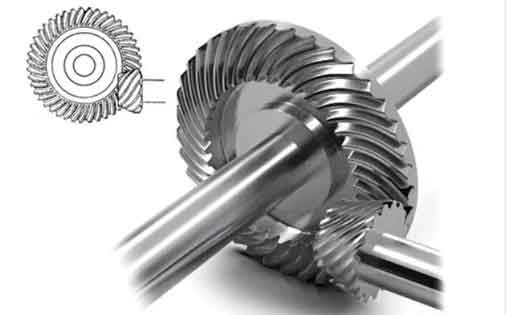
Our work centers on spiral bevel gears with modules ranging from 5 to 10 and diameters from 200 mm to 400 mm, typical in applications like tractors and loaders. These gears are made from low-carbon alloy steels, such as 20CrMnTi or similar grades, and undergo carburizing or carbonitriding to achieve surface hardness of 58-62 HRC and core hardness of 32-45 HRC. The technical requirements for these spiral bevel gears include parameters like pressure angle, spiral angle, and tooth flank roughness, which are crucial for ensuring proper meshing and load distribution. Below, we summarize key dimensions and parameters for various spiral bevel gear models in Table 1.
| Parameter | Model A (Tractor) | Model B (Loader) | Model C (Automotive) |
|---|---|---|---|
| Number of Teeth | 40 | 38 | 35 |
| Module (mm) | 5.5 | 6.0 | 7.0 |
| Pitch Diameter (mm) | 220 | 228 | 245 |
| Pressure Angle (°) | 20 | 22.5 | 20 |
| Spiral Angle (°) | 35 | 30 | 25 |
| Tooth Depth (mm) | 11.5 | 12.0 | 13.0 |
| Carburizing Depth (mm) | 0.8-1.2 | 1.0-1.4 | 1.2-1.6 |
The manufacturing process for spiral bevel gears involves several steps: material cutting, forging, pre-heat treatment, machining, carburizing/quenching, tempering, grinding, and inspection. Distortion occurs primarily during quenching, where thermal and transformational stresses cause changes in spiral angle, pressure angle, and tooth clearance. This alters the contact pattern on tooth flanks, increasing operational noise. To counteract this, we have conducted repeated trials to understand distortion patterns and adjust pre-heat treatment tooth-cutting specifications accordingly. Our approach involves cutting the driven spiral bevel gears based on calculated data, then pairing them with the drive gears after heat treatment to compensate for distortions.
Pre-heat treatment of gear blanks is crucial for minimizing subsequent distortion. For low-carbon alloy steels, a single normalizing process after forging often leads to abnormal structures, banding, and low hardness, which complicate machining and adversely affect carburizing. We have adopted a double normalizing strategy: the first normalizing after forging and the second after rough machining. The normalizing temperature is set 30-50°C above the carburizing temperature, typically at 930°C ± 10°C. This refines the microstructure and ensures uniformity. The impact of normalizing temperature on contact pattern shift is summarized in Table 2.
| Normalizing Temperature (°C) | Convex Flank Shift | Concave Flank Shift | Notes |
|---|---|---|---|
| 920 ± 10 | Moves 2-4 mm toward toe | Moves 1-3 mm toward heel | Reduced distortion compared to lower temps |
| 940 ± 10 | Moves 1-3 mm toward toe | Moves 2-4 mm toward heel | Optimal for minimizing pattern deviation |
For final heat treatment, we initially employed carburizing followed by press quenching. Carburizing is conducted in pit-type gas carburizing furnaces using drip-feed methods with methanol and kerosene. After carburizing, the gears are furnace-cooled to 850-880°C, then pit-cooled. Secondary heating for quenching is done in controlled atmosphere furnaces at 830°C ± 10°C, with holding time calculated based on effective thickness: $$ t_h = k \cdot D $$ where \( t_h \) is the holding time in minutes, \( D \) is the gear thickness in mm, and \( k \) is a coefficient typically ranging from 0.8 to 1.2 min/mm for spiral bevel gears. Protective atmospheres using methanol and formamide are maintained during heating.
Press quenching on equipment like the Y9050 press is essential for controlling distortion in spiral bevel gears. The press allows dynamic pressure application during quenching, redistributing stresses and minimizing warpage. Key parameters include pressure points, force distribution, and quenching media flow. For spiral bevel gears, we use dual-ring pressure application: the outer ring contacts the gear’s outer edge, and the inner ring contacts the inner toe plane. The radial distance between rings should be minimized to enhance stability. Pressure allocation between inner and outer rings is critical, with an optimal ratio of 1:2 to 1:3 (inner:outer). Quenching oil temperature is maintained at 80-100°C to balance cooling rate and viscosity, reducing thermal shock. The relationship between distortion and pressure can be expressed as: $$ \delta = \alpha \cdot \frac{P_i}{P_o} + \beta \cdot T_q $$ where \( \delta \) is the distortion in mm, \( P_i \) and \( P_o \) are inner and outer ring pressures in MPa, \( T_q \) is the quench temperature in °C, and \( \alpha, \beta \) are material-specific constants.
Optimizing quenching parameters involves adjusting heating temperatures based on steel chemistry and hardenability. We found that a quenching temperature of 830°C ± 10°C works well, but variations may require fine-tuning. Additionally, timely tempering within 2 hours after quenching is vital to stabilize the microstructure and prevent distortion progression. Table 3 shows the effect of tempering timing on flatness for large spiral bevel gears.
| Condition | Inner Face Flatness (mm) | Outer Face Flatness (mm) | Remarks |
|---|---|---|---|
| After Quenching | 0.05-0.10 | 0.08-0.15 | Initial distortion state |
| After Timely Tempering | 0.02-0.05 | 0.03-0.08 | Significant improvement |
| After Delayed Tempering | 0.10-0.20 | 0.15-0.25 | Distortion exacerbates over time |
In production, we processed spiral bevel gears with modules of 8-10 and diameters around 300 mm using a Y9050 press. The heating was done in a sealed quenching furnace with methanol and kerosene protection, holding for 90-120 minutes. Press quenching parameters are detailed in Table 4, where pulsating pressure application proved more effective than constant pressure.
| Stage | Press Time (s) | Oil Flow Rate (L/min) | Pressure Settings (MPa) |
|---|---|---|---|
| First | 30 | 200 | Inner: 2, Outer: 4, Expander: 1 |
| Second | 60 | 150 | Inner: 1.5, Outer: 3, Expander: 0.5 |
| Third | 30 | 100 | Inner: 1, Outer: 2, Expander: 0.2 |
Despite the effectiveness of press quenching, equipment limitations and production scalability led us to explore direct quenching after carburizing for spiral bevel gears. By analyzing distortion mechanisms, we identified that thermal stress is the primary driver, especially for gears with shallow carburized layers (0.8-1.2 mm). We implemented a direct quenching process using hot oil at 120-140°C, which reduces viscosity and improves cooling uniformity. The carburizing temperature was set at 920°C, followed by slow cooling to 850°C for quenching. This approach minimizes temperature gradients and resultant stresses. The process can be modeled as: $$ \Delta L = \int_{T_1}^{T_2} \gamma(T) \cdot dT $$ where \( \Delta L \) is the dimensional change, \( \gamma(T) \) is the thermal expansion coefficient as a function of temperature, and \( T_1, T_2 \) are initial and final temperatures. For spiral bevel gears, we optimized loading by stacking gears sequentially with thin copper plates between them, as shown in Figure 1, to ensure even gas circulation and reduce warpage.
Our trials with direct quenching revealed that distortion, primarily flatness deviation on outer faces, could be controlled within 0.05 mm. By adjusting cooling rates and using hot oil, we achieved a qualification rate over 95% for spiral bevel gears in mass production. This eliminates the need for secondary heating and press quenching, saving energy and resources. The key is to maintain carburizing depth at the lower specification limit (e.g., 0.8 mm) to shorten diffusion time and reduce thermal exposure. Empirical data for spiral bevel gears show that direct quenching reduces processing time by up to 30% compared to press quenching methods.
To further quantify the benefits, we conducted statistical analysis on distortion defects for spiral bevel gears. The major issues are summarized in Table 5, highlighting that outer face flatness accounts for over 70% of problems, which our optimized process effectively addresses.
| Defect Type | Frequency | Cumulative Percentage (%) |
|---|---|---|
| Outer Face Flatness Excess | 85 | 73.9 |
| Inner Face Flatness Excess | 15 | 86.9 |
| Bore Roundness Error | 10 | 95.7 |
| Bore Diameter Deviation | 5 | 100.0 |
In conclusion, through systematic experimentation and process refinement, we have demonstrated that spiral bevel gears can undergo carburizing and quenching with minimal distortion. By integrating optimized pre-heat treatment, controlled press quenching parameters, and direct quenching techniques, we achieve consistent gear quality. Spiral bevel gears processed this way meet all precision standards for motion accuracy, noise level, contact pattern, and fatigue life. In practice, drive and driven spiral bevel gears can be paired arbitrarily with high reliability. Our ongoing efforts focus on advancing simulation models to predict distortion for spiral bevel gears, incorporating factors like phase transformations and residual stresses. The formula for overall distortion reduction can be expressed as: $$ D_{total} = f(M, T, P, C) $$ where \( D_{total} \) is the total distortion, \( M \) is material hardenability, \( T \) is temperature profile, \( P \) is pressure application, and \( C \) is cooling rate control. For spiral bevel gears, mastering these variables is key to industrial success.