
The development of precise three-dimensional digital models is a critical prerequisite for modern design, analysis, and manufacturing processes. For complex components like spiral bevel gears, achieving an accurate geometric representation is particularly challenging yet essential. This article details a methodology and software framework for the precise parametric modeling of involute spiral bevel gears, independent of specific machining methods, utilizing the OpenGL graphics library for visualization and interaction.
Spiral bevel gears are pivotal components in power transmission systems, especially where non-parallel, intersecting shafts require smooth and high-load-capacity torque transfer. Their characteristic curved teeth engage gradually, leading to superior performance in terms of noise, vibration, and load distribution compared to straight bevel gears. Traditional design and manufacturing of spiral bevel gears are heavily reliant on specialized machine tools and cutter heads. This dependency creates a significant bottleneck; any modification in geometric parameters necessitates the redesign and fabrication of new cutting tools. The methodology presented herein decouples the geometric definition of the spiral bevel gear from its manufacturing process, enabling a purely mathematical and parametric approach to modeling. This foundational model serves as the cornerstone for subsequent finite element analysis (FEA), dynamic simulation, and the generation of numerical control (NC) machining code.
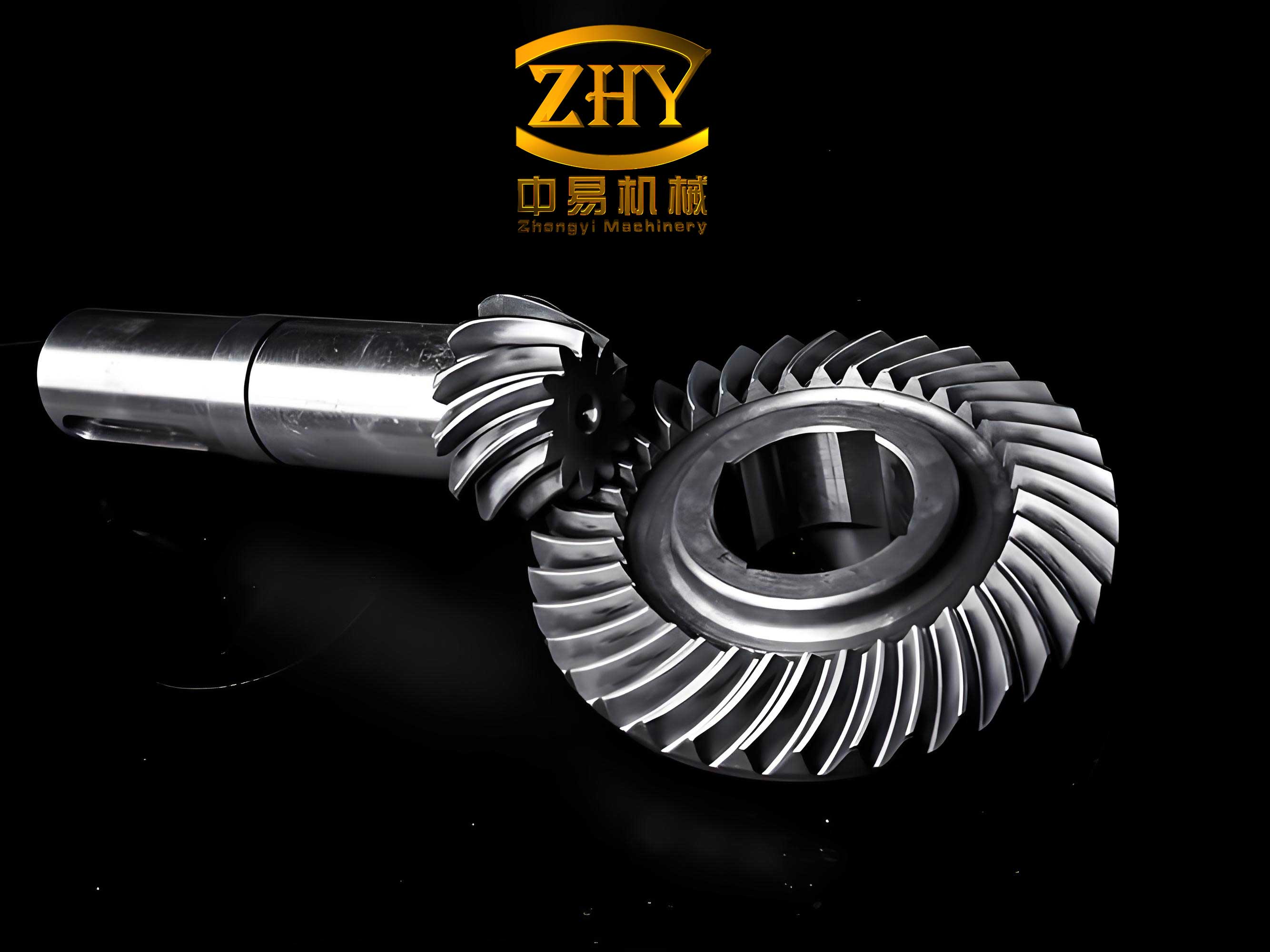
Mathematical Foundation of the Involute Spiral Bevel Gear
The core of a precise spiral bevel gear model lies in the accurate mathematical description of its tooth flanks. The approach is based on the generation of a spherical involute curve, which is the natural tooth form for conjugate action on a spherical surface, analogous to the planar involute for cylindrical gears.
1.1 Mathematical Description of the Spherical Involute
The spherical involute can be conceptualized as the trace of a point on a great circle that rolls without slipping on the base cone’s surface. Consider a base cone with its apex at the origin O of a coordinate system. Let a generating plane, tangent to the base cone along a generatrix, roll on the base cone. A point P fixed on this generating plane will trace a spherical involute on the surface of a sphere centered at O. The derivation leads to the following parametric equations for the spherical involute in a coordinate system attached to the start of the curve:
$$ x_1 = R_b (\sin\delta_b \cos\phi \cos\psi + \sin\phi \sin\psi) $$
$$ y_1 = R_b (\sin\delta_b \sin\phi \cos\psi – \cos\phi \sin\psi) $$
$$ z_1 = R_b \cos\delta_b (1 – \cos\psi) $$
Where:
| Symbol | Description |
|---|---|
| $$R_b$$ | Base cone distance (radius at the gear’s large end). |
| $$\delta_b$$ | Base cone angle. |
| $$\phi$$ | Rolling angle on the base cone’s development (small circle). |
| $$\psi$$ | Rolling angle on the generating plane (great circle), related by $$\psi = \phi \sin\delta_b$$. |
The direction of the curve is determined by the sign of $$\phi$$. A positive $$\phi$$ generates a left-hand spherical involute, while a negative $$\phi$$ generates a right-hand spherical involute, which is fundamental for defining the convex and concave flanks of the spiral bevel gear tooth.
1.2 Equation of the Base Cone Helix (Spiral Line)
The defining feature of a spiral bevel gear, as opposed to a straight bevel gear, is the helical curvature of its teeth along the face width. This curvature is defined by a helix on the base cone. The helix is characterized by its lead, $$T_b$$, which is the axial advancement along the cone for one complete revolution.
The parametric equations for a point on this base cone helix are given by:
$$ x = \frac{T_b}{2\pi} \theta_i \sin\delta_b \cos\theta_i $$
$$ y = \frac{T_b}{2\pi} \theta_i \sin\delta_b \sin\theta_i $$
$$ z = \frac{T_b}{2\pi} \theta_i \cos\delta_b $$
Where $$\theta_i$$ is the spiral angle parameter. The relationship between the instantaneous cone distance $$R_{bi}$$ and the spiral angle is $$R_{bi} = \frac{T_b}{2\pi} \theta_i$$. This helix serves as the directrix for constructing the spiral tooth flank.
1.3 Mathematical Description of the Tooth Flank Surface
The tooth surface of an involute spiral bevel gear, known as a spherical involute helicoid, is a complex three-dimensional surface. It can be generated as the locus of spherical involutes whose starting points lie on the base cone helix defined above. Conceptually, one takes a series of concentric spheres centered at the cone apex, with radii ranging from the inner to the outer cone distance. Each sphere intersects the base cone helix at a point. Starting from each intersection point, a spherical involute is drawn on that spherical surface. The family of all such spherical involutes forms the complete tooth flank.
Mathematically, this is achieved by making the base cone distance $$R_b$$ in the spherical involute equations a variable $$R_{bi}$$ that follows the helical path. Furthermore, the coordinate system must be rotated by the spiral angle $$\theta_i$$ corresponding to $$R_{bi}$$. The resulting parametric equations for a point on the spiral bevel gear tooth flank in the global coordinate system are:
$$ x = R_{bi}[(\sin\delta_b \cos\phi \cos\psi + \sin\phi \sin\psi)\cos\theta_i – (\sin\delta_b \sin\phi \cos\psi – \cos\phi \sin\psi)\sin\theta_i] $$
$$ y = R_{bi}[(\sin\delta_b \cos\phi \cos\psi + \sin\phi \sin\psi)\sin\theta_i + (\sin\delta_b \sin\phi \cos\psi – \cos\phi \sin\psi)\cos\theta_i] $$
$$ z = R_{bi}\cos\delta_b(1 – \cos\psi) + H \cdot (R_b – R_{bi}) / R_b $$
Where $$H = R_b \cdot \cos\delta_b$$ is the height of the base cone. The parameters are:
$$R_{bi}$$ (varying from inner to outer distance), $$\phi$$ (defining the involute profile), and $$\theta_i = 2\pi R_{bi} / T_b$$ (defining the spiral position). Setting $$\phi > 0$$ generates the convex flank (drive side), and $$\phi < 0$$ generates the concave flank (coast side) of the spiral bevel gear tooth.
1.4 Profile Rotation and Tooth Space Definition
A single tooth is bounded by two flank surfaces. To generate the opposite flank of the same tooth space, the calculated flank surface must be rotated about the gear axis. The required rotation angle is derived from the gear’s geometry at the pitch cone. The relationship involves the pressure angle $$\alpha$$, the spiral angle at the pitch cone $$\beta$$, and the angular tooth thickness. For a symmetric tooth, the rotation angle for generating the opposite flank from a given involute profile is $$2(\omega_d + s/d)$$, where $$\omega_d$$ is related to the pitch point parameters. This transformation is efficiently handled using 3D rotation matrices around the Z-axis:
$$
\begin{bmatrix}
X^* & Y^* & Z^* & 1
\end{bmatrix}
=
\begin{bmatrix}
X & Y & Z & 1
\end{bmatrix}
\cdot
\begin{bmatrix}
\cos\Theta & \sin\Theta & 0 & 0 \\
-\sin\Theta & \cos\Theta & 0 & 0 \\
0 & 0 & 1 & 0 \\
0 & 0 & 0 & 1
\end{bmatrix}
$$
Where $$\Theta$$ is the calculated rotation angle. Applying this rotation to the set of points defining one flank yields the points for the opposing flank, thereby defining the boundaries of a single tooth space for the spiral bevel gear.
Parametric Modeling and OpenGL Implementation
Based on the mathematical model, a specialized software application was developed using C++ and OpenGL. This software integrates geometric design, real-time visualization, and preliminary analysis. The core modeling workflow within the OpenGL environment is detailed below.
2.1 Geometric Design Parameters
The spiral bevel gear model is driven by a set of fundamental design parameters. The software interface allows users to input these key parameters, from which all other geometric properties are automatically calculated. The primary parameters are summarized in the following table:
| Parameter | Symbol | Source/Standard |
|---|---|---|
| Shaft Angle | $$\Sigma$$ | Input (e.g., 90°) |
| Number of Teeth (Pinion/Gear) | $$Z_1, Z_2$$ | User Input |
| Module (or Diametral Pitch) | $$m$$ | User Input |
| Face Width | $$B$$ | User Input ($$B \leq R_b / 3$$) |
| Pressure Angle | $$\alpha$$ | User Input |
| Spiral Angle at Pitch Cone | $$\beta$$ | User Input |
| Helix Lead | $$T_b$$ | Calculated from $$\beta$$ or User Input |
| Addendum Coefficient | $$n$$ | Standard Value |
| Dedendum Coefficient | $$-$$ | Standard Value |
| Clearance | $$c$$ | Standard Value |
| Bore Diameter | $$d_k$$ | User Input |
2.2 Derivation of Modeling Parameters
From the basic inputs, the software computes all necessary geometric values for rendering the spiral bevel gear.
1. Pitch and Base Cone Geometry: The pitch cone angle $$\delta$$ is calculated from the shaft angle and gear ratio. The base cone angle $$\delta_b$$ is derived from the pitch cone angle and pressure angle: $$\delta_b = \arccos(\cos\delta \cdot \cos\alpha)$$. The outer cone distance $$R_b$$ is calculated from the module and number of teeth: $$R_b = m \cdot Z / (2 \sin\delta)$$.
2. Profile Limits (Start and End of Active Involute): The spherical involute does not extend to the cone apex; it starts at the base of the active profile, typically at the root cone plus clearance, and ends at the tip circle. The limiting radii are:
– Tip Radius: $$r_a = R_b \sin(\delta + \gamma_a)$$
– Start Radius: $$r_{start} = R_b \sin(\delta_f + c/R_b)$$
The corresponding limits for the involute parameter $$\phi$$ are found by solving the spherical involute equation under the condition $$x^2 + y^2 = r^2_{limit}$$. This ensures the generated tooth profile has correct addendum, dedendum, and clearance for the spiral bevel gear.
3. Spiral Angle Calculation: The spiral angle $$\theta_i$$ at any cone distance $$R_{bi}$$ is directly given by the helix equation: $$\theta_i = 2\pi R_{bi} / T_b$$.
2.3 OpenGL Rendering Pipeline for a Single Tooth
The construction of the 3D model in OpenGL follows a procedural approach:
Step 1: Flank Surface Tessellation. The parametric surface equations are discretized. A nested loop iterates over the face width (parameter $$R_{bi}$$ from $$R_{inner}$$ to $$R_{outer}$$ with a chosen step $$\Delta R$$) and over the profile height (parameter $$\phi$$ from $$\phi_{start}$$ to $$\phi_{end}$$ with a step $$\Delta\phi$$). For each combination $$(R_{bi}, \phi)$$, the 3D coordinates $$(x, y, z)$$ of a point on the convex flank are computed using the tooth flank equations with $$\phi > 0$$.
Step 2: Mesh Generation. Consecutive points in the $$R_{bi}$$ and $$\phi$$ parameter space are connected to form quadrilateral polygons (quads). This is efficiently done in OpenGL using vertex arrays or immediate mode commands like `glBegin(GL_QUADS)`. For each quad defined by vertices $$V(R_{bi}, \phi)$$, $$V(R_{bi}+\Delta R, \phi)$$, $$V(R_{bi}+\Delta R, \phi+\Delta\phi)$$, and $$V(R_{bi}, \phi+\Delta\phi)$$, the vertices and their computed normal vectors (essential for lighting) are sent to the graphics pipeline. This process creates a meshed surface for the convex flank of the spiral bevel gear.
Step 3: Generating the Concave Flank. The set of vertices for the convex flank are transformed using the rotation matrix around the Z-axis by the angle $$\Theta = 2(\omega_d + s/d)$$. This rotated set of vertices defines the concave flank. The same quad-strip generation process can be applied to these points to mesh the concave surface.
Step 4: Capping the Tooth. To create a solid, watertight model suitable for FEA export (e.g., as an STL file), the tooth must be “capped” at its ends and sides. This involves creating surfaces for:
– The Tip Land: Connecting the points where $$\phi = \phi_{end}$$ (tip line) for all $$R_{bi}$$.
– The Root Fillet Region: A surface connecting the start-of-involute line ($$\phi = \phi_{start}$$) to the root cone surface. While an exact trochoidal fillet can be modeled, a simplified ruled surface is often used for visualization.
– The Inner and Outer Rim Faces: Planar (conical section) surfaces at $$R_{bi} = R_{inner}$$ and $$R_{bi} = R_{outer}$$, bounded by the convex and concave flanks and the root surface.
These surfaces are also tessellated into triangles or quads using OpenGL primitives.
Step 5: Full Gear Assembly. A single, complete tooth solid is now defined in memory. To create the entire spiral bevel gear, this tooth is duplicated around the axis. This is achieved by applying a rotational transformation of $$360^\circ / Z$$ repeatedly. In OpenGL, this can be done by pushing/popping the modelview matrix and using `glRotatef(360.0/Z, 0.0, 0.0, 1.0)` within a loop that renders the single tooth mesh Z times.
| OpenGL Function/Feature | Purpose in Spiral Bevel Gear Modeling |
|---|---|
| `glBegin(GL_QUADS)` / `glEnd()` | Defining quadrilateral facets for surface tessellation. |
| `glVertex3f(x, y, z)` | Specifying vertex coordinates computed from gear equations. |
| `glNormal3f(nx, ny, nz)` | Specifying vertex normals for proper lighting/shading. |
| `glPushMatrix()` / `glPopMatrix()` | Managing the transformation stack for gear assembly. |
| `glRotatef(angle, x, y, z)` | Rotating a tooth to create the concave flank and for arraying teeth around the axis. |
| Vertex Arrays / Buffer Objects | (Advanced) Efficiently storing and rendering large meshes for high-tooth-count spiral bevel gears. |
| `GLU` tessellator | Triangulating complex polygonal caps (tip, root) automatically. |
Advanced Modeling Considerations and Applications
The parametric model’s true power is revealed when addressing advanced design scenarios and downstream engineering applications for spiral bevel gears.
3.1 Localized Modifications and Optimization
The mathematical model allows for easy incorporation of profile and lead modifications, which are critical for compensating under load deflections and minimizing transmission error in spiral bevel gears. For instance:
– Profile Crowning: This can be simulated by adding a small, controlled parabolic deviation to the $$\phi$$ parameter as a function of the profile roll angle, effectively shifting the involute generation point.
– Lead Crowning: Similarly, a parabolic modification can be applied to the spiral angle $$\theta_i$$ as a function of the face width position $$R_{bi}$$.
These modifications are implemented by adding perturbation terms to the core equations, allowing designers to interactively adjust crown amounts and visualize their impact on the spiral bevel gear tooth contact pattern virtually.
3.2 Meshing for Finite Element Analysis
The OpenGL-rendered mesh, while suitable for visualization, often requires refinement and structuring to be an effective FEA mesh. The parametric nature of the model allows for direct generation of a structured hexahedral or high-quality tetrahedral mesh. The parameters $$R_{bi}$$, $$\phi$$, and the rotational tooth index naturally define a curvilinear coordinate system. Nodes can be placed directly from the surface equations, and connectivity is established based on parameter increments. This method yields a mesh with excellent geometric accuracy and element quality, which is crucial for reliable stress and contact analysis of the loaded spiral bevel gear pair.
3.3 Dynamic Simulation and Contact Analysis
The precise digital model serves as the geometric input for multi-body dynamic simulation (MBS) software. The tooth surface point data can be exported to define rigid or flexible gear bodies. Coupled with defined mass properties and bearing stiffness, the model enables the simulation of dynamic transmission error, mesh stiffness variation, and system-level vibrations. Furthermore, the exact geometry is essential for undertaking detailed elastohydrodynamic lubrication (EHL) analysis to predict film thickness and friction losses within the spiral bevel gear mesh.
3.4 Direct Link to CNC Machining
Liberating the spiral bevel gear design from fixed machining methods opens the door to advanced manufacturing. The coordinates of the tooth flank, calculated by the model, can be used directly to generate tool paths for:
– 5-Axis CNC Milling: Using a ball-nose or barrel cutter, the tool center points can be calculated via offsetting from the designed tooth surface.
– Additive Manufacturing (3D Printing): The model can be exported as an STL file, which is the standard input for layer-based manufacturing processes, enabling rapid prototyping or production of custom spiral bevel gears in metals or polymers.
The parametric approach allows for instant regeneration of the tool path whenever a design parameter is changed, dramatically shortening the development cycle for custom or optimized spiral bevel gears.
Advantages of the Proposed Methodology
The approach of direct mathematical modeling coupled with OpenGL visualization offers distinct benefits for spiral bevel gear engineering:
| Aspect | Traditional (Machine-Based) Method | Proposed Parametric Modeling Method |
|---|---|---|
| Design Flexibility | Limited by available cutter heads and machine settings. Changes require new hardware. | Unlimited. Any geometric parameter (pressure angle, spiral angle, profile curvature) can be changed via software input. |
| Model Accuracy | Approximate, based on simulated cutting action. Includes machine and cutter errors. | Theoretically exact, defined by pure mathematical equations (spherical involute). |
| Development Speed | Slow, requires physical cutter design/manufacture and trial cuts. | Extremely fast. Model regenerates instantly after parameter change. |
| Integration with CAE | Requires conversion from CAD, often losing precision. | Seamless. The same mathematical core feeds visualization, FEA meshing, and CAM tool path generation. |
| Cost for Prototyping | High (tooling costs). | Low (software-based). Ideal for one-off or customized spiral bevel gears. |
Conclusion
The development of a precise, parametric 3D modeling methodology for involute spiral bevel gears represents a significant advancement in gear design technology. By grounding the model in the fundamental geometry of the spherical involute and the base cone helix, an accurate and manufacturing-independent digital twin of the spiral bevel gear is created. The implementation using the OpenGL graphics library provides a robust and interactive framework for visualizing these complex models, validating geometry, and performing initial assembly checks.
This foundational model is far more than a visual aid; it acts as a single source of truth that drives the entire product development lifecycle for spiral bevel gears. It enables sophisticated finite element analysis for strength and durability prediction, forms the basis for dynamic system simulation, and directly generates data for modern, flexible manufacturing processes like 5-axis CNC machining and additive manufacturing. By decoupling design from specific production constraints, this approach empowers engineers to explore innovative spiral bevel gear geometries for performance optimization, weight reduction, and customization, ultimately leading to more efficient and reliable mechanical transmission systems.
Future work will focus on enhancing the software framework to include automatic contact pattern prediction under load, advanced optimization loops integrating genetic algorithms with the parametric model, and extending the methodology to hypoid gears. The continuous refinement of this digital modeling paradigm ensures that spiral bevel gear design will remain at the forefront of precision mechanical engineering.