
In the realm of power transmission, the cylindrical gear stands as a fundamental component. The performance, efficiency, and longevity of a gear pair are critically dependent on the precise control of the backlash or side clearance between mating teeth. This control is ultimately dictated by the specification of appropriate upper and lower deviations for the tooth thickness on the component drawing. In the design, manufacturing, and inspection of cylindrical gear elements, engineers frequently encounter the need to work with different parameters that describe tooth thickness: namely, the constant chord tooth thickness, the base tangent length (often called gear span measurement or measurement over pins), and the dimension over balls or rollers (M value). While gear handbooks often provide formulae for converting deviations between two of these parameters, a unified and comprehensive treatment of the incremental relationships among all three is less common. This article delves into the characteristics, applications, and, most importantly, the precise mathematical relationships between the increments (changes) of these three key tooth thickness parameters for standard spur cylindrical gears.
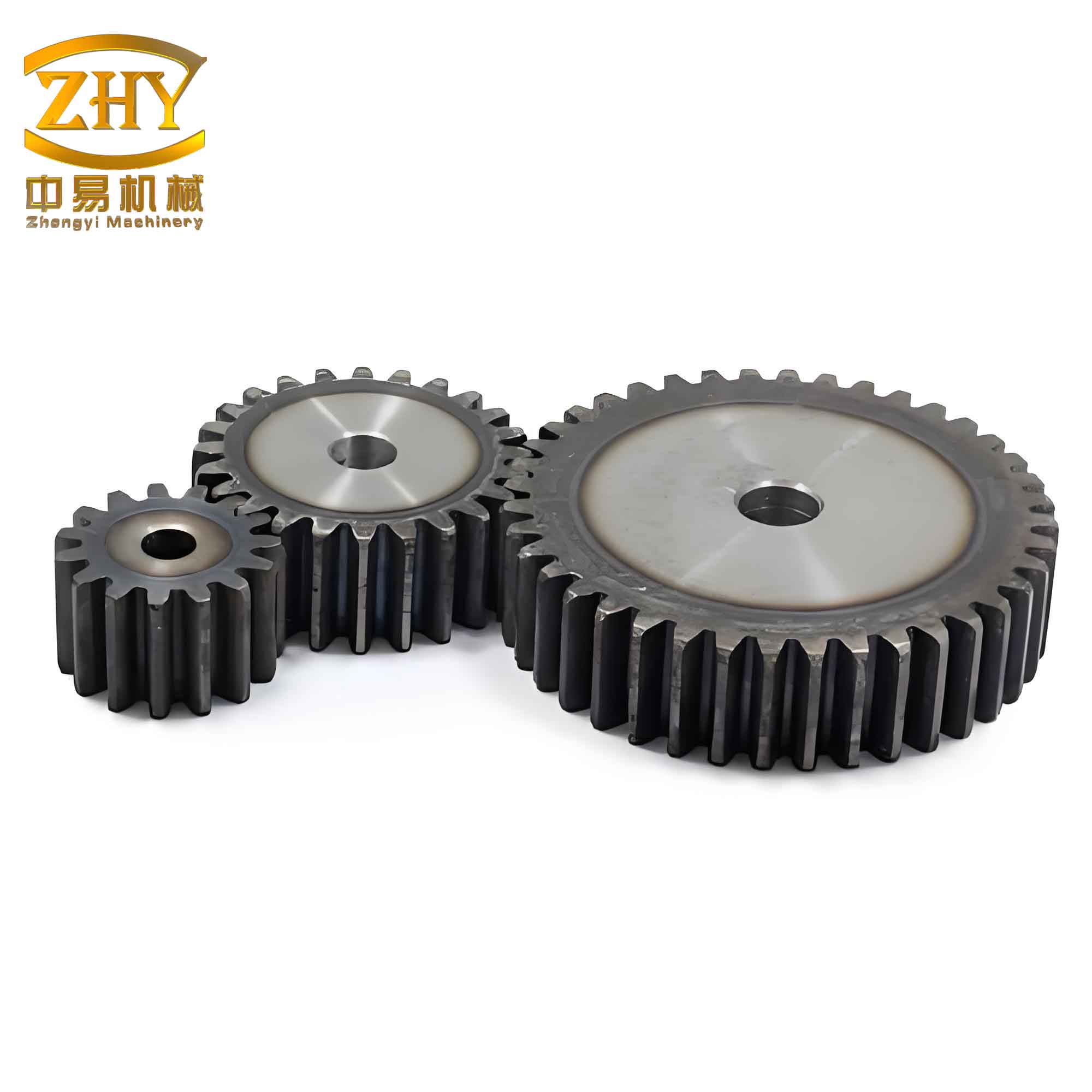
Three Fundamental Methods for Tooth Thickness Measurement
The effective size of a gear tooth can be assessed through several indirect measurement techniques. Each method has its own advantages, limitations, and ideal field of application within cylindrical gear manufacturing and inspection.
1. Constant Chord Tooth Thickness Measurement
This method is based on the concept of the “constant chord,” which is the chord length of a tooth where it is contacted by a basic rack tooth profile at symmetrical points. For a standard, non-modified cylindrical gear, this value is constant for a given module and pressure angle, independent of the number of teeth. The geometry is defined by two parameters: the constant chord tooth thickness $$ \overline{S_c} $$ and the constant chord height $$ \overline{h_c} $$.
The theoretical formulae are:
$$ \overline{S_c} = \frac{\pi m}{2} \cos^{2}\alpha $$
$$ \overline{h_c} = h_a – \frac{\pi m}{8} \sin 2\alpha – (R_a – R_{a,actual}) $$
Where:
\( m \) = module
\( \alpha \) = standard pressure angle at the reference circle (e.g., 20°, 15°, 14.5°)
\( h_a \) = addendum (typically equal to \( m \) for standard gears)
\( R_a \) = theoretical tip circle radius
\( R_{a,actual} \) = measured tip circle radius
The term \( (R_a – R_{a,actual}) \) accounts for deviations in the actual tip diameter, which directly affect the measurement height. This dependency on tip diameter accuracy is a significant drawback. Common tools for this measurement include gear tooth calipers and dedicated chordal thickness gauges. Simplified formulae for common pressure angles are shown in the table below.
| Pressure Angle \( \alpha \) (°) | Constant Chord Thickness \( \overline{S_c} \) | Constant Chord Height \( \overline{h_c} \) |
|---|---|---|
| 20 | 1.3871 \( m \) | 0.7476 \( m \) – \( \Delta R_a \) * |
| 15 | 1.4656 \( m \) | 0.8037 \( m \) – \( \Delta R_a \) * |
| 14.5 | 1.4723 \( m \) | 0.8096 \( m \) – \( \Delta R_a \) * |
* \( \Delta R_a = R_a – R_{a,actual} \)
While simple to calculate, the method’s susceptibility to errors from tooth profile deviations, radial runout, and tip diameter inaccuracies limits its use to relatively low-precision cylindrical gears, typically grade 7 or coarser per ISO 1328-1 for modules greater than 1 mm.
2. Base Tangent Length (Span Measurement) Measurement
This highly popular method involves measuring the distance between two parallel planes tangent to opposite tooth flanks. These tangent planes are generated by the jaws of a gear span micrometer or similar instrument. The key advantage is that the measurement is independent of the tip diameter and its errors. The base tangent length \( W_k \) over \( k \) teeth is given by:
$$ W_k = m \cos \alpha \left[ \pi (k – 0.5) + z \, \text{inv} \alpha \right] $$
Where:
\( z \) = number of teeth
\( \text{inv} \alpha \) = involute function of \( \alpha \) ( \( \text{inv} \alpha = \tan \alpha – \alpha \) )
\( k \) = number of teeth spanned, typically calculated as: \( k = \frac{z}{180^\circ} \alpha + 0.5 \) (rounded to the nearest integer).
Due to its insensitivity to tip diameter errors and the availability of precise micrometers, this method is the workhorse for inspecting cylindrical gears of module 0.5 mm and above, for precision grades 7 and finer.
3. Dimension Over Balls/Rollers (M Measurement)
This is an indirect but very sensitive method for assessing tooth thickness. Precision balls or rollers (wires) of diameter \( d_p \) are placed in opposite tooth spaces, and the distance \( M \) over the outer surfaces of these balls is measured. For an even number of teeth, the measurement is taken directly. For an odd number, a correction factor is applied because the measurement axis does not pass through the gear center.
The theoretical formulae for a standard cylindrical gear are:
For even \( z \): $$ M = D_m + d_p $$
For odd \( z \): $$ M = D_m \cos\left(\frac{90^\circ}{z}\right) + d_p $$
Where \( D_m \) is the diameter of the circle passing through the centers of the measuring balls:
$$ D_m = \frac{m z \cos \alpha}{\cos \alpha_m} $$
The pressure angle \( \alpha_m \) at the ball center must be solved from the involute equation:
$$ \text{inv} \alpha_m = \frac{d_p}{m z \cos \alpha} + \text{inv} \alpha – \frac{\pi}{2z} $$
While computationally more intensive, the M-measurement offers distinct advantages, especially for fine-pitch cylindrical gears:
1. It is exceptionally suitable for small and medium modules (particularly m < 1).
2. It provides highly precise and stable results, being unaffected by radial runout or tip diameter errors.
3. It has high sensitivity to tooth thickness variation. As will be derived, a small change in tooth thickness produces a magnified change in the M value (e.g., approximately 2.75 times for \( \alpha = 20^\circ \)), making it ideal for applications requiring extremely tight backlash control.
Derivation of Incremental Relationships Between Parameters
The core of practical interchangeability lies in understanding how a small deviation (increment) in one tooth thickness parameter relates to the corresponding increment in another. These relationships are linear for small deviations and are crucial for tolerance conversion and machining allowance calculations.
1. Relationship Between Base Tangent Length and Constant Chord Increments
Consider a small increase \( \Delta S_c \) in the constant chord tooth thickness. This increase occurs along the tooth profile. The corresponding increase in the base tangent length \( \Delta W_k \) is the projection of \( \Delta S_c \) onto the direction of the base tangent (which is normal to the tooth profile at the reference circle). From the geometry of the involute at the reference point, this direction has an angle \( \alpha \) relative to the radial line. Therefore, the approximate relationship is:
$$ \Delta W_k \approx \Delta S_c \cdot \cos \alpha $$
This is an approximation because the base tangent is measured over several teeth, but for small deviations and contact near the reference circle, it is sufficiently accurate for engineering purposes.
2. Relationship Between M Dimension and Base Tangent Length Increments
The analysis for the relationship between \( \Delta M \) and \( \Delta W_k \) requires considering the geometry of the ball contact. For a cylindrical gear with an even number of teeth, if the left and right tooth flanks each move outward by \( \Delta W_k / 2 \) in the direction normal to the flank at the ball contact point, the center of the measuring ball will be displaced radially outward. This radial displacement \( \Delta r_m \) is related to the normal flank movement by the sine of the pressure angle \( \alpha_m \) at the ball center.
$$ \frac{\Delta W_k}{2} = \Delta r_m \cdot \sin \alpha_m $$
Since \( \Delta M = 2 \Delta r_m \) for even teeth, we get:
$$ \Delta M = \frac{\Delta W_k}{\sin \alpha_m} \quad \text{(for even } z \text{)} $$
For a cylindrical gear with an odd number of teeth, the measured dimension M is not along a diameter. The incremental change must account for the angular offset:
$$ \Delta M = \frac{\Delta W_k}{\sin \alpha_m} \cdot \cos\left(\frac{90^\circ}{z}\right) \quad \text{(for odd } z \text{)} $$
For a standard gear where the ball contacts the flank near the reference circle, \( \alpha_m \) is approximately equal to the reference pressure angle \( \alpha \). As the number of teeth increases, \( \cos(90^\circ/z) \) approaches 1.
3. Relationship Between M Dimension and Constant Chord Increments
Combining the two previous relationships yields the direct link between \( \Delta M \) and \( \Delta S_c \). Substituting \( \Delta W_k = \Delta S_c \cdot \cos \alpha \) into the equations for \( \Delta M \) gives:
For even \( z \): $$ \Delta M = \frac{\Delta S_c \cdot \cos \alpha}{\sin \alpha_m} $$
For odd \( z \): $$ \Delta M = \frac{\Delta S_c \cdot \cos \alpha}{\sin \alpha_m} \cdot \cos\left(\frac{90^\circ}{z}\right) $$
A common and useful approximation, assuming contact at the reference circle (\( \alpha_m \approx \alpha \)), is:
$$ \Delta M \approx \Delta S_c \cdot \cot \alpha $$
Summary of Incremental Ratios and Application Charts
The derived relationships can be summarized as ratios. The ratio \( \Delta W_k / \Delta S_c \) depends only on the pressure angle \( \alpha \), as shown in Table 2. The ratios involving \( \Delta M \) depend on both \( \alpha \) and the number of teeth \( z \), as they are functions of \( \alpha_m \) and, for odd teeth, \( \cos(90^\circ/z) \).
| Pressure Angle \( \alpha \) (°) | \( \Delta W_k / \Delta S_c \) | \( \Delta S_c / \Delta W_k \) |
|---|---|---|
| 20 | 0.9397 | 1.064 |
| 15 | 0.9659 | 1.035 |
| 14.5 | 0.9681 | 1.033 |
The ratios \( \Delta M / \Delta W_k \) and \( \Delta M / \Delta S_c \) vary with \( z \). Tables 3 and 4 below provide these ratios for even and odd numbers of teeth under three common pressure angles. A key observation is that for small tooth numbers, the ratio for odd teeth is slightly smaller due to the \( \cos(90^\circ/z) \) factor. However, for \( z > 7 \), the difference becomes negligible for most engineering approximations, and the even-tooth formula can be used for both.
| \( \alpha \) (°) | Even Number of Teeth \( z \) | Odd Number of Teeth \( z \) | ||||||
|---|---|---|---|---|---|---|---|---|
| z=10 | z=20 | z=50 | z=∞ | z=9 | z=19 | z=49 | z=∞ | |
| 20 | 2.06 | 2.26 | 2.41 | 2.92 | 1.97 | 2.24 | 2.40 | 2.92 |
| 15 | 2.46 | 2.89 | 3.16 | 3.86 | 2.33 | 2.85 | 3.15 | 3.86 |
| 14.5 | 2.51 | 2.97 | 3.26 | 3.99 | 2.37 | 2.92 | 3.25 | 3.99 |
| \( \alpha \) (°) | Even Number of Teeth \( z \) | Odd Number of Teeth \( z \) | ||||||
|---|---|---|---|---|---|---|---|---|
| z=10 | z=20 | z=50 | z=∞ | z=9 | z=19 | z=49 | z=∞ | |
| 20 | 1.94 | 2.13 | 2.26 | 2.75 | 1.85 | 2.11 | 2.25 | 2.75 |
| 15 | 2.38 | 2.79 | 3.05 | 3.73 | 2.25 | 2.75 | 3.04 | 3.73 |
| 14.5 | 2.43 | 2.87 | 3.15 | 3.86 | 2.29 | 2.82 | 3.14 | 3.86 |
For practical on-the-spot use, graphical charts are invaluable. The charts below (Figures 1-3) visualize the relationship between the three increments \( \Delta S_c \), \( \Delta W_k \), and \( \Delta M \) for three common pressure angles and a range of tooth counts. Given any one increment, the corresponding values for the other two can be quickly read. These charts are particularly useful for cylindrical gear applications where quick, approximate conversions are needed during design or manufacturing.
Figure 1: Increment Relationship Chart for \( \alpha = 20^\circ \)
A graph would be plotted here with \( \Delta S_c \) (µm) on the primary x-axis. Three sets of lines/families would be present:
1. A nearly horizontal line showing the direct, z-independent conversion to \( \Delta W_k \) (right y-axis).
2. A family of curves for different \( z \) values (e.g., z=10, 20, 50, ∞) showing the conversion from \( \Delta S_c \) to \( \Delta M \) (left y-axis).
3. Secondary gridlines allowing a user to start from a known \( \Delta W_k \) or \( \Delta M \) and find the others.
(Note: As per the instruction, the graph itself is not rendered in this text, but its description and use are explained.)
Figure 2: Increment Relationship Chart for \( \alpha = 15^\circ \)
Similar to Figure 1, but with steeper slopes for the \( \Delta M \) curves, reflecting the higher sensitivity (larger \( \Delta M / \Delta S_c \) ratio) at this lower pressure angle.
Figure 3: Increment Relationship Chart for \( \alpha = 14.5^\circ \)
Similar to Figures 1 and 2, calibrated for the 14.5° pressure angle commonly found in certain gear systems.
Practical Application Examples
The derived formulae and charts find immediate use in engineering tasks related to cylindrical gear quality control and machining.
Example 1: Tolerance Conversion
Problem: A standard cylindrical gear has \( \alpha = 20^\circ \) and \( z = 30 \). The drawing specifies constant chord thickness limits as \( S_c^{-0.020}_{-0.065} \) mm. Find the corresponding upper and lower deviations for the base tangent length \( W_k \) and the dimension over balls \( M \).
Solution:
– Constant chord tolerance: \( \Delta S_{c,upper} = -0.020 \) mm, \( \Delta S_{c,lower} = -0.065 \) mm.
– For \( \Delta W_k \): Using the approximate formula \( \Delta W_k \approx \Delta S_c \cdot \cos 20^\circ \approx \Delta S_c \cdot 0.94 \).
\( \Delta W_{k,upper} \approx -0.020 \times 0.94 = -0.0188 \) mm ≈ \( -0.019 \) mm.
\( \Delta W_{k,lower} \approx -0.065 \times 0.94 = -0.0611 \) mm ≈ \( -0.061 \) mm.
Thus, \( W_k^{-0.019}_{-0.061} \) mm.
– For \( \Delta M \): Using the chart for \( \alpha=20^\circ, z=30 \), or the approximate formula \( \Delta M \approx \Delta S_c \cdot \cot 20^\circ \approx \Delta S_c \cdot 2.75 \).
\( \Delta M_{upper} \approx -0.020 \times 2.75 = -0.055 \) mm.
\( \Delta M_{lower} \approx -0.065 \times 2.75 = -0.17875 \) mm ≈ \( -0.179 \) mm.
A more precise lookup from a detailed chart/table for z=30 might yield \( \Delta M / \Delta S_c \approx 2.41 \), giving \( \Delta M_{upper} \approx -0.048 \) mm and \( \Delta M_{lower} \approx -0.157 \) mm. This demonstrates the importance of using the correct ratio for the specific z.
Example 2: Machining Allowance Calculation
Problem: A cylindrical gear with \( \alpha = 14.5^\circ \) and \( z = 25 \) is being finish-ground. An interim check of the dimension over balls shows it is \( \Delta M = +31 \) µm larger than the final target value (i.e., there is 31 µm of material left to remove on the M dimension). What is the corresponding amount of material to be removed in terms of normal tooth thickness (approximated by \( \Delta S_c \))?
Solution:
– Using the chart for \( \alpha=14.5^\circ \) and \( z=25 \), find the ratio \( \Delta M / \Delta S_c \). For this z, it is approximately 3.0.
– Therefore, \( \Delta S_c \approx \Delta M / 3.0 = 31 / 3.0 \approx 10.3 \) µm.
– Alternatively, find \( \Delta W_k \) from the same chart. For \( \Delta M = 31 \) µm, \( \Delta W_k \) is approximately 9.7 µm. Since \( \Delta W_k \approx \Delta S_c \cdot \cos 14.5^\circ \), we get \( \Delta S_c \approx 9.7 / 0.9681 \approx 10.0 \) µm.
This tells the machine operator that the grinding wheel needs to remove approximately 10 µm of material from the tooth flank in the normal direction to achieve the final M dimension.
Conclusion
The precise control and measurement of tooth thickness in a cylindrical gear are paramount for ensuring proper function. The three primary parameters—constant chord thickness, base tangent length, and dimension over balls—each serve a purpose based on required precision, gear size, and practicality. The key to flexible application in design and manufacturing lies in the incremental relationships between these parameters. The derivations presented establish the mathematical foundations: \( \Delta W_k \approx \Delta S_c \cdot \cos \alpha \), and \( \Delta M \approx \Delta W_k / \sin \alpha_m \approx \Delta S_c \cdot \cot \alpha \), with corrections for odd tooth numbers. Summary tables and the conceptual application charts provide engineers with rapid conversion tools. Mastering these relationships allows for seamless translation of tolerance specifications, accurate calculation of machining allowances, and ultimately, the production of high-quality cylindrical gears with precisely controlled backlash, directly contributing to the reliability and efficiency of mechanical systems.