
In the field of mechanical engineering, the accurate modeling and simulation of gear systems are crucial for optimizing performance in various applications, such as robotic joints. This article focuses on the precise modeling and systematic analysis of a straight bevel gear train used in a multi-axis robot’s end joint. Straight bevel gears are essential components for transmitting motion between intersecting shafts, offering advantages like high overlap ratio, smooth operation, and robust load-bearing capacity. The primary goal is to explore how the structural characteristics of the straight bevel gear train influence the end-effector performance of a robotic system. By comparing different modeling approaches and implementing a parameterized model using Pro/E software, this study aims to achieve high precision in geometry representation. Subsequently, dynamic simulations in ADAMS and finite element analysis (FEA) using HyperMesh and ABAQUS are conducted to validate the model’s accuracy and assess its mechanical behavior under operational conditions.
The importance of straight bevel gears in industrial machinery, including automotive and manufacturing equipment, cannot be overstated. In robotic systems, such as the six-degree-of-freedom robot discussed here, straight bevel gears facilitate power transmission from centralized motor groups to rotational joints at the end-effector. However, the complex geometry of straight bevel gears, characterized by spherical involute profiles, poses challenges for precise digital modeling. Traditional methods often introduce approximations that can lead to errors, especially in high-precision applications. Therefore, this research emphasizes a method based on the spherical involute principle to ensure accurate and parameterized modeling. The integration of multiple computer-aided engineering (CAE) tools enables a comprehensive analysis, covering dynamics and stress distribution, which provides a foundation for further optimization of similar mechanical systems.
To begin, it is essential to understand the fundamental modeling techniques for straight bevel gears. Three primary methods are commonly employed: the back-cone approximation method, the machining simulation method, and the principle-based derivation method. Each approach has its merits and limitations in terms of accuracy and practicality. The back-cone approximation method, for instance, simplifies the spherical geometry into a planar representation by unwrapping the back-cone surface, resulting in a “virtual” spur gear that approximates the straight bevel gear’s tooth profile. This method is widely used due to its simplicity and alignment with conventional design processes. However, it introduces errors, particularly when the ratio of the sphere radius to the gear module is small, as the deviation from the true spherical involute becomes significant. The machining simulation method replicates actual manufacturing processes, such as those using Gleason machine tools, by mathematically modeling the interaction between cutters and gear blanks. While this approach closely mirrors real-world production and aids in manufacturing preparation, it requires intricate coordinate transformations and expertise in numerical computation. In contrast, the principle-based derivation method leverages the spherical involute theory to derive exact tooth profiles. By solving equations based on the generation of spherical involutes, this method achieves high precision and is well-suited for parameterized modeling in software like Pro/E.
In this study, the principle-based derivation method is adopted for modeling the straight bevel gear train. The spherical involute is defined as the curve traced by a point on a great circle of a sphere as it rolls without slipping on a base cone. The parametric equations for the spherical involute are given by:
$$ x = l(\sin \phi \sin \psi + \cos \phi \cos \psi \sin \theta) $$
$$ y = l(-\cos \phi \sin \psi + \sin \phi \cos \psi \sin \theta) $$
$$ z = l \cos \psi \cos \theta $$
where \( l \) represents the cone distance, \( \theta \) is the base cone angle, \( \phi \) is the roll angle, and \( \psi \) is related to the pressure angle \( \alpha \) and pitch cone angle \( \delta \) through the geometric relations:
$$ \psi = \phi \sin \theta $$
$$ \sin \theta = \cos \alpha \sin \delta $$
These equations form the basis for generating accurate tooth profiles in the modeling software. The use of spherical involutes ensures that the straight bevel gear model closely adheres to theoretical geometry, minimizing errors that could affect simulation results. For the robotic joint application, the straight bevel gear train consists of multiple pairs with identical parameters to achieve a 1:1 transmission ratio, simplifying the design while maintaining efficiency. The parameterized modeling process in Pro/E involves several steps, from defining geometric parameters to creating solid entities, all of which are detailed in the following sections.
The first step in parameterized modeling is to establish a table of relational parameters in Pro/E. This table includes fundamental gear parameters, such as module, number of teeth, pressure angle, and pitch cone angle, along with derived parameters calculated through mathematical relationships. For example, the cone distance \( r_x \) is derived from the module \( m \) and number of teeth \( z \) using the formula \( r_x = \frac{m \cdot z}{2 \sin \delta} \), where \( \delta \) is the pitch cone angle. Similarly, addendum \( h_a \) and dedendum \( h_f \) are computed based on the addendum coefficient, clearance coefficient, and profile shift coefficient. This parameterization allows for easy modification and adaptation of the straight bevel gear model to different design requirements. The table below summarizes key parameters and their relationships for a typical straight bevel gear pair in the robot joint system.
| Parameter | Symbol | Value | Description |
|---|---|---|---|
| Module | \( m \) | 1.75 mm | Large end module |
| Number of Teeth | \( z \) | 35 | Total teeth count |
| Pressure Angle | \( \alpha \) | 20° | Standard pressure angle |
| Pitch Cone Angle | \( \delta \) | 45° | Angle between shaft and pitch cone |
| Cone Distance | \( r_x \) | Calculated | \( r_x = \frac{m \cdot z}{2 \sin \delta} \) |
| Addendum | \( h_a \) | Calculated | \( h_a = (h_{ax} + x) \cdot m \) |
| Dedendum | \( h_f \) | Calculated | \( h_f = (h_{ax} + c_x – x) \cdot m \) |
After defining the parameters, the next step is to create reference curves based on the spherical involute equations. In Pro/E, the “From Equation” tool is used to generate curves for the large and small end spherical involutes, as well as reference circles such as the addendum circle, dedendum circle, and pitch circle at both ends. These curves serve as the foundation for constructing the tooth surfaces. For instance, the spherical involute curve at the large end is plotted using the parametric equations, and a datum point is created at the intersection of the pitch circle and the involute. This point aids in defining the tooth profile symmetry. A datum line connecting the endpoints of the involute curves is also established to guide surface creation. The resulting set of curves accurately represents the theoretical tooth geometry of the straight bevel gear.
With the curves in place, the modeling process proceeds to surface creation. The boundary blend tool in Pro/E is employed to generate the tooth flank surface by blending the large and small end spherical involute curves. To ensure a continuous profile, the surface is extended slightly before trimming. A datum plane is created through the pitch point and the gear axis, and it is rotated by \( \frac{90}{z} \) degrees to serve as a mirror plane for generating the symmetrical half of the tooth. After mirroring, the two surfaces are merged to form a complete tooth flank. Additional surfaces, such as the tip land and root fillet surfaces, are created using rotational and boundary blend tools. The root fillet is particularly important for stress reduction; a variable radius fillet is applied based on the dedendum circle to mimic realistic gear geometry. All surfaces are then merged into a single quilt, which is solidified into a 3D entity. This entity represents one tooth of the straight bevel gear.
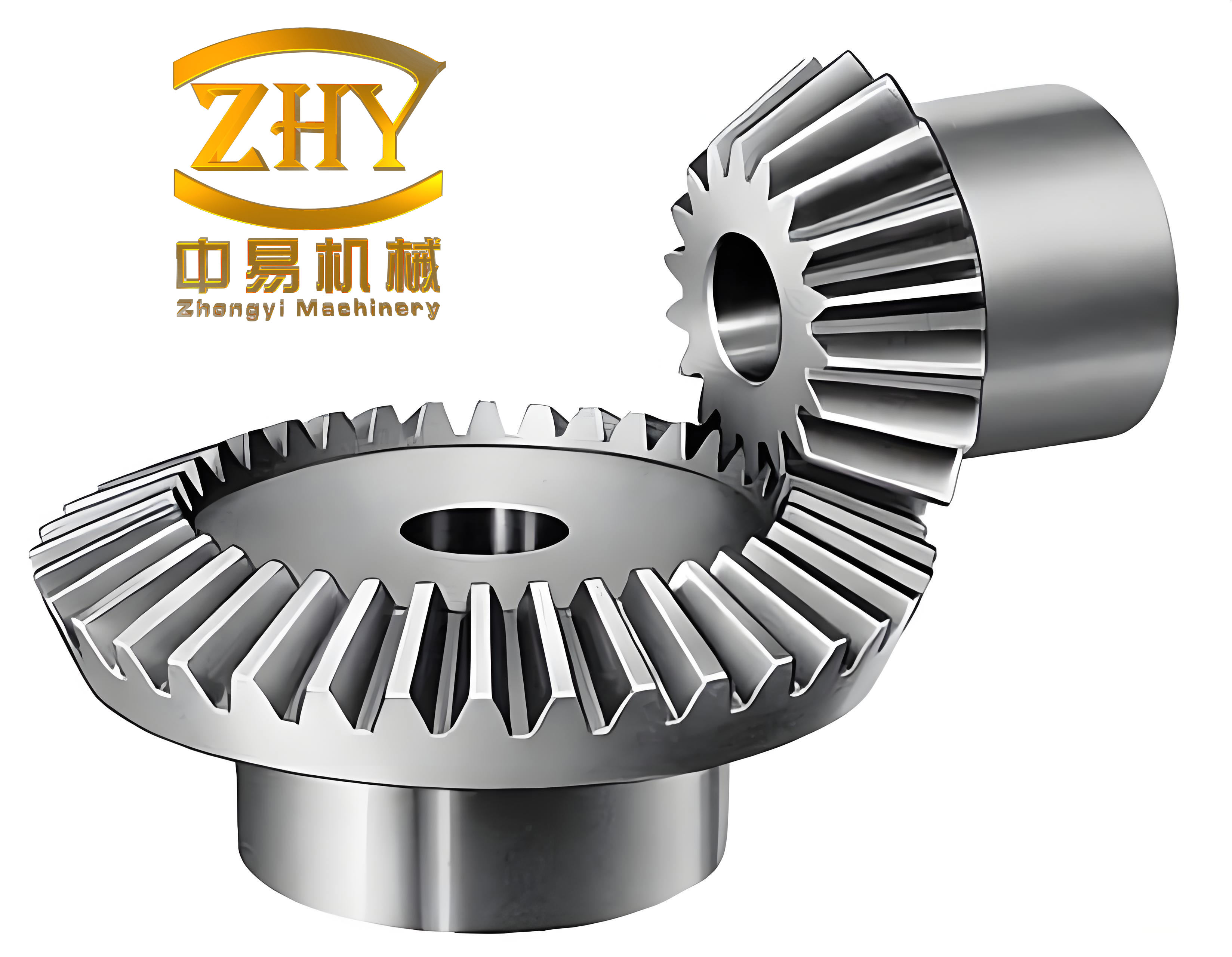
To complete the straight bevel gear model, the single tooth is patterned around the gear axis. The patterning tool in Pro/E is used with a relational parameter that links the number of instances to the number of teeth \( z \). For example, for a gear with 35 teeth, the pattern count is set to 35, and the rotation angle is \( \frac{360}{z} \) degrees. This ensures that the teeth are evenly distributed. The gear blank, including the hub and web features, is created by revolving a sketch around the axis, with dimensions controlled by the parameter table. This parameterized approach allows for rapid regeneration of the model with different specifications, facilitating design iterations. The final straight bevel gear model exhibits high geometric accuracy, with all features derived from the spherical involute theory.
For the robotic joint system, multiple straight bevel gears are assembled to form the gear train. In Pro/E, the assembly module is used to mate the gears based on their axes and reference planes. The parameter table is extended to include assembly constraints, such as axial distances and angular orientations, ensuring that the entire system is parameterized. Interference checks are performed to verify that there are no collisions between components, which is critical for realistic simulations. The assembled straight bevel gear train model is then exported to ADAMS for dynamic analysis.
The dynamic simulation in ADAMS focuses on evaluating the kinematic and kinetic behavior of the straight bevel gear train under operational conditions. The model is imported into ADAMS, and material properties are assigned to all components. Revolute joints are defined for each gear shaft, and contact forces between mating gears are modeled using the IMPACT function, which accounts for stiffness, damping, and friction. The contact stiffness coefficient \( K \) is calculated based on the material properties and gear geometry. For a typical straight bevel gear pair, \( K \) can be derived using the formula:
$$ K = \frac{\pi E}{1 – \nu^2} \cdot \frac{b}{\ln\left(\frac{r_{a1} + r_{a2}}{r_{b1} + r_{b2}}\right)} $$
where \( E \) is the Young’s modulus, \( \nu \) is Poisson’s ratio, \( b \) is the face width, and \( r_a \) and \( r_b \) are the addendum and base circle radii, respectively. For the straight bevel gears in this study, the stiffness values range from \( 4.98 \times 10^5 \) to \( 7.37 \times 10^5 \) N/mm, depending on the gear pair. Damping coefficients are set to 100 N·s/mm, and a collision exponent of 2.2 is used to model the nonlinear contact behavior. Friction is included with a dynamic coefficient of 0.05 and a static coefficient of 0.08, reflecting lubricated conditions.
Drives and loads are applied to the input and output shafts using STEP functions to simulate gradual engagement and avoid initial shocks. For example, the input angular velocity for one straight bevel gear pair is defined as \( \text{STEP}(time, 0, 0, 0.5, 120^\circ/s) \), and the output torque is \( \text{STEP}(time, 0, 0, 0.5, -200) + \text{STEP}(time, 1.5, 0, 2, 200) \) N·mm. The simulation is run for 2 seconds with a step size of 200, and the results are analyzed for angular velocities and torques. The table below compares the simulated average angular velocities of the output shafts with theoretical values based on the transmission ratios.
| Shaft | Simulated Angular Velocity (°/s) | Theoretical Angular Velocity (°/s) | Relative Error |
|---|---|---|---|
| Output Shaft 1 | 90.38 | 90.11 | 0.30% |
| Output Shaft 2 | 97.08 | 94.61 | 2.50% |
The results show that the straight bevel gear train performs closely to theoretical expectations, with minimal error for directly connected pairs. However, for gear trains involving multiple stages, such as those with additional spur gears, error accumulation leads to slightly higher deviations. This highlights the importance of precise modeling in complex systems.
In addition to dynamics, finite element analysis (FEA) is conducted to assess the stress distribution and contact behavior of the straight bevel gears. The model is imported into HyperMesh for meshing, where the gears are divided into contact and non-contact regions to optimize computational efficiency. The contact region, which includes seven teeth, is meshed with hexahedral elements (C3D8R) using the SolidMap tool, resulting in a fine mesh for accurate stress capture. The non-contact region is meshed with tetrahedral elements (C3D10M) using Tetramap, with a coarser mesh to reduce model size. The meshed model is then exported to ABAQUS via an INP file.
In ABAQUS, material properties are defined, and boundary conditions are applied. Rigid body couplings are created at the gear axes to apply rotational velocities and torques. For instance, an angular velocity of 31.4 rad/s is applied to the input shaft reference point, and a torque of 100 N·m is applied to the output shaft reference point. The Explicit module is used for dynamic contact analysis, with a simulation time of 0.01 seconds. The results show that stress initially concentrates at the shaft couplings due to applied loads but quickly transitions to the tooth contact areas as meshing begins. The von Mises stress distribution over time indicates that stress peaks occur during tooth engagement and decrease upon disengagement. To analyze the contact stress variation, a path of nodes along the tooth face from the toe to the heel is selected, and the contact stress is plotted against the path distance. The stress distribution is relatively uniform in the central region but increases near the ends, suggesting potential areas for profile modification to improve load distribution.
The contact stress \( \sigma_c \) for a straight bevel gear can be estimated using the Hertzian contact theory formula:
$$ \sigma_c = \sqrt{\frac{F}{\pi b} \cdot \frac{1}{\frac{1 – \nu_1^2}{E_1} + \frac{1 – \nu_2^2}{E_2}} \cdot \frac{1}{\rho}} $$
where \( F \) is the normal load, \( b \) is the face width, \( E_1 \) and \( E_2 \) are the Young’s moduli of the two gears, \( \nu_1 \) and \( \nu_2 \) are their Poisson’s ratios, and \( \rho \) is the equivalent radius of curvature. In the FEA results, the maximum contact stress observed during engagement is around 450 MPa, which aligns with theoretical predictions for the given load conditions. This validates the accuracy of the straight bevel gear model and the FEA approach.
In conclusion, this study demonstrates a comprehensive methodology for the precise modeling and simulation of a straight bevel gear train in a robotic joint system. By adopting the spherical involute-based principle for modeling, a high level of geometric accuracy is achieved, enabling reliable dynamic and finite element analyses. The parameterized approach in Pro/E facilitates easy adaptation to different design scenarios, while the integration of ADAMS, HyperMesh, and ABAQUS provides insights into the system’s kinematic and structural behavior. The results confirm that the straight bevel gear train operates as expected, with minor deviations attributable to multi-stage传动累积误差. The stress analysis reveals uniform contact in the tooth central region, with elevated stresses at the ends, indicating areas for future optimization. This work establishes a robust foundation for further research on straight bevel gear systems in robotics and other mechanical applications, emphasizing the importance of precision in digital modeling and simulation.