
In this paper, I present a detailed methodology for the precise modeling of bevel gears using UG software, drawing inspiration from advanced gear modeling techniques. Bevel gears are crucial components in various mechanical systems, especially in applications requiring torque transmission between intersecting shafts. The accurate modeling of bevel gears is essential for performance analysis, finite element simulations, and CNC machining. Traditional modeling approaches often lack precision due to the complex geometry of bevel gears, which involve conical surfaces and varying tooth profiles. Here, I propose a method that leverages the principles of gear machining and vector algebra to generate exact tooth surfaces for bevel gears, ensuring high fidelity in digital prototypes. This approach is adaptable to different tooth profiles and gear parameters, making it versatile for engineering applications. Throughout this discussion, I will emphasize the importance of bevel gears in modern machinery and how this modeling technique can enhance their design and manufacturing processes.
Bevel gears operate based on the engagement of teeth on conical surfaces, transmitting motion and power between shafts that intersect, typically at right angles. The tooth geometry of bevel gears can be straight, spiral, or hypoid, each with unique characteristics. For instance, spiral bevel gears offer smoother operation and higher load capacity compared to straight bevel gears due to their curved teeth. The manufacturing of bevel gears often involves processes like gear cutting, grinding, or forging, where the tool path defines the tooth surface. In this work, I focus on generating the tooth surface by simulating the tool-workpiece interaction, similar to methods used in worm gear modeling. By considering the contact line between the cutting tool and the gear blank, I derive the necessary curves and surfaces to form the bevel gear teeth accurately. This method not only captures the intricate details of bevel gears but also facilitates parametric design changes for optimization.
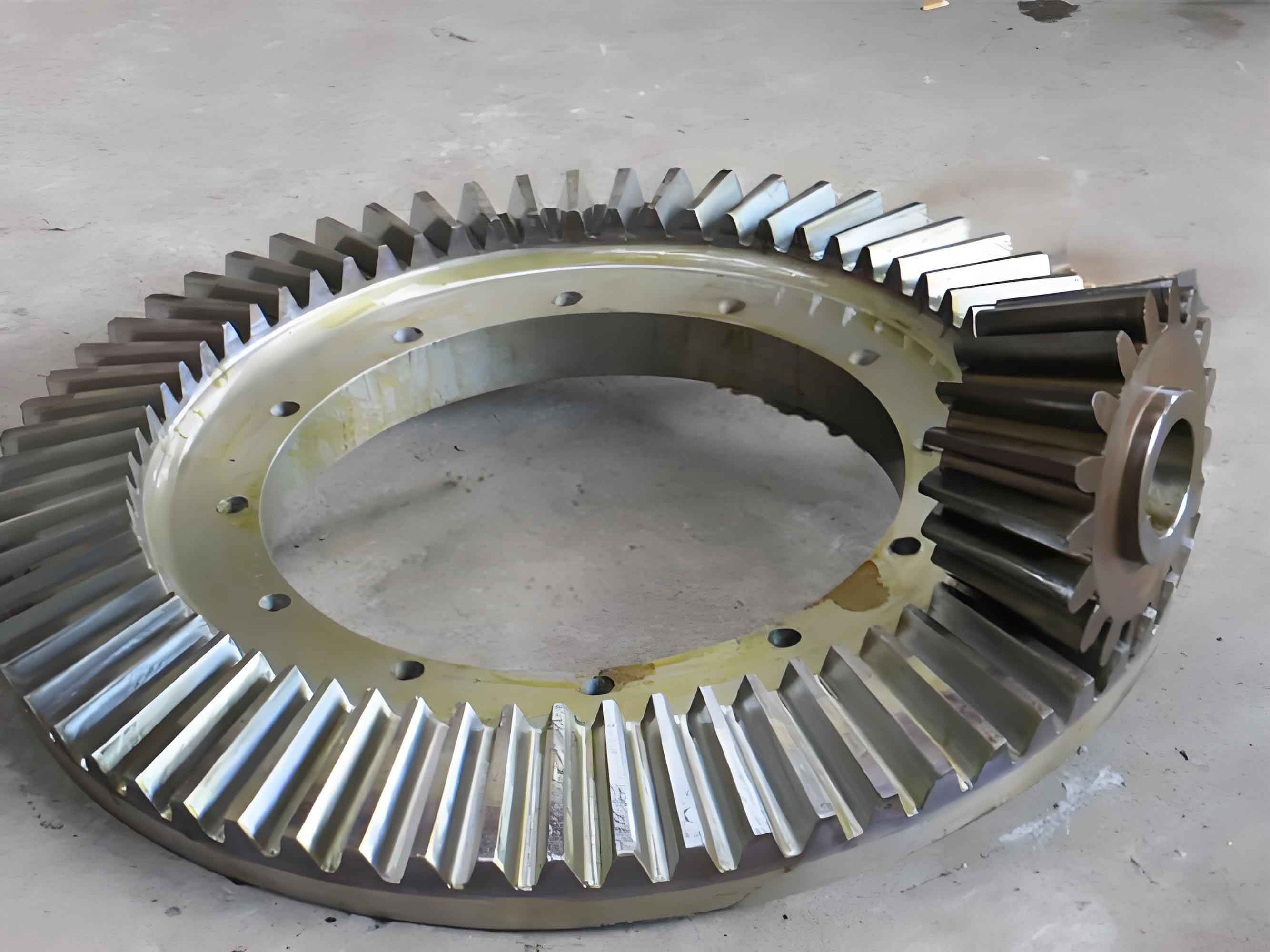
To understand the tooth formation of bevel gears, I employ vector algebra to describe the surface geometry. Consider a vector $\mathbf{r}(x, y, z)$ in a coordinate system $O-ijk$. When this vector rotates around an axis, such as the $k$-axis, by an angle $\phi_k$, the transformed vector $\mathbf{r}'(x’, y’, z’)$ can be expressed using rotation matrices. For rotation around the $k$-axis, the transformation is given by:
$$ \begin{bmatrix} x’ \\ y’ \\ z’ \end{bmatrix} = \begin{bmatrix} \cos \phi_k & -\sin \phi_k & 0 \\ \sin \phi_k & \cos \phi_k & 0 \\ 0 & 0 & 1 \end{bmatrix} \begin{bmatrix} x \\ y \\ z \end{bmatrix} $$
Similarly, for rotation around the $j$-axis or $i$-axis, the matrices are:
$$ \begin{bmatrix} x’ \\ y’ \\ z’ \end{bmatrix} = \begin{bmatrix} \cos \phi_j & 0 & -\sin \phi_j \\ 0 & 1 & 0 \\ \sin \phi_j & 0 & \cos \phi_j \end{bmatrix} \begin{bmatrix} x \\ y \\ z \end{bmatrix} $$
and
$$ \begin{bmatrix} x’ \\ y’ \\ z’ \end{bmatrix} = \begin{bmatrix} 1 & 0 & 0 \\ 0 & \cos \phi_i & -\sin \phi_i \\ 0 & \sin \phi_i & \cos \phi_i \end{bmatrix} \begin{bmatrix} x \\ y \\ z \end{bmatrix} $$
For bevel gears, the tooth surface is generated by a combination of rotation and translation along the gear axis, analogous to helical paths but adapted to conical geometries. In the case of spiral bevel gears, a spiral motion is involved, where a vector $\mathbf{r}(x, y, z)$ rotates around an axis while simultaneously moving along it. If $p$ represents the lead parameter (with $p > 0$ for right-hand spirals and $p < 0$ for left-hand spirals), and $\phi$ is the rotation angle, the new position after spiral motion is:
$$ \begin{bmatrix} x’ \\ y’ \\ z’ \end{bmatrix} = \begin{bmatrix} \cos \phi & -\sin \phi & 0 \\ \sin \phi & \cos \phi & 0 \\ 0 & 0 & 1 \end{bmatrix} \begin{bmatrix} x \\ y \\ z \end{bmatrix} + \begin{bmatrix} 0 \\ 0 \\ p\phi \end{bmatrix} $$
This equation describes a spiral path, and by varying the parameters, I can generate the tooth profiles for bevel gears. Specifically, for a bevel gear, the initial vector $\mathbf{r}(x(t), y(t), z(t))$ represents points on the cutting tool edge, and as it undergoes spiral motion, it forms the tooth surface. The parameter $t$ defines the tool profile, and $\phi$ sweeps out the surface. This approach allows for precise control over the tooth geometry, ensuring that the modeled bevel gears meet design specifications for applications like automotive differentials or industrial machinery.
In the context of bevel gears, the tooth profile parameters must be calculated accurately to ensure proper meshing and performance. For example, consider a spiral bevel gear set with the following parameters: module $m = 2.5$ mm, number of teeth $z = 20$, pressure angle $\alpha = 20^\circ$, spiral angle $\beta = 35^\circ$, and shaft angle $\Sigma = 90^\circ$. The pitch diameter $d$ is given by $d = m z$, and the cone distance $R$ can be derived from the pitch cone angle $\delta$. For a bevel gear, the pitch cone angle is related to the shaft angle and the gear ratio. If the pinion has $z_1$ teeth and the gear has $z_2$ teeth, the pitch cone angles are:
$$ \delta_1 = \tan^{-1}\left(\frac{z_1}{z_2}\right) \quad \text{and} \quad \delta_2 = \Sigma – \delta_1 $$
The tooth dimensions, such as addendum $h_a$ and dedendum $h_f$, are typically based on the module and addendum coefficient $f_0$ and dedendum coefficient $c_0$. For standard bevel gears, $h_a = f_0 m$ and $h_f = (f_0 + c_0) m$, with $f_0 = 1$ and $c_0 = 0.25$ commonly used. However, for precision bevel gears, these values may be adjusted to optimize strength and wear resistance. The following table summarizes key parameters for a sample bevel gear design:
| Parameter | Symbol | Value | Unit |
|---|---|---|---|
| Module | $m$ | 2.5 | mm |
| Number of Teeth | $z$ | 20 | – |
| Pressure Angle | $\alpha$ | 20 | degrees |
| Spiral Angle | $\beta$ | 35 | degrees |
| Shaft Angle | $\Sigma$ | 90 | degrees |
| Pitch Diameter | $d$ | 50.0 | mm |
| Cone Distance | $R$ | 28.87 | mm |
| Addendum | $h_a$ | 2.5 | mm |
| Dedendum | $h_f$ | 3.125 | mm |
To generate the tooth surface for bevel gears, I use the concept of the cutting tool path. Suppose the tool has a straight cutting edge with a defined orientation relative to the gear blank. For a spiral bevel gear, the tool path follows a spiral on the pitch cone. The spiral lead $L$ is related to the spiral angle $\beta$ and the pitch circumference. Specifically, $L = \frac{\pi d}{\tan \beta}$. Using vector algebra, I define points on the tool edge and apply the spiral motion equation to generate curves that represent the tooth flanks. For instance, let the tool edge be defined by points $A$, $B$, $C$, and $D$ in a local coordinate system. Their coordinates might be $A(x_1, y_1, z_1)$, $B(x_2, y_2, z_2)$, etc., based on the tooth geometry. By applying the rotation and translation, I obtain spiral curves that form the boundaries of the tooth surface.
In UG software, I implement this by first defining expressions for the spiral curves using the “Expression” tool under the “Tools” menu. For example, the $x$, $y$, and $z$ coordinates of a spiral point can be defined as functions of the rotation angle $\phi$ and lead parameter $p$. Using the “Law Curve” command in the “Insert” menu, I generate these spiral curves based on the mathematical expressions. For a bevel gear, I might generate multiple curves for the left and right flanks of the teeth, considering any asymmetry in the tooth profile. Subsequently, I use surface modeling commands such as “Ruled Surface” or “Through Curve Mesh” to create surfaces from these curves. These surfaces are then stitched together using the “Sew” command to form a solid body representing the tooth space. By subtracting this from the gear blank, I obtain the precise tooth geometry for the bevel gear.
The modeling process for bevel gears in UG involves several steps to ensure accuracy. First, I create the gear blank as a conical surface based on the pitch cone angle and face width. Then, I define the tooth profile curves in a transverse section, which are then mapped onto the conical surface using coordinate transformations. For spiral bevel gears, I incorporate the spiral motion by generating helices on the cone. The general equation for a point on a conical helix can be derived from the spiral motion equation, adjusted for the cone angle. If the cone half-angle is $\delta$, then the radius $r$ at a height $z$ is $r = R – z \tan \delta$, where $R$ is the outer radius. The spiral path on the cone is given by:
$$ x = r \cos \phi, \quad y = r \sin \phi, \quad z = \frac{p \phi}{2\pi} $$
where $p$ is the lead of the spiral. By varying $\phi$ from $0$ to $2\pi n$ for $n$ threads, I generate the helix. In UG, I use this to create curves that guide the tooth surface generation. Next, I use the “Sweep” or “Swept” commands to sweep the tooth profile along these helical paths, forming the 3D tooth surfaces. For complex bevel gears with localized modifications, I may use additional curves and surfaces to refine the model. This method allows me to create high-fidelity models of bevel gears that can be used for further analysis and manufacturing.
To illustrate the parameter calculations for bevel gears, consider a pair of spiral bevel gears with different modules or pressure angles on the left and right flanks, analogous to dual-lead worms but adapted for conical geometries. For instance, if the left flank has a module $m_L$ and the right flank has a module $m_R$, the tooth thickness varies along the face width. The axial tooth thickness $s$ at a given position can be calculated based on the spiral lead and module difference. Let $\Delta m = m_L – m_R$ be the module difference. Then, the tooth thickness variation per revolution $\Delta s$ is related to the lead and module parameters. Specifically, for a spiral bevel gear, the lead $L$ is constant, but the tooth thickness may change due to the conical shape. The following equations define key relationships for such bevel gears:
$$ \text{Lead for left flank:} \quad L_L = \pi m_L z \cot \beta_L $$
$$ \text{Lead for right flank:} \quad L_R = \pi m_R z \cot \beta_R $$
$$ \text{Spiral angle difference:} \quad \Delta \beta = \beta_L – \beta_R $$
where $\beta_L$ and $\beta_R$ are the spiral angles for the left and right flanks, respectively. The axial displacement required to adjust the backlash $\Delta b$ can be found from the tooth thickness gradient. If $k_s$ is the tooth thickness increment coefficient, then $\Delta b = k_s \Delta s$, where $\Delta s$ is the axial adjustment. This is crucial for precision applications of bevel gears, such as in aerospace or robotics, where minimal backlash is desired. The table below provides an example calculation for a spiral bevel gear with asymmetric flanks:
| Parameter | Left Flank | Right Flank | Unit |
|---|---|---|---|
| Module | $m_L = 2.6$ | $m_R = 2.4$ | mm |
| Spiral Angle | $\beta_L = 36^\circ$ | $\beta_R = 34^\circ$ | degrees |
| Lead | $L_L = 150.8$ | $L_R = 138.2$ | mm |
| Pressure Angle | $\alpha_L = 22^\circ$ | $\alpha_R = 18^\circ$ | degrees |
| Tooth Thickness Gradient | $k_s = 0.05$ | mm/rev | |
Using these parameters, I can model the bevel gear in UG by generating separate spiral curves for the left and right flanks. The contact lines between the tool and gear blank are used to define the initial curves, which are then transformed into spiral paths. For example, the left flank spiral curve might be generated with lead $L_L$ and spiral angle $\beta_L$, while the right flank uses $L_R$ and $\beta_R$. By creating surfaces from these curves and combining them, I achieve an accurate representation of the bevel gear teeth. This approach ensures that the modeled bevel gears have the desired tooth contact patterns and load distribution, which are critical for efficient power transmission.
In UG, the modeling of bevel gears can be automated using parametric expressions and user-defined features. I start by creating a new part file and defining the gear parameters as expressions. For instance, I set variables for module, number of teeth, pressure angle, spiral angle, and cone angle. Then, I use these to calculate derived parameters like pitch diameter, cone distance, and lead. Using the “Law Curve” command, I input the parametric equations for the spiral curves. For a point on the left flank spiral, the coordinates might be:
$$ x = (R – z \tan \delta) \cos \phi, \quad y = (R – z \tan \delta) \sin \phi, \quad z = \frac{L_L \phi}{2\pi} $$
where $\phi$ is the angular parameter. I generate multiple such curves for different $z$ values to define the tooth surface completely. Then, I use the “Through Curves” or “Swept” feature to create surfaces between these curves. For the tooth profile, I sketch the tooth shape in a plane normal to the spiral direction and sweep it along the spiral path. This generates the solid tooth surfaces. Finally, I use pattern features to replicate the teeth around the gear blank, resulting in a complete bevel gear model. This parametric approach allows for easy modifications; if I change a parameter like the module or spiral angle, the entire model updates automatically, saving time in design iterations.
The accuracy of this modeling method for bevel gears is validated through virtual testing and comparison with theoretical calculations. For example, I can perform motion analysis in UG to check the meshing behavior with a mating gear. By applying the generated bevel gear model in an assembly and running simulation, I observe the contact points and transmission error. This helps in identifying any interferences or inefficiencies early in the design phase. Additionally, the model can be exported for finite element analysis (FEA) to evaluate stress distribution and durability under load. The precise geometry ensures that FEA results are reliable, leading to better-informed design decisions. Moreover, for CNC machining, the UG model can be used to generate tool paths directly, reducing errors in manufacturing. This integrated workflow from modeling to analysis and manufacturing highlights the practical benefits of this approach for bevel gears.
In conclusion, the method I have described for modeling bevel gears using UG software provides a precise and efficient way to create digital prototypes. By leveraging vector algebra and simulation of machining processes, I generate accurate tooth surfaces that capture the complex geometry of bevel gears. The use of parametric modeling and expressions in UG allows for flexibility and adaptability to various design requirements. This approach is particularly valuable for applications involving spiral bevel gears, where tooth contact and load capacity are critical. The ability to incorporate asymmetric profiles or adjustments for backlash further enhances its utility. Overall, this methodology supports the design, analysis, and manufacturing of bevel gears, contributing to improved performance and reliability in mechanical systems. As bevel gears continue to be essential components in industries like automotive, aerospace, and robotics, such advanced modeling techniques will play a key role in innovation and optimization.