
The evolution of industrial machinery increasingly demands transmission components that satisfy highly specific, customized performance requirements. While standardized cylindrical gears form the backbone of many systems, their fixed geometric parameters—such as pressure angle, addendum, dedendum, and profile shift coefficient—often fall short of addressing unique operational conditions involving load, space, noise, or efficiency constraints. Consequently, non-standard cylindrical gears, which deviate from these established norms, present a significantly broader application potential. However, altering these fundamental parameters directly influences the definitive geometry of the gear tooth: the active involute profile and the root transition curve. These geometric changes subsequently dictate critical performance characteristics, including surface load-bearing capacity, root bending stress, and overall transmission behavior, such as contact ratio and susceptibility to undercutting.
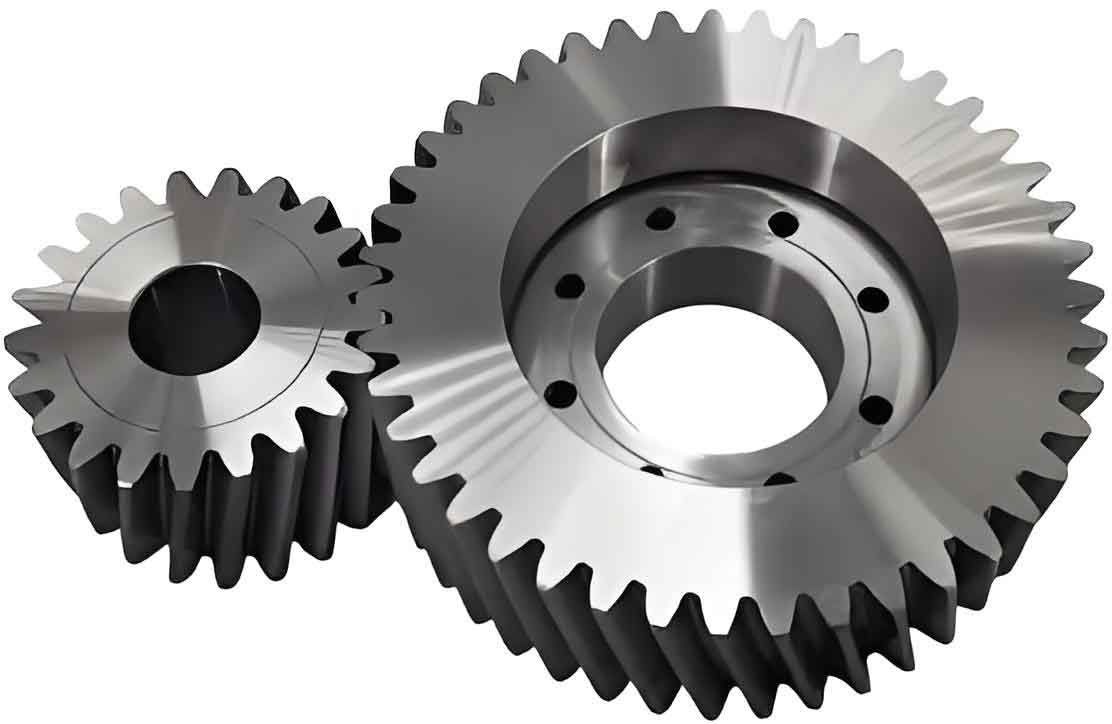
Current methodologies for evaluating and designing non-standard cylindrical gear pairs are fraught with inefficiency and imprecision. The first common approach relies on applying ISO standard gear empirical formulas to approximate the performance of non-standard designs. This method yields low-fidelity results that lack the necessary accuracy for reliable design validation, as the formulas are not valid for the altered geometry. The second approach involves deriving the complex mathematical model of the tooth flank, manually creating a 3D CAD model, importing it into Finite Element Analysis (FEA) software, and meticulously setting up the simulation environment (meshing, contacts, boundary conditions). This process is notoriously time-consuming, prone to error during geometry translation, and must be entirely repeated for any parameter change, making design iteration and optimization prohibitively slow.
Therefore, constructing a precise, parametric analysis model for non-standard cylindrical gear pairs is the foundational step towards accurately understanding their meshing behavior. Such a model is indispensable for effective parameter design, manufacturing process adjustment, and targeted tooth flank modifications like crowning or lead correction. This article addresses this need by presenting a methodology to build accurate, parametric finite element models for both external and internal non-standard cylindrical gears. The core innovation lies in simulating the actual gear manufacturing process—hobbing for external gears and shaping for internal gears—to derive the exact mathematical equations for the tooth profile and root fillet. This model is then fully parameterized and automated, enabling real-time, high-fidelity simulation that adapts instantly to changes in any non-standard geometric parameter.
1. Construction of the Precise Parametric Gear Model
The tooth profile of a cylindrical gear consists of two distinct segments: the active involute flank and the root transition curve (fillet). For external cylindrical gears, the profile is typically generated via a rack-type cutter (hob or worm grinding wheel). For internal cylindrical gears, a shaping process with a pinion-type cutter is standard. The transition curve geometry differs based on the process: an extended involute for hobbed gears and an extended epicycloid for shaped gears. While calculating the coordinates of the involute profile is relatively straightforward, accurately determining the coordinates of the transition curve and ensuring its smooth, tangential connection to the involute is critical. By formulating equations that mathematically replicate the generation process, the precise coordinates for the entire tooth contour can be obtained.
This foundational principle is integrated with FEA model creation. Based on the derived profile and fillet equations, node coordinates are calculated. These nodes are then connected using 8-node, three-dimensional isoparametric brick elements (e.g., C3D8R in Abaqus) following a defined sequence to build a precise 3D finite element model of a single tooth. A circular pattern of this tooth, followed by a merge operation to eliminate duplications at mesh boundaries, yields the complete gear model. After precise assembly and application of boundary conditions and loads, a complete FEA solution model for the non-standard cylindrical gear pair is established.
1.1 Accurate Tooth Form Generation for Non-Standard Cylindrical Gears
1.1.1 Tooth Profile Equation for Hobbed External Gears
The geometry of hobbing a spur gear is illustrated below. In the fixed coordinate system \(XPY\), the rack cutter translates. The coordinate system \(X_1O_1Y_1\) is attached to the rack, with its \(O_1X_1\) axis lying on the pitch line, which rolls without slip on the gear’s pitch circle of radius \(r\). The \(O_1Y_1\) axis bisects the rack tooth space. The parameter \(S\) represents the distance from the \(PY\) axis to the rack’s \(O_1Y_1\) axis, governing the amount of profile shift \(\xi m\).
The linear cutting edge segment \(LM\) generates the involute profile. A point \(B\) on this edge has coordinates in \(S_1\) given by:
$$ x_1 = -\left( \frac{\pi m}{4} – \xi m \tan\alpha_0 – S \right) $$
$$ y_1 = \frac{\frac{\pi m}{4} \tan\alpha_0 + \xi m}{\tan\alpha_0 + \cot\alpha_0} $$
where \(m\) is the module, \(\alpha_0\) is the tool pressure angle, and \(\xi\) is the profile shift coefficient.
The tip rounding segment \(MN\) with radius \(R_T\) generates the transition curve. The distance from the start of the fillet \(M\) to the rack centerline is:
$$ E = 1.25m – R_T + R_T \sin\alpha_0 $$
The distance from the fillet center \(Q\) to the pitch line is:
$$ F = 1.25m – R_T – \xi m $$
The auxiliary angle \(\psi\) and distance \(L\) are:
$$ L = \frac{F}{\sin\psi}, \quad \psi = \arctan\left( \frac{F}{\frac{\pi m}{4}\tan\alpha_0 – E – R_T\cos\alpha_0 – S} \right) $$
A point \(K\) on the fillet in \(S_1\) is:
$$ x_1 = L \cos\psi + R_T \sin\psi – S $$
$$ y_1 = L \sin\psi – R_T \cos\psi $$
Finally, the coordinates of points \(B\) and \(K\) are transformed into the gear coordinate system \(S_2(x_2, y_2)\) through the rolling motion, where the rack translation \(S\) is linked to the gear rotation angle \(\phi\) by \(S = r\phi\):
$$ x_2 = (S + x_1) \cos\phi + (r + y_1) \sin\phi $$
$$ y_2 = -(S + x_1) \sin\phi + (r + y_1) \cos\phi $$
This system of equations, solved for \(\phi\), yields the exact Cartesian coordinates of the entire external gear tooth profile, including the transition curve.
1.1.2 Tooth Profile Equation for Shaped Internal Gears
The profile of an internal cylindrical gear is generated by a shaping process using a pinion-type cutter. The internal gear tooth form is therefore the envelope of the cutter’s family of positions. The cutter’s own profile is first obtained as if it were generated by a virtual rack.
The coordinates of a point on the involute profile of the shaper cutter in its coordinate system \(S_1(x_1, y_1)\) are:
$$
\mathbf{r}_1^{(B)} = \begin{bmatrix}
\left[ r_{p1} \theta_1 – \left( \frac{\pi m}{4} – x_c m \tan\alpha_1 \right) \cos\alpha_1 \right] \cos(\theta_1 + \alpha_1) + \left[ r_{p1} – \left( \frac{\pi m}{4} – x_c m \tan\alpha_1 \right) \sin\alpha_1 \right] \sin(\theta_1 + \alpha_1) \\
-\left[ r_{p1} \theta_1 – \left( \frac{\pi m}{4} – x_c m \tan\alpha_1 \right) \cos\alpha_1 \right] \sin(\theta_1 + \alpha_1) + \left[ r_{p1} – \left( \frac{\pi m}{4} – x_c m \tan\alpha_1 \right) \sin\alpha_1 \right] \cos(\theta_1 + \alpha_1)
\end{bmatrix}
$$
where \(r_{p1}\) is the cutter pitch radius, \(\theta_1\) is its rotation parameter, \(\alpha_1\) is the generating pressure angle, and \(x_c\) is the cutter’s profile shift coefficient.
The tip of the shaper cutter is rounded with a circular arc of radius \(R_{T1}\) to avoid generating a sharp, stress-concentrating corner at the root of the internal gear. The center \(Q_1\) of this tip rounding is found geometrically. A point \(K_1\) on this rounded tip in \(S_1\) has coordinates:
$$
\begin{aligned}
x_1^{(k)} &= \left[ r_{a1} – (r_{a1} – R_{T1} – r_{p1}) \cos\left(\theta_1 + \frac{\pi}{Z_1}\right) – R_{T1} \cos(\gamma_1 – \psi_1) \right] \\
y_1^{(k)} &= \left[ (r_{a1} – R_{T1} – r_{p1}) \sin\left(\theta_1 + \frac{\pi}{Z_1}\right) – R_{T1} \sin(\gamma_1 – \psi_1) \right]
\end{aligned}
$$
with the auxiliary angle \(\psi_1\) defined as:
$$
\psi_1 = \arctan\left( \frac{ \left[ r_{a1} – (r_{a1} – R_{T1} – r_{p1}) \cos\left(\theta_1 + \frac{\pi}{Z_1}\right) \right] \cos\gamma_1 }{ \left[ r_{a1} – (r_{a1} – R_{T1} – r_{p1}) \cos\left(\theta_1 + \frac{\pi}{Z_1}\right) \right] \sin\gamma_1 – (r_{a1} – R_{T1} – r_{p1}) \sin\left(\theta_1 + \frac{\pi}{Z_1}\right) } \right)
$$
Here, \(r_{a1}\) is the cutter tip radius, \(Z_1\) is the number of teeth on the cutter, and \(\gamma_1\) is a constant angle from the tooth centerline to the point where the tip arc meets the top land.
Applying the coordinate transformation for the shaping process (internal meshing between cutter and gear) gives the coordinates of the internal gear tooth. The involute part is given by:
$$
\begin{aligned}
x_2 &= A \sin\left( \frac{Z_1}{Z_2} \theta_1 \right) – \left[ r_{p1} \theta_1 – \left( \frac{\pi m}{4} – x_c m \tan\alpha_1 \right) \cos\alpha_1 \right] \cos\left( \alpha_1 + \theta_1 – \frac{Z_1}{Z_2} \theta_1 \right) \\
&\quad – \left[ r_{p1} – \left( \frac{\pi m}{4} – x_c m \tan\alpha_1 \right) \sin\alpha_1 \right] \sin\left( \alpha_1 + \theta_1 – \frac{Z_1}{Z_2} \theta_1 \right) \\
y_2 &= A \cos\left( \frac{Z_1}{Z_2} \theta_1 \right) + \left[ r_{p1} \theta_1 – \left( \frac{\pi m}{4} – x_c m \tan\alpha_1 \right) \cos\alpha_1 \right] \sin\left( \alpha_1 + \theta_1 – \frac{Z_1}{Z_2} \theta_1 \right) \\
&\quad – \left[ r_{p1} – \left( \frac{\pi m}{4} – x_c m \tan\alpha_1 \right) \sin\alpha_1 \right] \cos\left( \alpha_1 + \theta_1 – \frac{Z_1}{Z_2} \theta_1 \right)
\end{aligned}
$$
The root transition curve of the internal cylindrical gear is given by:
$$
\begin{aligned}
x_2 &= A \sin\left( \frac{Z_1}{Z_2} \theta_1 \right) – \left[ r_{a1} – (r_{a1} – R_{T1} – r_{p1}) \cos\left(\theta_1 + \frac{\pi}{Z_1}\right) – R_{T1} \cos(\gamma_1 – \psi_1) \right] \cos\left( \theta_1 – \frac{Z_1}{Z_2} \theta_1 + \psi_1 \right) \\
&\quad + \left[ (r_{a1} – R_{T1} – r_{p1}) \sin\left(\theta_1 + \frac{\pi}{Z_1}\right) – R_{T1} \sin(\gamma_1 – \psi_1) \right] \sin\left( \theta_1 – \frac{Z_1}{Z_2} \theta_1 + \psi_1 \right) \\
y_2 &= A \cos\left( \frac{Z_1}{Z_2} \theta_1 \right) – \left[ r_{a1} – (r_{a1} – R_{T1} – r_{p1}) \cos\left(\theta_1 + \frac{\pi}{Z_1}\right) – R_{T1} \cos(\gamma_1 – \psi_1) \right] \sin\left( \theta_1 – \frac{Z_1}{Z_2} \theta_1 + \psi_1 \right) \\
&\quad – \left[ (r_{a1} – R_{T1} – r_{p1}) \sin\left(\theta_1 + \frac{\pi}{Z_1}\right) – R_{T1} \sin(\gamma_1 – \psi_1) \right] \cos\left( \theta_1 – \frac{Z_1}{Z_2} \theta_1 + \psi_1 \right)
\end{aligned}
$$
where \(A\) is the center distance between the shaper and internal gear, and \(Z_2\) is the number of teeth on the internal cylindrical gear.
1.2 Parametric Model Construction
The derived mathematical models are implemented into a computational algorithm. By discretizing the parameter \(\phi\) (for external gears) or \(\theta_1\) (for internal gears), a set of precise nodal coordinates defining the tooth cross-section is generated. These nodes on the transverse plane are then extruded along the gear axis to form the 3D geometry. For helical cylindrical gears, the base nodal coordinates are simply transformed according to the helix angle before extrusion. Linear reduced-integration hexahedral elements (C3D8R) are used to connect these nodes due to their efficiency and satisfactory accuracy for contact stress analysis, especially compared to higher-order elements which can cause oscillatory contact forces.
The process for creating a single-tooth model, patterning it to form the full gear, and assembling a gear pair is fully automated through scripting. The entire FEA workflow—part creation, material assignment (e.g., steel with Elastic modulus \(E = 2.1 \times 10^5\) MPa, Poisson’s ratio \(\nu = 0.3\)), assembly, defining surface-to-surface contact interactions (with a friction coefficient, e.g., \(\mu = 0.05-0.1\)), applying boundary conditions (fixing one gear, applying torque/rotation to the other), meshing, and job submission—is encapsulated in a parameterized script. This allows the entire model of the non-standard cylindrical gear pair to be regenerated and analyzed in a single step upon changing any input parameter (\(m, \alpha_0, \xi\), tooth numbers, face width, helix angle, etc.).
| Parameter | Sun Gear | Planet Gear | Ring Gear |
|---|---|---|---|
| Number of Teeth, \(Z\) | 48 | 55 | 162 |
| Module, \(m\) (mm) | 3.8 | ||
| Pressure Angle, \(\alpha_0\) (°) | 22.5 | ||
| Face Width (mm) | 90 | 88 | 88 |
| Sun Gear Speed (rpm) | 1128.0 | ||
| Input Power (kW) | 2985.8 | ||
| Input Torque (Nm) | 25278.7 | ||
2. Model Validation via Tooth Flank Modification Analysis
The accuracy and robustness of the parametric modeling framework are validated using a demanding application: the analysis of parabolic micro-geometry modifications on a non-standard planetary gear set. The parameters for this system, featuring both external (sun-planet) and internal (planet-ring) meshes, are listed in Table 1. This dual-mesh scenario provides a comprehensive test for the modeling of both external and internal non-standard cylindrical gears.
Tooth flank modifications, such as tip and root relief or lead crowning, are applied by directly offsetting the nodal coordinates of the perfect involute model according to a defined modification function (e.g., a parabolic curve). The parametric model seamlessly incorporates these deviations. The contact stress distribution along the path of contact is then compared for the unmodified and modified gear pairs. The results, as illustrated conceptually in the stress plots below, demonstrate that the model correctly captures the effect of modifications: the unmodified gears show edge-loading with high, localized stress peaks at the ends of contact, while the modified gears exhibit a more uniform, centralized, and lower maximum contact stress pattern.
Furthermore, the model’s capability to handle misalignments is tested by introducing a small shaft parallelism error (e.g., 1 arc-minute) and then applying compensatory lead crowning. The analysis clearly shows that the unmodified, misaligned gears suffer from severe biased edge loading, whereas the appropriately modified gears successfully redistribute the load evenly across the face width, validating the model’s geometric fidelity and its utility for designing corrective modifications for non-standard cylindrical gears operating under non-ideal conditions.
| Aspect | Traditional FEA Approach | Proposed Parametric Approach |
|---|---|---|
| Geometry Source | CAD model from generic involute equations; approximate fillet. | Exact equations derived from tool generation process. |
| Model Update | Manual: Redraw CAD, re-import, re-mesh, re-setup. | Automatic: Change parameter in script, run. |
| Accuracy of Fillet | Often approximated (circular arc), not process-true. | Exact extended involute or epicycloid. |
| Design Iteration Speed | Slow (hours to days per iteration). | Fast (minutes per iteration). |
| Application to Modification | Difficult to map modifications precisely to nodes. | Modification functions applied directly to nodal coordinates. |
3. Conclusion
A methodology for the precise parametric modeling and analysis of non-standard cylindrical gears has been developed and demonstrated. By rigorously simulating the gear manufacturing processes—hobbing for external gears and shaping for internal gears—the exact mathematical equations for the complete tooth profile, including the critical root transition curve, are derived. This ensures that the theoretical tooth flank model is identical to the geometry produced by the actual cutting process (disregarding manufacturing errors), establishing a foundation of high geometric fidelity.
This mathematical model is seamlessly integrated into a fully automated, parametric finite element analysis workflow via scripting. The resulting framework eliminates the tedious, error-prone steps of manual CAD modeling and FEA setup. It enables real-time, high-precision simulation where changes to any non-standard parameter—module, pressure angle, profile shift, addendum modification, helix angle, or even tool tip radius—are instantly reflected in an updated and ready-to-solve FEA model.
The validation through tooth flank modification analysis under both ideal and misaligned conditions confirms the model’s accuracy and practical utility. This approach provides a powerful and efficient technical means for the parameter design, manufacturing process adjustment, and targeted flank modification of non-standard cylindrical gears, facilitating their optimal design for advanced industrial applications.