
In the field of mechanical design and manufacturing, helical gears are widely used due to their smooth operation, high load capacity, and reduced noise compared to spur gears. However, parametric modeling of helical gears remains a challenging and hot topic, especially when aiming for high precision. Current popular methods for parametric modeling of helical gears often suffer from issues such as approximate substitution of curves, arbitrary tooth profile generation, and lack of accuracy verification techniques. To address these problems, I have developed an approach based on the generating principle of gear cutting using a rack-type tool. This method derives the equations for the involute tooth profile and the transition curve, establishes the fundamental model for parametric modeling, and implements the modeling of helical gears using the parametric features of PRO/E. Furthermore, I propose a method to verify the accuracy of the helical gear model, ensuring reliability in practical applications.
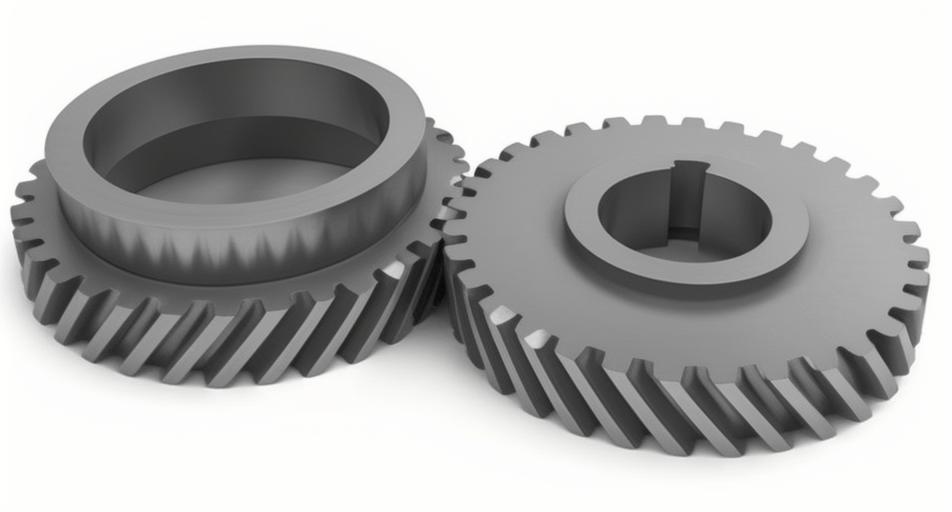
The parametric modeling of helical gears is critical for custom gear design, simulation, and production. Traditional methods often rely on simplifications that compromise accuracy. For instance, using a 0.38 times module arc to approximate the transition curve ignores the positional relationship between the root circle and the base circle, leading to failures in model generation under specific tooth numbers. Additionally, some methods project straight lines onto cylindrical surfaces to create helical lines, resulting in significant deviations from the actual machined tooth profile. The choice of how to generate the helical involute surface also greatly impacts the model’s precision. Moreover, there is a scarcity of tools to validate the accuracy of generated helical gear models. In this work, I tackle these issues by deriving precise mathematical models and integrating them into a robust parametric framework within PRO/E.
To begin, let’s consider the geometry of a helical gear. A helical gear is characterized by its teeth, which are cut at an angle to the axis of rotation. This helix angle, denoted as $\beta$, is a key parameter that influences the gear’s performance. The parametric modeling process starts with defining the basic parameters of the helical gear. These include the normal module $M$, number of teeth $N_T$, helix angle $\beta$, pressure angle $\alpha_n$ (typically 20°), addendum coefficient $h_{a}^*$, dedendum coefficient $c^*$, and modification coefficient $x_n$. The helix direction is controlled by a parameter $D_S$, which takes values of ±1. From these, we derive the transverse parameters, which are essential for modeling the gear in the transverse plane.
The transverse module $M_t$ is calculated as:
$$ M_t = \frac{M}{\cos \beta} $$
The transverse pressure angle $\alpha_t$ is given by:
$$ \tan \alpha_t = \frac{\tan \alpha_n}{\cos \beta} $$
The transverse addendum coefficient $h_{at}^*$ and transverse dedendum coefficient $c_t^*$ are:
$$ h_{at}^* = h_{a}^* \cos \beta, \quad c_t^* = c^* \cos \beta $$
The transverse modification coefficient $x_t$ is:
$$ x_t = x_n \cos \beta $$
These transformations ensure that the model accounts for the helical nature of the gear when generating the tooth profile in the transverse section.
Next, I define the geometric dimensions of the helical gear. The reference diameter $D$ is:
$$ D = \frac{M N_T}{\cos \beta} $$
The addendum height $h_a$ and dedendum height $h_f$ are:
$$ h_a = (h_{a}^* + x_n) M, \quad h_f = (h_{a}^* + c^* – x_n) M $$
The tip diameter $D_a$ and root diameter $D_f$ are:
$$ D_a = D + 2 h_a, \quad D_f = D – 2 h_f $$
The base circle diameter $D_b$ is:
$$ D_b = D \cos \alpha_t $$
Additionally, the helix angle at the base circle $\beta_b$ is crucial for accurate modeling and is computed as:
$$ \beta_b = \arctan \left( \tan \beta \cos \alpha_t \right) $$
In parametric modeling, this is often expressed in degrees for software input. The rotation angle $k_\beta$ for the helical twist is:
$$ k_\beta = \frac{2 B \tan \beta}{D} \times \frac{180}{\pi} $$
where $B$ is the face width of the helical gear.
To generate the tooth profile, I derive the equations for the involute curve and the transition curve based on the generating process of a rack-type cutter. The involute part of the tooth profile is described by parametric equations. Let $t$ be a parameter ranging from 0 to 1. The involute curve in the transverse plane is given by:
$$ \alpha_e = \arctan \left( \tan \alpha_t – \frac{4 (h_{a}^* – x_n) \cos \beta}{N_T \sin (2 \alpha_t)} \right) $$
$$ \alpha_k = (45 – \alpha_e) t + \alpha_e $$
$$ \beta_k = \frac{90}{N_T} – \tan \alpha_k \times \frac{180}{\pi} + \alpha_k + \tan \alpha_t \times \frac{180}{\pi} – \alpha_t + \frac{2 x_t \tan \alpha_t}{N_T} \times \frac{180}{\pi} $$
$$ x = \frac{0.5 D_b}{\cos \alpha_k} \sin \beta_k $$
$$ y = \frac{0.5 D_b}{\cos \alpha_k} \cos \beta_k $$
Here, $\alpha_e$, $\alpha_k$, and $\beta_k$ are intermediate angles used in the derivation. This set of equations accurately represents the involute portion of the helical gear tooth in the transverse section.
The transition curve, which connects the involute to the root circle, is derived from the tool tip geometry. For a rack-type cutter with tip radius $\rho_p$, the transition curve equations are:
$$ \rho_p = \frac{c^* M}{1 – \sin \alpha_t} $$
$$ a_a = h_{a}^* M + c^* M – \rho_p $$
$$ b_b = \frac{\pi M_t}{4} + h_{a}^* M \tan \alpha_t + \rho_p \cos \alpha_t $$
Let $a_1 = a_a – x_n M$. Then, for parameter $\alpha$ varying from $\alpha_t$ to 90°, we have:
$$ \alpha = \alpha_t + (90 – \alpha_t) t $$
$$ \phi = \frac{a_1 \tan (90 – \alpha) + b_b}{D/2} \times \frac{180}{\pi} $$
$$ x = \frac{D}{2} \sin \phi – \left( \frac{a_1}{\sin \alpha} + \rho_p \right) \cos (\alpha – \phi) $$
$$ y = \frac{D}{2} \cos \phi – \left( \frac{a_1}{\sin \alpha} + \rho_p \right) \sin (\alpha – \phi) $$
These equations ensure a smooth transition that matches the machined profile from the cutting process. By using these precise equations, the parametric model avoids approximations that lead to inaccuracies.
With the equations established, I proceed to the parametric modeling in PRO/E. The process begins by creating a new part model named “gear”. In the PRO/E environment, I use the tools to input parameters and relations. First, I define the independent parameters such as normal module, number of teeth, helix angle, and modification coefficient. Then, I input the derived relations for transverse parameters and geometric dimensions. This is done via the “Parameters” and “Relations” dialog boxes in PRO/E. The relations are written in PRO/E’s syntax, which closely resembles the mathematical equations above.
For example, the relations in PRO/E might look like this:
/* Transverse parameter relations */
M_T = M / COS(BETA)
HAX_T = HAX * COS(BETA)
CX_T = CX * COS(BETA)
PA_T = ATAN(TAN(PA) / COS(BETA))

/* Gear geometry relations */
D = M * NT / COS(BETA)
HA = (HAX + XN) * M
HF = (HAX + CX - XN) * M
DA = D + 2 * HA
DF = D - 2 * HF
DB = D * COS(PA_T)

/* Base helix angle */
BETA_B = ATAN(TAN(BETA) * COS(PA_T))
After setting parameters, I generate the basic circle system. This involves sketching four concentric circles on the FRONT plane, representing the reference circle, tip circle, root circle, and base circle. Their diameters are driven by the relations defined earlier. This circle system serves as the foundation for creating the tooth profile.
To generate the transverse tooth shape, I use the “Curve from Equation” feature in PRO/E. I select the default coordinate system and choose Cartesian coordinates. For the involute curve, I input the involute equations; for the transition curve, I input the transition curve equations separately. It is crucial to generate these curves accurately to ensure the precision of the helical gear model. Once both curves are created, I combine them to form a closed profile representing one tooth space in the transverse plane.
The next step is to create the three-dimensional helical gear model. Instead of using projection methods, which can introduce errors, I generate a precise helix based on the helical geometry. The helix equation in Cartesian coordinates is:
$$ x = \frac{D}{2} \cos \left( \frac{2 \pi z}{P} \right) $$
$$ y = \frac{D}{2} \sin \left( \frac{2 \pi z}{P} \right) $$
$$ z = z $$
where $P$ is the lead of the helix, given by $P = \pi D \cot \beta$. In PRO/E, this can be implemented using a parametric curve equation. This helix serves as the trajectory for sweeping the tooth profile.
To form the helical tooth, I use the “Sweep Blend” feature in PRO/E. This method involves placing multiple cross-sections along the helix and blending them. The number of cross-sections, denoted as $N$, influences the accuracy of the model. I set the twist angle $k_\beta$ for the blend, calculated as:
$$ k_\beta = \frac{2 B \tan \beta}{D} \times \frac{180}{\pi} $$
For the sweep blend, I use $N=6$ cross-sections, as this provides a good balance between accuracy and computational efficiency. The transverse tooth profile is placed at the start and end of the helix, with additional profiles inserted at intermediate points. PRO/E then blends these profiles along the helical path to create a smooth helical tooth surface. This approach is superior to the “Variable Section Sweep” method, which can lead to inaccuracies as it simply sweeps the profile along the helix without accounting for the helical twist properly.
After generating one helical tooth, I use the “Pattern” feature to create the full set of teeth around the gear axis. The number of instances is equal to the number of teeth $N_T$. This completes the parametric model of the helical gear. The model is fully driven by the initial parameters; changing any parameter, such as module or helix angle, automatically updates the entire gear geometry. This makes it highly suitable for design iterations and custom gear generation.
To validate the accuracy of the helical gear model, I propose a verification method that compares the generated tooth surface with the theoretical helical surface. The idea is to measure the deviation between points on the model and corresponding points on the ideal helix. Specifically, I consider an arbitrary cylindrical surface concentric with the gear axis. On this cylinder, the theoretical tooth surface should follow a helical line. I sample points along this helical line and measure the distance to the nearest point on the generated tooth surface at the same axial coordinate. This distance represents the modeling error.
I apply this method to compare two modeling techniques: the Variable Section Sweep method and the Sweep Blend method with different $N$ values. For the Variable Section Sweep, the error is measured at points along the face width, normalized from 0 to 1. The results are summarized in the following table:
| Position (Fraction of Face Width) | Error Distance (×10⁻⁴ mm) |
|---|---|
| 0.0 | 9.62814 |
| 0.1 | 9.19662 |
| 0.2 | 8.86896 |
| 0.3 | 8.79170 |
| 0.4 | 9.33899 |
| 0.5 | 9.49448 |
| 0.6 | 9.24764 |
| 0.7 | 8.66779 |
| 0.8 | 8.70874 |
| 0.9 | 9.06680 |
| 1.0 | 9.62814 |
The error for the Variable Section Sweep method is around 0.001 mm, indicating a moderate level of inaccuracy. This is due to the approximation inherent in sweeping a profile without proper helical blending.
For the Sweep Blend method with $N=6$, the error is significantly reduced. The measurements are as follows:
| Position (Fraction of Face Width) | Error Distance (×10⁻⁵ mm) |
|---|---|
| 0.0 | 3.12514 |
| 0.1 | 3.23272 |
| 0.2 | 3.03272 |
| 0.3 | 2.78071 |
| 0.4 | 3.04986 |
| 0.5 | 3.13603 |
| 0.6 | 3.02846 |
| 0.7 | 2.76765 |
| 0.8 | 3.04236 |
| 0.9 | 3.25141 |
| 1.0 | 3.12514 |
The error is approximately 0.00003 mm, which is much lower than that of the Variable Section Sweep method. This demonstrates the high precision achieved by the Sweep Blend approach with $N=6$.
To explore the effect of $N$ on accuracy, I also tested the Sweep Blend method with $N=3$. The results show a notable increase in error:
| Position (Fraction of Face Width) | Error Distance (mm) |
|---|---|
| 0.0 | 3.12514×10⁻⁵ |
| 0.1 | 0.000691325 |
| 0.2 | 0.00114044 |
| 0.3 | 0.00137405 |
| 0.4 | 0.00138227 |
| 0.5 | 0.00115438 |
| 0.6 | 0.000782286 |
| 0.7 | 0.00036468 |
| 0.8 | 3.97457×10⁻⁵ |
| 0.9 | 0.000115485 |
| 1.0 | 3.12514×10⁻⁵ |
With $N=3$, the error is as high as 0.0014 mm in some regions, which is even worse than the Variable Section Sweep method at certain points. This confirms that a higher number of cross-sections improves accuracy, but beyond $N=6$, the gains diminish while computational cost increases. Therefore, $N=6$ is recommended for practical helical gear modeling.
The proposed verification method is more rigorous than simply measuring helical line lengths on different cylinders, as it directly compares point-to-point distances, providing a clearer assessment of model fidelity. This approach can be used to validate any helical gear modeling technique and guide improvements.
In conclusion, I have presented a comprehensive method for precision parametric modeling of helical gears using PRO/E. By deriving exact equations for the involute and transition curves from the gear generation process, I ensure accurate tooth profile representation. The parametric model is built with input parameters and relations, allowing for flexible design changes. The use of Sweep Blend with $N=6$ cross-sections yields high-precision helical teeth, as verified by the proposed accuracy检验 method. This approach overcomes the limitations of existing methods, such as approximate curves and lack of validation, making it suitable for advanced applications in gear design and analysis. The helical gear model generated can be easily modified by adjusting independent parameters, enabling rapid prototyping and customization for various mechanical systems.
Further extensions of this work could include incorporating manufacturing tolerances, simulating meshing behavior with other gears, and optimizing tooth geometry for specific performance criteria. The parametric framework also facilitates integration with finite element analysis for stress and durability studies. Overall, this methodology enhances the reliability and efficiency of helical gear design in modern engineering.