
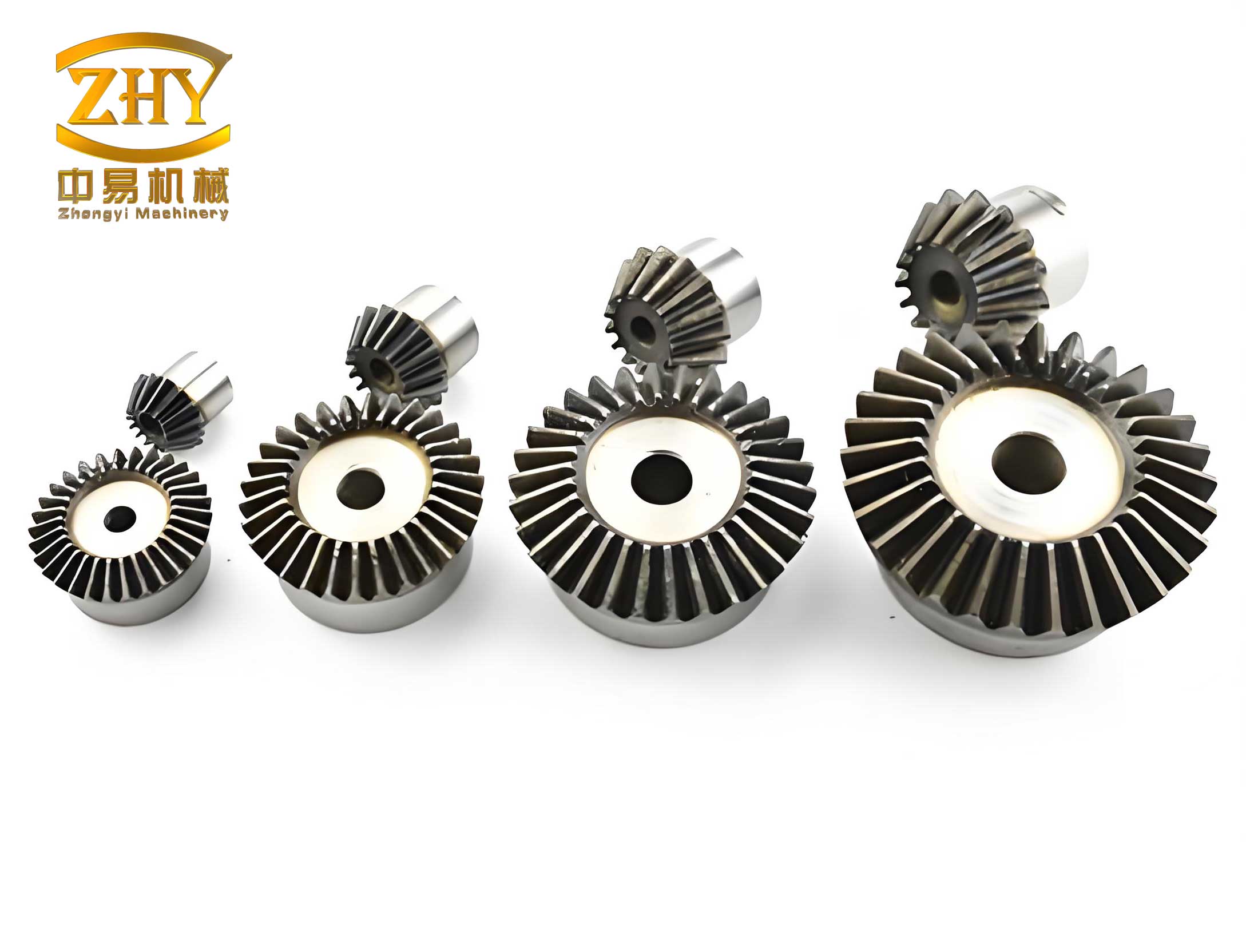
In my extensive experience with mechanical transmission systems, I have consistently observed the critical role played by bevel gears in enabling efficient power transfer between intersecting shafts. These bevel gears are ubiquitous in automotive differentials, machine tool drives, and various industrial machinery, where their performance directly impacts overall system reliability and efficiency. Among the diverse types of bevel gears, straight bevel gears offer simplicity but are fraught with manufacturing difficulties, often leading to noise and vibration issues. In contrast, spiral bevel gears provide superior operational smoothness, significantly reduced acoustic emissions, enhanced load-bearing capacity, and extended service life, making them indispensable for high-performance applications. The Oerlikon cyclo-palloid system, a specialized method for generating spiral bevel gears, produces gears with a unique tooth profile based on cycloidal curves, resulting in excellent contact patterns and durability. However, the machining of these advanced bevel gears has traditionally depended on imported specialized equipment, with the cutting blade assembly—particularly the铣刀盘 or milling cutter head—being a cornerstone of the process. The precision adjustment of this cutter head’s blades is paramount, as even minor deviations can compromise the tooth geometry, contact pattern, and overall quality of the final bevel gears. Consequently, my research and practical work have focused on developing and refining a robust adjustment methodology for Oerlikon cyclo-palloid bevel gear cutting blades. This endeavor aims not only to ensure manufacturing accuracy but also to facilitate the broader adoption of these high-performance bevel gears across the mechanical transmission landscape.
To appreciate the complexity involved, one must first understand the intricate composition of the cutter head used for these bevel gears. The Oerlikon system employs several types of cutter heads, and in my work, I have concentrated on the EN-type, which is renowned for its efficiency and finish quality. The EN-type cutter head is designed for high-speed operation, which enhances the surface finish of the bevel gears and boosts productivity. Its construction is a meticulous assembly of multiple components, each serving a specific function in the cutting process for bevel gears. The blades are arranged in a precise sequence: roughing blades first remove the bulk of material, followed by outer finishing blades and inner finishing blades, which refine the tooth flanks to the required accuracy for bevel gears. The main body of the cutter head provides the structural foundation, while individual blade seats hold each blade. Adjustment screws and clamping screws enable fine-tuning and secure fixation, respectively. Additionally, flat washers and angled washers are used to achieve the necessary blade positioning and orientation, which are critical for generating the correct tooth profile on bevel gears. The interplay of these components underscores the sophistication required in manufacturing high-quality bevel gears.
| Component Name | Primary Material | Function in Bevel Gear Machining | Typical Tolerance |
|---|---|---|---|
| Roughing Blades | High-Speed Steel or Carbide | Perform initial material removal to approximate bevel gear tooth shape | Edge sharpness Ra ≤ 0.8 μm |
| Outer Finishing Blades | Carbide | Machine the convex flank surfaces of the bevel gears | Profile accuracy ±0.005 mm |
| Inner Finishing Blades | Carbide | Machine the concave flank surfaces of the bevel gears | Profile accuracy ±0.005 mm |
| Cutter Head Body | Alloy Steel | Provides mounting interface and maintains alignment for all blades | Run-out ≤ 0.002 mm |
| Blade Seats | Tool Steel | Hold individual blades, allowing for radial and height adjustment | Seat flatness ≤ 0.003 mm |
| Height Adjustment Screws | Stainless Steel | Enable precise vertical positioning of blades relative to base | Thread pitch 0.5 mm |
| Clamping Screws | Alloy Steel | Lock blades in position after adjustment to prevent movement during cutting of bevel gears | Torque 15-20 Nm |
| Flat Washers | Spring Steel | Distribute clamping force evenly and allow for coarse radial adjustment | Thickness tolerance ±0.01 mm |
| Angled Washers | Spring Steel | Provide fine angular adjustment for blade tangent radius control | Angle tolerance ±0.1° |
Following blade sharpening or replacement, the cutter head must undergo a rigorous adjustment and inspection procedure to ensure it meets the exacting standards required for producing precision bevel gears. In my practice, I utilize a dedicated adjustment and inspection apparatus, which is essentially a calibrated fixture designed to measure and set all critical parameters. This apparatus includes a robust base that holds the cutter head, a precision height gauge, a sensitive radial run-out indicator, a mechanism to set the measurement contact point height, a handwheel for adjusting cutter head eccentricity, and a calibrated scale for setting the tangent radius. Each element of this device plays a vital role in replicating the kinematic conditions of the actual bevel gear machining process, thereby allowing for accurate pre-setting.
The inspection criteria for the blades are non-negotiable to guarantee the integrity of the manufactured bevel gears. First, the surface roughness of the sharpened cutting edges must be better than Ra 0.4 μm to ensure clean cuts and minimize wear on the bevel gears. Second, the blade height run-out—the variation in the vertical position of each blade’s cutting edge—must not exceed 0.01 mm. This is crucial for maintaining uniform tooth depth across the bevel gear. Third, the blade radius run-out—the variation in the effective cutting radius—must be within 0.004 mm. This parameter directly influences the tooth profile accuracy and the conjugate action of the mating bevel gears. These tolerances can be expressed in a unified quality index. For instance, a combined error index \( E_t \) for blade setting might be defined as:
$$ E_t = \sqrt{ ( \Delta h )^2 + ( \Delta r )^2 } $$
where \( \Delta h \) is the height run-out and \( \Delta r \) is the radius run-out. For acceptance, \( E_t \leq 0.0108 \) mm, derived from the individual tolerances for bevel gears. Adherence to these limits is fundamental for producing bevel gears that exhibit low noise and high load capacity.
The adjustment process is methodical and begins with configuring the basic geometric parameters of the cutter head as specified in the job-specific adjustment card for the target bevel gears. These parameters establish the foundational geometry for the cutting process. The first parameter is the cutter head height scale value, denoted \( h_w \). This represents the nominal distance from the blade’s cutting edge (at its highest point) to the reference base plane of the cutter head body. It is set directly using the height gauge on the adjustment apparatus according to the value provided for the bevel gears. The second parameter is the measurement contact point height, calculated as \( h_w – h_f \), where \( h_f \) is the dedendum height of the bevel gear tooth. This value positions the measurement probe at the theoretical pitch point of the gear tooth, which is critical for accurate radius adjustment. The relationship is:
$$ h_c = h_w – h_f $$
where \( h_c \) is the contact point height. The third parameter is the cutter head eccentricity, \( E_{bw} \). This intentional offset is used to introduce slight modifications to the tooth flank profile of bevel gears, optimizing the contact pattern under load. It is adjusted via a calibrated handwheel, always starting from a zeroed position to eliminate mechanical backlash. The fourth and perhaps most critical parameter is the blade tangent radius, \( r \). This radius defines the curvature of the cutting edge in the plane tangent to the pitch cone of the bevel gear. It must be set separately for the outer finishing blades, inner finishing blades, and the inner edges of roughing blades. The adjustment card provides specific \( r \) values for each, and they are set using a dedicated radial adjustment handle while observing the radius indicator.
| Parameter & Symbol | Gear Design Relation (Example) | Adjustment Apparatus Action | Typical Value Range for Medium-Sized Bevel Gears |
|---|---|---|---|
| Cutter Head Height \( h_w \) | \( h_w \approx h_a + c + \delta \) where \( h_a \) is addendum, \( c \) is clearance, \( \delta \) is machine offset. |
Set height gauge micrometer to value from card. Lock setting. | 100 mm to 300 mm |
| Contact Pt. Height \( h_c = h_w – h_f \) | \( h_f = 1.25 m_n \) (for a basic design) with \( m_n \) as normal module. |
Adjust vertical position of measurement probe to calculated \( h_c \). | \( h_c \) is typically 0.7 to 0.9 times \( h_w \) |
| Eccentricity \( E_{bw} \) | Determined empirically/software for desired contact pattern on bevel gears. Often \( E_{bw} = k \cdot m_n \) with k ≈ 0.02-0.05. | Rotate eccentricity handwheel from zero to specified value. Verify with dial indicator. | 0.05 mm to 0.30 mm |
| Tangent Radius \( r \) | For Oerlikon system: Related to generating gear geometry. \( r \approx \frac{R_m \cdot \sin \beta}{\cos \alpha_n} \) where \( R_m \) is mean cone distance, \( \beta \) spiral angle, \( \alpha_n \) normal pressure angle of bevel gears. |
For each blade type, use radius adjustment handle to align indicator to specified \( r \) value. | 50 mm to 150 mm |
With the basic parameters configured, I proceed to the meticulous adjustment of each individual blade. This is a sequential process performed on the adjustment apparatus. I begin by rotating the cutter head to bring the first blade (usually a roughing blade) directly beneath the measurement head. I then engage the mechanical reference arm or “靠尺”, aligning it with the measurement head before gently lowering the head so the blade makes light contact. The side indicator on the apparatus must show minimal run-out; any significant deviation indicates misalignment of the cutter head on its base, which must be corrected before proceeding, as it would adversely affect all subsequent bevel gears.
Once the cutter head is aligned and clamped, I retract the reference arm and raise the measurement head. The adjustment of each blade follows a strict cycle: adjust blade height, adjust blade tangent radius, and then re-verify blade height. To adjust height, I rotate the cutter head so the blade is on the right-side access position. Using the appropriate wrench, I carefully manipulate the height adjustment screw for that blade seat, observing the vertical dial indicator until it reads zero (corresponding to the set \( h_w \) value). The clamping screw is then partially tightened to hold the position. The allowable residual height run-out for bevel gears is ≤ 0.01 mm. Next, for radius adjustment, I rotate the cutter head to bring the same blade to the left-side position. I lower the radial measurement head onto the blade’s cutting edge. The radial dial indicator now shows the effective tangent radius. By carefully loosening the clamping screw and using the radial adjustment screw (which acts on the stack of flat and angled washers behind the blade), I adjust the blade’s radial position until the indicator reads the target value \( r \) for that blade type. The allowed radius run-out for precision bevel gears is ≤ 0.004 mm. Finally, I rotate the blade back to the right-side position and re-check the height indicator. Due to interactions, the height may have shifted slightly during radius adjustment, necessitating iterative fine-tuning until both height and radius are within tolerance for the bevel gears.
The process is identical for inner and outer finishing blades, with the only distinction being that for outer finishing blades, the measurement contacts the outer cutting edge (which machines the concave flank of the bevel gear), while for inner finishing blades, the inner edge (convex flank) is measured. The washers are key to this adjustment. The flat washers of varying thicknesses provide the primary means of setting the blade’s radial position. The angled washers, with their slight taper (often around 1:100), allow for micro-adjustments of the blade’s tilt, which directly refines the effective tangent radius \( r \). The mathematical effect of an angled washer with taper angle \( \theta \) and thickness variation \( \Delta t \) on the radius adjustment \( \Delta r \) at a distance \( L \) from the fulcrum can be approximated by:
$$ \Delta r \approx L \cdot \tan(\theta) \cdot \frac{\Delta t}{t_{avg}} $$
where \( t_{avg} \) is the average washer thickness. This level of control is essential for achieving the sub-micron-level accuracy required for high-performance bevel gears. Throughout the adjustment, I am careful to apply force only through the screws, never striking the blades directly, to avoid chipping or misalignment. After all blades in a set are adjusted and verified, I perform a final comprehensive check by rotating the entire cutter head and observing both height and radius indicators for each blade sequentially. Only when all readings are stable and within specification for the bevel gears is the cutter head considered ready. It is then carefully cleaned, lubricated if necessary, and prepared for installation on the bevel gear cutting machine.
| Step | Action Description | Measurement Instrument | Acceptance Criterion for Bevel Gears | Corrective Action if Out of Tolerance |
|---|---|---|---|---|
| 1. Cutter Head Mounting | Mount and lightly clamp cutter head on adjustment apparatus base. | Visual and torque wrench | Secure, no rocking | Re-clean mounting surfaces, check for debris. |
| 2. Preliminary Run-out Check | Rotate head, use side indicator against reference arm. | Dial indicator (side) | Run-out ≤ 0.002 mm | Loosen and re-seat cutter head, check base alignment. |
| 3. Set Basic Parameters | Set \( h_w \), \( h_c \), \( E_{bw} \), and master \( r \) scale per adjustment card. | Height gauge, probe positioner, eccentric dial, radius scale | Values match card within ±0.005 mm | Re-calibrate apparatus scales or verify adjustment card data. |
| 4. Blade Height Adj. (Per Blade) | Rotate blade to right station. Adjust height screw to zero vertical indicator. | Vertical dial indicator | Indicator reads 0.000 ±0.005 mm (run-out ≤ 0.01 mm) | Adjust height screw; if persistent, check for damaged seat or washer. |
| 5. Blade Radius Adj. (Per Blade) | Rotate blade to left station. Adjust radial screw via washers to target \( r \). | Radial dial indicator | Indicator reads target \( r \) ±0.002 mm (run-out ≤ 0.004 mm) | Change flat washer combination; use angled washer for fine tune. |
| 6. Height Re-check (Per Blade) | Rotate blade back to right station, note vertical indicator. | Vertical dial indicator | Remains within 0.000 ±0.005 mm | Iterate steps 4 and 5 until both height and radius are stable and in spec. |
| 7. Final Clamping | Fully tighten all clamping screws for the blade with specified torque. | Torque wrench | Torque value as per spec (e.g., 18 Nm) | Ensure screw is not stripped and seat is not distorted. |
| 8. Comprehensive Audit | Rotate cutter head fully, record height and radius for every blade. | Vertical and radial indicators | All blades within height (≤0.01mm) and radius (≤0.004mm) run-out. | If a blade fails, isolate and re-adjust it, then re-audit adjacent blades. |
The implications of proper adjustment extend far beyond the cutter head itself. When the blades are precisely set, the resulting bevel gears exhibit a host of desirable characteristics. The tooth profile error is minimized, which is fundamental for ensuring a conjugate gear mesh. The surface finish on the tooth flanks is superior, reducing initial run-in wear and improving efficiency. Most importantly, the contact pattern—the area where the teeth of the mating bevel gears actually bear load—is centralized and optimally shaped, leading to quiet operation, high torque capacity, and long service life. In my application of this method, I have correlated adjustment precision with measurable outcomes on bevel gears. For instance, a reduction in blade radius run-out from 0.006 mm to 0.003 mm can lead to a measurable decrease in gear noise of 2-3 dB and an increase in surface durability. The relationship between adjustment accuracy \( \sigma_{adj} \) (standard deviation of blade setting errors) and a composite gear quality index \( Q_g \) can be modeled empirically for a family of bevel gears:
$$ Q_g = \frac{K_1}{\sigma_{adj}} + K_2 $$
where \( K_1 \) and \( K_2 \) are constants derived from gear design and application. This underscores the direct technical and economic benefit of meticulous cutter head adjustment for bevel gear production.
In conclusion, the method I have described and applied for adjusting Oerlikon cyclo-palloid bevel gear cutting blades is a systematic integration of precise measurement, iterative fine-tuning, and rigorous verification. It transforms the complex theoretical geometry of spiral bevel gears into a practical, controllable manufacturing process. By mastering this adjustment methodology, the dependency on external calibration services is reduced, production consistency for bevel gears is enhanced, and the full performance potential of the Oerlikon cyclo-palloid system can be reliably realized. This contributes significantly to manufacturing competitiveness and enables the production of bevel gears that meet the ever-increasing demands for power density, efficiency, and quiet operation in modern machinery. The continued refinement of such adjustment techniques remains a vital area of focus for advancing the state of the art in bevel gear technology.