
In heavy machinery transmission systems, such as those used in mining and metallurgical equipment, straight bevel gears play a critical role due to their ability to transmit power between intersecting shafts. Traditionally, the tooth profile machining of large straight bevel gears has been performed on form-cutting machines that rely on physical templates. These templates, often designed under idealized two-dimensional assumptions, introduce errors because they do not account for actual spatial conditions. Moreover, the use of generalized templates for gears with varying parameters further exacerbates inaccuracies. In this article, I will delve into the precise design methodology for cutting machine templates based on spherical involute tooth profiles and propose a comprehensive digital control scheme. The goal is to establish a theoretical foundation for developing advanced CNC (Computer Numerical Control) cutting machines dedicated to large straight bevel gears, enhancing accuracy and efficiency in manufacturing.
The core of this discussion revolves around the kinematics of form-cutting machines and the mathematical modeling of the tooth generation process. By analyzing the mechanism运动 and deriving the spherical involute equations, we can define an exact template design. Subsequently, I will explore the数控化 (digital control) transformation, including mathematical models for quantitative control and system configuration. Throughout, emphasis is placed on the repeated mention of straight bevel gears to underscore their significance in this context. Let’s begin by examining the working principle of form-cutting machines.
Working Principle of Form-Cutting Machines for Straight Bevel Gears
Form-cutting machines for straight bevel gears typically come in two configurations: single-cutter and double-cutter setups. Both operate on similar principles, but for clarity, I’ll focus on the single-cutter machine. The gear blank is mounted on the machine spindle, with its axis intersecting the machine center point O. A cutting tool, such as a planer knife, is attached to a tool holder that reciprocates along a swinging ram. This ram oscillates around a horizontal axis, while simultaneously, the entire assembly—including the ram and an attached spherical roller—rotates around a vertical axis for feed motion. The roller follows the contour of a physical template, which controls the angular position of the ram relative to the horizontal plane. The synthesis of these motions allows the cutter to generate one tooth flank per cutting cycle. After each cycle, the feed mechanism reverses, the tool retracts, and the gear blank is indexed for the next tooth. Key conditions for accurate machining include: (1) the intersection of all machine axes (swinging ram axis, vertical rotation axis, and spindle axis) at a common point O, known as the machine center; (2) alignment of the gear blank’s cone apex with O; and (3) orientation of the cutter’s cutting edge trajectory to pass through O during finishing cuts.
To mathematically describe this process, I establish two coordinate systems: Σ_O (O; X_O, Y_O, Z_O) for the spherical involute tooth profile on a unit sphere centered at O, and Σ (O; X, Y, Z) for the trajectory of the spherical roller center. Here, the Y_O and Y axes coincide with the vertical axis O-O1, Z_O aligns with the spindle axis O-O3, and the Z axis is inclined at an angle equal to the gear’s pitch cone angle δ. From geometric analysis, the coordinates of a point m_Oi on the spherical involute in Σ_O are given by:
$$
x_{Oi} = \cos \tau_i \sin \sigma_i, \quad y_{Oi} = \sin \tau_i, \quad z_{Oi} = \cos \tau_i \cos \sigma_i
$$
where τ_i and σ_i are angular parameters defining the orientation of the tooth flank母线 (generating line). Correspondingly, the coordinates of the roller center m_i in Σ are derived as:
$$
x_i = l_1 \cos(\delta – \sigma_i) – l_2 \cos \tau_i \sin(\delta – \sigma_i)
$$
$$
y_i = l_2 \sin \tau_i
$$
$$
z_i = l_1 \sin(\delta – \sigma_i) + l_2 \cos \tau_i \cos(\delta – \sigma_i)
$$
Here, l_1 and l_2 are fixed machine dimensions. By combining these equations, we obtain the functional relationship between the roller center trajectory and the tooth profile:
$$
x_i = l_1 \cos(\delta – \sigma_i) – l_2 (1 – y_{Oi}^2)^{1/2} \sin(\delta – \sigma_i)
$$
$$
y_i = l_2 y_{Oi}
$$
$$
z_i = l_1 \sin(\delta – \sigma_i) + l_2 (1 – y_{Oi}^2)^{1/2} \cos(\delta – \sigma_i)
$$
$$
\sigma_i = \sin^{-1} \left[ x_{Oi} / (1 – y_{Oi}^2)^{1/2} \right]
$$
This set of equations forms the basis for template design, as the template surface must guide the roller along this computed path. To proceed, we first need a rigorous model for the spherical involute tooth profile of straight bevel gears.
Mathematical Model of Spherical Involute Tooth Profile for Straight Bevel Gears
The tooth flanks of straight bevel gears are theoretically based on spherical involutes, which are generated by a great circle plane rolling without slipping over a base cone. Consider a unit sphere centered at the cone apex O. The base cone intersects the sphere in a circle, and as the generating plane rolls, a point on it traces a spherical involute curve on the sphere. This curve represents the tooth profile in spherical coordinates. To derive its equations, I analyze spherical triangles formed by arcs on the sphere. Let δ be the pitch cone angle, α the pressure angle, and δ_b the base cone angle. The relationship between these angles is given by:
$$
\sin \delta_b = \sin \delta \cos \alpha
$$
For any point on the spherical involute, defined by an auxiliary angle δ_i (ranging from δ_b to the heel), we can establish parameters through spherical trigonometry. The generation process implies that the arc length from the point to the line of action is equal to the rolled arc on the base circle. This leads to expressions for angles θ_i and ξ_i:
$$
\theta_i = \frac{\cos^{-1}(\cos \delta_i / \cos \delta_b)}{\sin \delta_b}, \quad \xi_i = \cos^{-1}(\tg \delta_b \ctg \delta_i)
$$
Similarly, for the pitch point (where δ_i = δ), we have:
$$
\theta = \frac{\cos^{-1}(\cos \delta / \cos \delta_b)}{\sin \delta_b}, \quad \xi = \cos^{-1}(\tg \delta_b \ctg \delta)
$$
Then, the angular parameter ζ_i is defined as:
$$
\zeta_i = (\theta – \xi) – (\theta_i – \xi_i) = \frac{\cos^{-1}(\cos \delta / \cos \delta_b)}{\sin \delta_b} – \cos^{-1}(\tg \delta_b \ctg \delta) – \frac{\cos^{-1}(\cos \delta_i / \cos \delta_b)}{\sin \delta_b} + \cos^{-1}(\tg \delta_b \ctg \delta_i)
$$
For points where δ_i ≤ δ_b, the spherical involute does not exist; instead, a transition curve along the arc from the apex is used, and ζ_i simplifies to the first two terms only. Finally, the coordinates (σ_i, τ_i) in the Σ_O system are obtained as:
$$
\sigma_i = \tg^{-1} [\cos \zeta_i \tg \delta_i], \quad \tau_i = \cos^{-1}(\cos \delta_i / \cos \sigma_i)
$$
These equations describe the spherical involute for a single-cutter machine. For double-cutter machines, which cut both flanks simultaneously, the tooth profile is symmetric about the X_O-Z_O plane. A coordinate transformation is applied by rotating Σ_O around Z_O by a half-tooth-profile angle ψ, which accounts for gear geometry parameters like chordal tooth thickness, modifications, and变位 coefficients. Thus, for the upper flank in double-cutters, ζ_i is replaced by (ζ_i + ψ) in the σ_i equation. The complete set of equations forms the tooth profile model essential for template design and数控化.
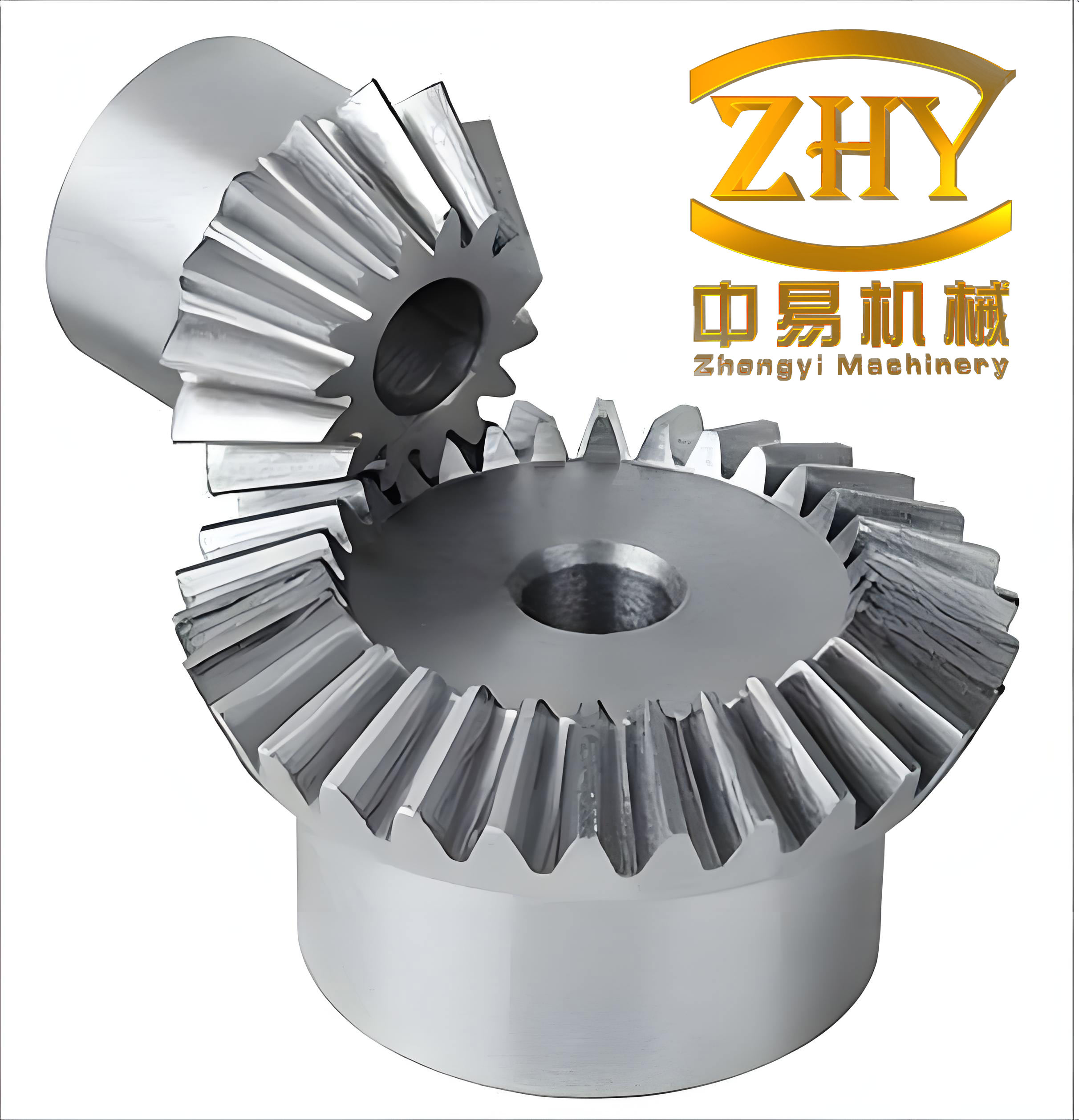
To visualize the geometry of straight bevel gears, consider the following image, which illustrates a typical gear used in such applications:
Precise Template Design Methodology
With the roller center trajectory and tooth profile equations established, I now address the template design. The template is a three-dimensional surface that guides the spherical roller. In practice, its thickness must accommodate variations in the Z-coordinate of the roller path. For manufacturing simplicity, templates are often designed with constant height in the Z-direction, meaning the surface is generated by extruding a planar curve. This planar curve is the envelope of circles centered on the roller center trajectory points, with radius equal to the roller radius R. Essentially, the template curve is the offset or equidistant curve of the roller center curve.
Let the roller center trajectory in the X-Y plane be denoted by points m_i(x_i, y_i). The template curve M_i(X_i, Y_i) for cutting the upper tooth flank is given by the offset equations:
$$
X_i = x_i + \eta_{ix} R, \quad Y_i = y_i + \eta_{iy} R
$$
For single-cutter machines, the lower flank requires a separate template curve M*_i(X*_i, Y*_i):
$$
X^*_i = x_i – \eta_{ix} R, \quad Y^*_i = -y_i + \eta_{iy} R
$$
Here, η_ix and η_iy are the components of the unit normal vector η_i at point m_i on the roller center curve, calculated from derivatives:
$$
\eta_{ix} = \frac{y’_i}{[(x’_i)^2 + (y’_i)^2]^{1/2}}, \quad \eta_{iy} = \frac{-x’_i}{[(x’_i)^2 + (y’_i)^2]^{1/2}}
$$
In practical computations, derivatives can be approximated using finite differences if analytical forms are complex. The design ensures that the template surface accurately guides the roller to generate the desired spherical involute profile on straight bevel gears. To summarize key parameters and equations, I present the following tables:
| Symbol | Description | Typical Range or Formula |
|---|---|---|
| δ | Pitch cone angle | 10° to 80° |
| α | Pressure angle | 20° or 25° |
| δ_b | Base cone angle | sin δ_b = sin δ cos α |
| m | Module | Standard values (e.g., 5 mm to 30 mm) |
| z | Number of teeth | Integer, ≥ 10 |
| χ | Profile shift coefficient | Can be positive or negative |
| χ_τ | Tangential shift coefficient | Used for tooth thickness adjustment |
| Equation Type | Formula | Purpose |
|---|---|---|
| Spherical Involute Coordinates | $$x_{Oi} = \cos \tau_i \sin \sigma_i, y_{Oi} = \sin \tau_i, z_{Oi} = \cos \tau_i \cos \sigma_i$$ | Define tooth profile on unit sphere |
| Roller Trajectory | $$x_i = l_1 \cos(\delta – \sigma_i) – l_2 \cos \tau_i \sin(\delta – \sigma_i)$$ $$y_i = l_2 \sin \tau_i$$ $$z_i = l_1 \sin(\delta – \sigma_i) + l_2 \cos \tau_i \cos(\delta – \sigma_i)$$ | Link machine kinematics to tooth profile |
| Template Curve Offset | $$X_i = x_i + \eta_{ix} R, Y_i = y_i + \eta_{iy} R$$ | Generate template surface from roller path |
| Normal Vector Components | $$\eta_{ix} = y’_i / \sqrt{(x’_i)^2 + (y’_i)^2}, \eta_{iy} = -x’_i / \sqrt{(x’_i)^2 + (y’_i)^2}$$ | Compute direction for offset |
The accuracy of template manufacturing is crucial; modern CNC machining can produce high-precision templates, but manual finishing with skilled labor and metrology is also viable. However, reliance on physical templates for each gear variant is inefficient, motivating the shift to digital control.
Digital Control Transformation of Straight Bevel Gear Cutting Machines
To overcome the limitations of physical templates, I propose a数控化 (digital control) scheme for form-cutting machines. This involves replacing mechanical templates with computer-controlled actuators that directly govern the machine motions. The advantages are multifold: elimination of template design and fabrication for each gear, reduced errors from template mismatches, and enhanced flexibility for producing straight bevel gears with varying parameters. The core of this transformation lies in developing a mathematical model for quantitative control and implementing a suitable CNC system.
Mathematical Model for CNC Control
From the earlier derivations, the cutting process is governed by the relationship between the angular parameters σ_i and τ_i, which represent the orientations of the swinging ram and feed rotation, respectively. For double-cutter machines, after incorporating symmetry, the functional relationship is encapsulated in the following set of equations, which serve as the CNC instruction model:
$$
\tau_i = \cos^{-1}(\cos \delta_i / \cos \sigma_i)
$$
$$
\sigma_i = \tg^{-1} [\cos(\zeta_i + \psi) \tg \delta_i]
$$
$$
\zeta_i = \frac{\cos^{-1}(\cos \delta / \cos \delta_b)}{\sin \delta_b} – \cos^{-1}(\tg \delta_b \ctg \delta) – \frac{\cos^{-1}(\cos \delta_i / \cos \delta_b)}{\sin \delta_b} + \cos^{-1}(\tg \delta_b \ctg \delta_i)
$$
For δ_i ≤ δ_b, ζ_i takes only the first two terms. The base cone angle δ_b is computed as δ_b = \sin^{-1}(\sin \delta \cos α). The half-tooth-profile angle ψ accounts for tooth geometry:
$$
\psi = (S – \Delta S) / d
$$
where S is the circular tooth thickness at pitch circle, ΔS is thinning amount, and d is pitch diameter. S can be expressed as:
$$
S = m \left( \frac{\pi}{2} \pm 2\chi \tg \alpha \pm \chi_\tau \right)
$$
Here, m is module, χ is profile shift coefficient, and χ_τ is tangential shift coefficient. These equations provide a direct mapping from gear design parameters to machine motion commands, enabling real-time control without templates.
CNC System Configuration
The proposed CNC system involves retrofitting the form-cutting machine with digitally controlled rotary axes. Three primary axes require actuation:
- Feed Rotation Axis: This axis controls the σ_i rotation. I recommend an open-loop数控转台 (CNC rotary table) driven by a power stepper motor. The table’s angle measurement element provides feedback to the CNC system for monitoring, though the drive is open-loop for cost-effectiveness.
- Swinging Ram Axis: This axis controls the τ_i oscillation. A closed-loop数控转台 with a servo motor is ideal here. The CNC system sends digital commands converted to analog signals, and the servo motor drives the table to the desired τ_i position. A high-resolution encoder provides feedback for precise closed-loop control, minimizing errors.
- Spindle Indexing Axis: For分齿 (tooth indexing), a closed-loop数控转台 on the machine spindle ensures accurate angular positioning between cuts. Feedback from an encoder allows verification of index accuracy.
To enhance measurement resolution, consider a friction-driven amplification mechanism: a coaxial disk in contact with the machine’s cylindrical surface can drive the measurement element with an increased transmission ratio, improving feedback precision without complex gearing.
Compensation for Cutter Orientation
During cutting, the cutter’s edge—often with a radius r—must remain tangent to the spherical involute tooth profile. In traditional template-based machines, this is inherently enforced by the template contour. In CNC systems, active compensation is needed. The principle involves adjusting the ram orientation around the tooth flank normal vector. Suppose the cutter is initially set tangent at the pitch point. As it moves to another point, the cutter’s normal vector deviates from the tooth profile’s normal. By rotating the ram around the local Z-axis (aligned with the cutting direction) by an angle (θ – θ_i), we can realign the cutter’s normal with the profile’s normal. This rotation compensates for the orientation error, allowing even straight-edged tools to be used effectively. Moreover, linear compensation actuators can be added to displace the ram along the normal direction in X and Y, enabling intentional modifications like tip and root relief for optimized meshing of straight bevel gears.
Auxiliary Enhancements for CNC Machines
Beyond motion control, additional improvements can boost productivity. For instance, replacing single planer knives with dual milling cutters enables simultaneous cutting on both forward and return strokes via climb and conventional milling modes. Hydraulic drives can provide smooth, high-force actuation. Integrated coolant systems and automated tool changers further modernize the machine. With these, a fully automated CNC cutting machine for straight bevel gears emerges: the CNC system processes input gear data (z, m, δ, d, S, ΔS, χ, χ_τ, material, etc.) and executes programmed sequences, coordinating servo drives, feed rates, spindle speeds, indexing, and auxiliary functions through feedback loops. This creates a high-precision, efficient, and user-friendly manufacturing solution.
To summarize the CNC control parameters and their relationships, the following table and formula set are provided:
| Control Axis | Parameter | Mathematical Relation | Control Type |
|---|---|---|---|
| Feed Rotation | σ_i | $$ \sigma_i = \tg^{-1} [\cos(\zeta_i + \psi) \tg \delta_i ] $$ | Open-loop with feedback |
| Swinging Ram | τ_i | $$ \tau_i = \cos^{-1}(\cos \delta_i / \cos \sigma_i) $$ | Closed-loop servo |
| Spindle Index | Index Angle | $$ \text{Index} = 360^\circ / z $$ | Closed-loop servo |
| Compensation | Rotation Angle | $$ \Delta \phi = \theta – \theta_i $$ | Closed-loop or linear actuator |
The core数控数学模型 can be condensed into a single functional block for implementation:
$$
\text{CNC Command Generator: } (\delta_i, \text{gear params}) \rightarrow (\sigma_i, \tau_i, \text{compensation})
$$
where δ_i is discretized along the tooth flank from heel to toe. This model is programmable in CNC systems, allowing adaptive control for different straight bevel gears.
Conclusion and Future Perspectives
In this comprehensive exploration, I have analyzed the form-cutting process for straight bevel gears and derived a precise methodology for template design based on spherical involute geometry. The mathematical models linking machine kinematics to tooth profiles provide a foundation for accurate manufacturing. Furthermore, the proposed数控化 scheme eliminates the need for physical templates by establishing a quantitative control model and outlining a practical CNC system configuration with compensation mechanisms. This digital transformation promises significant advancements in the production of large straight bevel gears, offering higher precision, flexibility, and efficiency.
Future work could focus on implementing and testing prototype CNC machines, refining compensation algorithms for real-time error correction, and integrating simulation software for virtual machining of straight bevel gears. Additionally, exploring additive manufacturing for custom tooling or adaptive control based on in-process metrology could further enhance capabilities. The theoretical framework presented here serves as a stepping stone toward next-generation gear manufacturing technology, ultimately contributing to more reliable and performant传动 systems in heavy industry.
Throughout this discussion, the emphasis on straight bevel gears underscores their enduring importance in mechanical engineering. By leveraging digital control, we can overcome historical limitations and usher in a new era of precision gear cutting.