
In modern mechanical systems, gears play a pivotal role as fundamental components in various transmission mechanisms. The quality and precision of gear manufacturing directly influence the performance and reliability of mechanical products. Among these, cycloidal gears are critical elements in RV reducers, determining the overall rotational accuracy. To produce high-precision cycloidal gears, the axis positioning accuracy of gear grinding machines must be rigorously maintained. Gear grinding, particularly gear profile grinding, is a sophisticated process that demands exceptional machine tool performance to avoid defects such as grinding cracks, which can compromise gear integrity. This article explores methods for measuring and compensating axis positioning errors in CNC gear grinding machines, focusing on linear and rotary axes, to enhance geometric accuracy cost-effectively.
Error compensation techniques are widely adopted to improve machine tool accuracy without costly hardware upgrades. By analyzing error patterns during operation and employing scientific measurement and modeling approaches, software-based compensation introduces artificial errors that counteract actual deviations. This method is economically advantageous, as it avoids replacing components like ball screws or guides. In gear grinding applications, precise axis control is essential to prevent issues like grinding cracks and ensure high-quality gear profile grinding. We utilize laser interferometry for accurate error measurement and compensation, demonstrating significant improvements in machine performance.
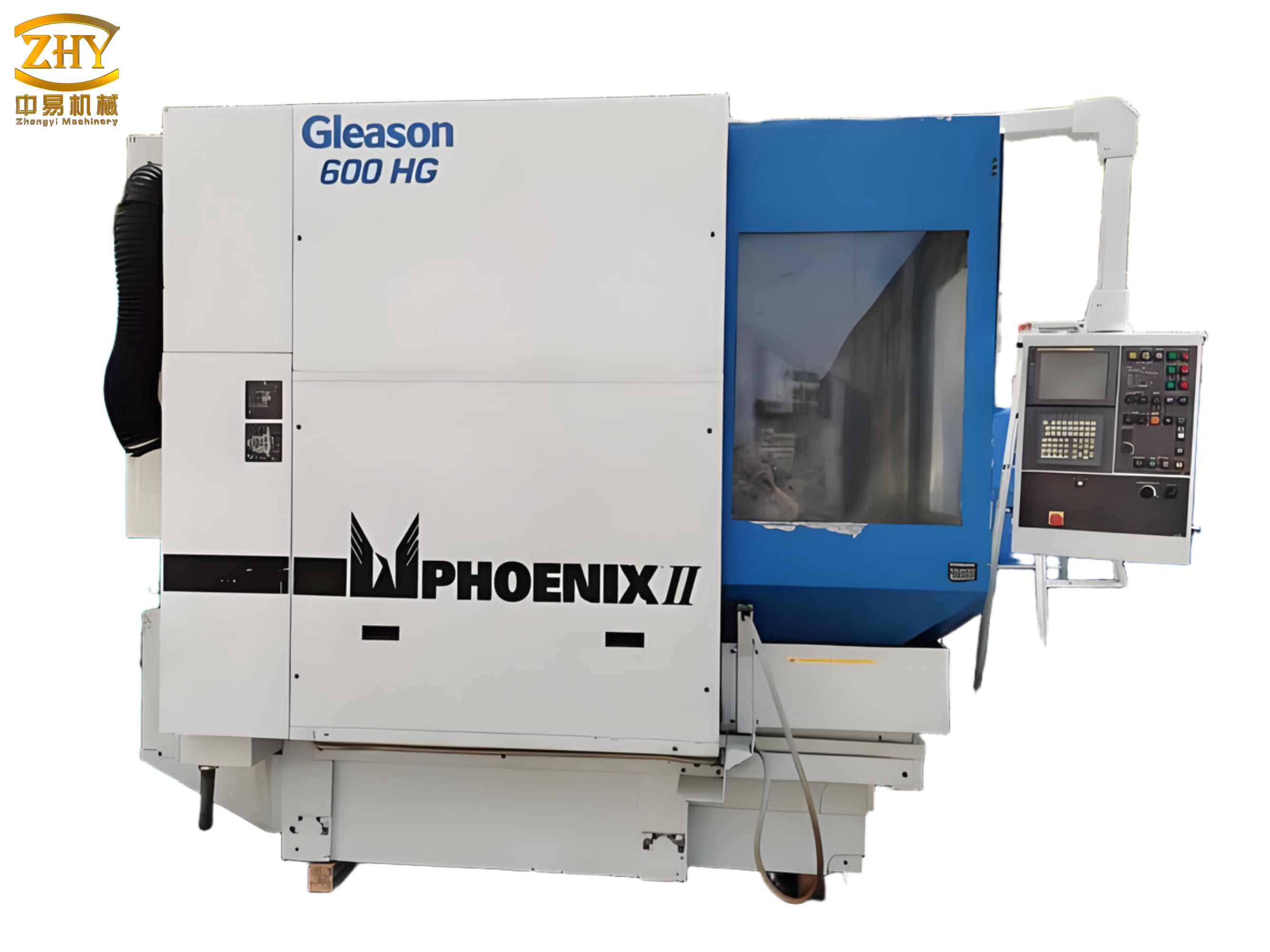
The foundation of error measurement lies in laser interferometry, which leverages the wave properties of light. Laser light, with its stable wavelength, creates interference patterns when split into two coherent beams. The displacement of a moving reflector alters the optical path difference, generating interference fringes detected by a laser head. The cumulative pulse count relates to the distance moved, as expressed by the formula: $$ l = \frac{\lambda}{2} N $$ where \( l \) is the measured distance, \( \lambda \) is the laser wavelength, and \( N \) is the cumulative pulse number. This principle is applied to measure linear axis errors in gear grinding machines, ensuring accurate positioning during gear grinding operations.
For linear axis measurement, a dual-frequency laser interferometer is employed. The setup involves a laser head, beam splitter, fixed mirror, and moving mirror. The laser beam splits into reference and measurement beams, which reflect off the fixed and moving mirrors, respectively. Upon recombination, interference occurs, and the detector analyzes frequency changes due to the Doppler effect. The moving mirror’s displacement is calculated based on the fringe count, providing precise position data. In practical gear grinding scenarios, this method helps identify pitch errors in ball screw drives, which are common in CNC machines used for gear profile grinding. Accurate measurement is crucial to mitigate grinding cracks caused by positional inaccuracies.
In our experimental setup for the X-axis of a gear grinding machine, the linear travel distance is 250 mm, with compensation points spaced at 50 mm intervals from -280 mm to -30 mm. Five measurement points are tested five times each in a standard cycle. The results before compensation show significant deviations, as illustrated in the analysis curve. The error compensation values are derived using the formula: $$ x_{ij} = p_{ij} – p_i $$ where \( p_{ij} \) is the actual position, \( p_i \) is the theoretical position, and \( x_{ij} \) is the compensation value. This approach minimizes errors that could lead to grinding cracks in gear grinding processes.
| Coefficient | Position (mm) | Compensation Value (μm) |
|---|---|---|
| 1 | -280.0000 | 0 |
| 2 | -230.0000 | -4 |
| 3 | -180.0000 | -4 |
| 4 | -130.0000 | -3 |
| 5 | -80.0000 | -3 |
| 6 | -30.0000 | -3 |
After inputting these compensation values into the CNC system, remeasurement reveals a notable improvement in X-axis positioning accuracy. The compensated data shows reduced deviations, enhancing the machine’s capability for precise gear grinding. This method effectively addresses pitch errors in ball screws, which is vital for achieving high-quality gear profile grinding and preventing grinding cracks. The economic benefits are substantial, as it avoids hardware modifications while improving performance.
For rotary axes, such as the C-axis in a gear grinding machine, similar laser interferometry principles apply, but with adaptations for angular measurements. A wireless rotary calibration device, equipped with high-precision angle mirrors and a motor-driven platform, is used. When the machine’s rotary axis rotates, the device’s mirror counter-rotates to maintain laser alignment. Any angular error \( \theta \) causes a displacement \( \Delta L \) in the interferometric path, related by the equation: $$ \theta = \arcsin\left( \frac{\Delta L}{s} \right) $$ where \( s \) is the nominal distance between mirrors in the angle reflector. This setup allows accurate measurement of rotational errors, which is critical in gear grinding to ensure proper tooth engagement and avoid grinding cracks.
In practical terms, the C-axis is measured over a 360° range, divided into 12 segments of 30° each. The rotary device records data at 13 points per rotation, both forward and reverse. Pre-compensation measurements indicate angular errors that could affect gear profile grinding quality. The compensation values are calculated and tabulated, similar to the linear axis approach. For instance, the error compensation chart for the C-axis includes positions from 0° to 360° with corresponding compensation values in arcseconds. This process is essential for maintaining accuracy in gear grinding operations, reducing the risk of grinding cracks by ensuring consistent angular positioning.
| Coefficient | Position (°) | Compensation Value (arcseconds) |
|---|---|---|
| 1 | 0.00000 | 0 |
| 2 | 30.00000 | 1 |
| 3 | 60.00000 | -1 |
| 4 | 90.00000 | -1 |
| 5 | 120.00000 | -1 |
| 6 | 150.00000 | 5 |
| 7 | 180.00000 | 0 |
| 8 | 210.00000 | 0 |
| 9 | 240.00000 | -3 |
| 10 | 270.00000 | 3 |
| 11 | 300.00000 | -2 |
| 12 | 330.00000 | 5 |
| 13 | 360.00000 | -1 |
Post-compensation measurements demonstrate a significant reduction in angular errors, improving the repeatability and accuracy of the C-axis. This enhancement is crucial for gear profile grinding, as it ensures precise rotational movements that minimize deviations leading to grinding cracks. The integration of error compensation tables into the CNC system via software provides a reliable and economical solution for boosting machine performance in gear grinding applications.
The measurement and compensation processes for both linear and rotary axes involve rigorous data analysis. For linear axes, the laser interferometer’s wavelength stability and pulse counting are key. The formula for distance measurement derives from the interference principle: $$ N = \int_0^t \Delta f \, dt = \frac{2}{\lambda} \int_0^t dl = \frac{2l}{\lambda} $$ thus, $$ l = \frac{\lambda}{2} N $$ This calculation is automated in modern interferometers, facilitating efficient error detection in gear grinding machines. Similarly, for rotary axes, the angular error computation relies on trigonometric relationships, ensuring high precision in gear profile grinding tasks.
In gear grinding, the prevention of grinding cracks is paramount, as these defects can arise from thermal and mechanical stresses during machining. Accurate axis positioning reduces uneven loading and heat generation, thereby mitigating crack formation. By implementing error compensation, we enhance the geometric accuracy of gear grinding machines, leading to superior gear quality. The repeated emphasis on gear grinding and gear profile grinding throughout this process underscores their importance in industrial applications.
Furthermore, the economic aspect of error compensation cannot be overstated. Instead of investing in expensive hardware upgrades, manufacturers can utilize software-based compensation to achieve desired accuracy levels. This approach is particularly beneficial for small and medium enterprises involved in gear grinding, as it reduces costs while maintaining competitiveness. The use of laser interferometry ensures reliable measurements, and the compensation tables provide a straightforward method for error correction.
In conclusion, the measurement and compensation of axis positioning errors in gear grinding machines using laser interferometry significantly improve geometric accuracy. This method addresses both linear and rotary axes, enhancing performance in gear grinding and gear profile grinding operations. By reducing errors, we minimize the risk of grinding cracks and ensure high-quality gear production. The tables and formulas presented herein serve as practical tools for implementing compensation strategies. Overall, this approach offers a cost-effective and efficient solution for advancing manufacturing capabilities in the gear industry.