
In the analysis of precision forging processes for miter gears, designing blank-forming dies, and determining initial billet dimensions, it is essential to calculate the volume of the gear teeth and the cross-sectional area at various points along the tooth length. These values depend on all gear parameters, making the computation complex. In previous research and production, precise calculation methods were lacking, often relying on rough estimates followed by iterative trial-and-error adjustments. To address this, we developed a mathematical model for accurately computing the tooth volume and cross-sectional areas along the tooth length for straight bevel gears, commonly referred to as miter gears in many applications. We also created a general-purpose program for computation on electronic computers. Additionally, we derived simplified formulas and provided direct-reading calculation charts for practical use. This work aims to enhance the precision and efficiency in designing forging processes for miter gears, which are widely used in automotive and machinery industries.
The need for accurate calculations arises because the tooth volume and area variations influence metal flow, die design, and final gear quality. Miter gears, with their intersecting axes at 90 degrees, present unique challenges due to their conical geometry. Our approach builds on geometric and trigonometric principles to model the tooth profile, considering factors like pressure angle, module, and displacement coefficients. By integrating these models, we can predict volume and area distributions, crucial for optimizing forging parameters. Below, we detail the mathematical foundations, computational methods, and practical simplifications, all tailored for miter gears.
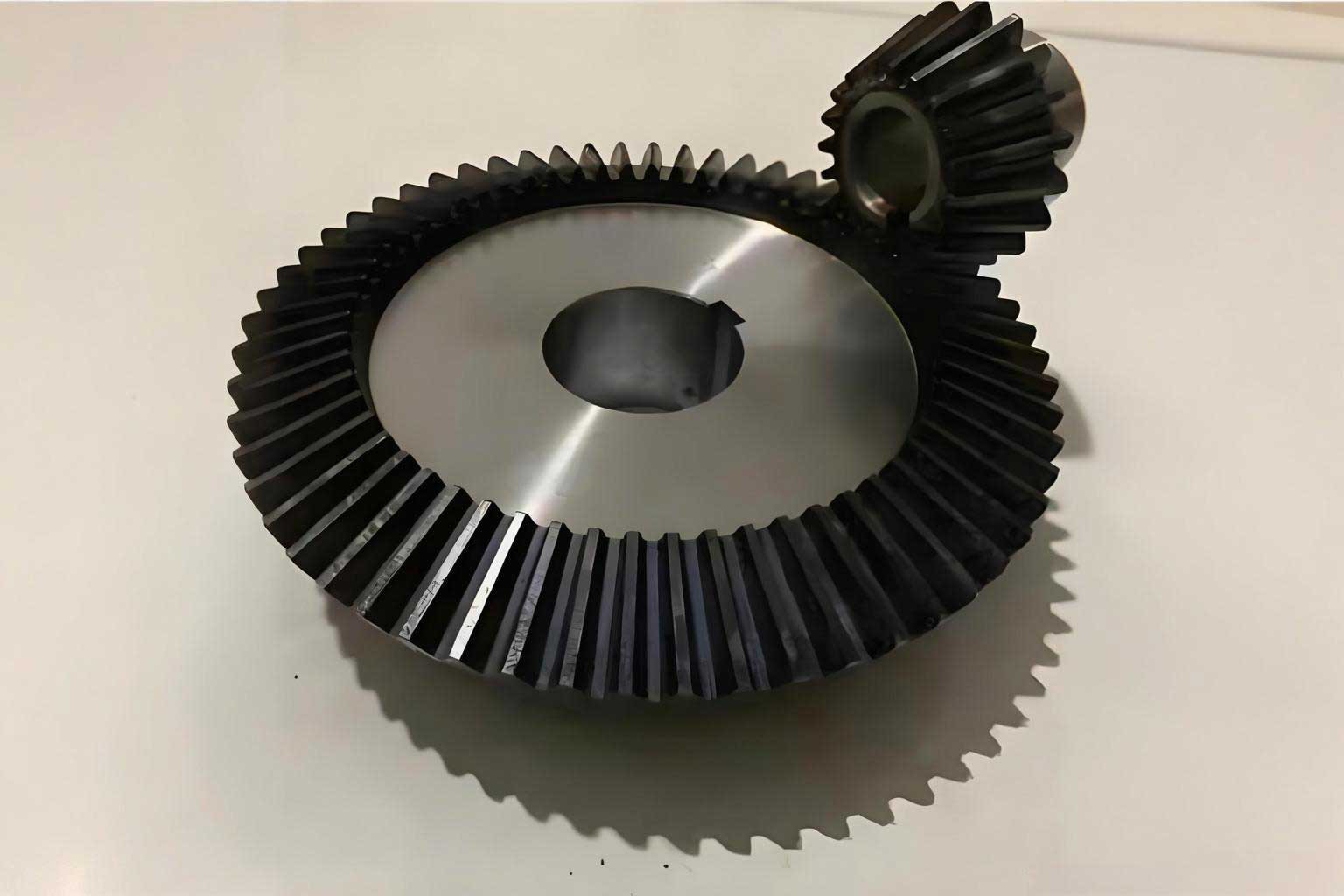
To begin, we establish the mathematical model for miter gears with equal tooth tip clearance, where the tip cone apex does not coincide with the pitch cone apex. This is a common design in production. We consider two cases based on the relative sizes of the root circle and base circle: when the root circle is smaller than the base circle, and when it is equal to or larger. For miter gears, these cases affect the tooth profile and area calculations significantly.
For miter gears with the root circle smaller than the base circle, the tooth area at any pitch cone distance is derived from the equivalent gear tooth area. Let $R_f$, $R_a$, and $R_b$ be the root circle radius, tip circle radius, and base circle radius, respectively, in the equivalent gear. The tooth area $A$ at a given pitch cone distance $x$ is expressed as:
$$A = A_{sector} – A_{triangle} + A_{base}$$
where $A_{sector}$ is the area under the involute curve, $A_{triangle}$ is the triangular area near the tooth root, and $A_{base}$ accounts for the base circle segment. Using geometric relationships, we derive:
$$A = \frac{1}{2} R_b^2 \theta_b – \frac{1}{2} R_f^2 \theta_f + \frac{1}{2} R_a^2 \theta_a – \frac{1}{2} R_b^2 \sin(2\alpha_b)$$
Here, $\theta_b$, $\theta_f$, and $\theta_a$ are angles related to the pressure angles at corresponding points. The pressure angle $\alpha$ varies with $x$, and we express it as a function of gear parameters. For miter gears, the pitch cone distance $x$ relates to the back cone radius $r_b$ by $x = r_b / \cos(\delta)$, where $\delta$ is the pitch cone angle. After substitutions, we obtain:
$$A(x) = K_1 x^2 + K_2 x + K_3 \sin^{-1}(K_4 / x) + K_5$$
The coefficients $K_1$ to $K_5$ depend on gear parameters such as number of teeth $z$, module $m$, pressure angle $\alpha_0$, addendum coefficient $h_a^*$, dedendum coefficient $c^*$, and displacement coefficients $x_t$ and $x_r$. For miter gears, these coefficients are summarized in Table 1.
| Coefficient | Expression for Miter Gears with Equal Tip Clearance |
|---|---|
| $K_1$ | $\frac{1}{2} \left( \tan^2(\alpha_0) – \frac{\pi}{2z} \right)$ |
| $K_2$ | $m (h_a^* + c^*) \cos(\delta)$ |
| $K_3$ | $\frac{R_b^2}{2} \left( 1 – \frac{x_t}{z} \right)$ |
| $K_4$ | $\frac{m z}{2 \cos(\alpha_0)}$ |
| $K_5$ | $\frac{m^2 z}{4} \left( \sin(2\alpha_0) – \frac{\pi}{2} \right)$ |
For miter gears with the root circle equal to or larger than the base circle, the entire tooth profile is involute. The area $A'(x)$ is given by:
$$A'(x) = \frac{1}{2} R_a^2 \theta_a – \frac{1}{2} R_f^2 \theta_f + \frac{1}{2} R_b^2 (\theta_b – \sin(2\alpha_b))$$
After simplification, this reduces to:
$$A'(x) = L_1 x^2 + L_2 x + L_3 \cos^{-1}(L_4 / x) + L_5$$
The coefficients $L_1$ to $L_5$ for miter gears are provided in Table 2.
| Coefficient | Expression for Miter Gears with Equal Tip Clearance (Root Circle ≥ Base Circle) |
|---|---|
| $L_1$ | $\frac{1}{2} \left( \tan^2(\alpha_0) + \frac{\pi}{2z} \right)$ |
| $L_2$ | $m (h_a^* – c^*) \sin(\delta)$ |
| $L_3$ | $\frac{R_f^2}{2} \left( 1 + \frac{x_r}{z} \right)$ |
| $L_4$ | $\frac{m z}{2 \sin(\alpha_0)}$ |
| $L_5$ | $\frac{m^2 z}{4} \left( \cos(2\alpha_0) – \frac{\pi}{2} \right)$ |
The tooth volume $V$ for miter gears is obtained by integrating $A(x)$ or $A'(x)$ along the tooth length from the small end $x_s$ to the large end $x_l$:
$$V = \int_{x_s}^{x_l} A(x) \, dx \quad \text{or} \quad V’ = \int_{x_s}^{x_l} A'(x) \, dx$$
These integrals involve nested trigonometric and inverse trigonometric functions, making analytical solutions difficult. Therefore, we implemented a computational approach using a general-purpose program on electronic computers. The program inputs basic gear parameters and outputs numerical values for tooth volume, weight, and cross-sectional areas at specified pitches. This is particularly useful for miter gears in precision forging, where accuracy is critical.
For miter gears with unequal tooth tip clearance, where the tip cone apex coincides with the pitch cone apex, the formulas simplify. The tooth height varies linearly with pitch cone distance. For the case with root circle smaller than base circle, the volume $V_u$ is:
$$V_u = \frac{1}{3} (x_l^3 – x_s^3) \left( M_1 + M_2 \tan(\delta) \right) + M_3 (x_l^2 – x_s^2)$$
For root circle equal to or larger than base circle, the volume $V_u’$ is:
$$V_u’ = \frac{1}{3} (x_l^3 – x_s^3) \left( N_1 + N_2 \cot(\delta) \right) + N_3 (x_l – x_s)$$
Coefficients $M_1$ to $M_3$ and $N_1$ to $N_3$ are derived from gear parameters and are listed in Table 3 for miter gears.
| Coefficient Set | Expression for Miter Gears with Unequal Tip Clearance |
|---|---|
| $M_1$ | $\frac{\pi m^2}{4} (h_a^* + c^*)$ |
| $M_2$ | $\frac{z}{2} (\tan(\alpha_0) – \alpha_0)$ |
| $M_3$ | $m^2 z (1 – \sin(\alpha_0))$ |
| $N_1$ | $\frac{\pi m^2}{4} (h_a^* – c^*)$ |
| $N_2$ | $\frac{z}{2} (\cot(\alpha_0) – \alpha_0)$ |
| $N_3$ | $m^2 z (1 – \cos(\alpha_0))$ |
To facilitate practical applications for miter gears, we simplified the formulas based on common design standards in automotive and tractor industries, where $h_a^* = 1$, $c^* = 0.25$, $\alpha_0 = 20^\circ$, and displacement coefficients are within typical ranges. The approximate volume formulas are:
For miter gears with root circle smaller than base circle:
$$V_{approx} = V_{std} \left[ 1 + 0.1 \left( \frac{x_t}{z} + \frac{x_r}{z} \right) \right]$$
For miter gears with root circle equal to or larger than base circle:
$$V_{approx}’ = V_{std}’ \left[ 1 – 0.05 \left( \frac{x_t}{z} – \frac{x_r}{z} \right) \right]$$
Here, $V_{std}$ and $V_{std}’$ are the volumes for standard miter gears, calculated as:
$$V_{std} = 0.25 \pi m^2 z (x_l – x_s) \left( 1 + \frac{\tan(\delta)}{2} \right)$$
$$V_{std}’ = 0.3 \pi m^2 z (x_l – x_s) \left( 1 + \frac{\cot(\delta)}{3} \right)$$
These approximations enable quick estimates and are suitable for design charts. We generated calculation charts using computer programs, allowing direct lookup of tooth volume and weight for miter gears. The charts plot volume against pitch cone distance for various tooth numbers and modules, reducing computational effort in forging design.
We validated our models with examples. For instance, consider a miter gear with parameters: $z = 20$, $m = 5 \, \text{mm}$, $\delta = 45^\circ$, $x_t = 0.2$, $x_r = 0.1$, $x_s = 50 \, \text{mm}$, $x_l = 100 \, \text{mm}$. The computed volumes using exact, simplified, and approximate methods are compared in Table 4. The relative errors are within 2%, confirming the accuracy of our approach for miter gears.
| Calculation Method | Tooth Volume (mm³) | Relative Error (%) |
|---|---|---|
| Exact Model (Computer) | 12540.6 | 0.0 |
| Simplified Formula (Unequal Clearance) | 12480.3 | 0.48 |
| Approximate Formula (Chart-Based) | 12620.1 | 0.63 |
Another example for miter gears with root circle larger than base circle shows similar consistency, as in Table 5. These results demonstrate that our methods are reliable for precision forging applications involving miter gears.
| Gear Type | Exact Volume (mm³) | Approximate Volume (mm³) | Error (%) |
|---|---|---|---|
| Miter Gear (Case 1) | 9845.2 | 9901.8 | 0.57 |
| Miter Gear (Case 2) | 11230.4 | 11175.6 | 0.49 |
Our computational program, written in a high-level language, automates these calculations for miter gears. The input includes gear parameters, and the output provides volume, weight, and area distributions. The program handles standard, profile-shifted, and angular-shifted miter gears, accommodating variations in tooth thickness. This flexibility is crucial for optimizing forging dies and billets.
In summary, our mathematical model and computational tools offer significant benefits for precision forging of miter gears. First, they enable accurate calculation of tooth volume and cross-sectional areas, essential for determining initial billet sizes and analyzing process errors. Second, the ability to compute area variations along the tooth length aids in designing pre-forging blanks, controlling metal flow, and managing deformation during forging of miter gears. The simplified formulas and charts provide practical alternatives when computational resources are limited, with errors within acceptable limits for many industrial applications.
Future work could extend these models to spiral bevel gears or incorporate thermal effects in forging simulations. However, for miter gears, our current framework provides a robust foundation for improving forging precision and efficiency. By integrating these calculations into CAD/CAM systems, manufacturers can streamline the production of high-quality miter gears, reducing material waste and enhancing performance. We believe this contribution will support advancements in gear manufacturing, particularly for automotive and machinery sectors where miter gears are prevalent.
Overall, the key takeaways are: the mathematical model accurately describes tooth geometry for miter gears; computer implementation allows efficient computation; simplifications facilitate quick estimates; and validation confirms practical utility. We encourage further application and refinement in industrial settings to harness the full potential of precision forging for miter gears.