
In the realm of precision forging for spur gears, achieving complete tooth cavity filling while minimizing deformation forces remains a significant challenge. As we delve into this topic, our focus is on developing an efficient process that combines the principles of floating die structures and constrained split-flow methods. This article presents our experimental and numerical investigation into the precision forging of spur gears, aiming to address issues of insufficient forming and excessive load. We will explore how these techniques interact to improve metal flow and reduce operational pressures, ultimately contributing to the advancement of near-net shape manufacturing for spur gears.
The spur gear, a fundamental component in mechanical transmission systems, requires high precision and durability. Traditional manufacturing methods often involve extensive machining, but precision forging offers a promising alternative by directly forming the tooth profile with minimal post-processing. However, the complex geometry of spur gears, particularly the involute tooth shape, poses difficulties in ensuring complete filling of the tooth cavities during forging. Additionally, high friction forces, especially radial friction, can lead to increased deformation loads, necessitating larger equipment and higher costs. Therefore, our research seeks to optimize the forging process for spur gears by leveraging innovative die designs and flow control mechanisms.
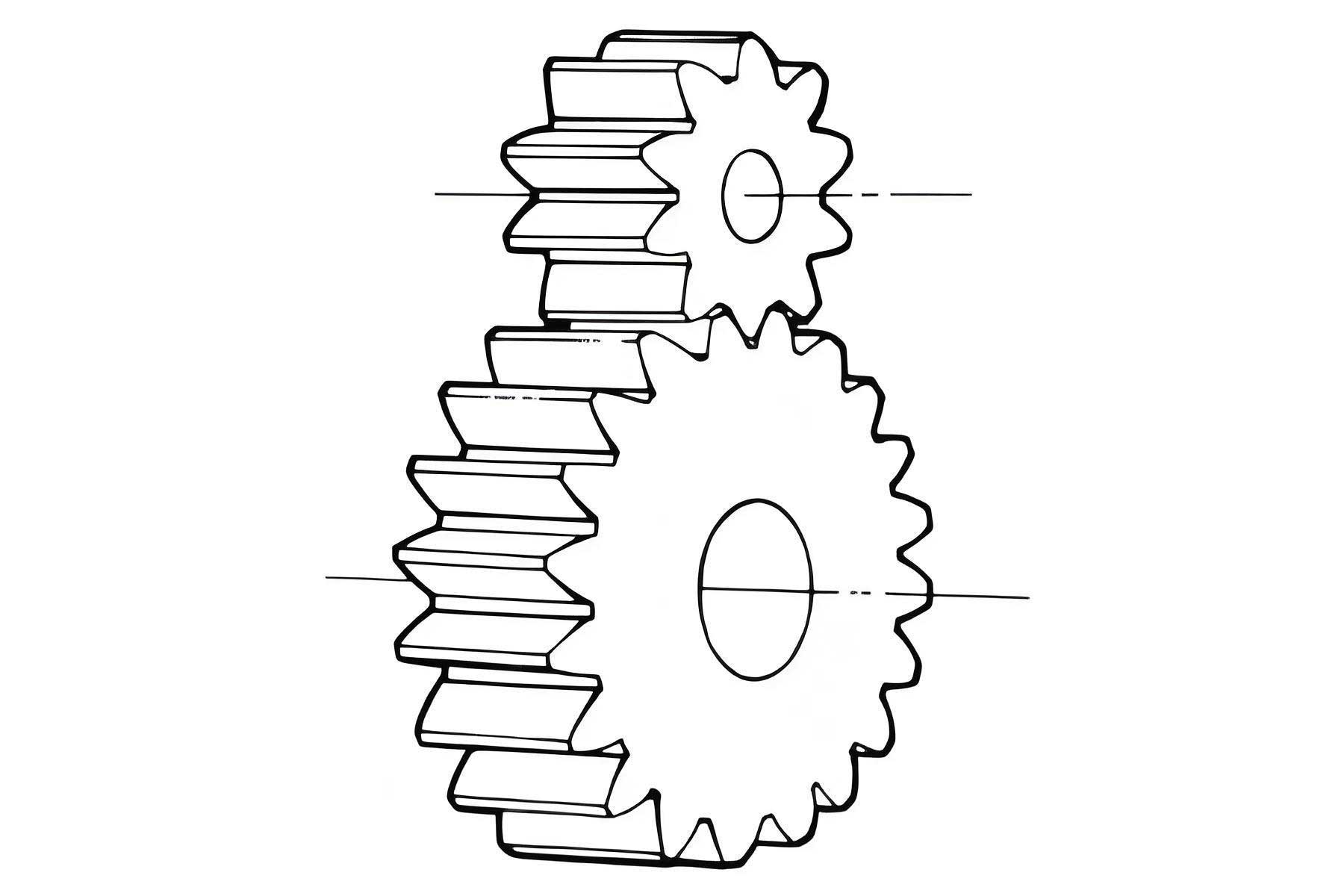
To set the stage, let’s consider the basic mechanics of spur gear forging. When a metal billet is compressed in a die cavity, the material flows perpendicular to the applied force, making it challenging to fill intricate tooth profiles. The friction at the die-workpiece interface further complicates this flow, often resulting in incomplete filling at the tooth tips or corners. Over the years, various approaches have been proposed to mitigate these issues. One prominent method is the use of floating dies, where the die is allowed to move relative to the punch, utilizing “positive friction” to enhance filling at the lower tooth ends. However, this can inadvertently increase the forming load. Another strategy involves split-flow techniques, where excess material is diverted to relief areas, reducing pressure. But uncontrolled分流 can lead to insufficient filling in critical regions. Hence, constrained split-flow methods have emerged, incorporating obstacles like small mandrels or symmetric protrusions to regulate the flow and ensure balanced filling.
In our study, we focus on a specific type of constrained split-flow: the small mandrel constrained分流, combined with a floating die structure. This approach aims to harness the benefits of both concepts—improved filling through positive friction and load reduction through controlled分流. We target a reduction spur gear with a modulus of 2.5, 18 teeth, and a tooth thickness of 16 mm. Our experimental work uses industrial pure lead as a model material to simulate hot forging of steel, followed by numerical simulations for 45 steel using DEFORM-3D software. Through this comprehensive analysis, we aim to establish a viable process window for precision forging of spur gears.
To understand the underlying principles, let’s formalize some key concepts. The deformation force in forging can be approximated by the following equation, which accounts for material flow stress and friction:
$$ F = \sigma_f \cdot A \cdot (1 + \mu \cdot \frac{h}{r}) $$
where \( F \) is the forging force, \( \sigma_f \) is the flow stress of the material, \( A \) is the contact area, \( \mu \) is the friction coefficient, \( h \) is the billet height, and \( r \) is the radius. For spur gears, the contact area varies with tooth geometry, making the process non-uniform. The floating die introduces an additional velocity component, modifying the friction term. In a floating die setup, the die moves with the punch, so the relative velocity is reduced, potentially decreasing friction losses. The positive friction effect can be described as:
$$ F_{\text{float}} = F_{\text{fix}} – \Delta F_{\text{fric}} $$
where \( F_{\text{float}} \) is the force with floating die, \( F_{\text{fix}} \) is the force with fixed die, and \( \Delta F_{\text{fric}} \) is the reduction due to altered friction.
Constrained split-flow, on the other hand, involves creating a分流 path with a constraint to limit excessive material diversion. The small mandrel method uses a central mandrel to restrict radial flow into a分流 hole. The effectiveness of this constraint can be quantified by the constraint ratio \( \lambda \), defined as:
$$ \lambda = \frac{d_m}{d_b} $$
where \( d_m \) is the mandrel diameter and \( d_b \) is the billet inner diameter. A higher \( \lambda \) indicates stronger constraint, which may improve filling but also increase force. The optimal \( \lambda \) balances these factors. Additionally, the volume constancy principle governs billet sizing:
$$ V_{\text{billet}} = V_{\text{gear}} + V_{\text{flash}} $$
where \( V_{\text{billet}} \) is the initial billet volume, \( V_{\text{gear}} \) is the final gear volume, and \( V_{\text{flash}} \) is the flash volume. For hollow billets, the inner diameter influences the height and deformation behavior.
Our experimental setup involved designing a precision forging mold based on the floating die and small mandrel constrained分流. The die assembly consisted of a fixed upper die and a floating lower die, as illustrated in our trials. The spur gear cavity was machined into the dies, with a central mandrel of 10 mm diameter for constraint. We used a WAW-1000C electro-hydraulic servo testing machine for the experiments, with a pressing speed set to simulate industrial conditions. The billet material was industrial pure lead, chosen for its low flow stress and similarity to steel in terms of plastic behavior at elevated temperatures. Billet dimensions were selected based on the gear’s root circle diameter of 38 mm, with varying inner diameters to study the effect on forming.
The table below summarizes our experimental schemes and key results. We compared fixed die forging (with冲挤+镦挤 process) against constrained分流 methods with different billet inner diameters, and finally integrated the floating die.
| Scheme | Billet Dimensions (mm) | Forming Force, F (kN) | Filling Condition | Notes |
|---|---|---|---|---|
| Fixed Die (冲挤+镦挤) | Φ38 × 21 (solid) | 298.60 | Severe underfilling, large flash at top | Baseline for comparison |
| Constrained分流 B1-1 | Φ38 × Φ12 × 25 | 135.30 | Underfilling at lower tooth corners | Small inner diameter, early constraint |
| Constrained分流 B1-2 | Φ38 × Φ16 × 27.3 | 212.42 | Good filling | Optimal in fixed die case |
| Constrained分流 B1-3 | Φ38 × Φ20 × 31 | 219.23 | Good filling | Larger inner diameter, higher force |
| Floating Die + Constrained分流 B1-2 | Φ38 × Φ16 × 27.3 | 207.40 | Good filling | Improved with floating die |
From the table, several observations emerge. The fixed die process required the highest force (298.60 kN) and resulted in poor filling, highlighting the limitations of conventional forging for spur gears. Introducing constrained分流 significantly reduced the force—by over 25% in scheme B1-1—but at the cost of incomplete filling at the lower corners. This is because the small inner diameter (12 mm) led to a shorter billet height, reducing total deformation but also limiting the分流 effect duration. As the inner diameter increased (schemes B1-2 and B1-3), the force rose slightly, but filling improved due to more uniform material flow. Scheme B1-2 struck a balance, with good filling and moderate force (212.42 kN), making it the preferred option for fixed die constrained分流.
When we incorporated the floating die into scheme B1-2, the force decreased further to 207.40 kN, while maintaining good filling. This demonstrates the synergistic effect of floating die and constrained分流: the positive friction from the floating die aids in filling the lower tooth regions, and the constrained分流 reduces overall pressure. The force reduction can be attributed to the altered friction dynamics, as per our earlier equations. To quantify this, we can define a load reduction factor \( \eta \):
$$ \eta = \frac{F_{\text{fix}} – F_{\text{float}}}{F_{\text{fix}}} \times 100\% $$
For scheme B1-2, \( \eta \approx 2.4\% \), indicating a modest but meaningful improvement. In broader terms, the combination of floating die and constrained分流 offers a robust solution for spur gear forging.
To delve deeper into the mechanics, let’s analyze the force-stroke curves from our experiments. The curve for the floating die with constrained分流 (B1-2 scheme) shows three distinct phases: an initial gradual rise, a steady increase during tooth cavity filling, and a sharp climb at the final forging stage. This pattern aligns with theoretical expectations. In the early stage, the material undergoes free upsetting with minimal resistance. As the teeth start to form, the flow becomes restricted, increasing force. Finally, when the cavity is nearly filled, further compression requires high pressure due to work hardening and reduced flow areas. The numerical simulation of this process using DEFORM-3D for lead samples yielded a similar curve, validating our experimental findings.
Extending our analysis to steel, we performed numerical simulations for 45 steel spur gears under hot forging conditions. The simulation parameters were set as follows: billet temperature at 1100°C, die temperatures at 300°C (punch) and 400°C (die), friction factor m = 0.2, and a forging speed of 20 mm/s. The billet dimensions matched scheme B1-2 (Φ38 mm outer diameter, Φ16 mm inner diameter, 27.3 mm height). The load-stroke curve from the simulation exhibited the same trend as the lead experiments, with forces scaled higher due to steel’s greater flow stress. The final forged spur gear showed complete tooth filling with clear contours, confirming the process’s effectiveness for realistic materials.
The success of this approach for spur gears hinges on the interplay between billet geometry and constraint design. We can formulate an optimization problem to determine the ideal billet inner diameter \( d_b \) and mandrel diameter \( d_m \). Let \( F_{\text{max}} \) be the maximum allowable force, and \( Q \) be a filling quality index (e.g., percentage of tooth volume filled). The goal is to maximize \( Q \) subject to \( F \leq F_{\text{max}} \). From our data, we observe that \( Q \) improves with increasing \( d_b \) up to a point, but \( F \) also increases. A simple empirical model can be derived:
$$ Q = k_1 \cdot d_b – k_2 \cdot \frac{1}{d_b} $$
$$ F = k_3 \cdot d_b + k_4 \cdot h $$
where \( k_1, k_2, k_3, k_4 \) are material-dependent constants, and \( h \) is billet height related to \( d_b \) via volume constancy. For the spur gear in question, with fixed outer diameter, \( h \) is inversely proportional to \( d_b^2 \) for hollow billets. Thus, we can solve for the optimal \( d_b \) that balances \( Q \) and \( F \). Our experimental optimum of 16 mm inner diameter aligns with this reasoning.
Furthermore, the role of the floating die can be modeled by incorporating a velocity factor. In a floating die system, the die velocity \( v_d \) matches the punch velocity \( v_p \), so the net velocity difference is zero, reducing shear stresses. The effective friction coefficient \( \mu_{\text{eff}} \) becomes:
$$ \mu_{\text{eff}} = \mu \cdot \left(1 – \frac{v_d}{v_p}\right) $$
For \( v_d = v_p \), \( \mu_{\text{eff}} = 0 \), idealizing the positive friction effect. In practice, some slippage occurs, but the reduction is significant. This explains the lower forces in our floating die trials.
To generalize our findings, we compare different constrained split-flow methods for spur gears. The table below contrasts three common techniques: symmetric constraint分流, small mandrel constraint分流, and flange split-flow. Each has distinct mechanisms and applications.
| Method | Constraint Mechanism | Typical Application | Advantages for Spur Gears | Disadvantages |
|---|---|---|---|---|
| Symmetric Constraint分流 | Symmetrical protrusions around分流 hole | Cold forging of spur gears | Balanced flow, good precision | Complex die design |
| Small Mandrel Constraint分流 | Central mandrel in hollow billet | Hot forging of spur gears | Simple, effective load reduction | Sensitive to billet inner diameter |
| Flange Split-Flow | Axial constraint with mandrel | Gear forming with shafts | Handles axial flow well | May not suit thin spur gears |
For our spur gear, the small mandrel method proved suitable due to its simplicity and compatibility with hollow billets. When paired with a floating die, it addresses both filling and force concerns. This combination is particularly beneficial for spur gears with moderate module and tooth count, as in our case study.
In terms of numerical simulation, we used DEFORM-3D to model the entire forging process for the 45 steel spur gear. The software’s finite element analysis allowed us to visualize material flow, stress distribution, and defect formation. Key outputs included the effective strain field, which showed higher strains at the tooth tips, indicating good filling. The simulation also predicted a maximum force of approximately 1.2 MN for the steel gear, which is within acceptable ranges for industrial presses. These results reinforce the viability of our process for real-world spur gear production.
Beyond the immediate experiments, we can explore the implications for spur gear design and manufacturing. Precision forging enables near-net shape spur gears with superior mechanical properties due to grain flow alignment along the tooth profile. This enhances fatigue resistance and load capacity compared to machined gears. Our process, with its reduced forging load, allows for smaller, more energy-efficient presses, lowering capital costs. Additionally, the use of constrained分流 minimizes material waste by controlling flash formation, aligning with sustainable manufacturing goals.
To further optimize the process, we propose a multi-objective optimization framework. Let \( \mathbf{x} = [d_b, d_m, v_p, T] \) be the design vector, where \( T \) is temperature. The objectives are to minimize force \( F(\mathbf{x}) \) and maximize filling quality \( Q(\mathbf{x}) \). Constraints include geometric limits (e.g., \( d_b \leq \text{root diameter} \)) and material properties. Using response surface methodology or genetic algorithms, we can identify Pareto-optimal solutions for spur gear forging. This approach could be implemented in future work to tailor the process for different spur gear specifications.
In conclusion, our investigation into precision forging for spur gears demonstrates that integrating floating die and constrained split-flow methods offers a compelling solution to the dual challenges of incomplete filling and high deformation forces. Through experimental trials with industrial pure lead and numerical simulations for 45 steel, we established that a hollow billet with an inner diameter of 16 mm, combined with a small mandrel constraint and floating die, yields well-filled spur gears with reduced loads. The synergy between positive friction and controlled分流 underpins this success. As spur gears continue to be critical components in various industries, from automotive to aerospace, advancements in forging technology like ours contribute to more efficient and cost-effective production. We encourage further research into adaptive die designs and real-time process control to enhance the precision and scalability of spur gear forging.
Looking ahead, potential extensions of this work include applying the floating die and constrained分流 principles to helical gears or bevel gears, which present additional complexities due to their twisted or angled teeth. Also, exploring advanced materials like titanium alloys for spur gears could reveal new challenges and opportunities. Ultimately, the goal is to push the boundaries of near-net shape manufacturing, making high-performance spur gears more accessible and sustainable. Our study serves as a step in that direction, highlighting the importance of innovative die mechanics in the forging of spur gears.