
In modern engineering, spur gears play a critical role as fundamental components for transmitting motion and power across various applications. Traditional manufacturing methods, such as free forging and machining, often lead to low material utilization, inefficient production, and compromised mechanical properties due to disrupted metal flow lines. To address these limitations, we investigated precision closed-die forging for spur gears using 17Cr2Ni2MoVNb steel, aiming to enhance material efficiency, mechanical performance, and service life. This study explores the effects of forging parameters on material properties, designs optimized forging processes, and validates results through finite element analysis and experimental batch production. Our findings demonstrate that closed-die forging significantly improves the integrity of forging streamlines and enables high-precision manufacturing of spur gears, contributing to sustainable manufacturing goals by reducing waste and extending component lifespan.
The material used in this research is 17Cr2Ni2MoVNb steel, with its chemical composition detailed in Table 1. This alloy was selected for its high strength and toughness, which are essential for demanding gear applications. The spur gears studied here have key parameters summarized in Table 2, including module, number of teeth, and pressure angle, which are typical for industrial use. We conducted forging experiments using a 2500t screw press equipped with a medium-frequency induction heating system, ensuring precise temperature control during deformation. Specimens were prepared under varying forging ratios and normalizing temperatures to analyze mechanical properties, grain size, and banded structure, as outlined in Table 3. Mechanical testing involved tensile and impact tests, while microstructural examination assessed non-metallic inclusions, grain size, and banded structure levels, providing a comprehensive understanding of material behavior under different processing conditions.
| C | Si | Mn | P | S | Cr | Ni | Mo | Nb | Others |
|---|---|---|---|---|---|---|---|---|---|
| 0.20 | 0.18 | 0.58 | 0.004 | 0.002 | 1.70 | 1.60 | 0.28 | 0.02–0.06 | — |
| Module m (mm) | Number of Teeth z | Pressure Angle α (°) | Helix Angle β (°) | Face Width b (mm) | Addendum Coefficient ha | Modification Coefficient x | Accuracy Grade |
|---|---|---|---|---|---|---|---|
| 4 | 21 | 25 | 0 | 32 | 1 | 0 | 6 |
Our experimental approach focused on evaluating how forging ratio and normalizing temperature influence the mechanical and microstructural characteristics of 17Cr2Ni2MoVNb steel. The forging ratio, defined as the ratio of initial to final cross-sectional area, is a key parameter in deformation processing. It can be expressed as: $$ \text{Forging Ratio} = \frac{A_i}{A_f} $$ where \( A_i \) is the initial cross-sectional area and \( A_f \) is the final cross-sectional area. Higher forging ratios correspond to greater deformation, which we hypothesized would refine microstructure and enhance properties. Specimens were subjected to normalizing treatments at 880°C, 910°C, and 950°C, followed by mechanical tests and microstructural analysis. The results, compiled in Table 4, reveal trends in yield strength, tensile strength, elongation, reduction of area, and impact energy at room and low temperatures. Additionally, we assessed non-metallic inclusion levels, grain size ratings, and banded structure grades to correlate processing conditions with material quality.
| Forging Ratio | Specimen Size (mm) at 880°C Normalizing | Specimen Size (mm) at 910°C Normalizing | Specimen Size (mm) at 950°C Normalizing |
|---|---|---|---|
| 2 | φ36×160 | φ36×160 | φ36×160 |
| 3 | φ30×250 | φ30×250 | φ30×250 |
| 4 | φ26×320 | φ26×320 | φ26×320 |
| Specimen ID | Rp0.2 (MPa) | Rm (MPa) | A (%) | Z (%) | Impact Energy at Room Temp (J) | Impact Energy at Low Temp (J) | Non-metallic Inclusions Level | Grain Size Grade | Banded Structure Grade |
|---|---|---|---|---|---|---|---|---|---|
| 21 | 903, 909 | 1023, 1046 | 16, 14 | 55, 42 | 100, 80 | 56, 54 | A0, B0, C0, D0 | 10 | 2 |
| 22 | 907, 913 | 1046, 1048 | 17, 17 | 53, 52 | 106, 90 | 52, 58 | A0, B0, C0, D0 | 10 | 0 |
| 23 | 917, 935 | 1058, 1076 | 15.5, 16 | 52, 48 | 94, 98 | 50, 56 | A0, B0, C0, D0 | 10 | 0 |
| 31 | 947, 922 | 1070, 1053 | 15.5, 16 | 53, 56 | 80, 92 | 50, 50 | A0, B0, C0, D0 | 10 | 2 |
| 32 | 883, 922 | 1018, 1061 | 11.5, 14.5 | 29, 39 | 98, 66 | 30, 34 | A0, B0, C0, D0 | 10 | 2 |
| 33 | 949, 960 | 1084, 1086 | 15, 11 | 47, 28 | 78, 80 | 48, 44 | A0, B0, C0, D0 | 10 | 0 |
| 41 | 932, 913 | 1066, 1049 | 13.5, 16 | 37, 51 | 90, 120 | 58, 62 | A0, B0, C0, D0 | 10 | 0 |
| 42 | 920, 914 | 1063, 1080 | 12.5, 10 | 35, 28 | 80, 86 | 46, 50 | A0, B0, C0, D0 | 10 | 0 |
| 43 | 963, 960 | 1107, 1096 | 14, 8 | 45, 28 | 90, 94 | 58, 56 | A0, B0, C0, D0 | 10 | 0 |
Analysis of the mechanical properties and microstructure revealed that increasing the forging ratio and normalizing temperature positively affects material quality. For instance, specimens with a forging ratio of 4 and normalizing at 950°C exhibited banded structure grades of 0 and grain size grades of 10, indicating a refined and homogeneous microstructure. The yield ratio, defined as the ratio of yield strength to tensile strength (\( \text{Yield Ratio} = \frac{R_{p0.2}}{R_m} \)), showed a decreasing trend with higher forging ratios, suggesting improved ductility and toughness. This relationship can be modeled as: $$ \text{Yield Ratio} = k \cdot \exp(-\lambda \cdot \text{Forging Ratio}) $$ where \( k \) and \( \lambda \) are material constants. Such insights are crucial for selecting raw material dimensions in precision forging of spur gears, as they ensure optimal deformation without compromising integrity.
Building on these material studies, we designed a closed-die forging process for spur gears to replace conventional methods. The traditional manufacturing route for spur gears involves free forging, rough turning, finish turning, gear cutting (e.g., hobbing or shaping), carburizing heat treatment, and grinding. This approach not only wastes material but also severs the continuous metal flow lines in the tooth regions, reducing load-bearing capacity and service life. In contrast, our precision forging process comprises billet cutting, closed-die forging, finish machining of end faces and inner holes, carburizing heat treatment, and grinding of inner holes and end faces. This streamlined sequence enhances material utilization to over 70% and improves mechanical properties by preserving forging streamlines.
For the forging process design, we focused on the gear geometry with a module of 4 mm and 21 teeth. The forging part drawing was developed considering a grinding allowance of 0.6 mm on the tooth profiles, no grinding at the tooth roots, and a modification coefficient of +0.15 to ensure uniform grinding. Additional machining allowances were added to the outer diameter and end faces, and a overflow cavity was incorporated to accommodate excess metal and reduce forming resistance. The billet was designed as a cylindrical bar with dimensions of φ50 mm × 84 mm, calculated based on volume consistency with the forging part and ease of placement into the die cavity. The billet volume \( V_b \) is given by: $$ V_b = \pi \left(\frac{d_b}{2}\right)^2 h_b $$ where \( d_b = 50 \, \text{mm} \) is the billet diameter and \( h_b = 84 \, \text{mm} \) is the billet height. This ensures efficient material flow during forging.
The die design for closed-die forging included pre-forging and finish-forging stages to achieve complete tooth formation. Ejector pins were integrated to facilitate part removal without distortion, and the dies were connected to the press using T-bolts. To enhance die durability, we employed a prestressed ring design, where a single-layer stress ring is fitted around the die core to counteract forging pressures. The von Mises stress \( \sigma_v \) in the die can be approximated by: $$ \sigma_v = \sqrt{\frac{(\sigma_1 – \sigma_2)^2 + (\sigma_2 – \sigma_3)^2 + (\sigma_3 – \sigma_1)^2}{2}} $$ where \( \sigma_1, \sigma_2, \sigma_3 \) are principal stresses. This design increases the maximum pressure tolerance of the die, ensuring longevity during batch production of spur gears.
We conducted finite element analysis (FEA) to simulate the closed-die forging process and optimize parameters. The billet was modeled as an elastoplastic material, while the dies were treated as rigid bodies. A shear friction model with a coefficient of 0.3 was applied, and the forging temperature was set to 1050°C with a punch speed of 300 mm/s. The flow stress behavior of 17Cr2Ni2MoVNb steel at high temperatures was characterized using stress-strain data, as summarized in Table 5. For example, at 1100°C, the flow stress decreases with increasing strain, following a typical work-hardening and dynamic recovery pattern. The relationship can be described by the Arrhenius-type equation: $$ \sigma = K \cdot \varepsilon^n \cdot \exp\left(\frac{Q}{RT}\right) $$ where \( \sigma \) is flow stress, \( \varepsilon \) is strain, \( n \) is the work-hardening exponent, \( Q \) is activation energy, \( R \) is the gas constant, and \( T \) is temperature.
| Strain | Flow Stress at 800°C (MPa) | Flow Stress at 900°C (MPa) | Flow Stress at 1100°C (MPa) |
|---|---|---|---|
| 0.1 | 150 | 120 | 80 |
| 0.2 | 180 | 140 | 90 |
| 0.3 | 200 | 155 | 95 |
| 0.4 | 210 | 160 | 98 |
| 0.5 | 215 | 162 | 100 |
Simulation results indicated that at a reduction of 41.2 mm, the tooth roots began to fill, and at 42.9 mm, full tooth formation was achieved. The temperature distribution during forging showed localized increases at the tooth roots and tips due to direct die contact, while the forging load increased rapidly during corner filling, peaking at the end of the process. The total forging force \( F \) can be estimated by: $$ F = A \cdot \sigma_y \cdot C_f $$ where \( A \) is the projected area, \( \sigma_y \) is the yield stress, and \( C_f \) is a constraint factor accounting for die geometry. This analysis confirmed the feasibility of our die and process design for producing precise spur gears.
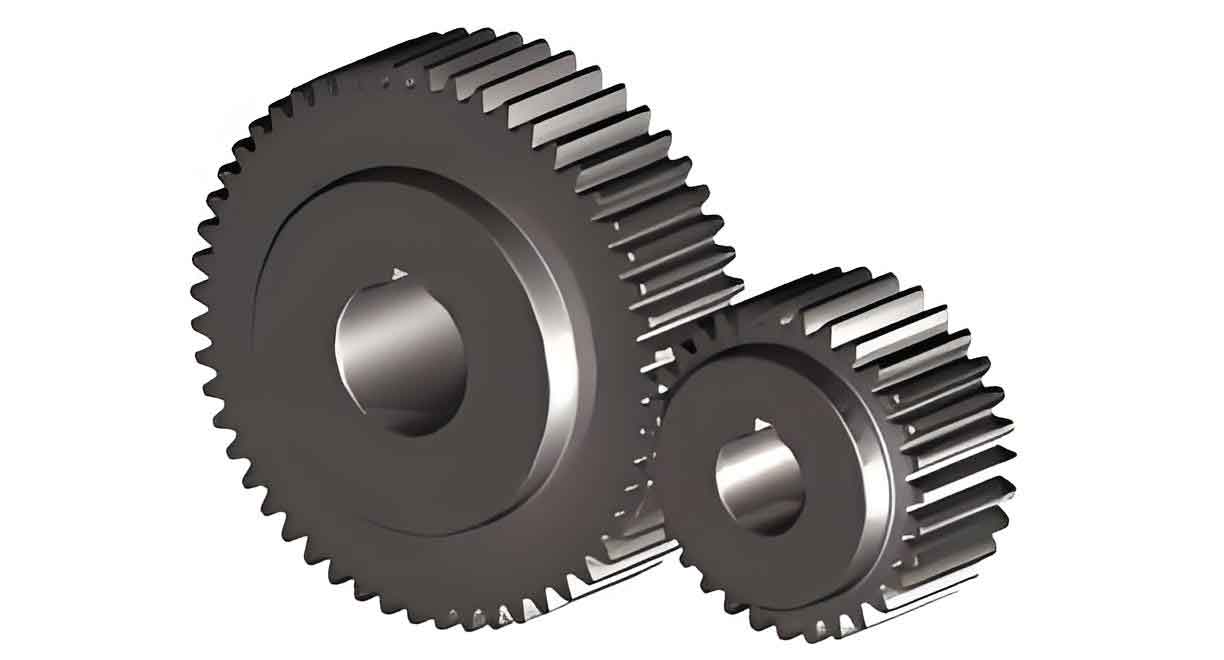
Experimental validation was performed using the designed closed-die forging setup. The process involved induction heating, upsetting, pre-forging, finish-forging, and ejection. Billets of φ50 mm × 84 mm were heated to a start-forging temperature of 1050°C, with die preheating at 200–300°C. A water-based graphite lubricant was applied to reduce friction and wear. The forged spur gears exhibited complete tooth profiles with intact forging streamlines, as confirmed by macrostructural analysis. The streamline distribution followed the gear contour, indicating proper metal flow without defects. This aligns with the FEA predictions and underscores the effectiveness of closed-die forging for spur gears.
For batch production, we established a manufacturing route comprising induction heating → upsetting → pre-forging → finish-forging → ejection. This process was applied to produce multiple spur gears with consistent quality. The material utilization exceeded 70%, compared to around 40% in conventional methods, and the production efficiency increased by approximately 40%. The mechanical properties of the forged spur gears, such as impact toughness and fatigue resistance, are expected to improve due to the continuous streamlines, enhancing their performance in service. The fatigue life \( N_f \) can be related to the stress amplitude \( \sigma_a \) by: $$ N_f = C \cdot \sigma_a^{-m} $$ where \( C \) and \( m \) are material constants, highlighting the importance of microstructure in longevity.
In conclusion, our research demonstrates that precision closed-die forging is a viable method for manufacturing high-quality spur gears from 17Cr2Ni2MoVNb steel. Key findings include the positive correlation between forging ratio, normalizing temperature, and microstructural refinement, as well as the successful application of FEA and die design to achieve complete tooth formation. The batch production results validate the process efficiency and material benefits, paving the way for broader adoption in industries requiring durable and precise spur gears. Future work could focus on optimizing heat treatment parameters and extending this approach to other gear types, further advancing sustainable manufacturing practices.