
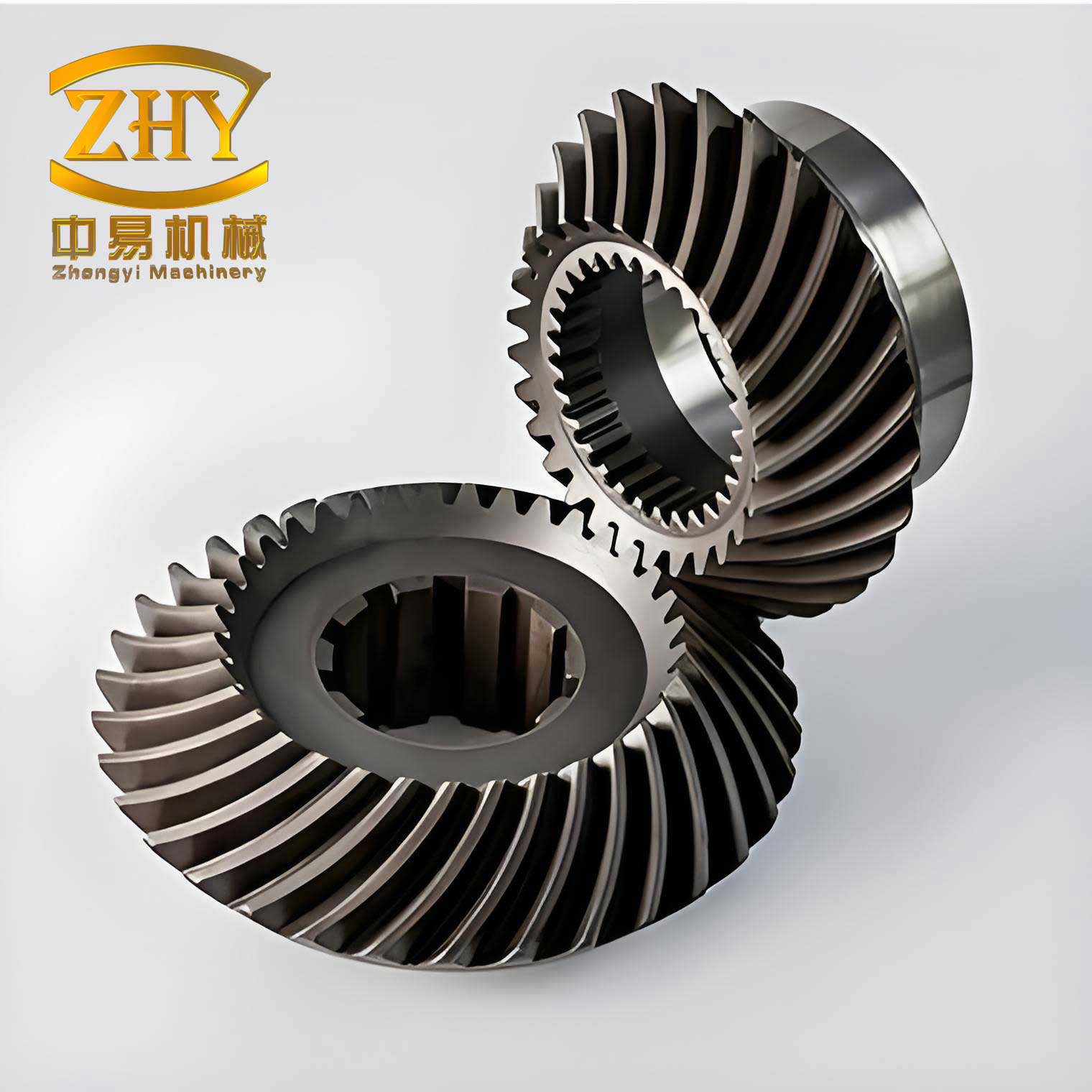
The demand for high-performance power transmission systems has propelled the use of spiral gears, particularly involute helical gears, into a prominent position across various industries, including automotive, aerospace, and heavy machinery. Compared to their spur gear counterparts, spiral gears offer superior operational characteristics such as smoother engagement, higher load capacity, and reduced noise and vibration. However, achieving the required precision and surface integrity on the complex helical tooth flanks of a spiral gear presents a significant manufacturing challenge. Among various finishing processes, form grinding stands out as a highly efficient and accurate method for machining hardened gear teeth. The core principle of form grinding a spiral gear involves using a grinding wheel whose axial profile is the precise conjugate of the gear tooth space. Consequently, the final accuracy of the ground spiral gear is intrinsically tied to the precision of the grinding wheel’s contoured profile. This article delves into the comprehensive methodology for modeling the gear geometry, calculating the exact wheel profile, and implementing advanced Computer Numerical Control (CNC) dressing techniques to achieve high-precision form grinding of involute spiral gears.
Mathematical Foundation for the Involute Helicoid
The tooth flank of an involute helical gear is a specific type of helical surface known as an involute helicoid. Understanding its mathematical generation is paramount for deriving the grinding wheel profile. A helicoid is generally defined as a surface generated by a curve undergoing a simultaneous rotary and translational motion along a fixed axis. For the involute helicoid of a spiral gear, the generating curve is a straight line.
Consider a right-handed Cartesian coordinate system \( (O – x, y, z) \) fixed in space, where the \(z\)-axis coincides with the gear’s axis of rotation. A straight line (the generatrix) is positioned tangent to an imaginary base cylinder of radius \(r_b\). This line also maintains a constant angle \(\alpha\) relative to the transverse plane (the \(xOy\) plane), which is equal to the base helix angle. When this generatrix undergoes a screw motion—rotation around the \(z\)-axis coupled with translation along it—it sweeps out the involute helicoidal surface. The parameter \(p\) defines the linear displacement along the \(z\)-axis per unit radian of rotation and is related to the gear’s helical pitch.
Let the straight generatrix be parameterized by \(u\), the distance from the point of tangency on the base cylinder. Its initial position can be described as:
$$
x_0 = r_b, \quad y_0 = u \cos\alpha, \quad z_0 = u \sin\alpha
$$
Applying the screw motion transformation, where \(\theta\) is the rotation angle, the equation of the generated right-hand involute helicoid becomes:
$$
\begin{aligned}
x &= r_b \cos\theta – u \cos\alpha \sin\theta \\
y &= r_b \sin\theta + u \cos\alpha \cos\theta \\
z &= u \sin\alpha + p\theta
\end{aligned}
$$
The surface normal vector \(\vec{n} = (n_x, n_y, n_z)\) at any point on this spiral gear tooth flank is crucial for subsequent meshing conditions and is derived from the partial derivatives of the surface equations:
$$
\begin{aligned}
n_x &= u \cos\alpha \sin\alpha \sin\theta \\
n_y &= -u \cos\alpha \sin\alpha \cos\theta \\
n_z &= u \cos^2\alpha
\end{aligned}
$$
The transverse cross-section (the profile in a plane perpendicular to the gear axis) of this helicoid is obtained by setting \(z=0\), which gives \(u = -p\theta / \sin\alpha\). Substituting this back eliminates \(u\) and yields the classic equation of an involute curve in the transverse plane, confirming the “involute” nature of the helicoid:
$$
x = r_b \cos\theta + r_b \theta \sin\theta, \quad y = r_b \sin\theta – r_b \theta \cos\theta
$$
This mathematical model forms the bedrock for analyzing the interaction between the grinding wheel and the spiral gear tooth.
Geometric Model of Form Grinding for Spiral Gears
In the form grinding process for a spiral gear, the grinding wheel is considered a rotary tool. Its axis is typically set at an angle \(\Sigma\) relative to the workpiece (gear) axis. For grinding a helical gear with lead angle \(\beta\), the standard setup is \(\Sigma = 90^\circ – \beta\). The fundamental requirement is that at any instant during the relative motion, the surface of the grinding wheel and the target involute helicoid of the spiral gear must be in tangential contact along a continuous spatial curve, known as the contact line.
To establish this condition, we define two coordinate systems: the workpiece system \( (O – x, y, z) \) attached to the spiral gear, and the wheel system \( (O’ – X, Y, Z) \) attached to the grinding wheel. The transformation between them involves the center distance \(a\) and the shaft angle \(\Sigma\):
$$
\begin{aligned}
X &= a – x \\
Y &= -y \cos\Sigma – z \sin\Sigma \\
Z &= -y \sin\Sigma + z \cos\Sigma
\end{aligned}
$$
The condition for continuous tangency (the contact condition) can be expressed using the surface normal and the relative velocity vector, or more directly via the equation that ensures the wheel surface normals at the contact points are perpendicular to the relative screw motion direction. For the involute helicoid of the spiral gear defined earlier, this contact condition equation simplifies to:
$$
( u + p\theta \sin\alpha ) \sin\theta – ( a \sin\alpha + r_b \cos\alpha ) \cos\theta + ( p \cot\Sigma + a ) \cos\alpha = 0
$$
This equation, together with the original surface equations for \(x, y, z\), implicitly defines the spatial contact line in the workpiece coordinate system as a relationship between the parameters \(u\) and \(\theta\):
$$
\begin{aligned}
& ( u + p\theta \sin\alpha ) \sin\theta – ( a \sin\alpha + r_b \cos\alpha ) \cos\theta + ( p \cot\Sigma + a ) \cos\alpha = 0 \\
& x = r_b \cos\theta – u \cos\alpha \sin\theta \\
& y = r_b \sin\theta + u \cos\alpha \cos\theta \\
& z = u \sin\alpha + p\theta
\end{aligned}
$$
Once the coordinates of points on this contact line are found, they are transformed into the wheel coordinate system using the transformation above. The grinding wheel itself is a surface of revolution generated by rotating this contact line around the wheel axis (the \(Z\)-axis). Therefore, the axial profile of the grinding wheel—the shape that must be dressed—is obtained by expressing these transformed points in cylindrical coordinates relative to the wheel axis:
$$
R = \sqrt{X^2 + Y^2}, \quad Z = Z
$$
The set of points \((R, Z)\) defines the required axial cross-sectional profile of the form grinding wheel for the specified spiral gear.
| Parameter | Symbol | Description |
|---|---|---|
| Base Radius | \(r_b\) | Radius of the base cylinder for the involute. |
| Base Helix Angle | \(\alpha\) | Angle between generatrix and transverse plane; equals base cylinder helix lead angle. |
| Screw Parameter | \(p\) | Linear displacement along axis per radian: \(p = P_n/(2\pi)\), where \(P_n\) is helical lead. |
| Rotation Parameter | \(\theta\) | Angular parameter of the screw motion. |
| Generatrix Parameter | \(u\) | Distance along the straight generatrix from the point of tangency. |
| Shaft Angle | \(\Sigma\) | Angle between grinding wheel axis and gear axis (\( \Sigma = 90^\circ – \beta \)). |
| Center Distance | \(a\) | Shortest distance between the wheel axis and the gear axis. |
Numerical Computation of the Grinding Wheel Profile
The system of equations defining the contact line and subsequently the wheel profile is transcendental and coupled. Obtaining an analytical solution for the wheel coordinates \((R, Z)\) as a simple function is impractical. Therefore, a robust numerical approach is essential. The procedure is as follows:
- Define Gear Parameters: Input the basic spiral gear data: normal module \(m_n\), number of teeth \(Z\), helix angle \(\beta\), normal pressure angle \(\alpha_n\), and grinding wheel diameter \(D\). Calculate derived parameters: base radius \(r_b = (m_n Z \cos\alpha_n) / (2 \cos\beta)\), base helix angle \(\alpha = \arctan(\tan\beta \cos\alpha_n)\), screw parameter \(p\), and shaft angle \(\Sigma\).
- Solve the Contact Condition: For a discrete set of values of the parameter \(\theta\) within a range covering the active tooth flank, solve the contact condition equation for the corresponding value of \(u\). This is a single-variable transcendental equation of the form \(f(u, \theta)=0\). Powerful numerical solvers like the fsolve function in MATLAB are ideal for this task.
- Calculate Contact Line Coordinates: For each \((\theta_i, u_i)\) pair, compute the corresponding point on the contact line in the workpiece system \((x_i, y_i, z_i)\) using the surface equations.
- Transform to Wheel System: Apply the coordinate transformation to obtain the point in the wheel system \((X_i, Y_i, Z_i)\).
- Compute Wheel Profile Coordinates: Finally, calculate the radial distance \(R_i = \sqrt{X_i^2 + Y_i^2}\). The set \((R_i, Z_i)\) represents discrete points on the grinding wheel’s axial profile. This process must be repeated separately for the left-hand and right-hand flanks of the spiral gear tooth space to obtain the complete wheel profile.
For example, consider a spiral gear with: \(m_n = 12 \text{ mm}\), \(Z = 15\), \(\beta = 30^\circ\), \(\alpha_n = 20^\circ\), and a grinding wheel diameter \(D = 300 \text{ mm}\). The following table summarizes the computational workflow implemented in a technical computing environment.
| Step | MATLAB Command / Operation | Purpose |
|---|---|---|
| 1. Parameter Definition | `beta_rad = deg2rad(30); alpha_n_rad = deg2rad(20); … r_b = (m_n * Z * cos(alpha_n_rad)) / (2 * cos(beta_rad));` | Calculate all necessary geometric constants for the spiral gear. |
| 2. Define Solver Function | `f = @(u, theta) (u + p*theta*sin(alpha))*sin(theta) – (a*sin(alpha)+r_b*cos(alpha))*cos(theta) + (p*cot(Sigma)+a)*cos(alpha);` | Encode the contact condition equation. |
| 3. Loop & Solve | `for i = 1:length(theta_range) u_sol(i) = fsolve(@(u) f(u, theta_range(i)), u_guess); … end` | Iterate over θ, solving for u at each step. |
| 4. Coordinate Computation | `x = r_b*cos(theta) – u_sol.*cos(alpha).*sin(theta); … [X, Y, Z] = transform_coords(x, y, z, a, Sigma);` | Calculate contact line and transform to wheel system. |
| 5. Profile Extraction | `R = sqrt(X.^2 + Y.^2); profile_data = [R’, Z’];` | Extract the (R, Z) axial profile coordinates for the grinding wheel. |
The result is a dense set of data points that accurately defines the complex, non-linear axial profile required to form-grind the specific involute helicoid of the target spiral gear. This data is the direct input for the CNC wheel dressing system.
CNC-Based Precision Dressing of the Form Grinding Wheel
The successful implementation of form grinding for high-precision spiral gears hinges on the ability to accurately and reproducibly dress the complex calculated profile onto the grinding wheel. Traditional mechanical copy dressing methods lack the flexibility and precision needed for these sophisticated profiles. Modern solutions employ CNC dressing systems integrated into the grinding machine.
A typical CNC wheel dresser features two independently controlled linear axes (usually labeled V and W) driving a diamond dressing tool (a single-point diamond or a profile roller). The V-axis controls the radial in-feed of the diamond towards the wheel center, while the W-axis controls the axial position along the wheel face. The dresser unit is mounted on the same saddle as the grinding wheelhead, ensuring positional integrity. The core of the dressing process is the synchronized movement of these V and W axes, tracing the computed \((R, Z)\) profile data in the wheel’s coordinate frame. Since the wheel rotates at a constant speed during dressing, the diamond tool essentially “turns” the desired profile onto the wheel’s circumference.
The dressing path for a complete tooth space profile, which is concave, requires a strategic approach. The profile is divided into left and right flanks, each dressed by one side of a diamond tool or by separate tools. The standard dressing cycle involves:
- Approach: The diamond tool moves from a safe position (F) to the start point (A) of the profile segment (e.g., the left flank).
- Dressing Pass: The tool follows the precise calculated path from A through points B, C, to D, synchronizing V and W motions to sculpt the wheel’s left-side profile (BCD).
- Retract: The tool retracts from D to a clearance point (E) and then returns to the safe start position (F).
- Repeat for Opposite Flank: The process is then repeated for the right flank (path F’→A’→B’→C’→D’→E’→F’), using the corresponding profile data. This two-pass strategy ensures high accuracy for both sides of the groove that will form the spiral gear tooth space.
A critical aspect in production is wheel wear. As the grinding wheel diameters reduces, the effective profile relative to the workpiece changes. Advanced CNC systems compensate for this by dynamically adjusting the dressing program. The current wheel radius is monitored, and the original profile data is mathematically recalculated or offset to suit the new wheel diameter, ensuring the ground spiral gear geometry remains constant throughout the wheel’s life. This adaptive capability is a key advantage of CNC dressing for the form grinding of spiral gears.
Practical Application and Verification
The methodology described has been applied in practical industrial settings, such as on specialized CNC thread and rotor grinding machines retrofitted with CNC dressing units. After dressing the wheel with the profile calculated for a specific spiral gear (like the example with \(m_n=12\)mm, \(\beta=30^\circ\)), the gear is ground. The grinding process involves indexing the gear blank and feeding the precisely profiled wheel through the tooth space, often in a single plunge or a modified plunge-feed cycle.
Verification of the ground spiral gear is performed using precision gear metrology equipment, such as gear measuring centers or coordinate measuring machines (CMMs). Key parameters like profile deviation, lead (helix) deviation, and pitch error are measured. Results consistently show that the form grinding process, enabled by accurately CNC-dressed wheels, can achieve very high geometrical accuracy. Profile form errors and lead deviations can be controlled within tight tolerances, for instance, within ±10 μm for a gear of the size discussed. The surface finish achieved is also superior to other gear finishing methods, contributing to the enhanced performance and durability of the final spiral gear component.
| Performance Aspect | Form Grinding with CNC Dressing | Conventional Gear Hobbing/Shaping |
|---|---|---|
| Tooth Profile Accuracy | Very High (±10 μm or better achievable) | Good, but limited by tool rigidity and machine kinematics. |
| Surface Finish (Ra) | Excellent (Low Ra values, typically < 0.8 μm) | Moderate, often requires subsequent finishing. |
| Ability for Hardened Gears | Excellent primary method for finishing hardened teeth. | Not suitable; performed prior to heat treatment. |
| Process Flexibility | High. Wheel profile is digitally defined, allowing rapid changeover for different spiral gear designs. | Low. Requires dedicated, physical cutting tools (hobs, shaper cutters). |
| Setup Complexity for Helical Gears | Relatively simple. Complexity is handled in software (profile calc & dressing path). | Complex mechanical setup (differential gear trains for lead). |
Conclusion
The precision form grinding of involute spiral gears represents a sophisticated synthesis of mathematical modeling, numerical computation, and advanced manufacturing technology. The process begins with a rigorous definition of the involute helicoid surface based on gear geometry. The core challenge of determining the exact grinding wheel profile is solved by applying the principles of spatial gearing to find the contact line between the wheel and the target gear tooth, followed by a coordinate transformation. This results in a set of transcendental equations that are efficiently solved using numerical methods in software environments like MATLAB, yielding the discrete axial profile data for the wheel.
The critical translation of this digital profile into a physical tool is accomplished through CNC dressing technology. The synchronized motion of radial and axial axes guides a diamond tool to accurately sculpt the computed contour onto the rotating grinding wheel. This approach offers unparalleled flexibility, accuracy, and the ability to compensate for wheel wear. The final grinding operation, using this precision-dressed wheel, produces spiral gears with exceptional dimensional accuracy and surface quality, essential for modern high-performance mechanical transmissions. As demands for efficiency, noise reduction, and power density increase, the role of precision form grinding and advanced CNC wheel dressing in manufacturing high-quality spiral gears will continue to be of paramount importance.