
The pursuit of high-precision, efficient, and cost-effective finishing methods for hardened gear teeth has consistently driven innovation in gear manufacturing. Among these, form grinding stands out, particularly for complex geometries like the spiral gear. The accuracy of a form-ground spiral gear is fundamentally dictated by the precision of the grinding wheel’s profile. Therefore, the core challenge lies in the accurate calculation and fabrication of this wheel profile to precisely generate the desired involute helicoidal surface. This article, from the perspective of my research, delves into the complete methodology for the precision form grinding of involute spiral gears, encompassing mathematical modeling, computational simulation, and experimental validation.
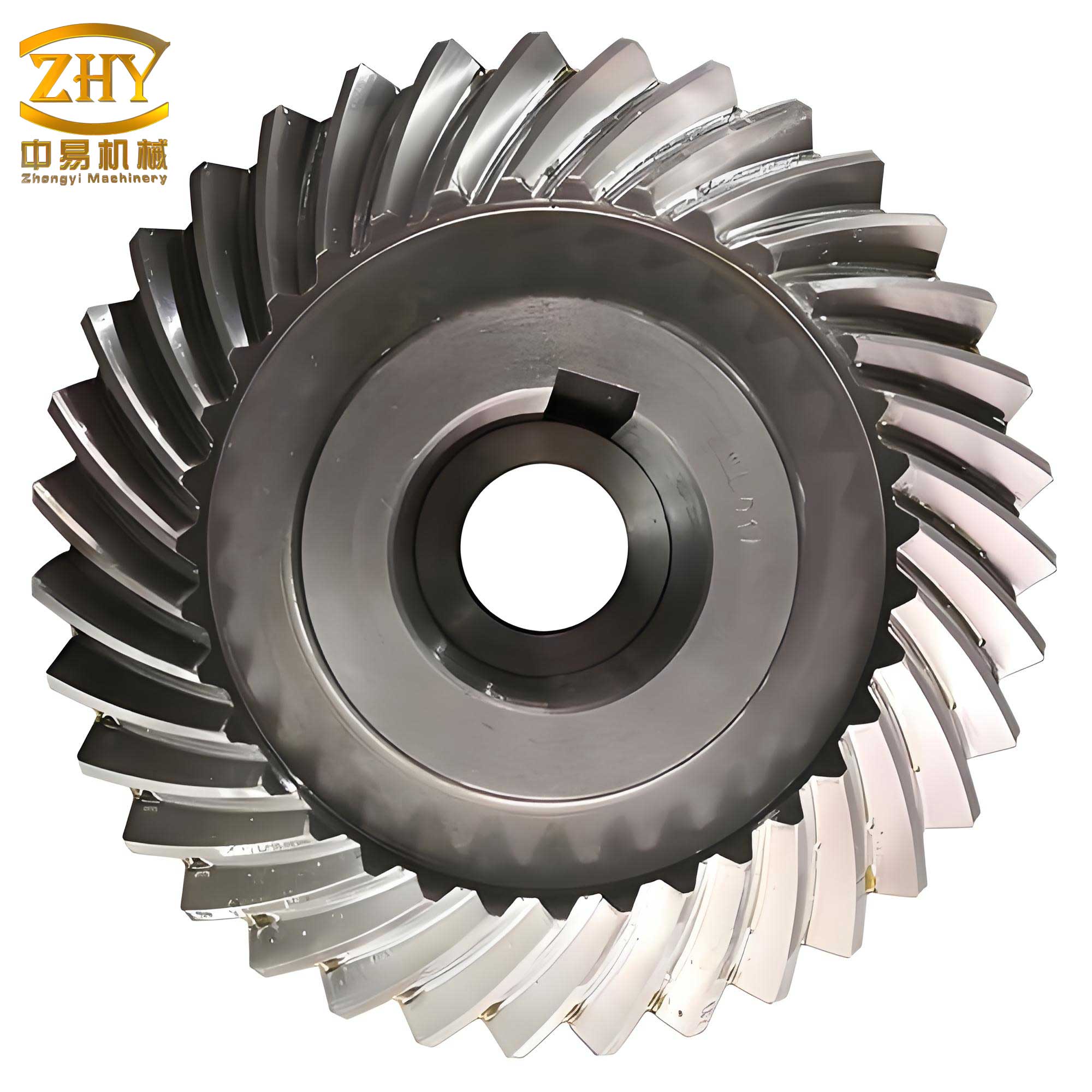
1. Mathematical Foundation for Form Grinding
The process begins with a rigorous mathematical definition of the workpiece and the grinding principle. The foundation is built upon spatial geometry and the theory of gearing.
1.1 Mathematical Model of the Involute Helicoidal Surface
The tooth flank of a right-handed involute spiral gear can be conceptualized as the surface swept by an involute curve undergoing a screw motion. In a coordinate system \( O-xyz \) attached to the gear (where the z-axis coincides with the gear axis), the parametric equations for the involute helicoid are derived. Let the base circle radius be \( r_b \) and the spiral parameter be \( p \), where \( p = r_b \tan(\beta_b) \) and \( \beta_b \) is the base helix angle. The involute curve on the transverse plane is given by:
$$ x_0 = r_b (\cos \varphi + \varphi \sin \varphi) $$
$$ y_0 = r_b (\sin \varphi – \varphi \cos \varphi) $$
$$ z_0 = 0 $$
Here, \( \varphi \) is the roll angle parameter of the involute. Applying a screw motion around the z-axis with parameter \( \theta \) yields the helicoidal surface equation:
$$
\begin{cases}
x = x_0(\varphi) \cos \theta – y_0(\varphi) \sin \theta \\
y = x_0(\varphi) \sin \theta + y_0(\varphi) \cos \theta \\
z = p \cdot \theta
\end{cases}
\quad \text{(1)}
$$
The unit normal vector \( \vec{n} = (n_x, n_y, n_z) \) at any point on this surface is crucial for subsequent contact analysis and is given by:
$$
\begin{cases}
n_x = p(x’_0 \sin \theta + y’_0 \cos \theta) / \Delta \\
n_y = -p(x’_0 \cos \theta – y’_0 \sin \theta) / \Delta \\
n_z = (x_0 y’_0 – y_0 x’_0) / \Delta
\end{cases}
\quad \text{(2)}
$$
where \( \Delta = \sqrt{p^2((x’_0)^2+(y’_0)^2) + (x_0 y’_0 – y_0 x’_0)^2} \), and \( x’_0 = dx_0/d\varphi \), \( y’_0 = dy_0/d\varphi \).
1.2 Modeling the Root Fillet Transition Surface
The geometry of the root fillet significantly impacts the bending strength and fatigue life of the spiral gear. To avoid stress concentration, a smooth transition between the involute flank and the root cylinder is necessary. This transition is typically composed of a trochoid or a circular arc. For generality, we represent the planar root curve parametrically as \( (x_f(\psi), y_f(\psi)) \). The corresponding root transition helicoidal surface is then generated by the same screw motion:
$$
\begin{cases}
x = x_f(\psi) \cos \theta – y_f(\psi) \sin \theta \\
y = x_f(\psi) \sin \theta + y_f(\psi) \cos \theta \\
z = p \cdot \theta
\end{cases}
\quad \text{(3)}
$$
The specific form of \( x_f(\psi), y_f(\psi) \) depends on the manufacturing process of the pre-grinding gear (e.g., hobbing, shaping).
1.3 Contact Condition and Wheel Profile Derivation
The core of form grinding modeling is determining the condition under which the revolving grinding wheel surface and the workpiece helicoidal surface are in continuous tangency (contact) during the generating motion.
We establish two coordinate systems: \( O-xyz \) (workpiece, as above) and \( O’-XYZ \) (grinding wheel, with Z-axis as the wheel axis). The two systems are positioned relative to each other by a center distance \( a \) (along the x-axis of O-xyz) and an inter-axis angle \( \Sigma \), which is ideally \( \Sigma = 90^\circ – \beta \) for a simple setup, where \( \beta \) is the gear’s helix angle at the reference cylinder. The coordinate transformation is:
$$
\begin{bmatrix}
X \\ Y \\ Z
\end{bmatrix}
=
\begin{bmatrix}
1 & 0 & 0 \\
0 & -\cos\Sigma & -\sin\Sigma \\
0 & -\sin\Sigma & \cos\Sigma
\end{bmatrix}
\begin{bmatrix}
a – x \\ -y \\ z
\end{bmatrix}
\quad \text{(4)}
$$
According to the theory of gearing, for the wheel surface \( \vec{r}_w \) and gear surface \( \vec{r}_g \) to be in contact, their normal vectors must satisfy the meshing equation: \( \vec{n} \cdot \vec{v}^{(wg)} = 0 \), where \( \vec{v}^{(wg)} \) is the relative velocity at the potential contact point. For the setup where the gear rotates slowly and the wheel feeds axially (or vice-versa), the essential contact condition for the involute helicoid simplifies to the following nonlinear equation relating the surface parameters \( \varphi \) and \( \theta \):
$$
F(\varphi, \theta) = z\, n_x + a\, n_y \cot\Sigma + (a – x + p \cot\Sigma)n_z = 0
\quad \text{(5)}
$$
Substituting equations (1) and (2) into (5) yields a specific transcendental equation:
$$
\theta – \frac{r_b^2 \varphi}{p^2} – \frac{(p a \cot\Sigma + r_b^2) \cot(\sigma_0 + \varphi + \theta)}{p^2} + \frac{r_b(p \cot\Sigma + a)}{p^2 \sin(\sigma_0 + \varphi + \theta)} = 0
\quad \text{(6)}
$$
where \( \sigma_0 \) is an initial phase angle related to the involute’s start point. Equation (6) is solved numerically (e.g., using Newton-Raphson iteration) for \( \theta \) given a series of \( \varphi \) values. The set of points \( (x(\varphi, \theta), y(\varphi, \theta), z(\varphi, \theta)) \) satisfying (6) constitutes the contact line on the gear tooth surface.
The grinding wheel is a surface of revolution. The axial profile of this wheel is found by transforming the contact line into the wheel coordinate system \( O’-XYZ \) using (4) and then recognizing that for a surface of revolution around the Z-axis, the profile in the \( \rho-Z \) plane (where \( \rho = \sqrt{X^2 + Y^2} \)) is simply:
$$
\begin{cases}
R(\varphi) = \sqrt{X(\varphi)^2 + Y(\varphi)^2} \\
Z(\varphi) = Z(\varphi)
\end{cases}
\quad \text{(7)}
$$
The pair \( (R(\varphi), Z(\varphi)) \) defines the required axial profile of the form grinding wheel for the given spiral gear.
2. Computational Implementation and Case Study
To bring the theory into practice, a specific spiral gear is analyzed. The computational workflow involves parameter definition, numerical solution of the meshing equation, profile calculation, and 3D modeling.
2.1 Gear Parameters and Profile Calculation via MATLAB
Consider a helical gear with the following specifications. The form grinding wheel diameter is chosen as 476 mm for this example.
| Parameter | Symbol | Value | Unit |
|---|---|---|---|
| Normal Module | \( m_n \) | 4 | mm |
| Number of Teeth | \( z \) | 20 | – |
| Normal Pressure Angle | \( \alpha_n \) | 20 | ° |
| Helix Angle (at Ref. Circle) | \( \beta \) | 35 | ° |
| Face Width | \( b \) | 60 | mm |
| Addendum Coefficient | \( h_a^* \) | 1 | – |
| Dedendum Coefficient | \( c^* \) | 0.25 | – |
| Grinding Wheel Diameter | \( D_w \) | 476 | mm |
| Center Distance | \( a \) | Calculated | mm |
| Shaft Angle | \( \Sigma \) | 55° (90°-β) | ° |
The first step is to calculate the transverse parameters: transverse pressure angle \( \alpha_t = \arctan(\tan \alpha_n / \cos \beta) \), reference diameter \( d = m_n z / \cos \beta \), and base circle diameter \( d_b = d \cos \alpha_t \). The spiral parameter is \( p = d_b \tan(\beta_b)/2 \), where \( \beta_b = \arcsin(\sin \beta \cos \alpha_n) \).
A MATLAB script is developed to perform the following sequence:
- Discretize the involute profile (from root to tip) using the parameter \( \varphi \).
- For each \( \varphi \), solve the contact equation (6) for \( \theta \) using an iterative solver.
- Calculate the corresponding 3D point on the gear contact line using Eq. (1).
- Transform this point to wheel coordinates \( (X, Y, Z) \) using Eq. (4).
- Compute the wheel axial profile coordinates \( (R, Z) \) using Eq. (7).
This process yields a discrete set of points representing the required grinding wheel axial profile for one side of the spiral gear tooth space. The process is repeated for the opposite flank (using a negative pressure angle parameter) to generate the complete “V” shaped profile of the form wheel.
2.2 Curve Fitting via Cubic Spline Interpolation
The computed wheel profile \( (R_i, Z_i) \) is a cloud of discrete points. Modern CNC wheel dressing machines typically use linear (G01) and circular (G02/G03) interpolation commands. To generate a smooth, machineable profile, the discrete data must be fitted with a continuous curve. Cubic spline interpolation is an excellent choice as it guarantees second-order derivative continuity (\( C^2 \)), resulting in a very smooth curve.
For a dataset \( {(R_i, Z_i)}_{i=1}^n \), a cubic spline \( S(R) \) consists of \( n-1 \) cubic polynomials \( S_i(R) \) defined on each interval \( [R_i, R_{i+1}] \), satisfying:
$$ S_i(R_i) = Z_i, \quad S_i(R_{i+1}) = Z_{i+1} \quad \text{(Value matching)} $$
$$ S’_i(R_{i+1}) = S’_{i+1}(R_{i+1}) \quad \text{(First derivative continuity)} $$
$$ S”_i(R_{i+1}) = S”_{i+1}(R_{i+1}) \quad \text{(Second derivative continuity)} $$
$$ S”_1(R_1) = S”_{n-1}(R_n) = 0 \quad \text{(Natural boundary condition)} $$
Applying this interpolation to the calculated \( (R, Z) \) data produces a smooth, continuous profile suitable for generating CNC dressing tool paths, either as a series of finely spaced linear segments or by approximating with connected circular arcs.
2.3 3D Modeling and Assembly in UG NX
To visualize the process and verify spatial relationships, 3D models are created. The spiral gear model is generated using the built-in gear modeling tools in UG NX (or any other CAD software like SolidWorks) based on the parameters in Table 1.
The grinding wheel model is created by importing the spline-fitted axial profile curve \( (R, Z) \) into the CAD software. This 2D curve is then revolved 360 degrees around the Z-axis to create the solid model of the form grinding wheel. Finally, an assembly is created by positioning the wheel model relative to the gear model according to the defined center distance \( a \) and shaft angle \( \Sigma \). This 3D assembly provides a clear visual confirmation of the wheel-gear engagement and helps in checking for potential collisions or interferences outside the active profile region.
3. In-Depth Analysis of Contact Lines and Wheel Profile Characteristics
The theoretical model reveals profound insights into the nature of the grinding process for spiral gears.
3.1 Analysis of the Contact Line Behavior
The contact line is a space curve on the gear tooth surface where the grinding wheel and gear are theoretically in tangency at a given instant. Its characteristics are vital for understanding grinding performance (heat distribution, force, accuracy).
3.1.1 Governing Parameters: Equation (6) shows that the contact line \( L_c \) is a function of multiple parameters:
$$ L_c = f(\, \varphi; \, Z, m_n, \beta, \alpha_n, \zeta \,; \, a, \Sigma, D_w \,) $$
It depends on gear geometry \( (Z, m_n, \beta, \alpha_n, \zeta) \) and the grinding setup parameters \( (a, \Sigma, D_w) \).
3.1.2 Effect of Shaft Angle \( \Sigma \): While the theoretical value is \( \Sigma_0 = 90^\circ – \beta \), practical considerations (like improving contact conditions or avoiding interference) often lead to using a modified shaft angle \( \Sigma = \Sigma_0 + \Delta\Sigma \). The contact line is highly sensitive to \( \Sigma \).
- For a fixed gear, as \( \Sigma \) increases from a lower value, the contact line on a single flank typically becomes shorter and straighter near the pitch line region. The total “height” of the contact line (its extent along the gear axis, \( \Delta z \)) often reaches a minimum near \( \Sigma_0 \).
- When \( \Sigma < \Sigma_0 \), the contact line tends to be more curved and extends higher along the tooth flank.
- The optimal \( \Sigma \) for minimizing grinding error or maximizing efficiency may not be exactly \( \Sigma_0 \), requiring analysis based on the specific spiral gear parameters.
The mathematical expression for the contact line shift can be analyzed by taking the partial derivative of the meshing function \( F(\varphi, \theta, \Sigma)=0 \) with respect to \( \Sigma \), illustrating the sensitivity.
3.1.3 Effect of Grinding Wheel Diameter \( D_w \): The center distance \( a \) is typically adjusted proportionally to the wheel radius \( R_w \). Analysis shows that:
$$ \text{For } D_w \to \infty \text{ (a rack-shaped tool), the contact line approaches a straight line.} $$
$$ \text{For smaller } D_w \text{, the contact line becomes shorter, steeper, and more curved.} $$
A remarkable geometric property is that for a given gear and fixed \( \Sigma = 90^\circ-\beta \), all contact lines corresponding to different wheel diameters pass through a unique, fixed point on the tooth surface known as the “fixed chord point.” This can be proven by analyzing the limit of the contact condition as the wheel diameter varies while maintaining tangency to the same base helicoid.
3.2 Characteristics of the Theoretical Wheel Profile
The axial profile of the grinding wheel, defined by \( (R(\varphi), Z(\varphi)) \), inherits its properties from the contact line.
3.2.1 Parameter Dependency: Similar to the contact line, the wheel profile \( P_w \) is a function of the same set of parameters:
$$ P_w = g(\, \varphi; \, Z, m_n, \beta, \alpha_n, \zeta \,; \, a, \Sigma, D_w \,) $$
3.2.2 Effect of Wheel Diameter: The curvature of the wheel profile is inversely related to the wheel diameter.
$$ \kappa_w \propto \frac{1}{D_w} $$
Where \( \kappa_w \) is the curvature of the wheel axial profile. A smaller wheel results in a more curved, highly concave/convex profile, while a larger wheel yields a flatter, more gently curved profile. Furthermore, all valid wheel profiles (for different \( D_w \) but same \( \Sigma = 90^\circ-\beta \)) are tangent to each other at the point corresponding to the “fixed chord point” on the gear. This point maps to a specific radius \( R_{fix} \) on the wheel profile. This can be expressed as:
$$ \left. \frac{dR}{dZ} \right|_{R_{fix}} \text{ is constant for all } D_w \text{ satisfying the contact condition.} $$
3.3 Summary of Relationships
The following table summarizes the key effects of primary grinding parameters on the contact line and wheel profile for a form-ground spiral gear.
| Parameter Change | Effect on Contact Line (\(L_c\)) | Effect on Wheel Profile (\(P_w\)) | Practical Implication |
|---|---|---|---|
| Increase Shaft Angle \( \Sigma \) | \(L_c\) becomes shorter/straighter on flank; \(\Delta z\) may first decrease then increase. | Changes profile curvature and pressure angle mapping. Profile shape alters significantly. | Used to optimize heat distribution, avoid interference, or tailor residual stress. |
| Increase Wheel Diameter \(D_w\) | \(L_c\) becomes longer, flatter, and less curved. | \(P_w\) becomes flatter, less curved. Dressing may become easier. | Larger wheels offer longer life, more stable dressing but require larger machine space. |
| Increase Gear Helix Angle \( \beta \) | \(L_c\) becomes more skewed along tooth flank. For fixed \(\Sigma\), contact condition changes fundamentally. | \(P_w\) becomes more asymmetric. The “V” angle of the wheel profile changes. | High-helix spiral gears require very precise calculation and setup alignment. |
| Increase Center Distance \(a\) | Shifts \(L_c\) radially across the tooth profile. Changes engagement depth. | Scales and translates the \(P_w\) curve. Affects the wheel’s working section. | Critical for setting the correct tooth depth and avoiding grinding the wrong part of the profile. |
4. Experimental Validation and Discussion on Process Optimization
To validate the theoretical calculations and software models, a practical form grinding trial was conducted on a dedicated CNC gear grinding machine (e.g., a model similar to the SK7032).
4.1 Experimental Procedure
- Wheel Dressing: The axial wheel profile coordinates, after cubic spline fitting and post-processing into CNC code (G-code), were used to dress a conventional aluminum oxide or CBN grinding wheel. A high-precision diamond dressing tool mounted on a CNC-controlled axis executed the profile.
- Machine Setup: The ground spiral gear workpiece was mounted on the machine spindle. The grinding wheel was positioned at the calculated center distance \( a \) and set to the shaft angle \( \Sigma \).
- Grinding Process: The process involved a slow rotation of the spiral gear synchronized with a relative axial feed between the wheel and the gear. The form wheel plunged into the tooth space or traversed along the face width, grinding both flanks simultaneously.
4.2 Results and Analysis
The ground spiral gear was inspected on a gear measuring center (e.g., a Klingelnberg or Gleason device). The results typically showed that while the general tooth form was achieved, deviations from the ideal involute and lead (helix) profiles were observed. Common discrepancies included:
- Profile Form Error: Deviations in the involute shape, especially in the root and tip regions.
- Lead Variation: Errors in the helix angle or modifications along the tooth length.
- Surface Finish: Potential for burns or chatter marks if process parameters were not optimized.
These errors confirm that while the geometrical model for the spiral gear wheel profile is fundamentally correct, the practical realization of precision grinding involves additional, critical factors beyond pure geometry.
4.3 Pathways for Optimization and Improvement
The experiment underscores areas requiring further optimization for high-precision spiral gear form grinding:
1. Enhanced Wheel Profile Calculation Accuracy:
- Discretization and Fitting Strategy: The accuracy of dressing the wheel profile is paramount. Using a dense set of calculated points \( (R, Z) \) and fitting with a high-order spline or a series of tangential circular arcs can reduce interpolation error. The optimal strategy minimizes the number of CNC blocks while keeping the profile error below a threshold (e.g., 1 micron). The error \( \epsilon \) between the theoretical spline \( S(R) \) and its CNC approximation \( \hat{S}(R) \) must be controlled:
$$ \max | S(R) – \hat{S}(R) | < \epsilon_{\text{total}} $$ - Inclusion of Machine Kinematics: The theoretical model assumes ideal geometry. In practice, the dresser kinematics (e.g., linear vs. rotary dresser), diamond tool nose radius compensation, and even machine thermal deformation must be integrated into a more comprehensive wheel profile prediction model.
2. Compensation for Machine Setting Errors:
The center distance \( a \) and shaft angle \( \Sigma \) are critical. Any installation error \( \Delta a \) or \( \Delta \Sigma \) will systematically distort the ground tooth profile. A sensitivity analysis can quantify this:
$$ \Delta \text{Profile} \approx \frac{\partial P_w}{\partial a} \Delta a + \frac{\partial P_w}{\partial \Sigma} \Delta \Sigma $$
Therefore, developing precise setup methodologies and potentially incorporating on-machine probing for feedback correction is essential for high-precision spiral gear manufacturing.
3. Optimization of Grinding Process Parameters:
The geometric model provides the correct wheel shape, but the final gear quality depends on grinding parameters:
- Wheel speed \( v_s \): \( v_s = \pi D_w n_s \)
- Workpiece speed \( v_w \)
- Feed rate \( f \)
- Depth of cut \( a_e \)
- Coolant application
These parameters influence grinding forces \( F \), power \( P \), and surface integrity. An integrated approach linking the geometric model with a grinding process model (e.g., for force, temperature prediction) is the next step for holistic optimization of the spiral gear form grinding process.
5. Conclusion
This comprehensive analysis has detailed the complete workflow for the precision form grinding of involute spiral gears. Beginning with the derivation of the fundamental mathematical models—including the helicoidal surface equation, the meshing-based contact condition, and the grinding wheel axial profile equation—we established a rigorous theoretical foundation. The implementation of this theory using computational tools like MATLAB for numerical solution and profile generation, coupled with CAD software for 3D visualization and assembly, provides a powerful design and verification platform.
The in-depth analysis revealed the intricate relationships between grinding parameters (shaft angle \( \Sigma \), wheel diameter \( D_w \)) and the resulting contact lines and wheel profiles, offering guidance for process optimization. The practical grinding trial confirmed the validity of the geometric approach while highlighting the significant role of real-world factors such as dressing accuracy, machine setup errors, and dynamic grinding parameters. Ultimately, achieving the highest quality in form-ground spiral gears requires the seamless integration of accurate geometric modeling, precise CNC dressing, meticulous machine setup, and optimized grinding process conditions. Future work lies in deepening this integration through closed-loop compensation and multi-physics process simulation.