
As critical transmission components in heavy-duty machinery, cylindrical gears face enormous market demand. Traditionally, large-modulus spur gears are primarily manufactured through machining processes. These methods are increasingly inadequate due to their low material utilization, high cost, and the disruption of metal flow lines, which compromises mechanical performance. In contrast, precision plastic forming technology offers a promising alternative, enabling near-net-shape production with improved strength, wear resistance, and superior material economy.
However, existing forming processes for cylindrical gears often encounter significant challenges: incomplete filling at the gear tooth tips (addendum), excessively high forming loads, severe mold wear, premature cracking, and poor dimensional accuracy. These issues directly impact production costs and hinder widespread industrial application. Therefore, developing a viable, high-efficiency cold extrusion process is crucial.
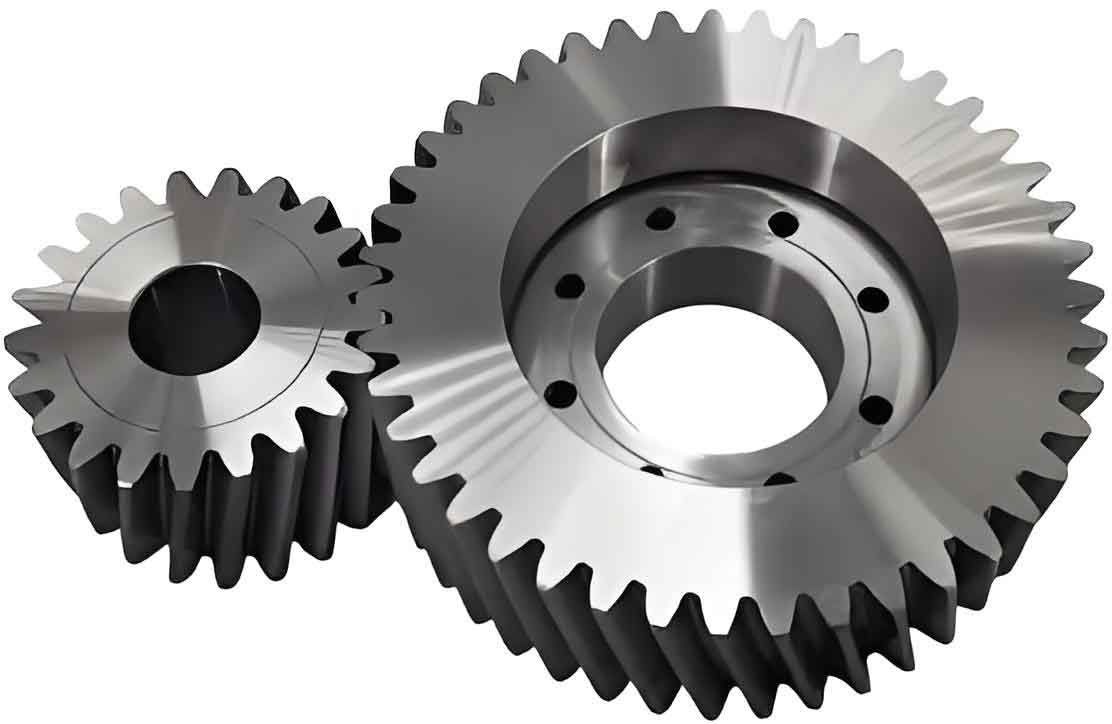
This study focuses on the sun gear from a heavy truck wheel-side reducer as the research object. The goal is to develop an effective continuous cold extrusion process and corresponding mold technology to overcome the aforementioned limitations.
Research Objectives and Methodology
The primary objectives of this research are threefold:
- To formulate and evaluate feasible cold extrusion process schemes for a complex sun gear featuring both external spur teeth and internal spline teeth.
- To optimize the die cavity structure and the prestressed combined die assembly to minimize forming load, ensure filling quality, and prevent die failure.
- To validate the optimized process and die design through numerical simulation and physical production trials.
The methodology integrates advanced computational techniques, including 3D Finite Element Method (FEM) simulation, experimental design (Latin Hypercube Sampling), approximation modeling (Kriging model), and global optimization algorithms (Genetic Algorithm).
Process Design and Comparative Analysis
The target component consists of an external spur gear (modulus m=4, teeth z=23) and an internal involute spline. Three progressive cold extrusion schemes were designed and simulated using DEFORM-3D software under rigid-plastic conditions. The material was defined as AISI-4120 (analogous to 20CrMnTi), with a shear friction factor of 0.12.
| Scheme | Process Flow | Key Observations from FEM Simulation | Advantages | Disadvantages |
|---|---|---|---|---|
| Scheme 1 | Simultaneous extrusion of internal & external teeth → Sizing of external teeth. | Severe plastic deformation of internal teeth occurs during external tooth formation. Incomplete filling and large sink at the external tooth tip. Requires significant machining allowance. | Potentially fewer steps. | Unacceptable part quality. High forming load. Theoretically infeasible for the intended goal. |
| Scheme 2 | Continuous cold extrusion of external teeth → Combined sizing of external teeth & extrusion of internal teeth. | External tooth forming via “part-pressing-part” is feasible. However, during combined sizing/extrusion, the finished external tooth profile undergoes secondary plastic deformation, degrading its precision. | High production efficiency for external teeth. | Fails to achieve the goal of precision sizing. Complex die interaction. |
| Scheme 3 | Continuous cold extrusion of external teeth → Precision sizing of external teeth → Machining (broaching) of internal teeth. | Continuous extrusion provides effective backpressure, improving fill. Precision sizing successfully improves gear accuracy. No interference between processes. | Good external tooth quality and accuracy. High material utilization. Simple die actions and high production efficiency. Theoretically sound. | Requires a separate step for internal teeth. |
Based on a comprehensive evaluation of material utilization, production efficiency, and technological feasibility, Scheme 3 was selected as the optimal process route.
Optimization of Extrusion Die Cavity Parameters
The cavity of the continuous extrusion die is divided into a splitting zone and a forming zone. Two key parameters significantly influence the forming load and part quality: the die entrance angle (α) and the split thickness (b). A single-factor simulation study was conducted to analyze their effects.
The forming load, material flow, and defect formation can be related to fundamental plasticity theory. The Levy-Mises flow rule governs the relationship between strain rate and deviatoric stress in the plastic region:
$$
\dot{\epsilon}_{ij} = \lambda \sigma’_{ij}
$$
where $\dot{\epsilon}_{ij}$ is the strain rate tensor, $\sigma’_{ij}$ is the deviatoric stress tensor, and $\lambda$ is a proportionality factor. The material’s resistance to flow is given by the effective stress, often modeled by a constitutive equation like:
$$
\bar{\sigma} = K \dot{\bar{\epsilon}}^m
$$
where $\bar{\sigma}$ is the effective stress, $\dot{\bar{\epsilon}}$ is the effective strain rate, and K and m are material constants. The forming load is the integral of the stress over the tool-workpiece contact area.
The simulation results are summarized below:
| Parameter | Variation | Effect on Max. Forming Load | Effect on Fill Quality (Sink, Flare) | Mechanism |
|---|---|---|---|---|
| Entrance Angle (α) | Increase from 40° to 60° | Decreases by ~15% | Improves (reduces sink and flare) | Larger α reduces shear power more than it increases friction power in the splitting zone, lowering total energy. Also increases metal volume in the zone, providing better backpressure. |
| α = 55° vs α = 60° | Minor further decrease | Marginal improvement | Diminishing returns. A very large α increases die manufacturing difficulty. | |
| Split Thickness (b) | Increase from 1mm to 3mm | Negligible change | Worsens (increases sink) | Reduces the amount of metal undergoing splitting, thereby reducing the beneficial backpressure effect during continuous extrusion. |
Considering both forming load reduction and manufacturability, the optimal cavity parameters were determined as: α = 55° and b = 1 mm.
Optimal Design of the Prestressed Combined Die
To withstand the high forming stresses (~300 tons total load) and prevent longitudinal cracking of the complex gear cavity, a three-layer prestressed combined die is essential. Traditional thick-walled cylinder theory is inadequate for designing such a complex cavity. This study employs an integrated optimization strategy: Latin Hypercube Sampling (LHS) for DOE → FEM Simulation → Kriging Metamodeling → Genetic Algorithm (GA) Optimization.
The Kriging model is ideal for this task as it interpolates data points exactly and handles nonlinearities well. It combines a global polynomial trend with a localized stochastic process:
$$
y(\mathbf{x}) = f(\mathbf{x})^T \boldsymbol{\beta} + Z(\mathbf{x})
$$
where $f(\mathbf{x})^T \boldsymbol{\beta}$ is the polynomial regression model (e.g., constant, linear) and $Z(\mathbf{x})$ is a Gaussian stochastic process with zero mean, variance $\sigma^2$, and a correlation function $R(\theta, \mathbf{x}^{(i)}, \mathbf{x}^{(j)})$. A common Gaussian correlation function is used:
$$
R(\theta, \mathbf{x}^{(i)}, \mathbf{x}^{(j)}) = \prod_{k=1}^{n} \exp\left(-\theta_k (x_k^{(i)} – x_k^{(j)})^2\right)
$$
The hyperparameters $\theta_k$ are found by maximizing the likelihood function.
Design Variables and Objective:
Six structural parameters were chosen as variables to minimize the maximum equivalent stress (Y) in the die core (YC15 material). The variables and their ranges are defined below.
| Variable | Definition | Lower Bound | Upper Bound |
|---|---|---|---|
| D1 | Equivalent inner diameter of die core (mm) | 84.50 | 103.10 |
| N2 | Diameter ratio: D2/D1 | 1.55 | 1.80 |
| N3 | Diameter ratio: D3/D1 | 2.45 | 3.25 |
| N4 | Diameter ratio: D4/D1 | 4.00 | 6.00 |
| λ2 | Interference coefficient: 2U2/D2 | 0.0025 | 0.0045 |
| λ3 | Interference coefficient: 2U3/D3 | 0.0020 | 0.0040 |
Where D2, D3, D4 are the outer diameters of the core, middle, and outer ring, respectively. U2 and U3 are the radial interferences.
LHS generated 28 sample points. FEM analysis for each combination provided the response Y. A Kriging model was constructed and verified (prediction error < 6%). The GA was then used to find the global optimum within the variable space.
Optimization Result:
The optimal configuration that minimizes the core’s maximum equivalent stress is:
- D1 = 88.35 mm
- N2 = 1.7872 (D2 = 157.90 mm)
- N3 = 3.0329 (D3 = 267.96 mm)
- N4 = 4.0001 (D4 = 353.49 mm)
- λ2 = 0.0025 (U2 = 0.20 mm)
- λ3 = 0.0021 (U3 = 0.28 mm)
Verification via FEM confirmed that under working conditions, the maximum equivalent stress in the die core (1500-1750 MPa) was well below the allowable stress for YG15 (~3200 MPa). Crucially, the combined effect of prestress and working pressure ensured the inner wall of the cavity remained under circumferential compression, effectively eliminating the risk of tensile-stress-induced longitudinal cracking.
Production Trial and Validation
The optimized process (Scheme 3) and die design were implemented in a production trial. The billet (20CrMnTi) underwent spheroidizing annealing, precision turning, and coating with an environmentally friendly water-based polymer lubricant. Forming was conducted on a YJ61-630T hydraulic press.
Results:
- The profile of the continuously cold-extruded external gear matched the simulation results closely, exhibiting the predicted flare at the bottom and sink at the top.
- The prestressed combined die performed without failure (no tooth breakage or cracking) throughout the trial, validating the optimization strategy.
- The as-extruded gear had a tooth profile accuracy of grade 7-8 and unstable tooth alignment accuracy of grade 10-12. After turning and shaving, both profile and alignment accuracy reached grade 7.
- Following normalizing, the internal spline was successfully broached.
The final sun gear component met all quality and precision requirements.
Conclusion
This research successfully developed a viable continuous cold extrusion process for manufacturing high-quality cylindrical gears. Key achievements include:
- The formulation and selection of an optimal multi-step process: continuous cold extrusion of external teeth → precision sizing → broaching of internal teeth.
- The determination of optimal die cavity parameters (α=55°, b=1mm) to balance forming load and fill quality.
- The innovative application of a Kriging-GA optimization strategy for the design of a complex prestressed combined die, effectively mitigating stress and preventing die failure.
- Validation through physical production trials, confirming the accuracy of simulations and the feasibility of the optimized process and tooling.
This work demonstrates a significant advancement in the precision forming technology for large-modulus cylindrical gears, offering a pathway towards efficient, high-quality, and cost-effective mass production.