
The pursuit of enhanced performance in power transmission systems, particularly in demanding applications such as aerospace and marine propulsion, has driven the development of advanced gear modification techniques. Standard involute tooth surfaces for helical gears, while efficient, often exhibit limitations in error accommodation, leading to undesirable vibration, noise, and stress concentrations under load. To mitigate these issues, tooth flank modifications—commonly known as topology modifications—are extensively employed to optimize load distribution and dynamic behavior. This involves intentional, controlled deviations from the theoretical involute surface. The accurate manufacturing of these sophisticated three-dimensionally modified surfaces necessitates advanced, flexible machining systems. Modern multi-axis Computer Numerical Control (CNC) technology provides the requisite capability for generating such high-precision, topologically modified tooth flanks. This article presents a comprehensive methodology for the design, manufacturing simulation, and error correction of topologically modified helical gears using a five-axis CNC form grinding machine.
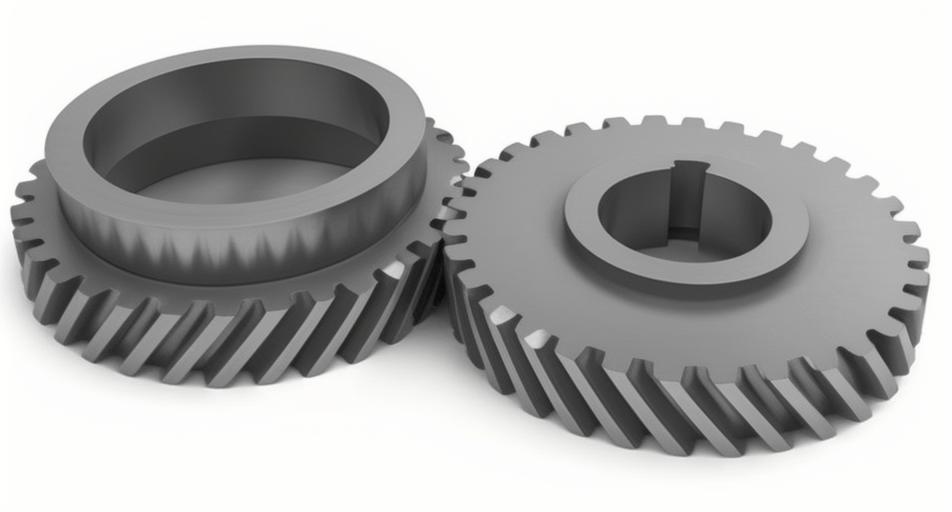
The foundation of high-performance gear design lies in precisely defining the target tooth surface. For helical gears, topological modification is typically decomposed into profile (across the tooth height) and lead (along the tooth width) modifications. These modifications are often designed to compensate for deflections and misalignments under operating conditions. A common requirement is tooth end relief or crowning to prevent edge loading. The modification surface, representing the normal deviation \(\delta\) from the theoretical involute flank, can be constructed as a superposition of independently designed profile and lead modification curves. These curves are defined by piecewise functions, such as parabolas and straight lines, allowing for a versatile representation of various modification patterns like tip/root relief, lead crown, or end relief. The modification magnitude at any point on the tooth flank is a function of its projected coordinates on a plane perpendicular to the gear axis.
Let the theoretical tooth surface of the pinion (workpiece) be represented by the position vector \(\mathbf{R}_1(u_1, l_1)\) and unit normal vector \(\mathbf{n}_1(u_1, l_1)\), where \(u_1\) and \(l_1\) are the surface parameters. The topologically modified surface \(\mathbf{R}_{1r}\) is then obtained by superimposing the normal modification \(\delta(x, y)\):
$$
\mathbf{R}_{1r}(u_1, l_1) = \mathbf{R}_1(u_1, l_1) + \delta(x, y) \cdot \mathbf{n}_1(u_1, l_1)
$$
The corresponding normal vector \(\mathbf{n}_{1r}\) of the modified surface must be recalculated based on the derivatives of the new surface. The projection coordinates \((x, y)\) are derived from the position vector of the theoretical point:
$$
x = \sqrt{R_x^2 + R_y^2}, \quad y = R_z
$$
where \(R_x, R_y, R_z\) are the coordinate components of \(\mathbf{R}_1\). To create a continuous and smooth modification surface, the discrete modification values at a grid of points (\(m \times n\)) on the flank are fitted using a cubic B-spline surface. This ensures the manufacturability and accuracy of the designed topology for the helical gears.
The accurate realization of this designed surface requires a capable manufacturing platform. For the form grinding of large, high-precision helical gears, a vertical five-axis CNC machine tool of the Free-Form type offers an ideal combination of flexibility and rigidity. This configuration typically involves three linear axes (\(X\), \(Y\), \(Z\)) and two rotational axes (\(A\), \(B\)). The kinematic chain defines the spatial relationship between the grinding wheel and the workpiece. The fundamental equation for the ground tooth surface, derived from the theory of gearing, requires that the relative velocity at the contact point between the wheel and workpiece has no component along the common normal. This is expressed by the meshing equation:
$$
\mathbf{n} \cdot \mathbf{v}^{(12)} = 0
$$
In the machine coordinate system, the position vector \(\mathbf{R}_1^C\) of a point on the ground gear flank is a function of the wheel surface parameters \((u, \theta)\) and the machine motion parameters \(C_k(\phi_1)\), where \(k = X, Y, Z, A, B\), and \(\phi_1\) is the work rotation (generating) angle, often used as the independent motion parameter.
$$
\mathbf{R}_1^C(u, \theta, \phi_1) = \mathbf{M}_1^C(\phi_1) \cdot \mathbf{R}_t(u, \theta)
$$
Here, \(\mathbf{M}_1^C(\phi_1)\) is the overall homogeneous transformation matrix from the wheel coordinate system to the workpiece system, encapsulating all axis motions. \(\mathbf{R}_t(u, \theta)\) is the position vector of a point on the form grinding wheel. The unit normal vector \(\mathbf{n}_1^C\) on the ground surface is derived from the partial derivatives of \(\mathbf{R}_1^C\). The meshing condition for this process is:
$$
f(u, \theta, \phi_1) = \mathbf{n}_1^C \cdot \frac{\partial \mathbf{R}_1^C}{\partial \phi_1} \frac{d\phi_1}{dt} = 0
$$
For grinding the theoretical (unmodified) involute helical gear, the nominal machine motions \(C_k^0\) are simple linear or constant functions of \(\phi_1\). For example:
$$
\begin{aligned}
C_X^0 &= \frac{d_1}{2 \tan \alpha} \phi_1 + K_1 \tan \beta – \frac{K_2}{\cos \beta} \\
C_B^0 &= -\phi_1
\end{aligned}
$$
where \(d_1\) is the pitch diameter, \(\alpha\) is the pressure angle, \(\beta\) is the helix angle, and \(K_1, K_2\) are machine constants.
| Axis | Primary Influence on Flank | Sensitivity Character | |||
|---|---|---|---|---|---|
| X (Axial Feed) | Tooth Thickness / Lead | Primarily affects lead direction; low sensitivity for profile. | |||
| Y (Radial Feed) | Profile (Bias to Tip) & Lead | Significant influence on profile shape and lead crowning. | |||
| Z (Tangential Feed) | Tooth Thickness / Lead | Strong influence on lead modification and minor profile effect. | |||
| A (Helix Angle Tilt) | Profile & Lead | Can induce profile tilt (bias to tip/root) and lead correction. | B (Work Rotation) | Tooth Thickness / Lead | Direct generating motion; highly sensitive for lead modification. |
A critical step in the form grinding process is the accurate determination of the grinding wheel profile. For helical gears with topology modification, the wheel profile is not simply the conjugate of the basic involute. An effective method is to calculate the wheel axial profile based on the condition of line contact with a chosen reference surface. A pragmatic approach is to use the profile-modified surface (i.e., applying only the profile modification part of the full topology) as the target for wheel generation. This simplifies the wheel shape while delegating the remaining lead modification to the coordinated motions of the CNC axes. The wheel axial profile points \((x_t, z_t)\) are calculated by solving the inverse kinematic and meshing equations, ensuring contact along a line on the profile-modified flank. These discrete points are then fitted with a cubic B-spline curve to obtain a continuous and accurate wheel axial profile \(\mathbf{R}_w(u)\), which is then rotated about its axis to define the full wheel surface \(\mathbf{R}_t(u, \theta)\).
To produce the full topological modification, the deviations from the theoretical machine motions must be introduced. The modification surface \(\delta\) can be considered as the result of small, coordinated perturbations \(\Delta C_k\) to the nominal axis movements \(C_k^0\). These perturbations are conveniently modeled as polynomial functions of the generating angle \(\phi_1\):
$$
C_k(\phi_1) = C_k^0(\phi_1) + \Delta C_k(\phi_1) = \sum_{m=0}^{6} a_{mk} \phi_1^m, \quad k = X, Y, Z, A, B
$$
Using a 6th-order polynomial provides sufficient degrees of freedom to approximate complex modification shapes. The sensitivity of the final tooth flank to changes in each polynomial coefficient \(a_{mk}\) is analyzed. For a given grid point \(i\) on the tooth surface, the resulting normal deviation \(\delta_i\) due to a set of coefficient perturbations \(\{\zeta_j\}\) (where \(j=1,…,35\) for 5 axes * 7 coefficients) can be linearly approximated as:
$$
\delta_i \approx \sum_{j} S_{ij} \zeta_j \quad \text{or in matrix form:} \quad \boldsymbol{\delta} = \mathbf{S} \boldsymbol{\zeta}
$$
Here, \(\mathbf{S}\) is the sensitivity matrix, where each element \(S_{ij} = \partial \delta_i / \partial \zeta_j\) represents the change in normal error at point \(i\) due to a unit change in coefficient \(j\). This matrix is computed numerically by varying each coefficient slightly and calculating the resulting flank deviation. The actual ground flank deviation \(\delta^C\) and the grinding error \(\Delta \delta\) are defined as:
$$
\begin{aligned}
\delta^C(u_i, \theta_i) &= (\mathbf{R}_1^C(u_i, \theta_i, C_k(\phi_1)) – \mathbf{R}_1^C(u_i, \theta_i, C_k^0(\phi_1))) \cdot \mathbf{n}_1^C(u_i, \theta_i, C_k^0(\phi_1)) \\
\Delta \delta &= \delta^C – \delta^{\text{target}}
\end{aligned}
$$
The core challenge is to find the optimal set of polynomial coefficients \(\boldsymbol{\zeta}\) that minimizes the difference between the ground modification \(\delta^C\) and the designed target modification \(\delta^{\text{target}}\). This is a constrained optimization problem because the grinding process is a material removal operation. The condition \(S_{ij}\zeta_j < 0\) at a point indicates the wheel would gouge (excessively cut) the surface, which is physically impermissible. Therefore, the optimization must seek coefficients that avoid gouging while minimizing error. A suitable objective function \(F(\boldsymbol{\zeta})\) is the sum of squared errors, with a penalty for points where the wheel would not contact the target surface (i.e., where the calculated modification is positive, indicating a gap):
$$
f(\zeta_i) =
\begin{cases}
S_i \boldsymbol{\zeta} – \delta^{\text{target}}_i, & \text{if } S_i \boldsymbol{\zeta} < 0 \text{ (contact)} \\
– \delta^{\text{target}}_i, & \text{if } S_i \boldsymbol{\zeta} \ge 0 \text{ (no contact)}
\end{cases}
$$
$$
F(\boldsymbol{\zeta}) = \min \sum_{i=1}^{p} f^2(\zeta_i)
$$
where \(p\) is the number of grid points. This non-linear, constrained optimization problem with potential local minima is effectively solved using a global optimization algorithm like Particle Swarm Optimization (PSO). PSO is robust, easy to implement, and well-suited for finding optimal machine parameters for manufacturing helical gears.
To demonstrate the methodology, a case study is performed on a helical gear pair. The basic parameters are listed below:
| Parameter | Pinion | Gear |
|---|---|---|
| Number of Teeth (z) | 19 | 47 |
| Module (mm) | 6 | |
| Pressure Angle (\(\alpha\)) | 20° | |
| Helix Angle (\(\beta\)) | 9.91° | |
| Face Width (mm) | 75 | |
A target topological modification surface is designed featuring a combination of profile relief and lead crowning. The sensitivity matrix \(\mathbf{S}\) is computed. Two grinding strategies are compared:
- Grinding I: The grinding wheel profile is calculated from the profile-modified flank. The full topology (profile + lead) is then achieved by optimizing the five-axis CNC motion polynomials.
- Grinding II: The grinding wheel profile is calculated from the theoretical (unmodified) involute flank. The full topology must be achieved solely through the optimized CNC motions.
The PSO algorithm converges stably within about 50 generations for Grinding I. The optimized axis motions \(C_k(\phi_1)\) show deviations \(\Delta C_k\) from their nominal paths \(C_k^0\). The results show a significant difference in achievable accuracy:
- For Grinding I, the maximum normal error on the flank is reduced to less than 1 \(\mu m\). The axis motion corrections \(\Delta C_Z\) and \(\Delta C_B\) are primarily responsible for generating the lead modification, while other axes make finer adjustments.
- For Grinding II, the maximum normal error is below 4 \(\mu m\), with the primary errors manifesting in the profile direction. This is because the theoretical wheel profile is not an optimal match for the modified surface, placing a greater burden on the axis motions to correct the shape.
The final optimized polynomial coefficients for the five axes for the more accurate Grinding I strategy are synthesized into the following motion equations:
| Axis | Optimized Motion \(C_k(\phi_1)\) for Topological Modification |
|---|---|
| \(C_X\) | \(-331.218927\phi_1 -0.199936\phi_1^2 -0.135345\phi_1^3 -0.2\phi_1^4 -0.081484\phi_1^5 +0.2\phi_1^6\) |
| \(C_Y\) | \(150.248218 -0.011034\phi_1 -0.101513\phi_1^2 -0.145257\phi_1^3 -0.120328\phi_1^4 -0.042017\phi_1^5 -0.047139\phi_1^6\) |
| \(C_Z\) | \(0.001174 +0.2\phi_1 -0.199845\phi_1^2 -0.2\phi_1^3 +0.113211\phi_1^4 -0.137373\phi_1^5 -0.2\phi_1^6\) |
| \(C_A\) | \(0.173297 -0.008445\phi_1 -0.005966\phi_1^2 +0.090073\phi_1^3 -0.166265\phi_1^4 -0.090725\phi_1^5 -0.125908\phi_1^6\) |
| \(C_B\) | \(0.000586 -0.997354\phi_1 +0.022545\phi_1^2 -0.002498\phi_1^3 +0.2\phi_1^4 +0.043401\phi_1^5 +0.050197\phi_1^6\) |
In conclusion, this article presents a systematic and effective methodology for the precision manufacturing of topologically modified helical gears. The process integrates the design of modification surfaces, the kinematic modeling of a five-axis CNC form grinding machine, the calculation of an optimized grinding wheel profile from a profile-modified reference surface, and the correction of tooth flank errors through the optimization of machine axis motion polynomials. The key findings are:
- Topological modification for helical gears can be effectively constructed by superimposing independently designed profile and lead modification curves onto the theoretical involute surface, with the final surface represented by a B-spline fit.
- The five-axis Free-Form CNC grinding machine model provides the necessary kinematic flexibility. The sensitivity of the ground flank to each axis’s polynomial motion coefficients can be rigorously calculated, forming the basis for error correction.
- Calculating the form grinding wheel profile based on a profile-modified flank, and then using optimized five-axis motions to generate the remaining lead modification, is a highly effective strategy. This approach significantly reduces the final grinding error compared to using a theoretical involute wheel profile.
- The PSO optimization algorithm is a robust tool for solving the non-linear, constrained optimization problem of identifying the optimal machine axis polynomial coefficients, ensuring minimal flank error while preventing gouging.
This methodology enables the high-precision fabrication of advanced helical gears with tailored contact patterns and transmission error characteristics, which are essential for achieving superior performance, longevity, and quiet operation in high-end mechanical transmission systems.