
The demand for high-precision machining continues to push the boundaries of component design in machine tools. Among these, the rotary table stands as an indispensable element for expanding a machine’s processing capabilities, enabling complex multi-face machining in a single setup and significantly reducing auxiliary time. In applications requiring precise 180-degree indexing—common in milling, drilling, and inspection operations—the performance of the rotary table directly dictates final part accuracy. My focus here is on the detailed exposition of a robust rotary table design that leverages a rack and pinion gear drive system, powered hydraulically, and incorporates a novel mechanism for the automatic elimination of backlash. This design philosophy prioritizes high torsional stiffness, simplicity, and superior positioning fidelity.
The core challenge in any gear-driven system, including the rack and pinion gear transmission, is inherent backlash or clearance between mating teeth. This mechanical play introduces a non-linear dead zone, causing a lag during motion reversal. In precision positioning systems, this lag translates directly into contouring errors and reduced repeatability. Traditional solutions, such as preloading with dual thin gears and springs, are often limited in their torque transmission capability and add complexity. The design I am describing addresses this by integrating the clearance compensation directly into the rack and pinion assembly itself, creating a system that is both powerful and precise.
Design Concept and Overall Architecture
The rotary table is conceived to perform two primary, independent motions: a 180-degree bi-directional rotary indexing and a vertical lifting motion. These functions are decoupled to allow for flexible operation sequences. The drive selection is critical. While servo-motor-driven systems offer responsiveness, they can suffer from high inertia and complexity in achieving high torque at low speeds. Hydraulic actuation, chosen for this design, provides compelling advantages: substantial driving force in a compact package, smooth motion due to fluid compressibility damping, inherent resistance to shock loads, and a simpler power transmission path. The core rotational motion is achieved through a linear hydraulic cylinder acting upon a rack and pinion gear set, converting linear piston movement into precise rotary output.
The overall system can be decomposed into several integrated subsystems housed within a rigid machine box or body. The major assemblies include:
- Work Table & Spindle Assembly: The face where the workpiece is mounted, directly connected to the main output shaft.
- Lifting Drive Mechanism: A hydraulic system dedicated to raising and lowering the entire work table assembly.
- Rotary Drive Mechanism: The heart of the system, featuring the hydraulic cylinder, the dual-rack and pinion gear transmission, and the output gearing.
- Automatic Clearance Elimination Mechanism: An integrated subsystem within the rack assembly that actively compensates for tooth wear and backlash.
The Lifting Drive Mechanism
Vertical positioning or clamping is often required to clear tools or to engage with different fixtures. The lifting mechanism must provide stable, controlled motion without compromising the rotational accuracy. In this design, the work table is rigidly bolted to a splined shaft. This splined shaft is, in turn, mated with an internal spline on the main gear shaft, allowing for vertical translation while maintaining a positive rotational drive connection.
The lifting force is generated by a hydraulic cylinder situated coaxially below the splined shaft. A critical design consideration is the method of force transmission. Direct contact between the hydraulic piston rod and the rotating splined shaft would lead to excessive wear and potential piston bending moments. To isolate the hydraulic actuator from rotational forces and to handle the significant axial load, a thrust ball bearing is employed. The piston rod acts upon the bearing’s outer race, which then transmits a pure axial force to a shoulder on the splined shaft. This arrangement ensures that the piston rod experiences only axial loads, significantly enhancing its service life and reliability.
The lifting sequence is straightforward. When pressurized oil is ported into the chamber beneath the piston, the resulting force pushes the piston rod upward. The rod presses against the thrust bearing, which lifts the splined shaft and, consequently, the entire work table assembly. Retraction is achieved by porting pressure to the opposing side of the piston. The key parameters for this subsystem can be summarized as follows:
| Parameter | Design Consideration |
|---|---|
| Lifting Force | Determined by workpiece/fixture weight and required clamping force. Calculated as $F_{lift} = P \cdot A_{piston}$. |
| Stroke Length | Sufficient to provide necessary tool clearance, typically 10-30mm. |
| Bearing Selection | Thrust ball bearing rated for dynamic axial load exceeding maximum $F_{lift}$. |
| Sealing | High-quality rod seals to prevent leakage and maintain pressure. |
The Rotary Drive and Core Rack and Pinion Mechanism
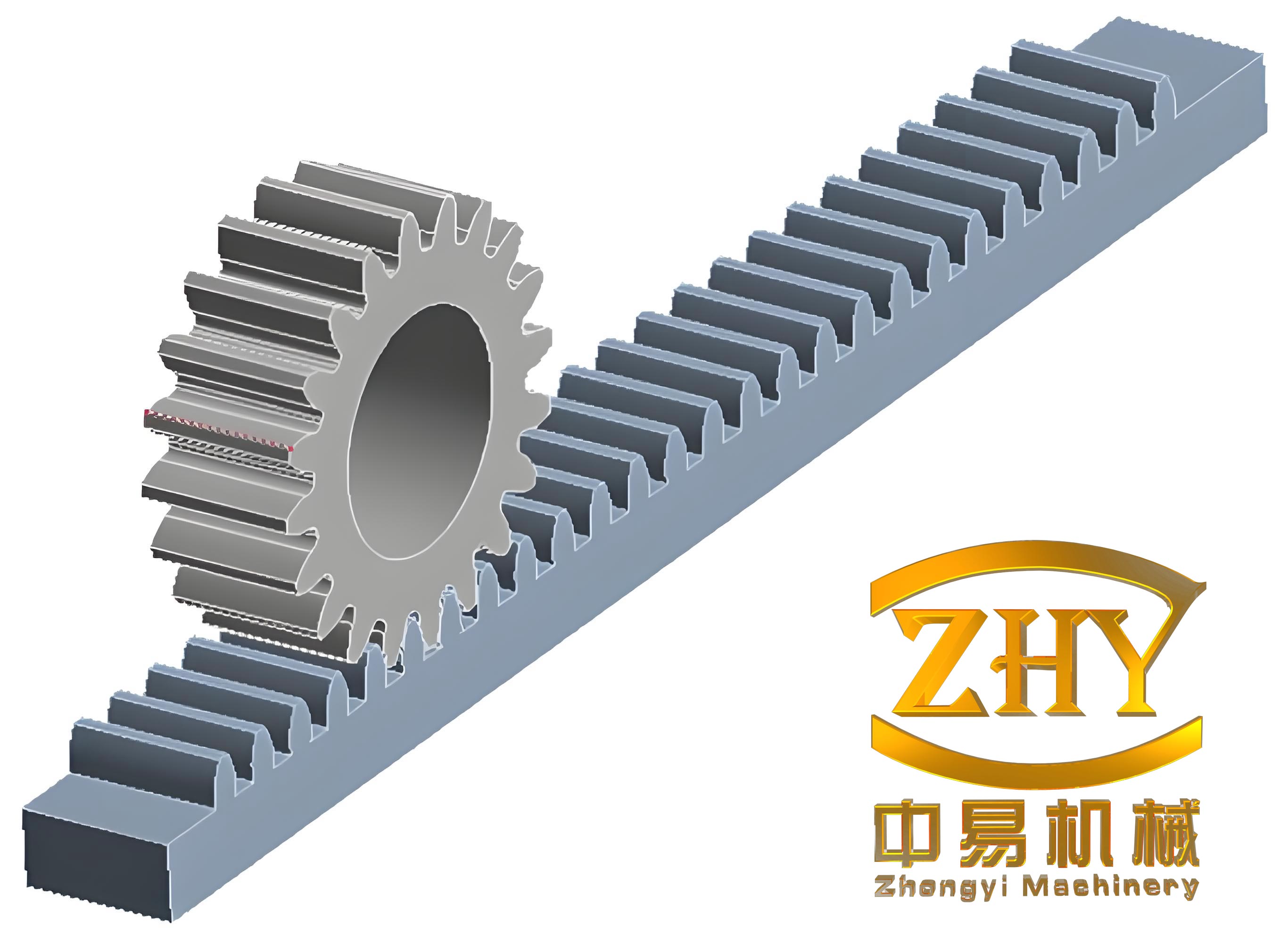
This mechanism is responsible for the precise 180-degree indexing. Its core is a high-strength rack and pinion gear pair. The innovation lies in implementing the rack not as a single piece, but as two separate, superimposed rack segments—Rack I and Rack II. Their combined width matches precisely the face width of the pinion gear, which is machined directly onto a gear shaft. The two racks are housed in a long bore within the machine body and are acted upon by pistons at each end, effectively forming a double-acting hydraulic cylinder where the rack assembly itself acts as the piston rod.
The gear shaft is splined internally and mates with the splined spindle shaft mentioned earlier. Thus, any rotation of the gear shaft is directly imparted to the work table. The operating principle is elegantly simple: Hydraulic fluid is directed to either the left or right chamber of the cylinder. Pressure on the left piston pushes the entire dual-rack assembly to the right. As the racks move, their teeth engage with the pinion, causing it to rotate counter-clockwise. Conversely, pressurizing the right chamber causes leftward rack motion and clockwise table rotation. The 180-degree limit is controlled by the stroke length of the hydraulic cylinder, which is precisely calculated based on the pinion’s pitch diameter.
The motion relationship is governed by the fundamental rack and pinion gear kinematic equation. For a pinion of pitch radius $r_p$, the linear displacement of the rack $s$ is related to the angular rotation of the pinion $\theta$ (in radians) by:
$$ s = r_p \cdot \theta $$
For a desired rotation of $\theta = \pi$ radians (180°), the required rack stroke is $s = \pi r_p$. The hydraulic system’s stroke is set to this exact value, providing positive mechanical stops at the desired indexing positions.
| Step | Action | Component Motion |
|---|---|---|
| 1 | Pressure ported to left cylinder chamber. | Left piston extends, pushing rack assembly right. |
| 2 | Rack teeth engage pinion. | Pinion & gear shaft rotate CCW. |
| 3 | Rotation transmitted via splines. | Splined shaft and work table rotate 180° CCW. |
| 4 | Cylinder reaches end of stroke. | Motion stops. Pressure holds position. |
| 5 (Return) | Pressure ported to right cylinder chamber. | Process reverses for CW rotation. |
The Automatic Clearance Elimination Mechanism
This is the cornerstone of the design’s precision. Backlash in a rack and pinion gear pair, denoted as $j$, is the circumferential play between teeth. It can be expressed as a linear equivalent at the rack:
$$ j_{linear} = j_{circumferential} / r_p $$
To eliminate this, the two rack segments (Rack I and Rack II) are not fixed together. Instead, they are allowed a small, controlled relative axial displacement. The mechanism to achieve this is housed in a cavity between the two racks and consists of a leadscrew-nut assembly and a planar spiral (volute) spring.
The leadscrew is mounted via needle bearings onto Rack II. The nut is fixed inside Rack I. The planar spiral spring has its inner end attached to the leadscrew shaft and its outer end anchored to Rack I. Under ideal, zero-backlash conditions, the spring is in a pre-tensioned neutral state, and the two racks are aligned as one solid body.
When wear or inherent tolerances create clearance between the pinion and the composite rack, the following sequence occurs automatically:
- The pinion experiences a slight free rotation before engaging the rack teeth during motion reversal.
- This lost motion represents energy stored in the rotating masses. More critically, it allows the pre-tensioned planar spiral spring to act.
- The spring torque $T_s$ acts to wind or unwind slightly, causing the leadscrew to rotate a small angle $\Delta \phi$.
- This rotation is converted into an axial displacement $\Delta x$ between the nut (on Rack I) and the leadscrew (on Rack II), according to the leadscrew pitch $p$:
$$ \Delta x = \frac{p \cdot \Delta \phi}{2\pi} $$ - This axial displacement shifts Rack I relative to Rack II, effectively “phasing” their teeth. This increases the effective composite tooth thickness of the dual rack, thereby taking up the clearance on both flanks of the pinion tooth.
The system reaches a new equilibrium when the spring torque balances the force required to elastically deform the gear teeth and the friction in the leadscrew. The compensation is continuous and self-adjusting throughout the life of the machine. The relationship between spring parameters and compensating force is crucial. The spring torque is proportional to its angular deflection:
$$ T_s = k_s \cdot \Delta \phi $$
where $k_s$ is the spring’s torsional stiffness. This torque generates an axial preload force $F_{pre}$ on the rack interface via the leadscrew:
$$ F_{pre} \approx \frac{2\pi \cdot \eta \cdot T_s}{p} $$
where $\eta$ is the efficiency of the leadscrew. This $F_{pre}$ is the force actively pressing the rack teeth against opposite flanks of the pinion teeth, ensuring zero-play engagement.
| Component | Parameter | Design Influence |
|---|---|---|
| Planar Spiral Spring | Torsional Stiffness ($k_s$) | Higher stiffness gives faster, more forceful correction but increases sliding friction. |
| Initial Pre-tension Angle | Sets the baseline preload before any wear occurs. | |
| Leadscrew | Pitch ($p$) | Finer pitch increases mechanical advantage, allowing a smaller spring to generate high $F_{pre}$. |
| Efficiency ($\eta$) | High efficiency ensures most spring torque is converted to preload force. | |
| Rack Pair | Maximum relative travel ($\Delta x_{max}$) | Determines the total amount of wear/backlash that can be compensated. |
Dynamic Performance and Analysis
The performance of this rack and pinion gear drive system can be modeled to understand its stiffness and response. The total torsional stiffness $K_{total}$ at the work table is a series combination of several compliances: the hydraulic oil column stiffness $K_{hyd}$, the bending/contact stiffness of the rack and pinion gear teeth $K_{gear}$, the torsional stiffness of the shafts $K_{shaft}$, and the contribution from the preload mechanism $K_{preload}$. For high performance, $K_{gear}$ must be maximized.
The preload from the automatic mechanism directly increases the effective meshing stiffness. When unloaded, a gear pair has clearance $j$. Under a preload force $F_{pre}$, the teeth are in contact on both flanks. The effective angular backlash $j_{eff}$ is reduced to nearly zero. The system’s resistance to reversal error is now governed by the elastic deflection of the preloaded teeth rather than a geometric gap. The reversal error $\epsilon$ can be estimated from the applied torque $T$ and the system stiffness:
$$ \epsilon \approx \frac{T}{K_{total}} $$
With the automatic clearance system engaged, $K_{total}$ is significantly higher than in a traditional, non-preloaded rack and pinion gear system, leading to a dramatically smaller $\epsilon$.
The dynamic equation governing the rotary motion during acceleration, neglecting damping for simplicity, is:
$$ J\ddot{\theta} + K_{total}\theta = T_{pinion} $$
where $J$ is the total reflected inertia at the pinion, $\ddot{\theta}$ is angular acceleration, and $T_{pinion}$ is the torque generated by the hydraulic force on the rack:
$$ T_{pinion} = (P \cdot A_{piston}) \cdot r_p $$
This shows the direct, linear relationship between hydraulic pressure $P$ and driving torque, a key benefit of the hydraulic rack and pinion gear drive.
Application and Summary
This integrated design for a hydraulic-driven, auto-clearance rack and pinion gear rotary table presents a compelling solution for heavy-duty, high-precision indexing applications. Its advantages are multifold:
- High Torque and Rigidity: The hydraulic rack and pinion gear transmission inherently provides high force in a compact volume, suitable for large workpieces.
- Automatic and Continuous Backlash Compensation: The integrated spring-loaded dual-rack mechanism ensures consistent precision over time without manual adjustment, addressing the primary weakness of standard gear drives.
- Simplified Architecture: Combining the rack and the hydraulic piston rod simplifies the force transmission path and reduces the number of components compared to systems using separate actuators and gearboxes.
- Decoupled Motions: The independent lifting and rotating mechanisms provide operational flexibility without compromising the design integrity of either function.
The successful implementation of this table hinges on precise manufacturing of the rack and pinion gear pair, careful selection of the planar spring characteristics, and robust sealing for the hydraulic systems. This design exemplifies how a thoughtful integration of mechanical design principles—kinematics, force analysis, and elastic compensation—can overcome traditional limitations. The auto-clearance rack and pinion gear system, as described, moves beyond being merely a component; it becomes a self-optimizing subsystem that ensures long-term precision in demanding industrial environments.