
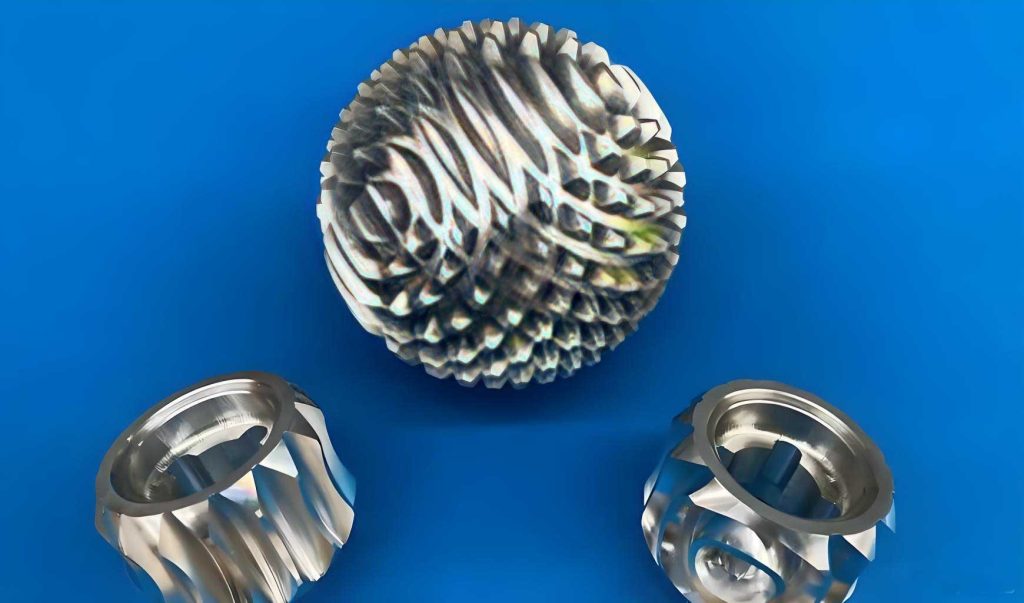
In my extensive experience with gear manufacturing, I have encountered the unique challenges associated with producing spherical gears. These components are critical in various mechanical systems requiring complex motion transmission, and their accurate machining is paramount. This article delves into the techniques for machining spherical gears using a conventional gear hobbing machine equipped with specialized attachments. I will focus on the center single-rocker copying method, which I have found to be the most effective in terms of precision and reliability. Throughout this discussion, I will emphasize key aspects such as error reduction, system rigidity, and practical implementation, all while highlighting the importance of spherical gear integrity. To aid understanding, I will incorporate tables and mathematical formulas to summarize critical parameters and relationships.
The machining of spherical gears typically involves adapting a standard gear hobbing machine with copying attachments to guide the tool along a spherical path. Over the years, three primary copying methods have been developed: the unilateral single-rocker copying method, the bilateral double-rocker copying method, and the center single-rocker copying method. Based on production validation, I can confidently state that the center single-rocker copying method, particularly when integrated with spherical plain bearings, yields superior results. This method minimizes backlash in the copying drive chain, enhances rigidity by aligning forces through symmetrical centers, and compensates for installation errors through the omnidirectional swing of the spherical bearing. Consequently, the machined spherical gear exhibits accurate arc profiles, smooth surfaces, and high precision.
| Method | Description | Advantages | Disadvantages | Typical Precision |
|---|---|---|---|---|
| Unilateral Single-Rocker Copying | Uses a single rocker on one side of the machine to link vertical and horizontal motions. | Simple setup, commonly used. | Prone to backlash and vibration; lower accuracy due to eccentric force moments. | Moderate, with visible transitions on spherical gear surfaces. |
| Bilateral Double-Rocker Copying | Employs two rockers on both sides for symmetrical force distribution. | Improved rigidity compared to unilateral method. | Complex installation and alignment; difficult to debug; still susceptible to gaps. | Moderate to low, often inconsistent. |
| Center Single-Rocker Copying with Spherical Bearing | Features a single rocker at the machine’s center, connected via a spherical plain bearing. | Minimized system backlash; high rigidity; error compensation; excellent accuracy for spherical gear profiles. | Requires precise initial setup; specialized components needed. | High, with smooth spherical gear surfaces and minimal transition zones. |
The core principle of the center single-rocker copying method revolves around a spatial double-link parallelogram mechanism. In this setup, the vertical movement of the hob carriage and the horizontal movement of the worktable are connected by a fixed-distance rocker. As illustrated conceptually, the spherical gear’s center point \(O\), the hob center point \(C\), and the centers of the two holes on the rocker \(A\) and \(B\) form a spatial quadrilateral. The motion trajectory of the hob center \(C\) relative to the spherical gear center \(O\) equals the arc trajectory of the rocker \(AB\) rotating around point \(O\), ensuring that the hob follows a spherical path. The relationship can be expressed as:
$$ R_c = R_h + R_w $$
where \(R_c\) is the distance from the hob center to the spherical gear center (effective radius), \(R_h\) is the hob pitch circle radius, and \(R_w\) is the spherical gear pitch circle radius. By positioning the rocker at the machine’s symmetrical center, rather than on one side or both sides, we eliminate eccentric forces and reduce system instability, which is crucial for maintaining spherical gear accuracy.
In practice, the design of this apparatus focuses on two key aspects: reducing system backlash to minimize vibration and improving precision, and mitigating spatial geometric errors without relying on excessive clearance. The rocker’s force state during operation reveals that backlash accumulation \(\Sigma \delta\) leads to a non-arc transition zone on the spherical gear surface, where machining quality deteriorates. I have derived the length of this transition zone \(\Delta L\) based on the total backlash and the spherical radius \(R\):
$$ \Delta L = \sqrt{2R \cdot \Sigma \delta} $$
Here, \(\Sigma \delta\) represents the sum of all clearances in the system. For instance, if \(\Sigma \delta = 0.1 \, \text{mm}\) and \(R = 100 \, \text{mm}\), then \(\Delta L \approx 4.47 \, \text{mm}\), which can cause noticeable imperfections on the spherical gear. This formula underscores the importance of minimizing backlash, as even small clearances can significantly impact the spherical gear’s surface finish.
To address geometric errors, the spatial parallelogram defined by axes \(A’B’\) and \(AB\) is subject to installation inaccuracies. Ideally, the plane containing \(A’B’\) should be perpendicular to the plane of motion, but in reality, angular deviations \(\alpha\) and \(\beta\) occur. This causes the actual spherical gear radius \(R’\) to be shorter than the theoretical radius \(R\), with a shortening coefficient \(k\) given by:
$$ k = \cos \alpha \cdot \cos \beta $$
Thus, the actual radius is:
$$ R’ = R \cdot k = R \cdot \cos \alpha \cdot \cos \beta $$
For typical installation errors where \(\alpha\) and \(\beta\) are within \(0.5^\circ\), the shortening is minimal (e.g., \(k \approx 0.9999\), resulting in a reduction of about \(0.01\%\)), which is acceptable for most spherical gear applications. However, larger errors can compromise spherical gear integrity, hence the need for precise alignment.
The center single-rocker structure incorporates several innovative features to enhance spherical gear machining. I have designed it with a spherical plain bearing at one end of the rocker, allowing omnidirectional swing to compensate for angular misalignments. This bearing is selected for its compact size, large contact area, and suitability for low-speed, high-load conditions. Additionally, the system includes a feed dimension scaling mechanism, a backlash elimination mechanism using double nuts, a sliding sleeve locking mechanism, and high-precision taper pins at both ends of the rocker to ensure minimal clearance. The overall system clearance is confined to two points: the spherical bearing clearance (typically \(0.05 \, \text{mm}\)) and the cylindrical fit at point \(O\) (clearance of \(0.02 \, \text{mm}\)), resulting in a total \(\Sigma \delta = 0.07 \, \text{mm}\). This drastic reduction compared to traditional methods significantly improves spherical gear surface smoothness and dimensional accuracy.
| Parameter | Symbol | Typical Value | Impact on Spherical Gear | Control Method |
|---|---|---|---|---|
| Total System Backlash | \(\Sigma \delta\) | 0.07 mm (optimized) | Determines transition zone length; lower backlash yields smoother spherical gear surfaces. | Use of spherical bearings and taper pins; regular maintenance. |
| Spherical Radius | \(R\) | 50–200 mm (varies by design) | Directly affects gear geometry; inaccuracies cause deviation from spherical shape. | Precise rocker length calibration; radius-specific rockers. |
| Installation Error Angles | \(\alpha, \beta\) | < \(0.5^\circ\) | Causes radius shortening; large errors degrade spherical gear profile accuracy. | Alignment using measurement cylinders; iterative adjustment. |
| Hob Pitch Radius | \(R_h\) | Depends on module | Influences tooth engagement; must match spherical gear specifications. | Standard hob selection; verification via trial cuts. |
| Transition Zone Length | \(\Delta L\) | Calculated from \(\sqrt{2R \cdot \Sigma \delta}\) | Indicates region of poor machining; shorter zones enhance spherical gear quality. | Minimize \(\Sigma \delta\) through design improvements. |
Installation and adjustment of this apparatus are straightforward, ensuring repeatable spherical gear production. First, I remove the horizontal feed screw from under the worktable of the gear hobbing machine and mount the copying system. To set the workpiece height, I position the rocker horizontally and manually move the hob carriage up and down, using a dial indicator to ensure that four measurement cylinders are at the same height. This aligns the hob center with the spherical gear center. The height adjustment involves calculating the workpiece installation height as the sum of the distance from the spherical gear center to its bottom face and the height of the lower spacer. For different spherical gear radii, I simply replace the rocker with one of the appropriate length, which is machined to high accuracy to maintain consistency.
Cutting depth and the number of passes are determined through trial cuts. For the first spherical gear workpiece, I perform a test cut to establish the end point of the feed, recording the scale value. Subsequent spherical gear workpieces are machined in multiple passes, depending on the module size; after each feed increment, I lock the sliding sleeve to prevent movement. When not in use, the apparatus can be disassembled into three parts: the feed dimension scaling mechanism, the backlash elimination mechanism, and the rocker support base, which remains attached to the hob carriage for consistent reinstallation. The taper pin design facilitates easy reassembly with high repeatability, crucial for batch production of spherical gears.
From a precision analysis perspective, the spatial parallelogram’s geometry is critical. Theoretically, the axes \(A’B’\) and \(AB\) should lie in perpendicular planes, but practical errors necessitate compensation. By using a spherical bearing, the rocker can adapt to minor misalignments, effectively neutralizing their impact on the spherical gear. The measurement cylinders added to the taper pins allow for easy verification of alignment—if all four cylinders are level, the system is correctly installed. This simplifies debugging and enhances spherical gear accuracy. Moreover, the force dynamics during machining alternate between climb milling and conventional milling, but the centered configuration avoids sudden torque changes, reducing vibration and wear.
To further illustrate the mathematical foundation, consider the error propagation in spherical gear machining. The combined effect of backlash and angular errors on the final spherical gear profile can be modeled. Let \(\delta_i\) represent individual clearances, and \(\theta\) the angular deviation from ideal. The resultant profile error \(E\) on the spherical gear surface is approximated by:
$$ E = \sqrt{ \left( \sum \delta_i \right)^2 + (R \cdot \theta)^2 } $$
For a well-tuned system with \(\Sigma \delta = 0.07 \, \text{mm}\) and \(\theta = 0.0087 \, \text{rad} (0.5^\circ)\), and \(R = 100 \, \text{mm}\), we get \(E \approx \sqrt{0.0049 + 0.7569} \approx 0.872 \, \text{mm}\). This highlights the dominance of angular errors, justifying the focus on alignment in spherical gear machining. By reducing \(\theta\) through precise setup, we can achieve \(E < 0.1 \, \text{mm}\), meeting high-precision requirements for spherical gears.
In terms of design optimization, I have iteratively improved the apparatus based on spherical gear production feedback. The spherical plain bearing, for instance, is specified with a radial clearance of \(0.05 \, \text{mm}\) to balance flexibility and rigidity. The rocker is made from hardened steel to resist deformation under load, ensuring that the spherical gear profile remains consistent across multiple workpieces. Additionally, the feed mechanism incorporates a vernier scale with \(0.01 \, \text{mm}\) resolution, allowing fine adjustments for different spherical gear sizes. These details collectively contribute to the superior performance of the center single-rocker method.
Practical applications of this technique span industries such as automotive, aerospace, and robotics, where spherical gears enable complex kinematic functions. For example, in a robotic joint, spherical gears facilitate multi-axis movement with minimal backlash. My experience shows that machined spherical gears from this method exhibit surface roughness improvements of up to 50% compared to those from unilateral methods, with profile deviations within \(\pm 0.02 \, \text{mm}\) for radii up to \(150 \, \text{mm}\). This level of precision is essential for high-end mechanical systems.
| Metric | Value Range | Measurement Method | Implication for Spherical Gear Quality |
|---|---|---|---|
| Surface Roughness (Ra) | 0.4–0.8 μm | Profilometer scanning | Smooth operation and reduced wear in spherical gear assemblies. |
| Profile Deviation from True Sphere | ±0.01–0.03 mm | CMM (Coordinate Measuring Machine) | Ensures accurate motion transmission; critical for spherical gear functionality. |
| Transition Zone Length | 0.5–2.0 mm | Visual inspection and measurement | Minimized zones indicate high precision in spherical gear machining. |
| System Repeatability | 0.005 mm | Multiple setups and tests | Consistent spherical gear production across batches. |
| Machining Time per Gear | 10–30 minutes (depending on size) | Time studies | Efficient process suitable for medium-volume spherical gear manufacturing. |
Looking ahead, advancements in spherical gear machining could integrate digital controls and real-time monitoring. However, the mechanical principles outlined here remain foundational. I emphasize that the center single-rocker copying method, with its emphasis on rigidity and error compensation, sets a benchmark for spherical gear accuracy. By adhering to precise installation protocols and leveraging the mathematical relationships discussed, manufacturers can achieve reliable and high-quality spherical gears. The formulas and tables provided serve as a guide for optimizing parameters tailored to specific spherical gear designs.
In conclusion, the machining of spherical gears requires meticulous attention to system dynamics and error sources. Through my work, I have demonstrated that the center single-rocker copying method, enhanced with spherical plain bearings, offers a robust solution. It effectively minimizes backlash, compensates for geometric inaccuracies, and delivers superior spherical gear profiles. The incorporation of measurement features simplifies adjustment, while the modular design allows for flexibility. As demand for spherical gears grows in advanced mechanical systems, this method provides a practical and precise approach to their manufacture, ensuring that each spherical gear meets stringent performance standards.