
In my experience working with precision mechanical components, spiral gears play a crucial role in various transmission systems, particularly in projection equipment where they are responsible for动力传递. The accuracy of these spiral gears directly impacts machine operation, noise reduction, and stability in applications such as audio playback. Historically, the machining of multi-start spiral gears, like the seven-start variant, posed significant challenges due to inefficiencies and precision limitations. This article details our journey in improving the加工 of spiral gears through innovative tooling methods, emphasizing the importance of precision in spiral gears for industrial applications.
The fundamental principle behind machining spiral gears involves understanding their helical geometry. Spiral gears, characterized by their helical teeth, require precise control over the lead or导程, which is the axial distance traveled per revolution. In traditional lathe turning, a single-point tool is used to cut each helical groove sequentially, necessitating accurate indexing for multi-start designs. The lead (L) for a spiral gear is calculated based on the number of starts (N) and the axial pitch (P_a), expressed as: $$L = N \times P_a$$ where P_a is the distance between corresponding points on adjacent teeth along the axis. For a seven-start spiral gear, this becomes: $$L = 7 \times P_a$$ This formula is essential for setting up the lathe’s gear train to achieve the correct helical path.
Previously, our approach involved using a single-point tool on a lathe,配挂挂轮 to match the calculated lead. We employed a seven-hole indexing plate attached to the headstock for分度 after each groove was cut. This method was not only time-consuming but also prone to errors. The齿距误差 (pitch error) often reached significant levels, sometimes exceeding allowable tolerances, leading to irregular transmission, increased noise, and vibration in放映机. The cumulative误差 across all starts further exacerbated these issues, affecting the overall performance of spiral gears in critical applications.
To address these precision deficits, we developed a multi-point toolholder, specifically a seven-point刀排, designed to machine all seven helical grooves simultaneously. This innovation eliminates the need for indexing, thereby reducing human error and improving consistency. The toolholder’s design ensures that the齿距误差 between adjacent grooves is minimized, typically within strict limits, and the累积误差 across the entire gear is controlled. By integrating this with a high-precision gear train on the lathe, we achieved a significant leap in加工 accuracy for spiral gears.
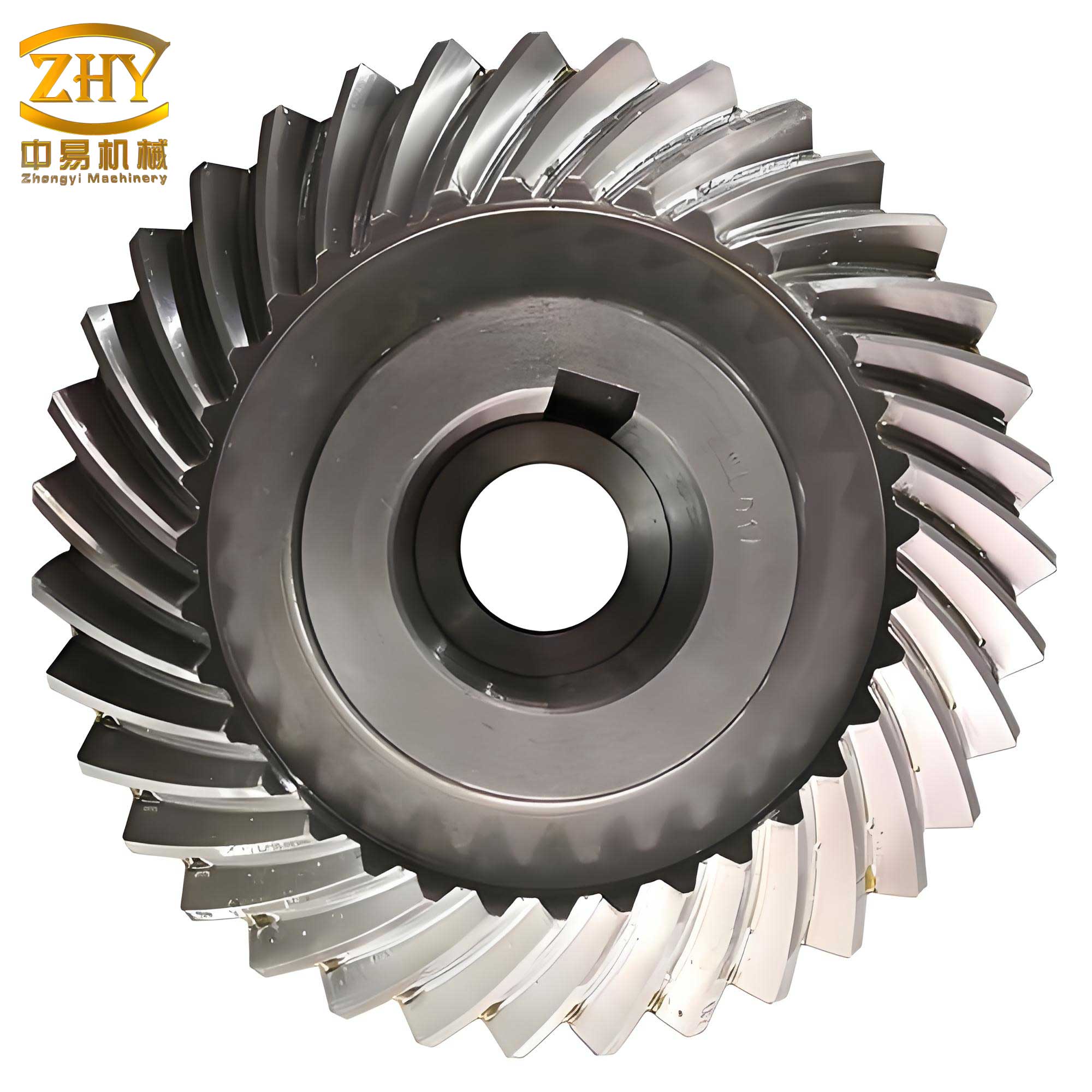
The design and implementation of the seven-point toolholder rely on meticulous engineering. Key parameters include the tool material, cutting conditions, and geometric alignment. We used high-speed steel for the刀具材料, such as W18Cr4V, which offers excellent wear resistance and toughness for machining spiral gears. The切削材料 was typically carbon steel or alloy steel, selected based on the application requirements for spiral gears. The toolholder’s齿距 is set to match the axial pitch of the spiral gear, ensuring that each cutting point engages the workpiece at the correct helical angle. The accuracy of the toolholder is verified through rigorous testing, with齿面光洁度 (surface finish) achieving high grades and齿面径向跳动 (radial runout) maintained within tight limits.
To quantify the improvements, we established technical指标 that highlight the performance of spiral gears machined with the new method. Below is a table summarizing the key specifications and tolerances achieved:
| Parameter | Symbol | Target Value | Allowable Tolerance | Achieved Value with Toolholder |
|---|---|---|---|---|
| Pitch Error (Single Tooth) | ΔP | Based on design | ±0.02 mm | ≤ 0.01 mm |
| Cumulative Pitch Error (7 Teeth) | ΔPcum | Based on design | ±0.05 mm | ≤ 0.03 mm |
| Surface Finish | Ra | Grade 6 or better | N/A | Grade 7-8 |
| Radial Runout | Rr | ≤ 0.03 mm | N/A | ≤ 0.02 mm |
| Accuracy Grade | — | Grade 7 per standards | N/A | Achieved Grade 7 |
These results demonstrate that spiral gears produced with the multi-point toolholder meet and often exceed the required精度等级, such as Grade 7, which is critical for high-performance applications. The齿距 for a single tooth is designed to be precise, with the seven-tooth cumulative pitch tightly controlled to ensure smooth engagement in spiral gears transmission systems.
The mathematical foundations for machining spiral gears extend beyond basic lead calculations. We incorporate formulas for helical angle (β), which relates to the gear’s diameter (d) and lead (L): $$\tan(\beta) = \frac{\pi d}{L}$$ This angle influences the cutting forces and tool geometry. Additionally, the axial pitch (P_a) is derived from the normal pitch (P_n) and helical angle: $$P_a = \frac{P_n}{\cos(\beta)}$$ For multi-start spiral gears, the relationship between starts (N), axial pitch, and lead is fundamental: $$L = N \times P_a = N \times \frac{P_n}{\cos(\beta)}$$ These equations guide the setup of the lathe and toolholder design, ensuring that spiral gears are machined with high fidelity to their intended geometry.
In practice, the加工 process involves several steps. First, the workpiece material is selected—often a durable steel alloy suitable for spiral gears. The lathe is configured with a precision gear train calculated using the lead formula. For instance, if the lead L is 100 mm for a seven-start spiral gear, the挂轮 ratio is set accordingly. With the single-point method, the indexing plate introduces potential errors; however, the multi-point toolholder integrates all cutting edges into a single unit, aligned to the helical path. This alignment is verified using calibration instruments, and the cutting parameters (speed, feed, depth) are optimized for spiral gears to achieve the desired surface finish and accuracy.
The effectiveness of the seven-point toolholder is evident in comparative analysis. Previously, with single-point turning, the班产量 was limited to about 10-15 spiral gears per shift, with齿距误差 as high as 0.05 mm or more. This resulted in operational issues like tight-loose transmission and increased机械声. In contrast, the toolholder method boosts productivity to over 100 pieces per shift, with齿距误差 reduced to within 0.01 mm and累积误差 under 0.03 mm. This not only enhances the quality of spiral gears but also reduces waste and rework, contributing to cost savings and improved reliability in放映机 systems.
To further elaborate on the toolholder design, we consider the应力分布 and wear characteristics. The cutting forces on spiral gears are analyzed using formulas for tangential (F_t), radial (F_r), and axial (F_a) components: $$F_t = \frac{2T}{d}$$ $$F_r = F_t \cdot \tan(\alpha) \cdot \cos(\beta)$$ $$F_a = F_t \cdot \tan(\beta)$$ where T is the torque, d is the pitch diameter, α is the pressure angle, and β is the helical angle. These forces influence tool life and accuracy, so the toolholder is designed to distribute them evenly across the seven points, minimizing deflection and ensuring consistent cutting action for spiral gears.
The implementation process included prototyping and testing. We conducted trials with various materials and cutting conditions, documenting results in tables for analysis. Below is a summary of cutting parameters optimized for spiral gears:
| Material Type | Cutting Speed (m/min) | Feed Rate (mm/rev) | Depth of Cut (mm) | Resulting Surface Finish (Ra, μm) |
|---|---|---|---|---|
| Carbon Steel (0.45% C) | 30-40 | 0.1-0.15 | 0.5-1.0 | 0.8-1.2 |
| Alloy Steel (Cr-Mo) | 25-35 | 0.08-0.12 | 0.3-0.8 | 0.6-1.0 |
| Stainless Steel | 20-30 | 0.05-0.10 | 0.2-0.6 | 1.0-1.5 |
These parameters ensure that spiral gears are machined efficiently without compromising精度. The toolholder’s rigidity plays a key role in maintaining these conditions, especially for multi-start designs where alignment is critical.
Beyond the technical aspects, the economic impact of this innovation is significant. By improving the加工 efficiency of spiral gears, we reduced production time and costs. The toolholder’s durability means less frequent tool changes, further enhancing productivity. In quality control, we implemented statistical process control (SPC) to monitor齿距误差 and other metrics, using formulas like the standard deviation (σ) to assess consistency: $$\sigma = \sqrt{\frac{1}{n-1} \sum_{i=1}^{n} (x_i – \bar{x})^2}$$ where x_i represents individual pitch measurements, and \(\bar{x}\) is the mean. For spiral gears, maintaining a low σ ensures that all gears meet the stringent requirements for noise reduction and stability.
In conclusion, the adoption of a multi-point toolholder for machining seven-start spiral gears has revolutionized our production process. The precision achieved—with齿距误差 within 0.01 mm and累积误差 under 0.03 mm—exceeds industry standards for spiral gears, leading to smoother operation and enhanced performance in projection equipment. The integration of mathematical formulas, such as those for lead and helical angle, with practical tooling design, has enabled us to produce high-quality spiral gears at scale. This approach not only addresses past challenges but also sets a benchmark for future advancements in gear machining. As spiral gears continue to be vital in various mechanical systems, ongoing innovation in加工 techniques will remain essential for meeting evolving demands for accuracy and efficiency.