
The performance of cylindrical gears, as core components in automotive transmissions, directly determines the quality, reliability, and noise-vibration-harshness (NVH) characteristics of the entire drivetrain. Surface failure modes such as wear, pitting, and fatigue cracking are predominant failure mechanisms, making surface hardening treatments critical. Carburizing followed by quenching is a quintessential thermochemical process that enriches the surface layer of low-carbon alloy steels with carbon, creating a hard, wear-resistant case while maintaining a tough, ductile core. This gradient structure is essential for achieving high load-bearing capacity and extended service life in cylindrical gears. However, the process involves complex interactions between carbon diffusion, heat transfer, phase transformations, and stress evolution, making traditional trial-and-error process development costly, time-consuming, and often suboptimal.
The advent of computational modeling and simulation has revolutionized heat treatment engineering. Numerical simulation based on multi-physics coupling theory provides a powerful virtual platform to predict the outcomes of carburizing-quenching processes. By establishing accurate finite element models that account for the interplay between diffusion, temperature, microstructure, stress, and hardness fields, it becomes possible to visualize and quantify the effects of key process parameters. This enables a scientific approach to process design and optimization, reducing development cycles, minimizing distortion, and ensuring consistent, high-quality hardened layers in cylindrical gears.
This paper presents a comprehensive investigation into the numerical simulation and parameter optimization of the gas carburizing and oil quenching process for 20CrMnTi steel cylindrical gears. The core of this work is the development and validation of a robust multi-field coupled finite element model. Using this model, the influence of critical process parameters—carburizing temperature, time, carbon potential, and cooling rate—on carburizing efficacy (surface carbon concentration and case depth) and final gear performance (hardness distribution) is systematically analyzed. Furthermore, optimization strategies combining orthogonal experimental design and artificial intelligence are employed to identify optimal process windows and establish predictive models, providing actionable guidance for industrial practice.
Fundamental Theories for Numerical Simulation of Carburizing-Quenching
The numerical simulation of carburizing-quenching is inherently a multi-physics problem where several physical fields are tightly coupled. A realistic model must solve the governing equations for these fields simultaneously or in a strongly coupled manner.
1. Diffusion Field Calculation
The ingress of carbon atoms from the furnace atmosphere into the steel surface and their subsequent diffusion inward is governed by Fick’s second law. The diffusion coefficient \( D \) is not constant but is a function of both temperature \( T \) and local carbon concentration \( C \), significantly affecting the accuracy of the carbon profile prediction.
The governing equation with its initial and boundary conditions is:
$$
\frac{\partial C}{\partial t} = \frac{\partial}{\partial x} \left[ D(C, T) \frac{\partial C}{\partial x} \right]
$$
Initial condition: \( C(x, 0) = C_0 \).
Inner boundary (symmetry/core): \( \frac{\partial C}{\partial x} = 0 \) at \( x \to \infty \).
Outer boundary (surface): \( -D \frac{\partial C}{\partial x} \bigg|_{surface} = \beta (C_g – C_s) \).
Here, \( \beta \) is the mass transfer coefficient describing the kinetics of carbon transfer from the gas phase (with potential \( C_g \)) to the solid surface (with concentration \( C_s \)). The diffusion coefficient model integrating temperature and carbon effects is:
$$
D(C, T) = D_{0.4} \cdot \exp\left(-\frac{Q}{R T}\right) \cdot \exp\left[B(0.4 – C)\right]
$$
where \( D_{0.4} \) is the diffusivity at 0.4 wt.% C, \( Q \) is the activation energy for diffusion, \( R \) is the gas constant, and \( B \) is a material constant.
2. Temperature Field Calculation
The transient temperature distribution, influenced by external heating/cooling and internal latent heat during phase transformations, is governed by the heat conduction equation.
$$
\rho C_p \frac{\partial T}{\partial t} = \nabla \cdot (\lambda \nabla T) + \dot{Q}_{latent}
$$
where \( \rho \) is density, \( C_p \) is specific heat capacity, \( \lambda \) is thermal conductivity, and \( \dot{Q}_{latent} \) is the volumetric heat generation rate due to phase changes. The boundary condition for quenching typically involves a convective heat transfer coefficient \( h(T) \) that is highly non-linear with temperature, especially during the boiling stages in oil quenching.
3. Microstructure Field Calculation
Phase transformations occur during both heating (austenitization) and cooling (decomposition of austenite). The models differ based on the transformation type.
- Diffusive Transformations (Ferrite, Pearlite, Bainite): These are typically modeled using time-temperature-transformation (TTT) diagrams or the Johnson-Mehl-Avrami-Kolmogorov (JMAK) equation, often implemented via the Scheil’s additive rule for continuous cooling.
- Non-Diffusive Transformation (Martensite): The Koistinen-Marburger equation is widely used, where the martensite volume fraction \( f_M \) is a function of undercooling below the martensite start temperature \( M_s \).
$$
f_M = 1 – \exp[-\alpha (M_s – T)]
$$
The \( M_s \) temperature itself is strongly dependent on the carbon concentration, making the microstructure evolution intimately linked to the diffusion field.
4. Stress-Strain Field Calculation
The total strain increment \( d\varepsilon_{ij} \) during the process is decomposed into several components:
$$
d\varepsilon_{ij} = d\varepsilon_{ij}^{el} + d\varepsilon_{ij}^{pl} + d\varepsilon_{ij}^{th} + d\varepsilon_{ij}^{tr} + d\varepsilon_{ij}^{tp}
$$
These represent elastic, plastic, thermal, transformation (volumetric change due to phase change), and transformation plasticity strains, respectively. Transformation plasticity is a critical phenomenon where stress can induce or accelerate phase transformations, significantly affecting the final residual stress state in the cylindrical gear.
5. Hardness Field Calculation
The final hardness distribution is a consequence of the local microstructure and its carbon content. A common approach is the rule of mixtures, where the composite hardness \( HV_{total} \) is calculated based on the volume fractions \( V_i \) and individual hardness values \( HV_i \) of the constituent phases (Martensite, Bainite, Ferrite-Pearlite, etc.).
$$
HV_{total} = \sum (V_i \times HV_i)
$$
Empirical formulas are used to estimate the hardness of each phase, which are functions of chemical composition (especially carbon) and the cooling rate. For high-carbon martensite near the surface, the hardness is primarily a function of carbon content, while for lower carbon structures, it depends on both carbon and cooling rate.
Establishment of the Finite Element Model for Cylindrical Gear Carburizing-Quenching
1. Geometric Modeling and Meshing
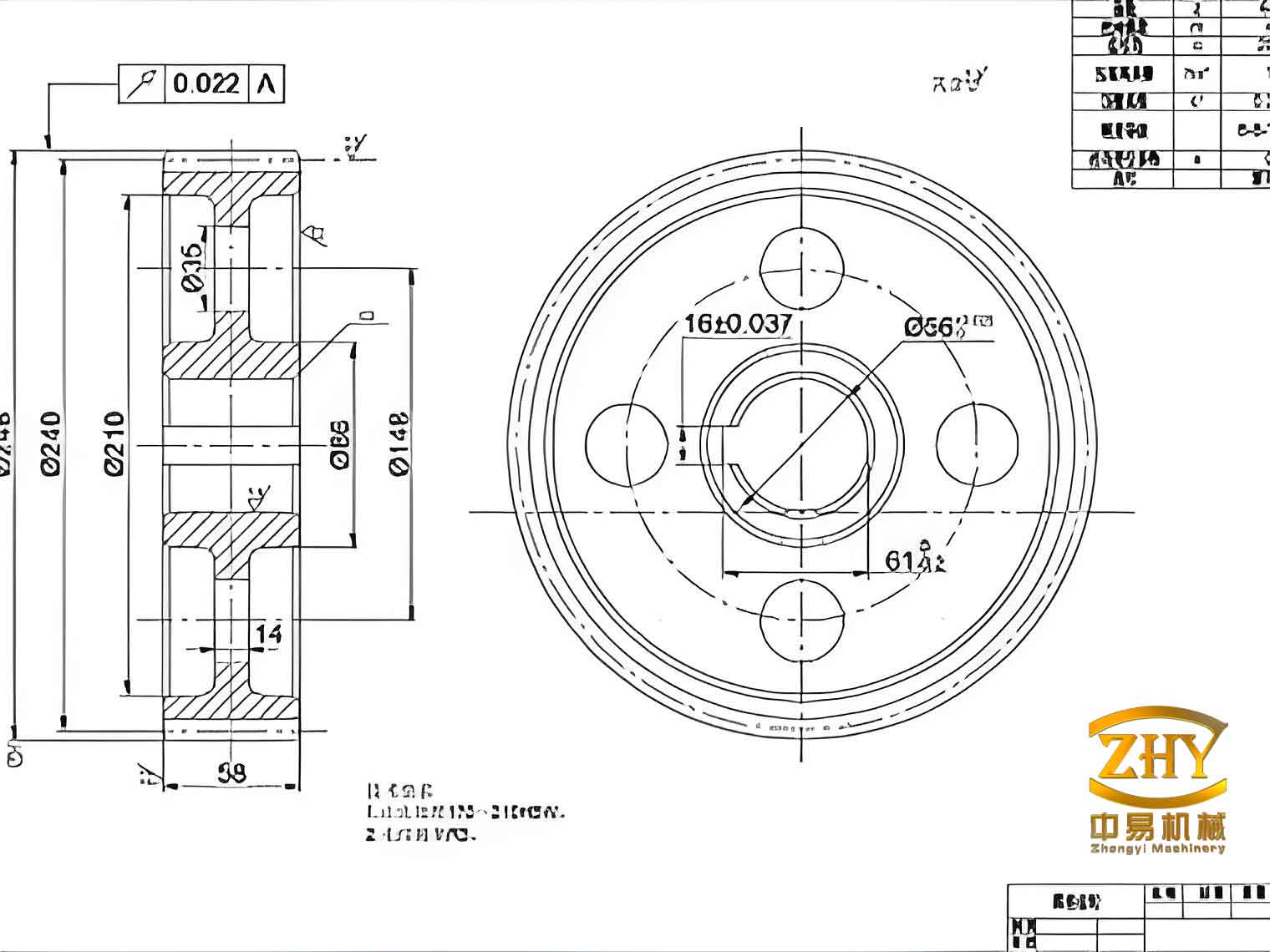
A three-dimensional model of a representative automotive transmission cylindrical gear was created. To leverage symmetry and reduce computational cost, a half-tooth sector model was employed for the simulation. A high-quality tetrahedral mesh was generated, with a refined mesh size (≤1 mm) in the critical tooth flank and root regions to ensure accuracy in capturing steep gradients in carbon and stress.
2. Material Properties and Phase Transformation Data
The material under study is 20CrMnTi, a widely used gear steel. Its chemical composition is provided in Table 1.
| Element | C | Si | Mn | Cr | Ti | Fe |
|---|---|---|---|---|---|---|
| Wt.% | 0.19 | 0.28 | 0.93 | 1.12 | 0.065 | Bal. |
Temperature-dependent thermophysical properties—such as thermal conductivity, specific heat, density, and Young’s modulus—were calculated using JMatPro software, considering the phase mixture at each temperature. Crucially, a set of TTT diagrams for different carbon levels (e.g., 0.2%, 0.4%, 0.8%, 1.0%) were generated to accurately model the phase transformation kinetics across the carburized case. This is essential as the \( M_s \) temperature drops significantly with increasing carbon content.
3. Boundary Conditions and Process Sequence
The process sequence implemented in the model is representative of industrial practice:
- Preheating: Heating to 820°C and holding.
- Boost (Strong Carburizing): Heating to a higher temperature (e.g., 905°C) under a high carbon potential (e.g., 0.9%C) to rapidly increase surface carbon.
- Diffusion: Lowering the temperature (e.g., 850°C) and/or carbon potential to allow carbon to diffuse inward, smoothing the concentration gradient.
- Quenching: Rapid cooling in oil at 25°C.
The boundary conditions consist of (a) a carbon flux boundary condition on all exposed surfaces during boost and diffusion stages, defined by the carbon potential and transfer coefficient \( \beta \), and (b) a temperature-dependent heat transfer coefficient \( h(T) \) during the oil quench, which models the full film boiling, nucleate boiling, and convective cooling regimes.
Model Validation via Experimentation
To validate the accuracy of the multi-field coupled FE model, physical experiments were conducted. Cylindrical gears were processed according to a specified carburizing-quenching cycle. Post-treatment, samples were sectioned for analysis.
- Microstructure: Optical microscopy revealed a gradient microstructure: fine plate/needle martensite with retained austenite at the high-carbon surface, transitioning to lath martensite in the mid-case, and a mixture of lath martensite and lower bainite/ferrite in the low-carbon core.
- Carbon Concentration Profile: Carbon content from the surface to the core was measured using spectroscopy combined with layer removal. The experimental profile showed a smooth decay from approximately 0.8% at the surface to the base carbon level of 0.19% in the core.
- Hardness Profile: Microhardness (HV) was measured along the tooth flank from surface to core, showing a high surface hardness (~62 HRC equivalent) decreasing gradually to the core hardness.
The simulation results for carbon and hardness profiles were in excellent agreement with the experimental data, as shown in the comparative plots. The predicted case depth (depth to 0.35% C or 550 HV) matched the measured value closely. This successful validation confirmed the reliability of the numerical model for subsequent parametric studies and optimization.
Numerical Investigation of Key Process Parameters
Using the validated model, a series of simulations were performed to isolate and understand the effect of individual process parameters on the carburizing outcome and final properties of the cylindrical gear. The boost and diffusion stages were analyzed separately.
1. Influence of Carburizing Temperature
Temperature primarily affects the diffusion coefficient \( D \). Simulations with varying boost temperatures (895°C to 925°C) while keeping other parameters constant showed that:
- Higher boost temperatures lead to a marginally higher surface carbon and a significantly deeper carburizing case due to exponentially faster diffusion.
- The effect on the final hardness profile is less pronounced than on carbon profile, as the higher temperature also promotes grain growth, which can slightly counteract hardness gains.
- Increasing the diffusion temperature similarly promotes deeper carbon penetration but can slightly reduce the peak surface carbon concentration.
2. Influence of Carburizing Time
Time is the most direct factor controlling case depth. The study varied boost time and diffusion time independently.
| Parameter Varied | Effect on Surface [C] | Effect on Case Depth | Effect on Core [C] |
|---|---|---|---|
| Increase Boost Time | Slight Increase | Large Increase | Noticeable Increase |
| Increase Diffusion Time | Slight Decrease/Smoothing | Moderate Increase | Very Slight Increase |
Longer boost times rapidly build case depth but can lead to excessive surface carbon if not controlled. The diffusion stage is crucial for redistributing carbon from the surface inward, preventing brittle carbides and creating a more favorable gradient. The hardness profile follows the carbon profile; a deeper carbon case results in a deeper effective hardening depth.
3. Influence of Carbon Potential
Carbon potential \( C_g \) controls the driving force for carbon absorption at the surface.
- Boost Carbon Potential: Increasing boost potential significantly raises the surface carbon saturation level and accelerates the initial carbon influx, leading to a steeper initial carbon gradient and a deeper achievable case for a given time. However, excessively high potential risks forming massive or networked carbides.
- Diffusion Carbon Potential: Lowering the diffusion potential is the primary method for controlling the final surface carbon concentration. A lower diffusion potential allows carbon to diffuse from the surface into the interior, reducing the peak surface carbon to a desired level (typically 0.7-0.9% for gear steels) while further deepening the case.
The interplay between boost and diffusion potentials is the key to designing an efficient process that meets both surface carbon and case depth targets.
4. Influence of Quenching Cooling Rate
The cooling rate, defined by the quenchant (oil type, temperature, agitation) and its heat transfer coefficient \( h(T) \), primarily affects the microstructure and hardness, not the carbon profile.
$$
\text{Higher Cooling Rate} \rightarrow \text{Greater Undercooling} \rightarrow \text{Higher Martensite Fraction} \rightarrow \text{Higher Hardness}
$$
Simulations comparing different \( h(T) \) curves confirmed that faster cooling results in higher hardness values at all depths for the same carbon profile. It also increases the risk of quenching distortion and residual stresses, highlighting the need for a balanced cooling intensity.
Process Parameter Optimization for Cylindrical Gears
Based on the parametric studies, an optimization strategy was formulated to determine the best combination of process parameters to achieve specified targets for surface carbon concentration (Target: ~0.8%) and effective case depth (Target: ~0.9 mm).
1. Optimization via Orthogonal Experimental Design
A four-factor, three-level \( L_9(3^4) \) orthogonal array was designed. The factors and levels are shown in Table 2.
| Factor | Level 1 | Level 2 | Level 3 |
|---|---|---|---|
| A: Boost Time (min) | 60 | 80 | 100 |
| B: Diffusion Time (min) | 40 | 50 | 60 |
| C: Boost Carbon Potential (wt%) | 0.85 | 0.90 | 0.95 |
| D: Diffusion Carbon Potential (wt%) | 0.80 | 0.85 | 0.90 |
Nine simulations corresponding to the orthogonal array were run. The results for surface carbon [C]s and case depth CD were analyzed using range analysis and analysis of variance (ANOVA).
Key Findings from Orthogonal Analysis:
- For Surface Carbon Concentration: The order of significance was Diffusion Carbon Potential (D) >> Boost Time (A) > Boost Potential (C) > Diffusion Time (B). Factor D was overwhelmingly dominant.
- For Case Depth: The order was Boost Time (A) >> Boost Potential (C) > Diffusion Time (B) > Diffusion Carbon Potential (D). Factor A was the most significant.
This analysis clearly delineates the primary control knobs: Diffusion potential for surface carbon and Boost time for case depth. The optimal parameter combination derived from the analysis was: A2B1C2D3 (Boost: 80 min at 0.9%C; Diffusion: 40 min at 0.9%C). A verification simulation with this set yielded [C]s = 0.796% and CD = 0.903 mm, remarkably close to the optimization targets.
2. Predictive Modeling using PSO-BP Neural Network
To facilitate rapid prediction and inverse design for various target specifications, a machine learning model was developed. A Back-Propagation (BP) neural network was chosen to map the non-linear relationship between process parameters (inputs) and performance outputs ([C]s, CD). To overcome the limitations of BP networks like slow convergence and local minima, the Particle Swarm Optimization (PSO) algorithm was used to optimize the initial weights and thresholds of the network.
PSO-BP Model Architecture and Parameters:
| Component | Specification/Value |
|---|---|
| Network Structure | 4 (Input) – 9 (Hidden) – 2 (Output) |
| Inputs | Boost Time, Diffusion Time, Boost Cp, Diffusion Cp |
| Outputs | Surface [C], Case Depth |
| PSO Population Size | 10 |
| PSO Iterations | 30 |
| BP Training Function | Levenberg-Marquardt |
The model was trained on a dataset generated from the numerical simulations. The performance of the PSO-BP model was superior to a standard BP model, demonstrating significantly lower prediction error on a test dataset. The maximum prediction error for case depth was within 4%, confirming its utility as a fast and reliable tool for preliminary process design for cylindrical gear carburizing-quenching.
Conclusion
This work successfully demonstrates a comprehensive framework for the analysis and optimization of the carburizing-quenching process for 20CrMnTi steel cylindrical gears using numerical simulation. A robust multi-physics coupled finite element model was developed and validated against experimental data, showing high accuracy in predicting carbon concentration, microstructure, and hardness distributions.
The systematic numerical investigation elucidated the distinct and coupled effects of key process parameters: Temperature and boost time predominantly govern case depth, while the diffusion carbon potential is the primary control for final surface carbon content. The quenching cooling rate critically determines the achieved hardness level from a given carbon profile.
Through orthogonal experimental design and statistical analysis, an optimized process parameter set was identified, effectively balancing the targets for surface carbon and case depth. Furthermore, the developed PSO-BP neural network predictive model provides a valuable, efficient tool for mapping the complex process-property relationships, enabling rapid inverse design for different gear specifications.
This integrated approach—combining physics-based numerical simulation with statistical design of experiments and machine learning—offers a powerful, science-based methodology for designing and optimizing heat treatment processes. It moves beyond empirical guesswork, leading to enhanced product quality (consistent hardened case), improved performance (wear and fatigue resistance), and increased manufacturing efficiency for critical components like cylindrical gears in the automotive and machinery sectors.