
The evolution of mechanical transmission systems in aerospace, automotive, and industrial machinery continuously demands components capable of sophisticated motion control. Among these, spiral gears, specifically those with non-constant helical angles, offer unique advantages for converting rotational motion into complex oscillatory outputs. This article delves into the precision manufacturing technologies for a specialized variant: logarithmic spiral gears. Unlike standard helical gears with a constant helix angle, logarithmic spiral gears feature a helix angle that varies according to a specific law along the face width of the gear tooth. This geometric characteristic enables the realization of tailored, non-uniform transmission functions essential for advanced applications in material handling, processing equipment, and specialized machinery where traditional linkages or constant-ratio gears fall short.
The core challenge lies in the fabrication of the mating pair: typically, a standard involute spur gear as the driver and a conjugate logarithmic spiral gear as the driven element. The driven gear’s variable helix profile dictates its unique oscillatory response. The precision machining of these spiral gears, therefore, is not merely about achieving high dimensional accuracy but, more critically, about faithfully replicating a predefined, continuously changing spiral angle (β). This article systematically explores the underlying principles and presents detailed, viable process strategies for the precision manufacturing of such spiral gears, comparing conventional, CNC-based, and specialized forming methods.
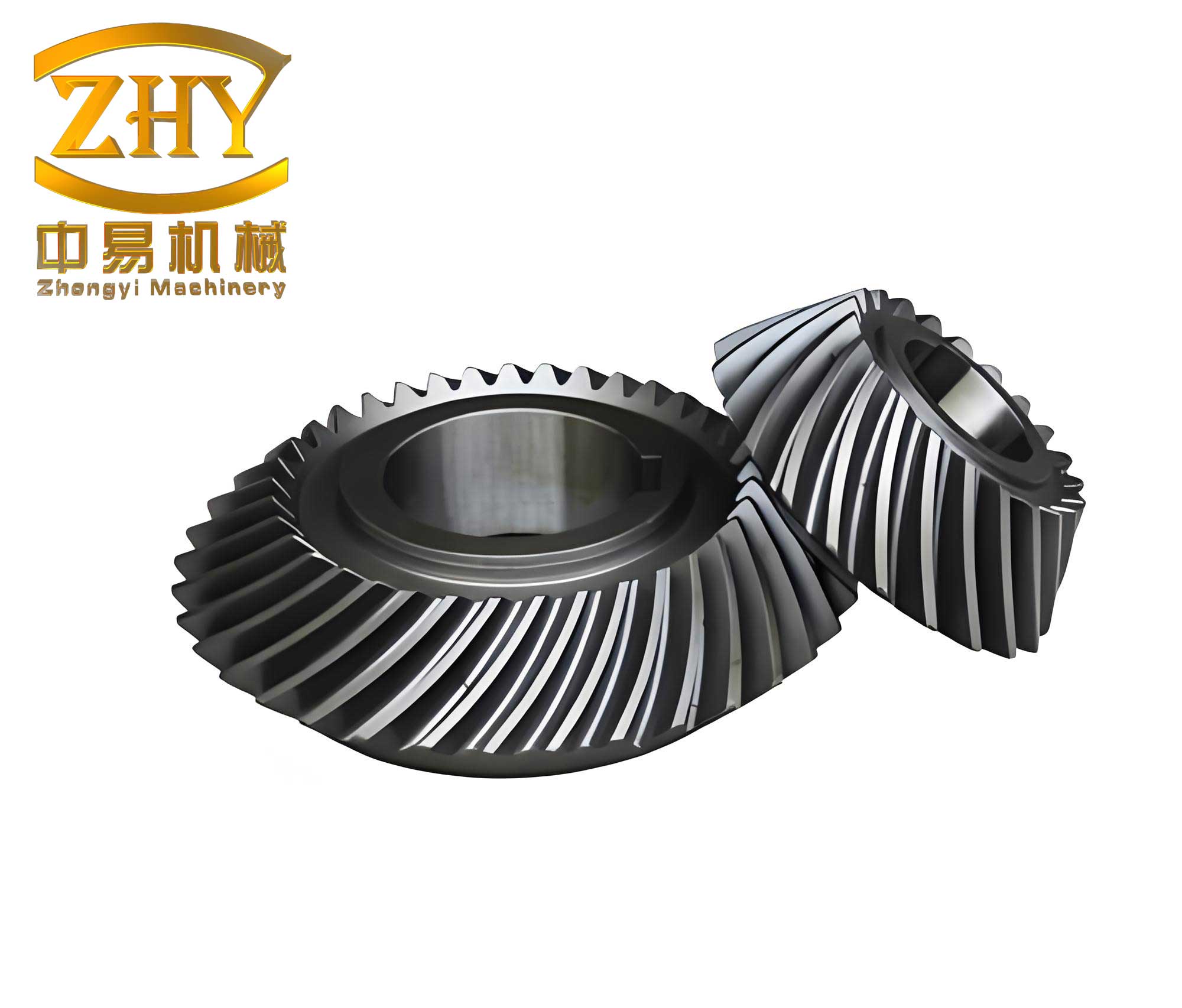
The fundamental principle of machining logarithmic spiral gears is rooted in the theory of conjugate gear generation. For the driven gear, the concept of a generating gear (crown gear or generating plane) is employed. In the specific case of spiral bevel-type generation, when the generating gear’s pitch angle is 90°, it transforms into a planar gear or a crown rack. The machining process simulates the rolling motion between the pitch surface of the workpiece and the pitch plane of this imaginary planar gear. The kinematic relationship governing this process is defined by the machine tool’s gear ratio. Let $W_p$ and $Z_p$ be the rotational speed and number of teeth of the imaginary planar gear, and $W$ and $Z$ be those of the workpiece gear. The required machine transmission ratio $i_M$ is:
$$ i_M = \frac{W}{W_p} = \frac{\sin 90^\circ}{\sin \Gamma} = \frac{1}{\sin \Gamma} = \frac{Z_p}{Z} $$
where $\Gamma$ is the pitch angle of the workpiece. For a mating pair with teeth numbers $Z_1$, $Z_2$ and pitch angles $\Gamma_1$, $\Gamma_2$ in an orthogonal (90°) arrangement ($\Gamma_1 + \Gamma_2 = 90^\circ$), the number of teeth on the planar gear can be derived as:
$$ Z_p = \frac{Z_1}{\sin \Gamma_1} = \frac{Z_2}{\sin \Gamma_2} = \frac{Z_2}{\cos \Gamma_1} $$
$$ Z_p = \sqrt{Z_1^2 + Z_2^2} $$
The tooth profile of this planar gear is a spherical involute, and the relative motion between the cutting tool (representing the planar gear’s tooth) and the blank generates the required conjugate profile on the spiral gear. The critical variable is the local helix angle $\beta$, which dictates the lead of the spiral. For a logarithmic spiral gear, $\beta$ is not constant but a function of the face width position or the rotation angle $\psi$. This necessitates dynamic adjustments during the machining process.
| Feature | Standard Helical Gear | Logarithmic Spiral Gear |
|---|---|---|
| Helix Angle (β) | Constant | Variable, follows a defined function (e.g., logarithmic law) |
| Transmission Function | Constant speed ratio | Variable ratio, producing oscillatory output |
| Primary Machining Challenge | Maintaining constant lead | Precisely controlling continuously variable lead/helix angle |
| Typical Generation Method | Fixed setup hobbing or shaping | Dynamic tool/workpiece axis adjustment during generation |
Precision Machining Processes for Spiral Gears
1. Conventional Hobbing with Dynamic Tool Axis Adjustment
Hobbing is a highly productive and accurate generative process for spiral gears. It is based on simulating the meshing of two crossed helical gears: the hob and the workpiece. For a standard helical gear, the hob is set at a fixed installation angle $\delta$ relative to the gear axis, where $\delta = \beta \pm \lambda$ (λ being the hob’s lead angle). For a logarithmic spiral gear, the instantaneous helix angle $\beta$ changes. Therefore, to maintain correct generation kinematics, the hob’s installation angle must vary dynamically in sync with $\beta(\psi)$.
This can be achieved on a conventional hobbing machine by modifying the tool head assembly. The hob head is mounted such that one end is fixed via a spherical joint (providing a pivot point), and the other end is connected to a mechanism that imparts the required oscillatory motion. This mechanism is typically a cylindrical cam whose profile is designed as the inverse function of the desired $\beta(\psi)$ variation. As the workpiece rotates through angle $\psi$, the cam follower moves, causing the hob head to swivel and adjust the installation angle $\delta$ accordingly.
The machine’s differential gear train must also provide variable lead compensation. The relationship between the workpiece rotation and the axial feed of the hob must change continuously to match the variable lead $L(\psi)$, which is related to the helix angle by:
$$ L(\psi) = \frac{\pi \cdot d}{\tan(\beta(\psi))} $$
where $d$ is the reference diameter of the spiral gear. The differential’s setting must be dynamically linked to the cam motion or controlled via a programmable interface. The key process parameters and their interrelation are summarized below:
| Process Parameter | Symbol/Relation | Requirement for Log Spiral Gears |
|---|---|---|
| Hob Installation Angle | $\delta(\psi) = \beta(\psi) \pm \lambda$ | Must vary dynamically with workpiece rotation. |
| Machine Differential Constant | $K_{diff} \propto 1/L(\psi)$ | Must provide variable lead compensation. |
| Hob Head Swivel Mechanism | Actuated by a custom cylindrical cam. | Cam profile derived from $\beta(\psi)$ law. |
| Kinematic Synchronization | Cam rotation ↔ Workpiece rotation ↔ Differential. | All motions must be precisely phased. |
2. CNC Gear Hobbing for Spiral Gears
Computer Numerical Control (CNC) gear hobbing machines offer a flexible and powerful solution for manufacturing complex spiral gears. These machines typically feature multiple independently controlled axes (e.g., workpiece rotary axis C, hob rotary axis B, radial axis X, tangential axis Y, and axial axis Z). The variable helix angle requirement is addressed through synchronized multi-axis interpolation.
In a standard CNC hobbing operation for a constant-helix gear, axes C and Z (workpiece rotation and hob axial feed) are linearly coupled. For a logarithmic spiral gear, an additional rotary motion is required to adjust the hob spindle orientation (axis B) or the workpiece tilt (if available). A common strategy on a 5-axis machine (with B, C, X, Z control) is to keep the hob fixed in orientation and instead tilt the workpiece cradle (simulating the change in installation angle) while simultaneously coordinating C and Z movements with the B-axis motion.
The core of the process is the CNC program, which defines the tool path. The mathematical model defining the relationship between axes is crucial. For a given target helix angle function $\beta(\theta_c)$, where $\theta_c$ is the workpiece rotational angle, the required cradle angle $i_{B}$ and the modified axial feed relationship are calculated in real-time by the CNC controller. The machine effectively performs a continuous sequence of infinitesimal hobbing operations, each with a slightly different setup. The main advantages are the elimination of complex mechanical cams and the ease of programming different spiral laws for different spiral gears.
$$ \text{Cradle Angle Command: } B(\theta_c) = f_1(\beta(\theta_c)) $$
$$ \text{Axial Feed Compensation: } \Delta Z(\theta_c) = f_2(L(\theta_c), \theta_c) $$
$$ \text{Workpiece Rotation: } C(\theta_c) = \theta_c $$
| Aspect | Conventional Hobbing with Cam | CNC Hobbing |
|---|---|---|
| Flexibility | Low. New cam required for each helix law. | Very High. Change via software program. |
| Setup Complexity | High (cam design, manufacture, phasing). | Lower (mostly software and setup parameters). |
| Accuracy & Dynamic Response | Limited by cam mechanics and backlash. | Superior, driven by high-precision servos. |
| Capital Investment | Lower (modification of existing machine). | Substantially higher. |
| Best For | High-volume production of a single design. | Low/medium volume, prototypes, multiple designs. |
3. Precision Form Milling with Indexing and Axis Swivel
For very low-volume production, such as prototypes or spare parts for legacy equipment, precision form milling presents a viable, albeit slower, alternative for creating spiral gears. This method uses a formed milling cutter whose profile matches the tooth space of the spiral gear at a specific reference section. Since it is a forming process, the accuracy of the tooth profile is directly tied to the cutter profile accuracy.
The challenge lies in generating the variable helix lead. The process involves two discrete, sequential motions for each tooth: Indexing and Form Milling with Swivel. A universal dividing head is used to provide precise angular indexing between teeth. For milling the helical flute itself, the workpiece must be swiveled relative to the milling feed direction by the local helix angle $\beta$ at that specific axial position. Since β changes, a mechanism to vary this swivel angle during the feed motion is required.
A practical implementation involves mounting the workpiece between a dividing head and a tailstock on a milling machine table. The entire assembly (dividing head, workpiece, tailstock) is mounted on a secondary swivel plate. This swivel plate’s angle is controlled not by a cam, but by a template or a manually adjusted mechanism linked to the machine’s table feed (e.g., a sine bar setup that changes as the table moves). The operator mills one tooth space, indexing the workpiece, adjusting the swivel setting for the start of the next cut, and repeating. The relationship for setting the swivel plate angle $\alpha$ at a longitudinal position $x$ is derived from the helix law:
$$ \tan(\beta(x)) = \frac{\pi d}{L(x)} $$
$$ \alpha(x) = \beta(x) $$
where $x$ is the axial feed position of the milling cutter. This method requires meticulous setup and skilled operation but avoids the need for specialized gear-generating machinery. Its primary sources of error are profile inaccuracy of the form cutter, indexing errors, and inaccuracies in setting the continuous swivel angle.
| Error Source | Impact on Spiral Gear | Mitigation Strategy |
|---|---|---|
| Form Cutter Profile Error | Directly translates to tooth profile deviation. | Use precision-ground cutters; apply profile compensation. |
| Indexing Inaccuracy | Uneven tooth spacing (adjacent pitch error). | Use high-precision dividing heads or CNC indexing. |
| Swivel Angle Setting Error | Deviation from intended helix law, affecting lead. | Use digital angle gauges; implement closed-loop feedback if possible. |
| Machine Feed Inaccuracy | Causes mismatch between axial position and swivel angle. | Use precision lead screws or CNC table feed. |
Analysis of Process Implementation and Fidelity
The fidelity of the manufactured spiral gear to its theoretical design is paramount. A critical analysis involves evaluating how each process handles the continuous variation of the helix angle. In the conventional cam-driven hobbing process, the limiting factor is the cam design and manufacturing. The cam profile must be calculated to provide not just the angular position but also to ensure smooth acceleration characteristics to avoid dynamic shocks in the tool head mechanism, which could cause vibrations and surface finish issues on the spiral gears. The equation governing the cam’s angular output $\phi_{cam}$ as a function of workpiece rotation $\theta_c$ is the inverse of the desired $\beta(\theta_c)$ function, considering the mechanical linkage ratio.
The CNC method offers superior fidelity as it directly implements the mathematical model. The controller interpolates the positions for axes B, C, and Z based on real-time calculations. However, the finite resolution of encoders and servo lag can introduce very small contouring errors. The feedrate must be optimized: too high, and servo lag distorts the helix law; too low, and productivity suffers. The CNC program essentially digitizes the continuous helix function into very small segments. The segment length and look-ahead processing capability of the CNC determine how accurately the path is followed for these complex spiral gears.
In the form milling approach, fidelity is the lowest due to its discrete nature. The variable helix is approximated by a series of short, constant-helix segments. The smoothness of the transition depends on how frequently the operator adjusts the swivel angle. It is inherently a roughing or semi-finishing method for spiral gears, often requiring subsequent hand-finishing or lapping to achieve a smooth running surface and approximate the true logarithmic spiral.
A universal consideration for all methods is the requirement for ultra-precise alignment of the workpiece axis with the machine’s rotational axis. Any eccentricity or misalignment will introduce periodic errors in the tooth spacing and profile of the spiral gears, severely impacting their meshing performance and the accuracy of the output oscillation. The setup must ensure runout is minimized, typically to levels below 0.01 mm.
$$ \text{Total Positional Error} = \sqrt{E_{align}^2 + E_{kinematic}^2 + E_{tool}^2 + E_{thermal}^2} $$
Where:
$E_{align}$ = Workpiece mounting alignment error,
$E_{kinematic}$ = Error from imperfect realization of helix law (cam error, CNC interpolation error, manual setting error),
$E_{tool}$ = Hob or cutter profile/grinding error,
$E_{thermal}$ = Thermal deformation error during cutting.
Conclusion
The precision manufacturing of logarithmic spiral gears demands a deep integration of mechanical design principles, kinematic synthesis, and advanced manufacturing techniques. The variable helix angle, which is the defining feature of these spiral gears, cannot be produced using standard, fixed-setup gear cutting processes. Three distinct methodological pathways have been elaborated: retrofitting conventional hobbing machines with custom cam-driven swivel mechanisms, employing multi-axis CNC gear hobbing technology, and utilizing precision form milling with indexing and dynamic swivel adjustments.
The selection of the optimal process is contingent on production volume, required precision, available capital, and flexibility needs. For high-volume production of a single spiral gear design, a dedicated cam-driven hobbing setup offers an efficient solution. For low-to-medium volume, prototype development, or job-shop environments where different spiral laws are needed, CNC hobbing is the superior, albeit more expensive, choice offering unmatched flexibility and accuracy. Form milling remains a valuable craft-based approach for one-off repairs or scenarios with extreme resource constraints.
Ultimately, the successful production of high-performance spiral gears hinges on a meticulous process that respects the precision requirements at every stage—from the mathematical definition of the helix law, through the design of the machine kinematics (physical or digital), to the final cutting and inspection. As demand for sophisticated motion control grows, the development of more accessible and standardized manufacturing solutions for these complex spiral gears will be a key focus in advancing transmission technology across multiple industries.