
In the field of mechanical power transmission, bevel gears play a crucial role in transmitting motion and torque between intersecting shafts. Among these, miter gears, which are a specific type of straight bevel gears with a shaft angle of 90 degrees and equal numbers of teeth on both gears, are widely used in applications requiring right-angle drives with high precision and efficiency. However, the tooth profile of miter gears is inherently a spherical curve, and even minor manufacturing errors can significantly impact the meshing performance, leading to noise, vibration, and reduced load-carrying capacity. Therefore, establishing an accurate three-dimensional mathematical model of miter gears is a fundamental prerequisite for analyzing their contact characteristics, durability, and overall dynamic behavior. This article presents a comprehensive methodology for the precision mathematical modeling of miter gears based on generation principles and subsequent tooth contact analysis (TCA), aiming to provide a robust framework for design and simulation.
Traditional approaches to modeling straight bevel gears, including miter gears, often rely on parametric CAD software, which may introduce approximations or instability errors during the conversion from mathematical equations to geometric entities. For instance, some methods use spherical involute curves or root fillet approximations, but these can lack the rigor of exact generation theory. Others depend on software-specific tools for scanning or sweeping operations, which might not fully capture the true tooth surface geometry derived from the cutting process. These limitations underscore the need for a modeling strategy grounded in the actual manufacturing kinematics, such as that of a planing machine, to ensure accuracy. In this work, I develop a precise tooth surface equation for miter gears based on the planing generation method, export coordinate data using MATLAB, construct surface patches in UG NX, and assemble a complete gear pair model. A novel mirroring technique along the pitch cone line at the pitch circle is introduced to generate the tooth slot symmetrically. Subsequently, virtual motion simulation and TCA are performed to validate the model’s fidelity and analyze contact patterns. The integration of these steps offers a reliable pathway for the digital prototyping of miter gears, facilitating advanced studies on their performance under various operating conditions.
The core of this modeling effort lies in deriving the tooth surface equations from the kinematics of the planing process. In a planing machine, the tool, typically a straight-edged blade, is mounted on a cradle and undergoes a rotational motion to generate the tooth profile through a generating (or hobbing-like) action, combined with a reciprocating linear motion for cutting. The coordinate systems involved in this process are essential for formulating the mathematical relationships. Let us define the cutting coordinate system as follows: denote the tool coordinate system as \( S_c(x_c, y_c, z_c) \), where the tool edge lies along a line in the \( x_cO_cz_c \) plane, representing the generating surface. The workpiece (gear blank) coordinate system is \( S_1(x_1, y_1, z_1) \), which rotates with the gear. The cradle rotation angle is \( \Phi_g \), and the gear rotation angle is \( \Phi_1 \). The pressure angle of the gear is \( \alpha \), and the root cone angle is \( \delta_f \). The generation process involves the relative motion between the tool surface and the gear blank, governed by the meshing condition that ensures continuous contact along the line of action.
The generating surface, being a plane, can be expressed in \( S_c \) as:
$$ \mathbf{r}_c = [u, 0, v]^T $$
where \( u \) and \( v \) are parameters defining the tool edge position. Through coordinate transformations from \( S_c \) to \( S_1 \), incorporating the rotation matrices for \( \Phi_g \) and \( \Phi_1 \), we obtain the family of tool surfaces in \( S_1 \). The meshing equation is derived from the condition that the relative velocity between the tool and the gear at the contact point is orthogonal to the common normal vector. This equation can be written as:
$$ \mathbf{n} \cdot \mathbf{v}^{(c1)} = 0 $$
where \( \mathbf{n} \) is the normal vector to the tool surface in \( S_1 \), and \( \mathbf{v}^{(c1)} \) is the relative velocity of the tool with respect to the gear. Solving this equation simultaneously with the coordinate transformation yields the tooth surface equation in \( S_1 \). For a standard planing setup with zero machine tool settings (i.e., no radial or axial corrections), the tooth surface of a miter gear can be expressed parametrically. Let \( \theta \) be a parameter along the tooth profile, and \( \phi \) relate to the generating motion. After algebraic manipulation, the position vector \( \mathbf{r}_1 \) of a point on the tooth surface is:
$$ \mathbf{r}_1(\theta, \phi) = \begin{bmatrix} x_1(\theta, \phi) \\ y_1(\theta, \phi) \\ z_1(\theta, \phi) \end{bmatrix} = \begin{bmatrix} (R_m – u \sin \alpha) \cos \Phi_1 + v \cos \alpha \sin \Phi_1 \\ (R_m – u \sin \alpha) \sin \Phi_1 – v \cos \alpha \cos \Phi_1 \\ u \cos \alpha + v \sin \alpha \end{bmatrix} $$
Here, \( R_m \) is the mean cone distance, and \( u \) and \( v \) are linked to \( \theta \) and \( \phi \) through the meshing condition. The detailed derivation involves trigonometric expansions and is omitted for brevity, but the essence is that this equation encapsulates the exact geometry of the miter gear tooth as produced by the planing process.
To implement this mathematically, I developed a program in MATLAB that computes discrete points on the tooth surface by varying \( \theta \) and \( \phi \) over specified ranges. The output is a point cloud data file (in DAT format) containing coordinates for a single tooth flank. The geometric parameters used for a sample miter gear pair are summarized in Table 1. Although miter gears typically have equal tooth counts, the methodology applies to any straight bevel gear; for generality, I consider a pair with slightly different teeth numbers to demonstrate the mirroring technique.
| Basic Parameter | Pinion | Gear |
|---|---|---|
| Number of Teeth | 25 | 30 |
| Addendum (mm) | 2.5 | 2.5 |
| Dedendum (mm) | 3.0 | 3.0 |
| Outer Cone Distance (mm) | 48.81 | 48.81 |
| Face Width (mm) | 14.64 | 14.64 |
| Pitch Cone Angle (rad) | 0.69 | 0.88 |
| Tip Cone Angle (rad) | 0.76 | 0.94 |
| Root Cone Angle (rad) | 0.63 | 0.81 |
| Circular Tooth Thickness at Pitch Circle (mm) | 3.93 | 3.93 |
| Pitch Diameter (mm) | 62.50 | 75.00 |
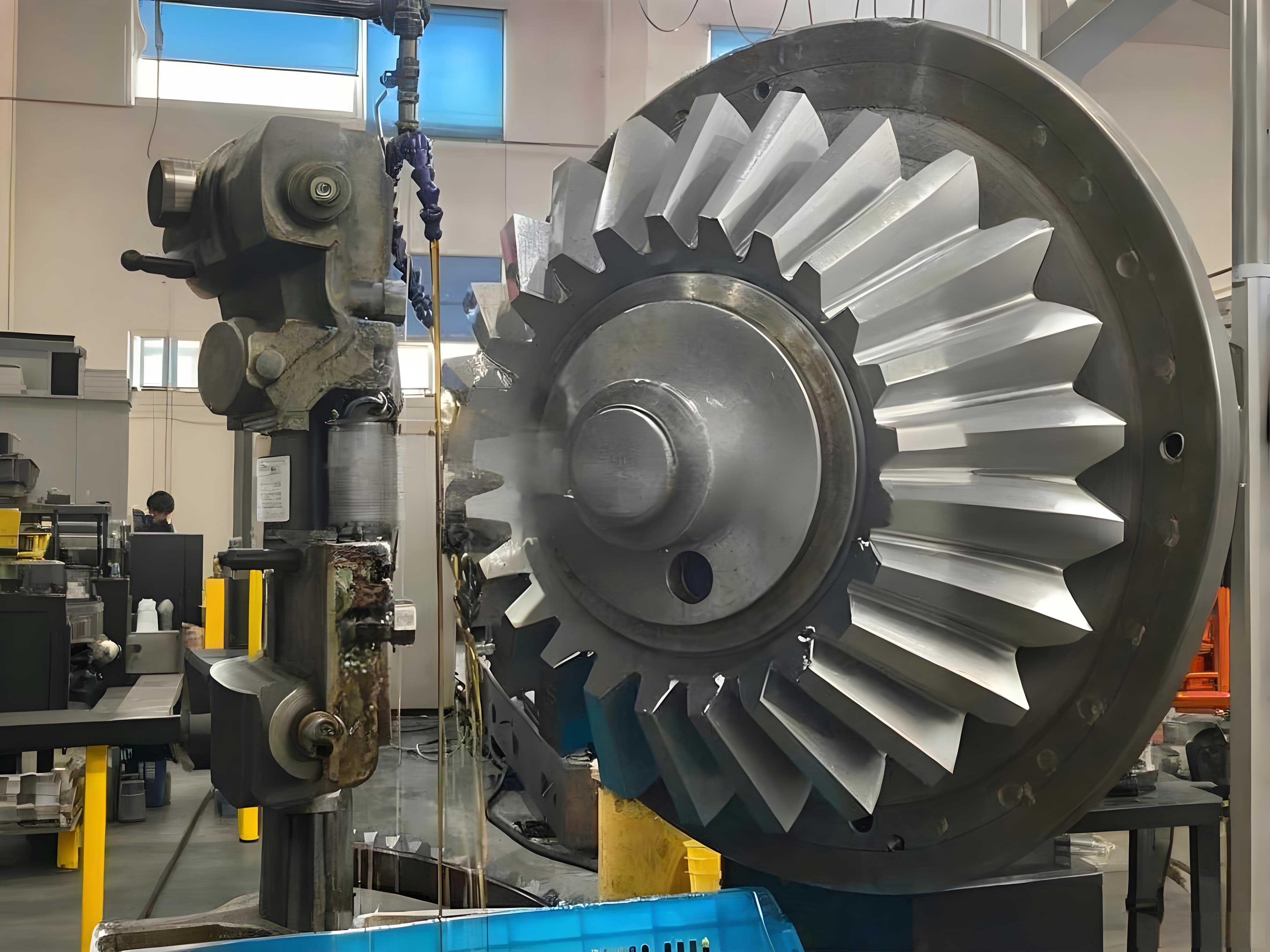
The point cloud data is imported into UG NX, where a surface patch is created through spline interpolation or surface fitting tools. This results in a precise, smooth representation of one flank of a miter gear tooth, as shown conceptually in the following image insert. The visual representation of miter gears helps in understanding their geometry, and for this purpose, an illustrative figure is provided below.
However, a single flank is insufficient for a complete miter gear model. To construct the entire tooth slot, I propose a mirroring method based on the geometric properties of the pitch cone. The key insight is that the tooth thickness at the pitch circle is a controlled design parameter. Given the circular tooth thickness \( L \) at the pitch circle, the corresponding central angle \( N \) (in radians) subtended by this arc can be computed as:
$$ N = \frac{L}{R_p} $$
where \( R_p \) is the pitch radius at the point of interest along the cone. Since the pitch circle lies on the pitch cone, the mirroring should occur about a line on this cone that corresponds to half the tooth thickness. In practice, for each cross-section, the mirror plane is defined by the pitch cone line and the axis of symmetry. For the entire surface patch, I determine the mirroring baseline on the pitch cone by calculating the angular displacement corresponding to the tooth thickness. Let \( S \) be the arc length per degree at the pitch circle: \( S = \frac{2 \pi R_p}{360} \). Then, the angle \( \Delta \gamma \) (in degrees) for the tooth thickness is:
$$ \Delta \gamma = \frac{L}{S} = \frac{L \cdot 360}{2 \pi R_p} $$
By positioning the mirror plane at an angle of \( \Delta \gamma / 2 \) from the initial flank position, I can reflect the single flank to obtain the opposite flank, ensuring the correct tooth slot width. This geometric approach guarantees accuracy without relying on software-specific mirroring tools that might introduce errors. To validate, I also computed the opposite flank point cloud using the same MATLAB program with adjusted parameters and confirmed that it matches the mirrored surface within numerical tolerance. The resulting symmetric flanks for a miter gear tooth are then stitched together in UG NX to form a solid tooth model. Repeating this for all teeth around the gear blank yields the complete miter gear three-dimensional model. The pinion and gear are modeled separately using their respective parameters, and then assembled in a virtual environment with the correct shaft angle (90 degrees for miter gears) and offset.
With the precise digital models of the miter gear pair, I proceeded to conduct a virtual motion simulation in UG NX’s motion analysis module. The assembly constraints define the rotational joints for both gears, and a constant angular velocity is applied to the pinion. The simulation computes the kinematic response of the gear, allowing for the observation of meshing behavior. To visualize the contact pattern, I employed a color-coding technique where the gear teeth are assigned a material that changes color upon contact. As the gears rotate through several cycles, the regions of contact leave a visible imprint, simulating a physical roll test. The resulting virtual roll test pattern shows a distinct contact path on the tooth surfaces, which is crucial for assessing the alignment and load distribution. For miter gears, the contact should ideally be along the middle of the tooth flank, extending from the heel to the toe, consistent with their design for uniform power transmission.
In parallel, I developed a tooth contact analysis (TCA) program specifically for miter gears. TCA is a computational technique that simulates the meshing of gear teeth under loaded or unloaded conditions by solving the geometry of contact. The core of TCA involves finding the points on the two tooth surfaces that satisfy the conditions of continuous tangency and common normal direction. For miter gears, the tooth surfaces are ruled surfaces, meaning they can be generated by a straight line moving along a path. This property simplifies the contact analysis because the contact lines are theoretically straight lines passing through the cone apex. The TCA algorithm iteratively adjusts the relative position of the gears (incorporating possible misalignments) to determine the transmission error and contact ellipse dimensions. The basic equations for TCA are:
$$ \mathbf{r}_1(u_1, v_1) = \mathbf{r}_2(u_2, v_2) $$
$$ \mathbf{n}_1(u_1, v_1) = \mathbf{n}_2(u_2, v_2) $$
where \( \mathbf{r}_1 \) and \( \mathbf{r}_2 \) are the position vectors of the pinion and gear tooth surfaces, respectively, \( \mathbf{n}_1 \) and \( \mathbf{n}_2 \) are their unit normals, and \( u_i, v_i \) are surface parameters. These equations are solved numerically using methods like Newton-Raphson for a series of rotation angles of the pinion. The transmission error \( \Delta \Phi_2 \) is defined as the deviation of the gear’s actual rotation from its theoretical position:
$$ \Delta \Phi_2 = \Phi_2 – \frac{N_1}{N_2} \Phi_1 $$
with \( N_1 \) and \( N_2 \) being the tooth numbers. For miter gears with equal teeth, the ratio is 1, so the transmission error should ideally be zero, but due to geometry and alignment, small errors arise. The contact ellipse at each point is approximated by the second-order surfaces, and its axes are derived from the principal curvatures and relative normal curvature. The results from the TCA program for the sample miter gear pair are summarized in Table 2 and graphically represented.
| Analysis Aspect | Result |
|---|---|
| Transmission Error Curve Shape | Downward-opening parabola, slightly asymmetric |
| Contact Path Orientation | Along the straight line from heel to toe, passing through pitch cone apex |
| Contact Ellipse Major Axis Length | Theoretically infinite (line contact) under ideal conditions |
| Contact Pattern Location | Centered on tooth flank, covering mid-region |
The transmission error curve, plotted as a function of pinion rotation angle, exhibits a parabolic trend, which is characteristic for straight bevel gears like miter gears. The slight asymmetry can be attributed to the non-uniform tooth geometry along the face width. The contact pattern derived from TCA shows a narrow band along the tooth, consistent with the virtual roll test imprint. This agreement validates both the accuracy of the mathematical model and the correctness of the TCA implementation. Importantly, for miter gears, the contact is essentially a line contact due to the ruled surface nature, meaning the contact ellipse’s major axis is extremely long, approximating a line. This aligns with theoretical expectations and ensures stable meshing under light loads.
To further elaborate on the modeling process, let me detail the MATLAB algorithm for point generation. The code loops over the parameters \( \theta \) and \( \phi \), computes the coordinates using the derived surface equations, and checks for boundaries such as the tip and root lines. The point density is controlled to ensure a smooth surface when imported into UG. For instance, I used 100 points along the profile direction and 50 points along the lengthwise direction for each flank. The data export function writes the coordinates in a format readable by UG, typically as a space-separated list. In UG, the points are imported as a cloud, and a free-form surface is created using the “Through Points” command. This surface is then trimmed according to the gear blank geometry to obtain the final flank patch.
The mirroring step is automated within UG by creating a datum plane based on the calculated angle \( \Delta \gamma / 2 \). Since the pitch cone is a conical surface, the mirror plane is tangent to this cone along the pitch line. For miter gears, the pitch cone angle is 45 degrees for each gear (since shaft angle is 90 degrees and teeth are equal), simplifying the geometry. However, in our example with unequal teeth, the angles differ, but the principle remains: the mirror plane passes through the gear axis and is rotated by half the tooth thickness angle from the flank’s reference plane. After mirroring, the two flanks are joined using surface stitching, and the edges are sealed to form a closed body. This body is then subtracted from the gear blank (a conical solid) to create the tooth slot. Pattern circular features are used to replicate the tooth slot around the axis, completing the miter gear model.
For the virtual motion simulation, the assembly environment in UG NX is set up with a fixed coordinate system. The pinion and gear are positioned such that their pitch cones are tangent along the pitch line, and the axes intersect at the prescribed angle. A revolute joint is assigned to each gear, and a motion driver is applied to the pinion joint with a constant angular velocity of, say, 10 rad/s. The simulation runs for a time corresponding to several tooth engagements. The contact detection is enabled using the “3D Contact” option, which calculates forces based on penetration, but for visual pattern analysis, I primarily rely on the geometric interference detection. The color change is achieved by assigning a transparent material that becomes opaque upon contact, leaving a permanent mark. This virtual roll test is a quick and effective way to assess the contact without physical prototyping.
The TCA program, written in a high-level language like Python or MATLAB, implements the numerical solution of the contact equations. I discretize the pinion tooth surface into a grid of points. For each point, I solve for the corresponding gear surface point that satisfies the tangency conditions. This involves a nested iteration: first, for a given pinion point and rotation angle, find the gear rotation angle that brings the surfaces into contact; second, solve for the parameters on the gear surface. The algorithm uses initial guesses based on the conjugate action theory. The output includes the transmission error values and the contact point coordinates, which are then plotted to show the contact path. Additionally, the contact ellipse parameters (major and minor axes, orientation) are computed using the curvature analysis. The results indicate that for miter gears, the contact path is straight and radial, as expected from their geometry.
Comparing the virtual roll test pattern from UG and the TCA-derived contact pattern reveals a high degree of consistency. Both methods show the contact occurring along a narrow band near the center of the tooth flank, with slight variations due to numerical approximations in the simulation versus the analytical nature of TCA. This concordance serves as a strong verification of the entire modeling pipeline. It demonstrates that the precision mathematical model based on planing generation, coupled with the mirroring technique, accurately represents the real geometry of miter gears. Consequently, this model can be confidently used for further analyses, such as finite element analysis for stress evaluation or dynamic simulation for noise prediction.
In conclusion, this work presents a robust methodology for the precision mathematical modeling and tooth contact analysis of miter gears. The key contributions include: (1) deriving the exact tooth surface equations from the planing generation process, ensuring a foundation in manufacturing reality; (2) developing a MATLAB-based point generation and export routine to create accurate surface patches in CAD software; (3) introducing a geometric mirroring method along the pitch cone to construct the complete tooth slot, enhancing modeling accuracy; (4) integrating virtual motion simulation and TCA to validate the model and analyze contact characteristics. The results confirm that the proposed approach yields reliable digital models of miter gears, with contact patterns and transmission errors consistent with theoretical expectations. This framework not only facilitates the design and optimization of miter gears but also provides a basis for extending to other types of bevel gears. Future work could explore the effects of misalignments, load-induced deformations, and advanced surface modifications on the performance of miter gears, leveraging the precise models developed here.
Throughout this article, the term “miter gears” has been emphasized to highlight the specific application, though the methodologies are broadly applicable to straight bevel gears. The use of tables and equations, as shown, helps in summarizing parameters and mathematical relationships, making the content accessible for engineers and researchers. By combining theoretical rigor with practical CAD/CAE tools, this study advances the digital twin concept for gear systems, enabling more efficient and reliable power transmission designs.