
In this paper, I present a detailed methodology for the precision mathematical modeling and tooth contact analysis of straight bevel gears. Straight bevel gears are essential components in mechanical transmission systems, enabling motion transfer between intersecting shafts. However, the tooth profile of a straight bevel gear is a spherical curve, and even minor manufacturing inaccuracies can significantly impact meshing performance, noise, and durability. Therefore, establishing an accurate mathematical model is crucial for analyzing the load capacity, contact patterns, and overall behavior of straight bevel gears. Previous approaches have relied on CAD-based parametric modeling or finite element simulations, but these often introduce errors due to software limitations or conversion issues. My work addresses these challenges by deriving tooth surface equations from the planing process, generating point clouds via MATLAB, creating surface patches in UG, and employing a novel mirroring technique based on geometric principles. I also develop a tooth contact analysis program to simulate meshing under load and validate the results through virtual motion simulations. This comprehensive approach ensures high accuracy and reliability for straight bevel gear design and analysis.
The paper is structured as follows: First, I derive the tooth surface equations using coordinate transformations and啮合 conditions from the planing machine process. Next, I describe the precise modeling method, including point cloud generation, surface patch creation, and mirroring based on the pitch circle. I then discuss the virtual motion simulation of the assembled gear pair in UG. Subsequently, I outline the tooth contact analysis algorithm and present results for transmission error and contact patterns. Finally, I conclude with key findings and implications for future work. Throughout, I emphasize the importance of straight bevel gears in mechanical systems and demonstrate the robustness of my methodology.
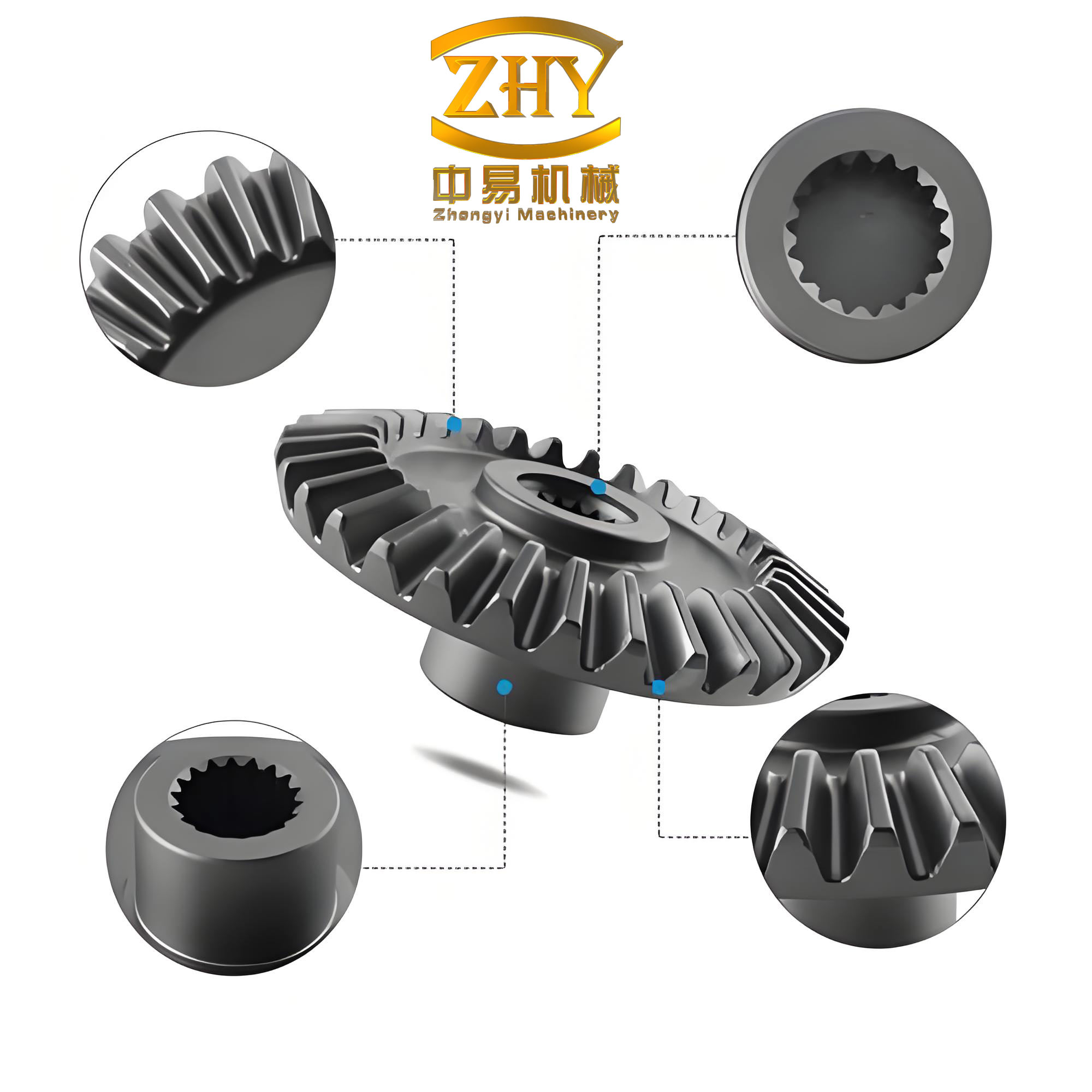
To begin, I establish the mathematical foundation for straight bevel gear tooth surfaces based on the planing process. In a planing machine, the tool—a straight blade—moves along a specific path while the gear blank rotates, generating the tooth profile through a series of coordinated motions. I define a coordinate system where the tool coordinate system (xc, yc, zc) is associated with the blade, and the gear coordinate system (x1, y1, z1) is fixed to the gear blank. Key parameters include the pressure angle α, cradle rotation angle Φg, root angle δf, and gear rotation angle Φ1. The tool edge is represented as a straight line in the xc-direction, and the generating surface lies in the xcoczc plane.
The position vector of a point on the generating surface is given by:
$$ \mathbf{r_c} = \begin{bmatrix} x_c \\ y_c \\ z_c \end{bmatrix} = \begin{bmatrix} u \\ v \cos\alpha \\ v \sin\alpha \end{bmatrix} $$
where u and v are parameters defining the tool surface. The normal vector to this surface is derived from the cross product of partial derivatives:
$$ \mathbf{n_c} = \frac{\partial \mathbf{r_c}}{\partial u} \times \frac{\partial \mathbf{r_c}}{\partial v} = \begin{bmatrix} 0 \\ -\sin\alpha \\ \cos\alpha \end{bmatrix} $$
The啮合 equation, which ensures continuous contact between the tool and gear tooth surface, is expressed as:
$$ \mathbf{n_c} \cdot \mathbf{v_c}^{(12)} = 0 $$
where \(\mathbf{v_c}^{(12)}\) is the relative velocity vector between the tool and gear in the tool coordinate system. Using coordinate transformations, I relate the tool system to the gear system through a transformation matrix \(\mathbf{M}_{1c}\). This matrix incorporates rotations and translations based on machine settings. For a standard setup with zero corrections, the transformation involves rotations around the z and y axes:
$$ \mathbf{M}_{1c} = \mathbf{T} \cdot \mathbf{R}_z(\Phi_g) \cdot \mathbf{R}_y(\delta_f) $$
where \(\mathbf{T}\) is the translation matrix, and \(\mathbf{R}_z\) and \(\mathbf{R}_y\) are rotation matrices defined as:
$$ \mathbf{R}_z(\theta) = \begin{bmatrix} \cos\theta & -\sin\theta & 0 \\ \sin\theta & \cos\theta & 0 \\ 0 & 0 & 1 \end{bmatrix}, \quad \mathbf{R}_y(\theta) = \begin{bmatrix} \cos\theta & 0 & \sin\theta \\ 0 & 1 & 0 \\ -\sin\theta & 0 & \cos\theta \end{bmatrix} $$
The translation vector is typically [0, 0, R] for standard settings, where R is the pitch cone distance. Solving the啮合 equation yields the tooth surface in the gear coordinate system:
$$ \mathbf{r_1} = \mathbf{M}_{1c} \mathbf{r_c} $$
Expanding this, the parametric equations for the straight bevel gear tooth surface are:
$$ x_1 = R \sin\delta \cos\phi + u \cos\phi – v \sin\alpha \sin\phi $$
$$ y_1 = R \sin\delta \sin\phi + u \sin\phi + v \sin\alpha \cos\phi $$
$$ z_1 = R \cos\delta – v \cos\alpha $$
where δ is the pitch angle and φ is the rotation angle of the gear. These equations form the basis for generating the tooth surface point cloud.
For precise modeling, I implement these equations in MATLAB to compute a dense point cloud representing one side of the tooth surface. The input parameters for the gear pair are listed in Table 1, which includes key geometric dimensions for both the pinion and gear. These parameters are essential for ensuring accurate modeling and analysis of straight bevel gears.
| Parameter | Pinion | Gear |
|---|---|---|
| Number of Teeth | 25 | 30 |
| Addendum (mm) | 2.5 | 2.5 |
| Dedendum (mm) | 3.0 | 3.0 |
| Outer Cone Distance (mm) | 48.81 | 48.81 |
| Face Width (mm) | 14.64 | 14.64 |
| Pitch Angle (rad) | 0.69 | 0.88 |
| Tip Angle (rad) | 0.76 | 0.94 |
| Root Angle (rad) | 0.63 | 0.81 |
| Circular Tooth Thickness (mm) | 3.93 | 3.93 |
| Pitch Diameter (mm) | 62.50 | 75.00 |
The MATLAB program outputs a DAT file containing coordinates of points on the tooth surface. This file is imported into UG, where I use the “Points from File” function to create a point set. Then, I generate a spline through these points and apply the “Through Curves” feature to form a surface patch. This patch represents one side of the tooth for the straight bevel gear. To create the complete tooth, I propose a mirroring method based on the pitch circle geometry. The mirroring relies on calculating the angular position corresponding to the tooth thickness on the pitch circle.
The circular tooth thickness L is given by:
$$ L = \frac{\pi m}{2} $$
where m is the module. The angle N (in radians) subtended by the tooth thickness on the pitch circle is:
$$ N = \frac{L}{R} $$
where R is the pitch radius. For the pinion, R = 31.25 mm, and L = 3.93 mm, so:
$$ N = \frac{3.93}{31.25} \approx 0.1258 \text{ radians} $$
Converting to degrees:
$$ N_{\text{deg}} = \frac{180}{\pi} \cdot N \approx 7.21^\circ $$
This angle defines the mirror plane orientation. In UG, I select a reference line on the pitch cone at this angle and use the “Mirror Body” tool to create the opposite tooth surface. The mirrored surface is verified by comparing it with a point cloud generated from MATLAB for the complementary side, ensuring accuracy. Once both sides are created, I缝合 the surfaces using the “Sew” command to form a solid tooth. This process is repeated for all teeth, and the gear body is extruded to complete the straight bevel gear model. Similarly, the gear model is constructed using the same parameters.
After modeling both gears, I assemble them in UG with proper alignment. The assembly involves positioning the pinion and gear such that their pitch cones are tangent and the axes intersect at the correct angle. I then proceed to virtual motion simulation within UG’s motion analysis module. Here, I define rotational joints for both gears and a contact constraint between the tooth surfaces. The simulation is set up with the pinion as the driver rotating at a constant speed, and the gear as the follower. Running the simulation allows me to observe the meshing behavior and identify the contact pattern on the tooth surfaces.
By adjusting the display properties, such as color modulation, I visualize the contact印痕 during motion. The results show a distinct contact pattern along the tooth face, which aligns with theoretical expectations for straight bevel gears. This virtual滚检 serves as an initial validation of the model’s accuracy and the effectiveness of the mirroring method for straight bevel gears.
To further analyze the meshing performance, I develop a tooth contact analysis program in MATLAB. TCA is critical for predicting contact patterns, transmission errors, and potential issues under load. The algorithm involves discretizing the pinion rotation into small increments and solving the啮合 equations for each position to find contact points. The fundamental啮合 equation in the gear coordinate system is:
$$ \mathbf{n}_1 \cdot \mathbf{v}_{12} = 0 $$
where \(\mathbf{n}_1\) is the normal vector on the pinion tooth surface, and \(\mathbf{v}_{12}\) is the relative velocity vector between the pinion and gear. The transmission error, which quantifies deviations from ideal motion transfer, is defined as:
$$ \Delta \phi_2 = \phi_2 – \frac{N_1}{N_2} \phi_1 $$
where \(N_1\) and \(N_2\) are the tooth numbers, and \(\phi_1\) and \(\phi_2\) are the rotation angles of the pinion and gear, respectively.
For straight bevel gears, the tooth surface is a ruled surface, meaning that the contact lines pass through the cone apex. Under load, the contact ellipse tends to have a large major axis along these contact lines. My TCA program computes the contact points iteratively using the Newton-Raphson method for numerical solution of the nonlinear equations. The Jacobian matrix is employed to ensure convergence. The output includes the transmission error curve and a plot of contact points on the tooth surface, representing the contact pattern.
The results from TCA show a parabolic transmission error curve with slight asymmetry, indicative of the inherent characteristics of straight bevel gears. The contact ellipses exhibit long major axes along the contact lines, consistent with theoretical predictions. Comparing these results with the virtual滚检 from UG, I observe a strong correlation in the contact patterns, validating the accuracy of both the model and the TCA program. This consistency underscores the reliability of my approach for straight bevel gear analysis.
In conclusion, I have demonstrated a robust methodology for precision mathematical modeling and tooth contact analysis of straight bevel gears. The key achievements include deriving accurate tooth surface equations, developing a MATLAB-based point cloud generator, implementing a geometric mirroring technique in UG, and creating a reliable TCA program. The validation through virtual motion simulations and TCA results confirms the method’s effectiveness. This work provides a foundation for optimizing straight bevel gear designs, reducing noise and wear, and enhancing overall transmission performance. Future research could extend this approach to spiral bevel gears or incorporate thermal and dynamic effects for more comprehensive analysis.
Throughout this study, the focus on straight bevel gears has highlighted their importance in mechanical systems and the need for precise modeling techniques. The integration of mathematical derivations, software tools, and validation methods ensures that the proposed approach is both practical and accurate, offering valuable insights for engineers and researchers working with straight bevel gears.