
In the demanding realm of aerospace engineering, the performance and reliability of every component are non-negotiable. Among these, the cylindrical gear stands as a foundational element within transmission systems, responsible for the precise, stable, and efficient transfer of power and motion under extreme conditions of speed, load, and environmental stress. The seamless operation of these systems is fundamentally contingent upon the geometrical and surface integrity of each individual cylindrical gear. Therefore, establishing a rigorous, scientifically grounded, and practically effective framework for the precision measurement and subsequent quality control of these components is paramount. This article delves into the core precision characteristics of aerospace-grade cylindrical gears, outlines comprehensive measurement methodologies, analyzes prevalent error sources, and proposes a holistic quality control strategy built upon precise measurement feedback.
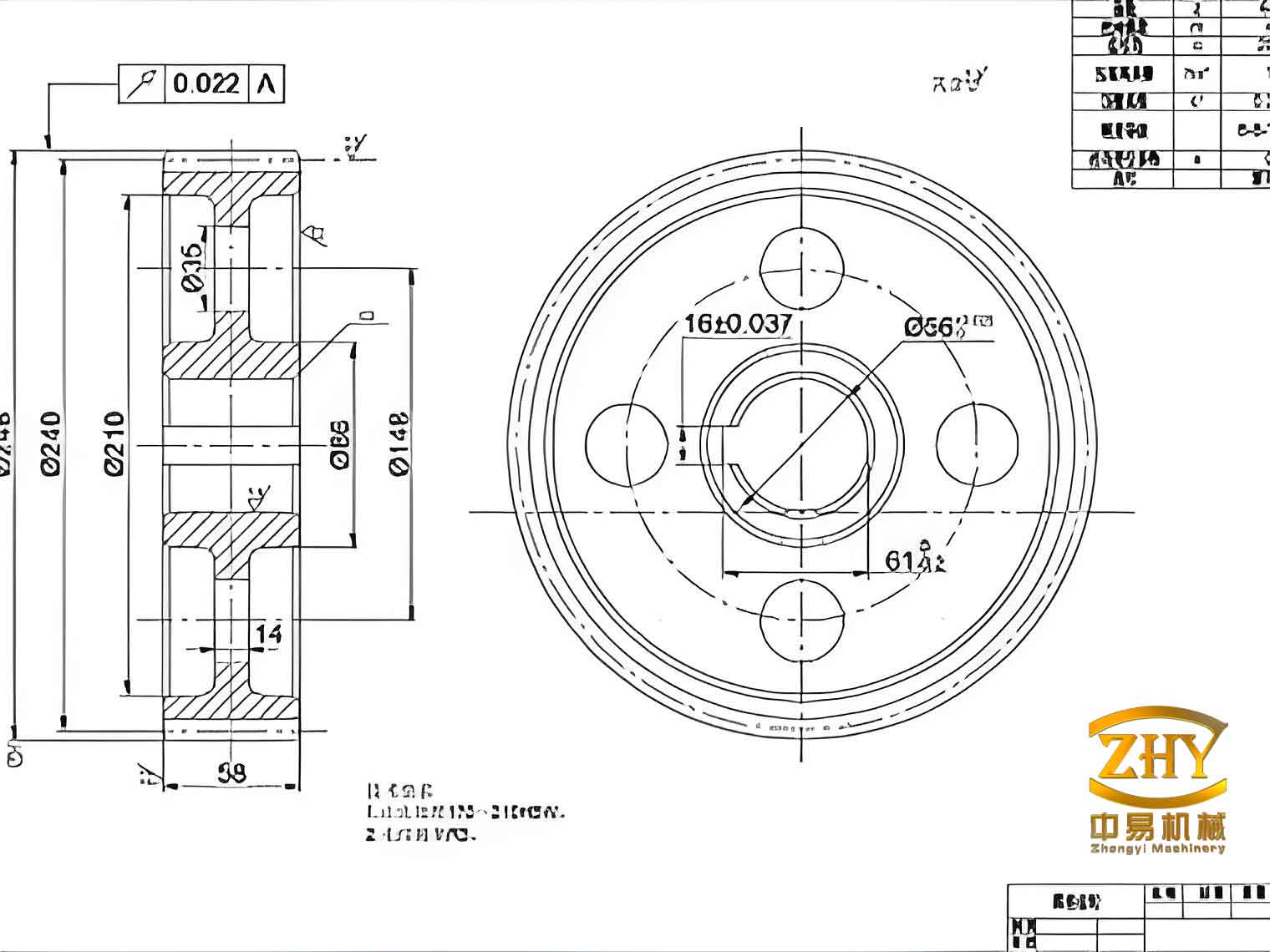
The manufacturing journey of a high-performance cylindrical gear is a multi-stage symphony of advanced processes. It typically begins with a forged blank made from high-quality alloy carburizing steel, chosen for its ability to develop a hard, wear-resistant case while maintaining a tough, shock-absorbing core. Initial tooth generation is performed via precision hobbing or shaping processes. The critical transformation occurs during subsequent carburizing and quenching heat treatments, which impart the necessary surface hardness and fatigue resistance. The final, and most critical, stage is precision grinding. This post-heat-treatment process is essential for correcting distortions and achieving the micro-geometrical accuracies required for silent, efficient, and durable operation. The target for such aerospace cylindrical gears is typically Grade 6 or better as per standards like GB/T 10095.1-2022 (aligned with ISO 1328-1). For a cylindrical gear with a module of 3 mm, this translates to demanding tolerances: profile and helix form errors often held within 8 µm, radial runout between 20-40 µm, and variations in base tangent length (span measurement) controlled within 10 µm, all coupled with superior surface finishes in the range of Ra 0.4 to 0.8 µm.
While gear standards enumerate numerous individual tolerance items, the functional performance of a cylindrical gear in service can be effectively evaluated and controlled through four cornerstone characteristics derived from precision measurement. These characteristics directly map to the gear’s operational behavior: motion accuracy, smoothness of transmission, contact quality, and proper meshing clearance.
Core Precision Characteristics and Their Evaluation Framework
The quality of a cylindrical gear is not a monolithic attribute but a composite of interdependent characteristics. The following table summarizes the primary precision aspects, their functional implications, and the key measurement parameters used for their control.
| Precision Characteristic | Functional Significance | Primary Evaluation Metrics | Critical Influence on Performance |
|---|---|---|---|
| Motion Accuracy (Single Revolution) | Ensures the angular position of the driven gear accurately follows the driver over one full revolution. Related to the uniformity of tooth spacing and alignment relative to the axis of rotation. | Radial Composite Deviation (Fi”), Radial Runout (Fr), Span Measurement Variation (ΔFw) | Directly impacts positional accuracy in servo systems and can cause low-frequency vibration (once-per-revolution errors). |
| Transmission Smoothness (Tooth-to-Tooth) | Governs the uniformity of instantaneous angular velocity ratio during meshing. Determines noise levels, vibration, and dynamic loads. | Tooth-to-Tooth Composite Error (fi”), Profile Form Error (ffα), Adjacent Pitch Error (Δfpt), Base Pitch Deviation (Δfpb) | Errors cause high-frequency excitation, leading to noise, increased dynamic stresses, and accelerated wear. |
| Contact Pattern & Load Distribution | Ensures the theoretical line contact along the tooth flank is achieved in practice, allowing for uniform stress distribution. | Helix Form Error (ffβ), Lead Angle Error, Surface Finish (Ra, Rz) | Poor contact leads to localized stress concentrations (edge loading), reduced load capacity, pitting, and scuffing. |
| Meshing Clearance (Backlash) | Provides necessary space between non-working flanks to accommodate thermal expansion, lubricant film, and prevent binding. | Tooth Thickness (Sn, Sv), Measurement Over Pins/Balls (M), Span Measurement (Wk) | Insufficient backlash causes overheating and seizure; excessive backlash leads to impact loads, noise, and loss of positional accuracy. |
1. Transmission Smoothness: The Role of Tooth-to-Tooth Accuracy
The smoothness of a cylindrical gear pair is predominantly governed by errors that manifest during the engagement of a single tooth pair. The primary contributors are the profile form error and the base pitch deviation between adjacent teeth. For a cylindrical gear to mesh smoothly, the base pitch of the gear must equal that of its mating counterpart. Any deviation disrupts the transition from one tooth pair to the next, creating an impulse. The theoretical base pitch, $$ P_b $$, is calculated from the basic gear parameters:
$$ P_b = \pi m \cos \alpha $$
where \( m \) is the module and \( \alpha \) is the standard pressure angle. A deviation in the actual pressure angle or local profile errors directly translates to a change in \( P_b \). In a high-precision cylindrical gear, monitoring the base pitch variation across all teeth using a base pitch comparator is a highly effective shop-floor method for assessing smoothness. The measured deviation \( \Delta f_{pb} \) must be minimized. Furthermore, the profile form error \( f_{f\alpha} \), measured on a gear analyzer, reveals imperfections in the involute shape that cause variations in the contact point’s velocity, again generating vibration. It is crucial to note that for optimal performance, the profile should often be intentionally modified (tip and root relief) to compensate for deflections under load, meaning a “perfect” theoretical involute is not always the target; rather, a controlled, optimized deviation is sought.
2. Motion Accuracy: Evaluating Single Revolution Errors
This characteristic assesses the cylindrical gear’s ability to maintain accurate angular positioning over one full rotation. The primary measure is the radial runout \( F_r \), which is the total variation in the distance from a datum axis to a probe contacting the tooth flanks (or a master ball placed between teeth) as the gear is rotated. This runout is a composite error stemming from eccentricity in the mounting bore relative to the tooth geometry, cumulative pitch errors, and other low-frequency geometrical imperfections. A significant \( F_r \) will cause a once-per-revolution fluctuation in the output speed of a gear pair. Another practical and sensitive indicator is the total variation \( \Delta F_w \) in the span measurement (base tangent length, \( W_k \)) taken over different starting positions around the cylindrical gear. The span measurement is sensitive to tooth spacing errors and is calculated for a cylindrical gear with no profile shift as:
$$ W_k = m \cos \alpha [\pi (k – 0.5) + z \cdot \text{inv} \alpha] $$
where \( k \) is the number of teeth spanned and \( z \) is the number of teeth. A large \( \Delta F_w \) directly indicates poor uniformity in tooth spacing, impacting motion accuracy.
3. Contact Pattern and Load Distribution: The Imperative of Helix Accuracy
For a parallel-axis cylindrical gear pair, the theoretical contact is a straight line parallel to the axis. In practice, deviations from this ideal line contact drastically reduce the effective load-bearing area, leading to premature failure. The helix form error \( f_{f\beta} \) is the critical parameter here. It represents the deviation of the actual tooth trace from the theoretical lead line across the usable face width. Errors can be in the form of a slope error (incorrect helix angle), a bow, or other complex shapes. Measuring \( f_{f\beta} \) requires a precision gear analyzer capable of relative motion between the probe and the cylindrical gear along its axis. The goal is to achieve a helix form that, when mated with its counterpart under load, yields a contact patch centered on the tooth flank and extending across a high percentage of the face width. Surface finish, characterized by parameters like \( R_a \) (arithmetical mean roughness) and \( R_z \) (mean roughness depth), is equally critical. A rough surface on a cylindrical gear inhibits the formation of a full elastohydrodynamic lubrication film, leading to increased friction, heat generation, and microwelding (scuffing).
4. Meshing Clearance: Controlling Tooth Thickness
Backlash, the play between mating tooth flanks, is a necessary evil in cylindrical gear design. It is controlled primarily by the tooth thickness. Direct measurement of tooth thickness on a finished cylindrical gear is challenging; therefore, indirect methods are universally employed. The two most common are the span measurement (\( W_k \)) and the measurement over pins or balls (\( M \)). For a cylindrical gear, the measurement over two pins placed in opposite tooth spaces is given by:
For even number of teeth: $$ M_{even} = \frac{d_b}{\cos \alpha_{Mt}} + d_p $$
For odd number of teeth: $$ M_{odd} = \frac{d_b}{\cos \alpha_{Mt}} \cos\left(\frac{90^\circ}{z}\right) + d_p $$
where \( d_b \) is the base diameter, \( d_p \) is the pin diameter, and \( \alpha_{Mt} \) is the pressure angle at the pin center. The measured value \( M \) is then compared to a theoretical value calculated from the nominal tooth thickness. Controlling the mean value ensures proper center distance assembly, while controlling its variation (linked to \( \Delta F_w \)) ensures consistent backlash across all tooth pairs.
Precision Measurement Techniques and Error Source Analysis
The accurate assessment of a cylindrical gear’s geometry hinges on selecting the appropriate measurement technology and meticulously understanding and controlling potential error sources within the measurement loop itself. The following table catalogs common measurement items for a cylindrical gear, their primary influencing factors, and recommended mitigation strategies.
| Measurement Item | Typical Instrument | Key Potential Error Sources | Control & Mitigation Measures |
|---|---|---|---|
| Profile Form (ffα) | Computerized Gear Analyzer | Probe alignment error, machine slide straightness/calibration error, datum axis establishment (centering/tilting of gear), thermal drift. | Regular master gear calibration, meticulous part alignment procedure (e.g., using journal diameters for axis establishment), stable thermal environment (±2°C from 20°C ideal). |
| Helix Form (ffβ) | Computerized Gear Analyzer | Same as profile, plus alignment of gear axis relative to instrument traverse direction. Probe skid or stylus deflection on rough surfaces. | Use of precision alignment mandrels, verification with helix master, appropriate probe tip selection and force setting. |
| Base Pitch (Δfpb) | Base Pitch Comparator / Gear Analyzer | Calibration master accuracy, probe repeatability, dirt/debris on flanks, operator feel for manual comparators. | Use a master gear of identical/similar tooth count for comparator setting. Automated measurement preferred. Ensure clean, dry tooth flanks. |
| Radial Runout (Fr) | Runout Tester with precision centers or arbor | Eccentricity or damage of mounting arbor/mandrel, dirt on gear bore or arbor, incorrect clamping force, bearing play in tester. | Use high-precision, certified arbors. Clean all mounting surfaces. Verify arbor runout before mounting gear. Use consistent, gentle clamping. |
| Span Measurement (Wk) | Micrometer with Disc Anvils or Gear Tooth Micrometer | Parallax error in reading, anvil pressure/deflection, anvil not seating properly on flank (contact point error), thermal expansion of micrometer and gear. | Proper anvil selection for pressure angle. Use consistent, light “feel”. Measure in a controlled temperature environment. Employ ratchet stop or friction thimble. |
| Measurement Over Pins (M) | Micrometer / Precision Caliper with Pins | Pin diameter tolerance and roundness, pin alignment (parallelism), measuring force, calculation errors for odd/even teeth. | Use calibrated, high-precision pin sets. Ensure pins are seated against both flanks. Use calculated values from actual pin diameter. |
A critical, often overlooked, aspect of measuring a cylindrical gear is the environmental and human factor. The standard reference temperature for dimensional metrology is 20°C (68°F). Significant deviation from this temperature, or temperature gradients, will cause the cylindrical gear, the measuring instrument, and the masters to expand or contract at different rates based on their coefficients of thermal expansion (CTE), introducing significant error. For example, the change in span measurement \( \Delta W_k \) due to a temperature change \( \Delta T \) can be approximated by:
$$ \Delta W_k \approx W_k \cdot \alpha_{gear} \cdot \Delta T $$
where \( \alpha_{gear} \) is the CTE of the gear material. A 5°C deviation for a steel cylindrical gear with a 50 mm span can induce an error of nearly 3 µm, which is a substantial portion of the total tolerance. Therefore, controlling the laboratory or inspection area temperature and allowing for adequate soak time is essential.
Integrating Measurement into a Proactive Quality Control Strategy
Precision measurement should not be merely a final pass/fail gate. For high-value components like an aerospace cylindrical gear, it must be an integrated, feedback-driven process that actively controls the manufacturing cycle. This strategy involves several key phases.
Phase 1: First-Article Validation & Process Capability Study. The first cylindrical gear produced from a new setup or batch undergoes a full, exhaustive inspection. All critical parameters—profile, helix, runout, pitch, thickness—are measured. This data serves two purposes: 1) to verify the part meets print specifications, and 2) more importantly, to establish the initial process capability (Cp, Cpk). The shape of the profile and helix charts provides immediate diagnostic feedback to the grinder operator. For instance, a periodic error on the profile might indicate an issue with the grinding worm or wheel dressing system, while a consistent slope error on the helix suggests a need for machine axis adjustment.
Phase 2: In-Process Monitoring with Key Characteristics. Performing a full gear analysis on every cylindrical gear is time-prohibitive. Therefore, a subset of quickly measurable “indicator” characteristics is monitored on a statistical sampling basis. The most effective indicators for a cylindrical gear are often:
- Base Pitch Variation (Δfpb): A sensitive indicator of machine stability and wheel condition. A sudden increase in variation signals wheel wear, dulling, or machine vibration.
- Span Measurement Variation (ΔFw): Monitors tooth spacing consistency. A trend outside control limits suggests issues with the index mechanism of the grinding machine.
- Tooth Flank Roughness: A tactile or quick visual check (aided by comparison samples) can catch issues with wheel grit, dressing, or coolant before they affect an entire batch.
Control charts (X-bar & R charts) are maintained for these parameters. The detection of an out-of-control condition triggers an alert for machine maintenance or wheel re-dressing before non-conforming parts are produced.
Phase 3: Correlation of Measurement Data with Functional Performance. The ultimate goal is to predict the in-service performance of the cylindrical gear from its measured geometry. Advanced analysis involves creating a “measured tooth model” from the inspection data (a digital twin of the physical gear) and running it through gear contact analysis (GCA) or loaded tooth contact analysis (LTCA) software in virtual mesh with its mate. This simulation can predict transmission error (a direct source of vibration and noise), contact stress distribution, and load sharing. This allows for a truly functional acceptance criterion beyond simple tolerance checks, and can guide selective assembly—matching gears with complementary error patterns to optimize pair performance.
Advanced Considerations for Ultra-Precision Cylindrical Gears
For the most critical aerospace applications, the control paradigm extends beyond macro-geometry. The surface and subsurface integrity of the cylindrical gear tooth flank become dominant factors in fatigue life.
Residual Stress: The grinding process can induce detrimental tensile residual stresses at the surface, which dramatically reduce bending fatigue and contact fatigue (pitting) resistance. Measurement techniques like X-ray diffraction are used to map subsurface residual stress profiles. The goal is to achieve a deep layer of beneficial compressive stress.
Microgeometry & Topography: The directionality and morphology of grinding marks (lay) influence lubricant retention and wear. Parameters like reduced peak height (Rpk) and reduced valley depth (Rvk) from the Abbott-Firestone curve provide more functional information than Ra alone. Honing or superfinishing processes are often applied to a cylindrical gear to create an optimal, isotropic plateau-honed surface texture.
Metallurgical Integrity: Non-destructive testing (NDT) is integral. Magnetic particle inspection (MPI) or fluorescent penetrant inspection (FPI) is mandatory to detect grinding burns (untempered martensite) or micro-cracks. Etching techniques (nital etching) are used to reveal any white etching layers or rehardened zones caused by excessive grinding heat, which are brittle and prone to spalling.
The pursuit of quality for a cylindrical gear in this context is a multi-disciplinary effort, uniting metrology, manufacturing engineering, materials science, and tribology. The precision measurement data forms the foundational dataset that informs decisions across all these domains.
Conclusion: Towards a Data-Driven, Closed-Loop Ecosystem
The精密 measurement of a cylindrical gear is the cornerstone of assured quality in high-performance transmissions. By focusing on the four cardinal characteristics—tooth-to-tooth smoothness, single-revolution accuracy, contact pattern quality, and controlled meshing clearance—and employing a disciplined, error-aware measurement regimen, manufacturers can move from simple conformity checking to true process understanding and control. The integration of shop-floor monitoring of key indicators with periodic full-gear analysis and advanced functional simulation creates a robust, closed-loop quality system. This system not only screens out non-conforming cylindrical gears but, more importantly, provides the diagnostic feedback necessary to correct and optimize the manufacturing process itself. This proactive, data-driven approach is essential for achieving the levels of reliability, efficiency, and longevity demanded by modern aerospace and other advanced industries, ultimately reducing lifecycle costs and fostering a true culture of精益 manufacturing excellence. The continuous evolution of measurement technologies, such as high-speed optical scanning and in-process monitoring sensors, promises to further tighten this feedback loop, pushing the boundaries of what is possible in cylindrical gear performance and quality control.