
In the field of power transmission, hypoid gears play a critical role due to their ability to facilitate crossed-axis drives with high torque capacity, smooth operation, and reduced noise. These gears are extensively used in automotive rear axles and heavy-duty machinery where efficient and reliable cross-shaft transmission is required. However, the complex geometry of hypoid gear tooth surfaces, characterized by non-linear curvatures and asymmetrical profiles, presents significant challenges in manufacturing and quality control. Traditional machining processes, such as those on Gleason machines or CNC milling systems, rely on calculated coordinate points for multi-point cutting, but inaccuracies in computation, machine tool positioning errors, tool wear, and lack of precise kinematic analysis often result in suboptimal meshing conditions and poor interchangeability. Achieving a large contact area between mating gears is essential for enhancing load-bearing capacity, yet this typically necessitates iterative adjustments of machine settings based on contact pattern inspections, a time-consuming and experience-dependent process. To address these limitations, I propose a novel measurement-based methodology for determining the actual machining parameters of hypoid gears using a coordinate measuring machine (CMM). This approach not only enables the production of gears with excellent meshing characteristics but also promotes interchangeability across different machine tools, thereby eliminating the need for tedious trial-and-error adjustments.
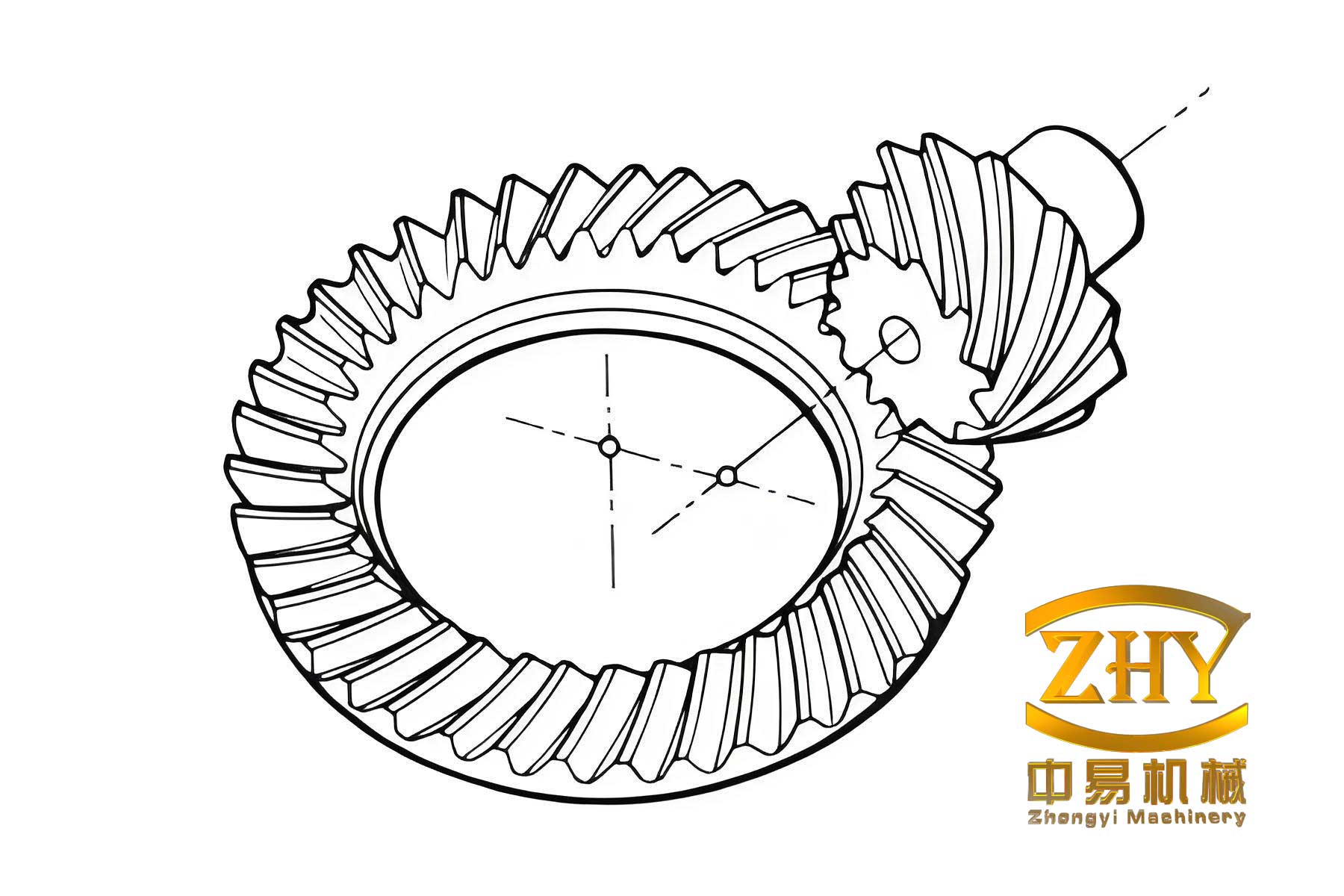
The core of this methodology lies in establishing a mathematical model of the cutter blade surface and the hypoid gear tooth surface, followed by multi-point measurement on the gear tooth using a three-dimensional coordinate measuring machine. By applying least-squares analysis to the measured coordinate data, I can derive the actual machine setting parameters that correspond to the real tooth surface geometry. These parameters can then be used to machine hypoid gears on one or multiple machines, ensuring consistent and high-quality meshing with their mating gears. This article delves into the theoretical foundations, experimental procedures, and practical applications of this measurement method, emphasizing its potential to revolutionize the manufacturing of hypoid gears. Throughout this discussion, the term “hypoid gears” will be frequently referenced to underscore their significance in advanced gear systems.
To begin, let us consider the mathematical representation of the cutter blade surface used in machining hypoid gears. In a typical duplex cutting process for hypoid gears, both the convex and concave tooth flanks are simultaneously generated using a dual-blade cutter. The cutter coordinate system is defined as \( O_c – x_c y_c z_c \), where \( z_c \) is the cutter axis. The cutter blade surface can be parameterized using two variables: \( u_g \), the rotation angle of the cutter blade around the \( z_c \)-axis relative to the \( y_c \)-axis, and \( v_g \), the length along the cutting edge. Key cutter parameters include the cutter diameter \( 2R_g \), the tip width \( W_g \), and the inclination angles of the inner and outer cutting edges, denoted as \( \gamma_{2g} \) and \( \gamma’_{1g} \), respectively. For the convex surface \( X_{gc} \) and the concave surface \( X’_{gc} \), the position vectors and unit normal vectors can be expressed as follows:
For the convex surface:
$$ X_{gc}(u_g, v_g) = \begin{bmatrix} -(-v_g \sin \gamma_{2g} + R_g – W_g/2) \sin u_g \\ (-v_g \sin \gamma_{2g} + R_g – W_g/2) \cos u_g \\ -v_g \cos \gamma_{2g} \end{bmatrix}, $$
with the unit normal vector \( N_{gc} \).
For the concave surface:
$$ X’_{gc}(u’_g, v’_g) = \begin{bmatrix} -(-v’_g \sin \gamma’_{1g} + R_g – W_g/2) \sin u’_g \\ (v’_g \sin \gamma’_{1g} + R_g + W_g/2) \cos u’_g \\ -v’_g \cos \gamma’_{1g} \end{bmatrix}, $$
with the unit normal vector \( N’_{gc} \).
These equations form the basis for modeling the cutter’s interaction with the gear blank during machining. The accurate representation of the cutter geometry is paramount for subsequent analysis of the hypoid gear tooth surface.
Next, the tooth surface of the hypoid gear, specifically the盆齿轮 (bevel gear) in a hypoid pair, must be mathematically described in relation to the machine tool settings. The machine coordinate system is established as \( O_m – x_m y_m z_m \), where \( O_m \) is the machine center. The cutter axis \( z_c \) is parallel to the machine axis \( z_m \), and the cutter center \( O_c \) is located by the vector \( D_g(V_g, H_g, Z_g) \) in the machine coordinates. The盆齿轮 coordinate system \( O_g – x_g y_g z_g \) is aligned with \( O_m – x_m y_m z_m \). The盆齿轮 tooth surfaces, denoted as \( X_g \) and \( X’_g \) for convex and concave flanks, respectively, are derived by applying coordinate transformations that account for the gear root angle \( \lambda_{gr} \) and machine movements. The transformation involves rotation matrices: \( A(\theta) \) for rotation around the \( x_m \)-axis and \( C(\psi) \) for rotation around the \( z_m \)-axis. Thus, the tooth surfaces in the machine coordinate system are:
$$ X_g(u_g, v_g) = A^{-1}(\lambda_{gr} + \pi/2) [X_{gc}(u_g, v_g) + D_g], $$
$$ X’_g(u’_g, v’_g) = A^{-1}(\lambda_{gr} + \pi/2) [X’_{gc}(u’_g, v’_g) + D_g]. $$
To relate this to measurements, we define a measurement coordinate system \( O_t – x_t y_t z_t \) for the CMM. The盆齿轮 is positioned such that its axis \( z_g \) coincides with \( z_t \), but the orientation of \( x_g \) relative to \( x_t \) is unknown, represented by an angle \( \Psi \). The tooth surfaces in the CMM coordinate system are then:
$$ X(u_g, v_g; \Psi) = C(\Psi) X_g(u_g, v_g), $$
$$ X'(u’_g, v’_g; \Psi) = C(\Psi) X’_g(u’_g, v’_g). $$
When measuring the hypoid gear tooth surface with a CMM using a spherical probe of radius \( r_0 \), the probe center position \( P \) is related to the tooth surface point \( X \) and its unit normal vector \( N \) by:
$$ P = X + r_0 N. $$
The CMM provides the measured coordinates of the probe center, denoted as \( M \) in the Cartesian system \( O_t – x_t y_t z_t \). Converting \( M \) and \( P \) to cylindrical coordinates \( (M_r, M_\theta, M_z) \) and \( (P_r, P_\theta, P_z) \), we note that \( P_r \) and \( P_z \) are independent of \( \Psi \), while \( P_\theta \) depends on \( \Psi \) and the machining parameters. The machining parameters, including tool geometry and machine settings, are embedded in the parameters \( u_g \) and \( v_g \), which can be expressed as functions of constants \( C_1, C_2, \dots, C_n \) representing deviations or errors. Thus, we have:
$$ P_r = P_r(u_g, v_g; \Psi, C_1, C_2, \dots, C_n), $$
$$ P_\theta = P_\theta(u_g, v_g; \Psi, C_1, C_2, \dots, C_n), $$
$$ P_z = P_z(u_g, v_g; \Psi, C_1, C_2, \dots, C_n). $$
By setting \( M_r = P_r \) and \( M_z = P_z \), we can solve for \( u_g \) and \( v_g \) in terms of \( C_1, C_2, \dots, C_n \). Substituting these into \( P_\theta \) yields \( P_\theta = P_\theta(\Psi, C_1, C_2, \dots, C_n) \). The residual error \( E \) between the measured and computed angular coordinates is:
$$ E(\Psi, C_1, C_2, \dots, C_n) = M_\theta – P_\theta(\Psi, C_1, C_2, \dots, C_n). $$
For multiple measurement points \( i = 1, 2, \dots, m \) on the hypoid gear tooth surface, we apply the least-squares method to minimize the sum of squared residuals:
$$ \min \sum_{i=1}^m E_i^2. $$
Given that the parameters \( C_1, C_2, \dots, C_n \) are small and linearly independent, we can iteratively solve for each pair \( (C_j, \Psi_j) \) to find the set that best fits the measurement data. The accuracy of fit is evaluated by the conformity precision \( \Delta_t \), defined as the root-mean-square error. This process allows us to determine the actual machining parameters that produced the measured hypoid gear tooth surface.
To illustrate this methodology, I conducted an experiment on a hypoid盆齿轮 with the following specifications: number of teeth = 45, module = 3.67 mm, outer diameter = 138.32 mm, outer cone distance = 83.81 mm, pitch cone angle = 79°47′, face cone angle = 80°39′, spiral angle = 33°06′, and face width = 24 mm. The machine setting parameters on the Gleason machine included the root angle \( \lambda_{gr} \), the distance from the vertical axis to the gear back \( L_g \), and the cutter center coordinates \( (V_g, H_g, Z_g) \) with \( Z_g = 0 \). The cutter parameters are summarized in Table 1.
| Parameter | Value |
|---|---|
| Cutter Diameter \( 2R_g \) | 152.40 mm |
| Tip Width \( W_g \) | 2.52 mm |
| Inner Edge Angle \( \gamma_{2g} \) | 17°5′ |
| Outer Edge Angle \( \gamma’_{1g} \) | 17°5′ |
| Cutter Center \( D_g(V_g, H_g, Z_g) \) | (-63.92 mm, 29.91 mm, 0 mm) |
For analysis, it is convenient to express the cutter center in terms of radial slip \( R_{sg} = \sqrt{V_g^2 + H_g^2} \) and offset angle \( A_{sg} = \tan^{-1}(H_g / V_g) \). Thus, the key machining parameters to be determined are \( R_{sg}, A_{sg}, Z_g, R_g, W_g, \lambda_{gr}, \gamma’_{1g}, \gamma_{2g}, \) and \( L_g \). Using a high-precision three-dimensional coordinate measuring machine, I measured 46 points each on the convex and concave tooth flanks of the hypoid gear, totaling 92 measurement points. The coordinate data were recorded in the CMM system \( O_t – x_t y_t z_t \).
Through least-squares analysis, I computed the residuals for various parameter pairs. The conformity precision \( \Delta_t \) was minimized for the pair \( (R_{sg}, \Psi) \), with \( \Delta_t = 2.1 \, \mu\text{m} \). The corresponding values were \( R_{sg} = 70.51 \, \text{mm} \) and \( \Psi = 330^\circ 52′ \). Using this pair as a basis, I calculated the other machining parameters. The results, compared with the original machine settings, are presented in Table 2.
| Machining Parameter | Original Machine Setting | Measured-Computed Value |
|---|---|---|
| Radial Slip \( R_{sg} \) | 70.58 mm | 70.51 mm |
| Offset Angle \( A_{sg} \) | 17.05° | 17.05° |
| Axial Position \( Z_g \) | 0 mm | 0 mm |
| Cutter Radius \( R_g \) | 75.90 mm | 75.90 mm |
| Tip Width \( W_g \) | 2.52 mm | 2.52 mm |
| Root Angle \( \lambda_{gr} \) | 74.56° | 74.56° |
| Outer Edge Angle \( \gamma’_{1g} \) | 17.05° | 17.05° |
| Inner Edge Angle \( \gamma_{2g} \) | 17.05° | 17.05° |
| Machine Distance \( L_g \) | 39.86 mm | 39.86 mm |
The hypoid gear measured exhibited excellent meshing characteristics with its mating pinion. The measured-computed radial slip \( R_{sg} \) was found to be 0.07 mm smaller than the original setting, while all other parameters remained consistent. The small deviation in \( R_{sg} \) highlights the sensitivity of hypoid gear tooth geometry to machine settings and underscores the importance of precise parameter determination. For other parameter pairs, such as \( (A_{sg}, \Psi) \) or \( (L_g, \Psi) \), the conformity precision \( \Delta_t \) was similar to that for \( (R_{sg}, \Psi) \), indicating that the original settings for these parameters were adequate. Thus, the measured-computed parameter set can be reliably used for machining hypoid gears.
To validate this methodology, I analyzed the contact pattern between the hypoid gear and its mating pinion. Using the measured-computed parameters, the calculated contact trajectory on the tooth surface was nearly identical to the original contact pattern observed in practice. In contrast, when using the original machine settings for simulation, the contact trajectory showed noticeable discrepancies, leading to poor meshing. This confirms that the proposed measurement method effectively captures the actual tooth surface geometry and enables the production of hypoid gears with optimal contact characteristics. Furthermore, by applying these parameters on different Gleason machines or CNC systems, I can manufacture hypoid gears that are interchangeable and require no additional adjustments, thereby streamlining the production process.
The advantages of this methodology extend beyond mere parameter determination. It facilitates a deeper understanding of the relationship between machine settings and tooth surface geometry in hypoid gears. For instance, the radial slip \( R_{sg} \) directly influences the tooth flank curvature and contact pattern. By precisely measuring and computing this parameter, manufacturers can optimize gear design for specific applications, such as high-load automotive differentials or industrial gearboxes. Additionally, the use of a CMM for multi-point measurement ensures high accuracy and repeatability, which is crucial for quality control in mass production of hypoid gears.
In practice, the implementation of this method involves several steps. First, a hypoid gear with satisfactory meshing is selected as a reference. Its tooth surfaces are measured using a CMM with a spherical probe, ensuring dense point coverage across both convex and concave flanks. The measurement data are then processed through the mathematical model and least-squares algorithm to extract the machining parameters. These parameters are stored in a database and can be used to set up any compatible machine tool for producing identical hypoid gears. This approach not only reduces setup time but also minimizes scrap rates and enhances product consistency.
Moreover, this methodology can be integrated with advanced manufacturing technologies such as digital twins and adaptive control systems. For example, real-time CMM data can be fed back to the machine tool to dynamically adjust parameters during machining, compensating for tool wear or thermal distortions. This is particularly relevant for hypoid gears, where even minor deviations can lead to significant performance issues. The mathematical framework presented here also allows for sensitivity analysis, where the impact of each machining parameter on tooth geometry can be quantified. Equations such as the partial derivatives of the tooth surface coordinates with respect to parameters like \( R_{sg} \) or \( \lambda_{gr} \) can be derived to guide tolerance allocation and process optimization.
Consider the general expression for the tooth surface in the measurement coordinate system:
$$ X = C(\Psi) A^{-1}(\lambda_{gr} + \pi/2) [X_{gc}(u_g, v_g) + D_g]. $$
The sensitivity of \( X \) to a parameter \( p \) (e.g., \( R_{sg} \)) is given by:
$$ \frac{\partial X}{\partial p} = \frac{\partial C}{\partial \Psi} \frac{\partial \Psi}{\partial p} A^{-1} [X_{gc} + D_g] + C A^{-1} \left[ \frac{\partial X_{gc}}{\partial p} + \frac{\partial D_g}{\partial p} \right]. $$
Such analyses help in understanding how variations in machine settings affect the final hypoid gear quality.
Another critical aspect is the calibration of the CMM itself. To ensure measurement accuracy, the CMM must be regularly calibrated using standard artifacts, and environmental factors like temperature and vibration should be controlled. For hypoid gears, which often have large diameters and complex shapes, a CMM with a large working volume and high precision is recommended. The spherical probe radius \( r_0 \) must be accurately known, as it appears in the equation \( P = X + r_0 N \). In our experiments, we used a probe with \( r_0 = 1.5 \, \text{mm} \), calibrated to within ±0.5 μm.
The application of this methodology is not limited to hypoid盆齿轮; it can be extended to other types of hypoid gears, such as those with non-standard tooth profiles or modified geometries. For instance, in wind turbine gearboxes, hypoid gears are subject to extreme loads and require precise manufacturing. By adopting this measurement-based approach, manufacturers can achieve the desired tooth contact patterns for enhanced durability and efficiency. Similarly, in aerospace applications, where weight and reliability are paramount, accurately machined hypoid gears can contribute to optimized transmission systems.
Looking ahead, future research could focus on automating the entire process through machine learning algorithms. By training models on large datasets of CMM measurements and corresponding machining parameters, it may be possible to predict optimal settings for new hypoid gear designs without extensive experimentation. Additionally, the integration of non-contact measurement techniques, such as laser scanning or structured light projection, could accelerate data acquisition and enable in-line inspection during production.
In conclusion, the measurement method presented here offers a robust solution for determining the actual machining parameters of hypoid gears. By combining precise coordinate measurement with mathematical modeling and least-squares analysis, it bridges the gap between theoretical design and practical manufacturing. The ability to produce interchangeable hypoid gears with consistent meshing performance eliminates the need for time-consuming调试 and enhances overall production efficiency. As the demand for high-performance gear systems grows, this methodology will play a pivotal role in advancing the state of the art in hypoid gear manufacturing. Through continuous refinement and integration with digital technologies, it promises to unlock new possibilities in the design and production of these critical mechanical components.