
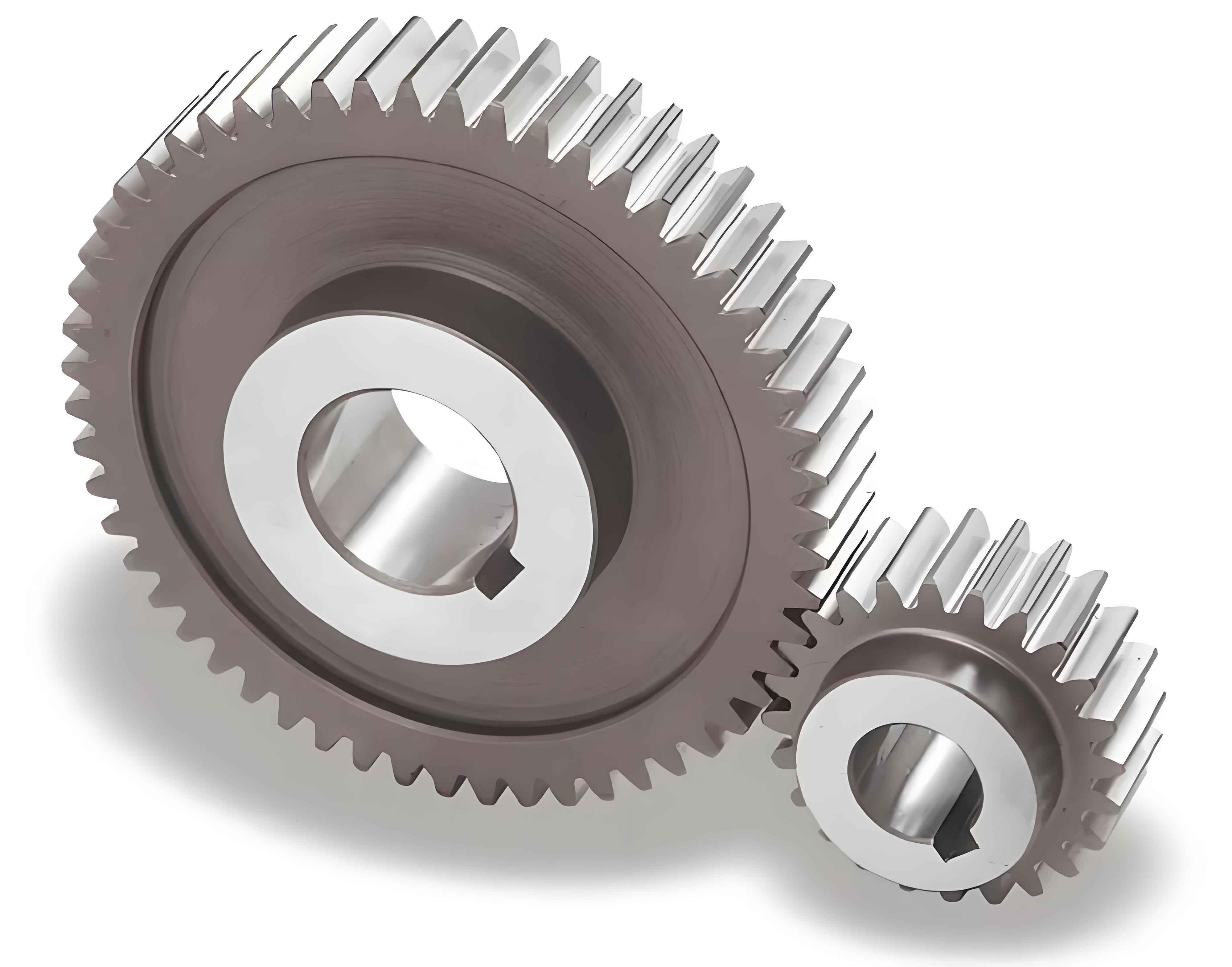
With the widespread application of spur gears in mechanical transmission systems, accurate parameter measurement becomes critical for ensuring operational efficiency and service life. Traditional contact-based measurement methods like coordinate measuring machines (CMMs) suffer from high costs, surface wear risks, and scalability limitations. This study proposes a non-contact measurement framework leveraging Halcon’s machine vision capabilities to address these challenges.
1. Machine Vision System Architecture
The hardware configuration for spur gear measurement comprises:
| Component | Specification |
|---|---|
| Camera | 12MP CCD with 30 fps |
| Lens | 16mm focal length, f/2.8 |
| Lighting | Backlit LED array (6000K) |
| Resolution | 15 μm/pixel calibration |
The imaging process follows:
$$ \text{Object Space} \xrightarrow{\text{Projection}} \text{Image Plane} \xrightarrow{\text{Processing}} \text{Parametric Data} $$
2. Algorithmic Pipeline for Spur Gear Analysis
The measurement workflow implements these critical Halcon operators:
| Stage | Operators | Purpose |
|---|---|---|
| Calibration | find_caltab, image_points_to_world_plane | Pixel-to-real conversion |
| Preprocessing | mean_image, threshold, fill_up | Noise reduction & binarization |
| Contour Analysis | smallest_circle, inner_circle | Diameter measurement |
| Feature Extraction | gen_circle, connection, count_obj | Tooth counting |
3. Parametric Calculation Model
Key spur gear parameters derive from fundamental relationships:
Module (m):
$$ m = \frac{d_f}{z – 2.5} $$
where $d_f$ = root diameter, $z$ = tooth count
Circular Pitch (p):
$$ p = \pi m $$
Pitch Diameter (d):
$$ d = m z $$
Experimental validation shows sub-pixel accuracy in diameter measurements:
| Parameter | Theoretical (mm) | Measured (mm) | Error (%) |
|---|---|---|---|
| Addendum Diameter | 60.00 | 59.96 | 0.067 |
| Root Diameter | 48.75 | 48.66 | 0.184 |
| Pitch Diameter | 55.00 | 54.95 | 0.091 |
4. Performance Advantages
Compared with conventional methods, the Halcon-based approach demonstrates:
- 83% reduction in measurement time (avg. 12s/gear)
- 60% lower equipment costs versus CMM solutions
- Zero surface contact prevents spur gear wear
- Adaptability to module ranges: 0.5–10 mm
The system achieves repeatability of ±2μm for critical spur gear dimensions through advanced subpixel edge detection algorithms:
$$ \sigma = \sqrt{\frac{1}{N-1}\sum_{i=1}^{N}(x_i – \bar{x})^2} $$
where σ represents measurement standard deviation across N trials.
5. Industrial Implementation Considerations
For optimal spur gear measurement accuracy:
- Maintain 85%–95% fill factor in camera FOV
- Use diffuse backlighting with >2000 lux intensity
- Implement temperature compensation:
$$ \Delta d = \alpha d_0 (T – T_0) $$
where α = thermal expansion coefficient - Apply multi-angle imaging for helical gear adaptation
This methodology establishes a robust framework for non-destructive spur gear inspection, combining Halcon’s computational efficiency with machine vision’s precision. Future enhancements will integrate deep learning for defect detection while maintaining parametric measurement capabilities.