
The accurate transmission of motion and power in mechanical systems heavily relies on the geometric precision of their constituent components. Among these, worm gear sets, comprising a worm and a mating worm gear, are pivotal for applications requiring high reduction ratios, compact design, and self-locking capabilities. The performance attributes of a worm drive—namely its transmission accuracy, operational smoothness, and contact reliability—are intrinsically linked to the manufacturing precision of both the worm and the worm gear. For instance, in indexing mechanisms, the cumulative pitch error of the worm gear must be strictly controlled to ensure positional accuracy, while the axial pitch deviation of the worm and the individual pitch error of the worm gear are critical for smooth operation. Furthermore, the profile accuracy in the direction of meshing directly impacts the load-bearing capacity and longevity of the drive.
Traditional methodologies for inspecting worm gears and worms often involve contact-based coordinate measuring machines (CMMs) or dedicated gear testers. While established, these techniques present notable limitations. Contact measurement requires meticulous pre-planning of the probe’s path based on the specific tooth geometry, a process that is time-consuming and lacks versatility for different worm profiles. The physical contact between the probe and the surface also introduces risks of scratching delicate finished surfaces and necessitates probe radius compensation, adding layers of complexity and potential error sources to the measurement chain. These factors collectively constrain measurement efficiency and can impact the final assessment accuracy.
This article presents a comprehensive non-contact measurement methodology for worm gears and worms, centered on the use of a laser displacement sensor. The core principle involves acquiring displacement data of the tooth flanks relative to a datum and constructing a measured profile model for subsequent analysis. For the worm, the axial tooth profile is measured, while for the worm gear, data is captured from a specific transverse cross-section. By comparing the measured profile to an ideal mathematical model, key deviation parameters such as tooth profile form deviation and pitch deviation can be efficiently calculated. This non-contact approach eliminates the need for probe path planning, avoids contact-induced errors and surface damage, and removes the requirement for probe radius compensation. Consequently, it significantly streamlines the measurement process, promising enhanced precision and operational efficiency in the quality control of worm gear drives.
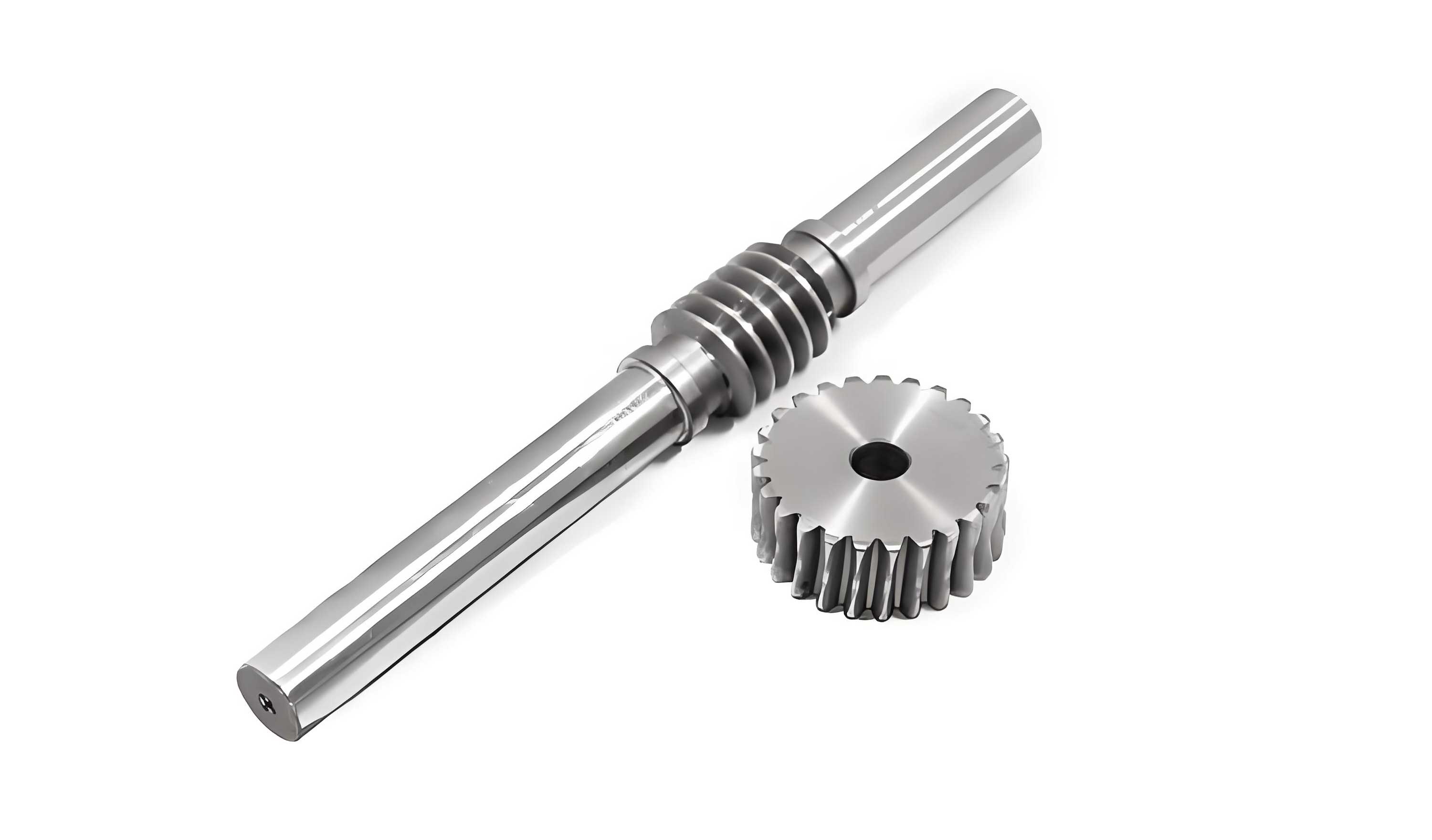
Design of the Laser-Based Measurement Apparatus
To realize the proposed non-contact measurement, a dedicated apparatus was designed and constructed. The system is required to provide precise relative motion between the laser sensor and the workpiece (worm or worm gear) to scan the tooth profiles. The necessary degrees of freedom include one rotational axis and three orthogonal linear axes.
The apparatus, as illustrated schematically, features a vertical structure. It is built upon a solid base plate supporting an X-axis linear guide. A Y-axis guide is mounted on the moving carriage of the X-axis, and a Z-axis guide is subsequently mounted on the Y-axis carriage. This configuration allows the laser displacement sensor, attached to the Z-axis carriage, to be positioned anywhere within a three-dimensional Cartesian volume. The workpiece is mounted on a high-precision rotary table, defining the C-axis (rotational axis). Each linear and rotary axis is equipped with a high-resolution optical encoder for closed-loop position feedback. A multi-axis motion control card, programmed for coordinated movement, governs all actuators. The laser displacement sensor operates on the optical triangulation principle, emitting a focused beam onto the target surface and measuring the position of the reflected spot on a dedicated detector to calculate distance.
The measurement workflow is as follows. For a worm, the sensor is first positioned at the radial height corresponding to the worm’s pitch circle. The Z-axis is then commanded to move at a constant velocity, traversing the sensor beam along the worm’s axis. As the worm is stationary, this scans its axial profile. The system simultaneously records the laser sensor’s distance reading and the Z-axis encoder’s position, building a dataset of (Z, Displacement) pairs covering several teeth. For a worm gear, the sensor is positioned to focus on its mid-face transverse plane. The rotary table (C-axis) is then rotated at a constant angular velocity for at least one full revolution. The system records the angular position from the rotary encoder and the corresponding sensor displacement, capturing the profile of all teeth in that specific cross-section.
Mathematical Modeling of Ideal Worm and Worm Gear Profiles
Accurate error analysis necessitates a precise mathematical description of the ideal tooth surfaces for both the worm and the worm gear. These models serve as the reference against which measured data is compared.
ZI (Cylindrical Involute) Worm Model
The tooth surface of a ZI worm is generated by a straight line (the generatrix) tangent to the base cylinder and inclined at the base lead angle \(\gamma_b\). Considering a right-hand worm, the left flank surface equation can be derived from its generation geometry. Let \(R\) be the radial distance of a point on the generatrix, \(\theta\) an angular parameter of the helical motion, \(p\) the screw parameter (\(p = \frac{m z_1}{2 \tan\gamma}\) for axial module \(m\) and worm thread count \(z_1\)), \(r_{b1}\) the worm base radius, and \(\alpha_t\) the axial pressure angle. The parametric equations for the left flank are:
$$
\begin{aligned}
x_1 &= R \cos\theta \\
y_1 &= R \sin\theta \\
z_1 &= p(\theta \mp \alpha_t) – R \sin\alpha_t \tan\gamma_b
\end{aligned}
$$
where the “\(-\)” sign corresponds to the left flank and the “\(+\)” sign to the right flank of a right-hand worm. For the axial tooth profile, which is the intersection of the tooth surface with the plane \(y_1 = 0\), the equation simplifies. Letting \(r_1\) be the worm pitch radius, the axial profile coordinate \(z\) as a function of radial coordinate \(x\) is given by:
$$
z = \pm m \left[ \frac{\pi}{4} \mp \alpha_t \pm \sin\alpha_t \tan\gamma_b \right] – \left[ \sqrt{x^2 – r_{b1}^2} \mp r_{b1} \tan\gamma_b \right]
$$
Again, the upper signs refer to the left flank, lower signs to the right flank. This equation describes the ideal straight-line profile in the axial section of a ZI worm, which is the basis for worm measurement analysis.
Worm Gear Model in the Meshing Plane
The conjugate worm gear tooth surface is complex. However, for a ZA (Archimedean) or ZN (Normal straight-sided) worm pairing with its worm gear, there exists a transverse plane in the worm gear where the tooth profile is an involute. This plane corresponds to the plane where the worm’s axial or normal profile is a straight line, simplifying the meshing to a rack-and-pinion analogy. Measurement and analysis in this specific plane are therefore highly advantageous.
In this transverse plane, the ideal tooth profile is a standard involute curve. In a coordinate system \(xOy\) with origin at the gear center, the involute equations are:
$$
\begin{aligned}
x &= r_{b2} (\cos\varphi + \varphi \sin\varphi) \\
y &= r_{b2} (\sin\varphi – \varphi \cos\varphi)
\end{aligned}
$$
where \(r_{b2}\) is the base circle radius of the worm gear, and \(\varphi\) is the involute roll angle. The pressure angle \(\alpha\) at any point on the involute is related to the roll angle by \(\alpha = \arctan\varphi\). The analysis is typically performed over a defined roll angle range from \(\varphi_{\text{root}}\) at the root to \(\varphi_{\text{tip}}\) at the tip, corresponding to a radial range from the root circle to the addendum circle.
Methodology for Deviation Analysis
The raw data from the laser sensor requires processing to compensate for systematic errors and to extract the relevant geometric deviations. The core challenge is to compare a set of discrete measurement points to a continuous ideal profile.
Mathematical Compensation for Mounting Eccentricity
Mounting the workpiece on the rotary table inevitably introduces a small eccentricity \(e\). This causes a periodic oscillation in the radial distance measured by the laser sensor as the part rotates, corrupting the true profile data. The eccentricity magnitude \(\Delta L\) can be directly estimated from one full revolution scan of a cylindrical surface (or the worm gear’s root circle): \(\Delta L = (D_{\text{max}} – D_{\text{min}})/2\), where \(D\) is the sensor reading.
Compensation involves calculating the true radial distance \(R_{\text{true}}\) at a given rotation angle \(\beta\), given the measured distance \(R_{\text{meas}}\) and the eccentricity vector. Assuming the eccentricity lies along the sensor’s measurement direction at angle zero, the corrected sensor value \(D_{\text{corr}}\) is found by solving the geometric relationship iteratively. The principle is to find the point on the theoretical circle that lies on the line defined by the laser beam path, given the offset center. The iterative update is based on the formula derived from the law of cosines applied to the triangle formed by the rotation center, the eccentric center, and the measured point.
Deviation Analysis for the Worm
The processed data for the worm consists of points \((z_i, x_i)\) representing the axial profile. To mitigate the influence of non-functional zones (root fillets, tip rounds) and measurement noise, the analysis zone is restricted to a radial height from \(-1m\) below to \(+0.7m\) above the pitch cylinder (\(m\) is the module).
1. Profile Form Deviation (\(f_{f\alpha1}\)): The measured points for a single flank are fitted with a smooth cubic polynomial curve using the least-squares method to approximate the actual profile. For \(k\) data points, the polynomial \(x = a_0 + a_1 z + a_2 z^2 + a_3 z^3\) is determined by minimizing the sum of squared residuals. The coefficients are found by solving the normal equation derived from the design matrix (Vandermonde-like matrix for \(z\) powers).
The ideal profile, given by the axial profile equation, is placed in the same coordinate system. At discrete, equally-spaced \(z\)-coordinates within the evaluation range, the normal vector to the ideal profile is calculated. The intersection point \(G_i\) between this normal line and the fitted polynomial curve (approximated by line segments between adjacent data points) is determined. The distance between \(G_i\) and the corresponding ideal profile point \(H_i\) is the local profile deviation. The profile form deviation \(f_{f\alpha1}\) for that flank is defined as the absolute maximum of these local deviations over the evaluation range.
$$
f_{f\alpha1} = | \max(\delta_i) – \min(\delta_i) |
$$
where \(\delta_i\) are the signed distances at all evaluated points for that flank.
2. Single Axial Pitch Deviation (\(f_{px1}\)) and Cumulative Pitch Deviation (\(F_{p1}\)): The fitted polynomial curve for each flank is used to find its intersection point \(C_j\) with the pitch cylinder (a line at \(x = r_1\), the pitch radius). The axial coordinate \(z_{C_j}\) of this intersection is calculated. For a worm with \(n\) measured threads, the measured axial pitch between adjacent flanks (e.g., left flank of tooth \(j\) and left flank of tooth \(j+1\)) is \(P_{\text{meas}, j} = z_{C_{j+1}} – z_{C_j}\). The single axial pitch deviation is:
$$
f_{px1, j} = P_{\text{meas}, j} – P_0
$$
where the theoretical axial pitch \(P_0 = \pi m\). The cumulative pitch deviation \(F_{p1}\) over \(n\) pitches is the difference between the actual axial distance from the first to the last intersection and \((n-1)P_0\).
Deviation Analysis for the Worm Gear
The data for the worm gear, after eccentricity compensation and coordinate transformation, consists of points \((x_i, y_i)\) in the transverse plane. The analysis zone is similarly limited, typically from \(-1m\) to \(+0.7m\) relative to the pitch circle radius \(r_2\).
1. Tooth Profile Form Deviation (\(f_{f\alpha2}\)): The ideal involute profile for the worm gear is generated in the measurement coordinate system. The measured points for a tooth are considered. For discrete points \(H_i\) on the ideal involute, the normal line is constructed. This normal line will be tangent to the base circle \(r_{b2}\). Its equation can be expressed as:
$$
y = k (x – x_{H_i}) + y_{H_i}, \quad \text{where } k = \tan(\arctan(y_{H_i}/x_{H_i}) + \pi/2 – \alpha_{H_i})
$$
The intersection point \(G_i\) of this normal with the line segment connecting the two measured points straddling it is calculated. The distance \(\delta_i\) from \(G_i\) to \(H_i\) is the local profile deviation. The profile form deviation \(f_{f\alpha2}\) for that tooth is the absolute difference between the maximum and minimum \(\delta_i\) over the evaluation range. The overall rating for the worm gear is the maximum value found among all teeth measured.
2. Single Pitch Deviation (\(f_{pt2}\)) and Total Cumulative Pitch Deviation (\(F_{p2}\)): For each tooth, the intersection point \(Q_j\) of its fitted profile curve (or a local interpolation of measured points) with the pitch circle of radius \(r_2\) is determined. The angular position \(\theta_j\) of \(Q_j\) is computed. The measured angular pitch between teeth \(j\) and \(j+1\) is \(\Delta\theta_{\text{meas}, j} = \theta_{j+1} – \theta_j\). The corresponding arc length is \(P_{\text{meas}, j} = r_2 \cdot \Delta\theta_{\text{meas}, j}\). The single pitch deviation is:
$$
f_{pt2, j} = P_{\text{meas}, j} – P_0
$$
where \(P_0 = \pi m\) is the theoretical circular pitch. The total cumulative pitch deviation \(F_{p2}\) is the maximum algebraic difference between the actual arc length from any tooth to any other tooth and the nominal arc length over the same number of pitches.
Experimental Measurement and Results
The proposed system and methodology were validated through practical measurements of a worm and a worm gear.
Worm Measurement
A right-hand ZI worm was measured. Its key parameters are: Module \(m = 2 \, \text{mm}\), Number of threads \(z_1 = 2\), Normal pressure angle \(\alpha_n = 20^\circ\), Pitch diameter \(d_1 = 11 \, \text{mm}\), IT6 accuracy grade. Three complete threads were scanned axially. The analysis software calculated the deviations as summarized below.
| Parameter | Symbol | Value (mm) |
|---|---|---|
| Max. Single Axial Pitch Dev. | \(\max(f_{px1})\) | +0.0027 |
| Min. Single Axial Pitch Dev. | \(\min(f_{px1})\) | -0.0065 |
| Cumulative Axial Pitch Dev. | \(F_{p1}\) | -0.0061 |
| Profile Form Deviation | \(f_{f\alpha1}\) | 0.0155 |
These results are consistent with the specified IT6 manufacturing tolerance for such a worm, confirming the method’s validity.
Worm Gear Measurement
A worm gear designed to mate with a ZA worm was measured. Its parameters are: Module \(m = 2.5 \, \text{mm}\), Number of teeth \(z_2 = 25\), Pressure angle at pitch circle \(\alpha = 20^\circ\), IT9 accuracy grade. The mid-face transverse plane was scanned over one full revolution. The detailed results for individual pitch and profile deviations are presented in the following table. The overall summary shows a maximum single pitch deviation \(f_{pt2}\) of +0.0269 mm, a total cumulative pitch deviation \(F_{p2}\) of 0.0789 mm, and a profile form deviation \(f_{f\alpha2}\) of 0.0193 mm. These values align with the IT9 accuracy grade for worm gears.
| Tooth # | \(f_{pt2}\) (mm) | Cumulative Dev. (mm) | \(f_{f\alpha2}\) (mm) |
|---|---|---|---|
| 1 | -0.0066 | -0.0066 | 0.0188 |
| 2 | -0.0231 | -0.0297 | 0.0182 |
| 3 | -0.0094 | -0.0391 | 0.0200 |
| 4 | -0.0202 | -0.0593 | 0.0193 |
| 5 | -0.0156 | -0.0749 | 0.0186 |
| 6 | -0.0005 | -0.0754 | 0.0183 |
| 7 | +0.0151 | -0.0603 | 0.0124 |
| 8 | -0.0118 | -0.0721 | 0.0198 |
| 9 | +0.0010 | -0.0711 | 0.0202 |
| 10 | +0.0226 | -0.0485 | 0.0175 |
| 11 | +0.0102 | -0.0383 | 0.0197 |
| 12 | +0.0251 | -0.0132 | 0.0199 |
| 13 | -0.0015 | -0.0147 | 0.0165 |
| 14 | +0.0269 | +0.0122 | 0.0160 |
| 15 | +0.0062 | +0.0184 | 0.0150 |
| 16 | +0.0258 | +0.0442 | 0.0191 |
| 17 | +0.0083 | +0.0525 | 0.0196 |
| 18 | +0.0247 | +0.0772 | 0.0150 |
| 19 | -0.0137 | +0.0635 | 0.0164 |
| 20 | +0.0154 | +0.0789 | 0.0181 |
| 21 | -0.0193 | +0.0596 | 0.0123 |
| 22 | -0.0043 | +0.0553 | 0.0186 |
| 23 | -0.0165 | +0.0388 | 0.0143 |
| 24 | -0.0167 | +0.0221 | 0.0188 |
| 25 | -0.0253 | -0.0032 | 0.0136 |
Conclusion
This article has detailed a comprehensive non-contact methodology for the precision measurement of worm gears and worms utilizing a laser displacement sensor. The core innovation lies in replacing tactile probing with optical scanning, thereby eliminating path planning, probe compensation, and contact-related errors. A dedicated measurement apparatus integrating three linear axes and one rotary axis enables flexible and automated data acquisition for both axial worm profiles and transverse worm gear profiles. The foundation of the error analysis is the robust mathematical modeling of the ideal tooth surfaces—specifically the axial straight-line profile for ZI worms and the transverse involute profile for worm gears in the meshing plane. The analytical procedures address practical issues such as mounting eccentricity compensation and employ curve fitting techniques to extract critical deviation parameters: tooth profile form deviation (\(f_{f\alpha}\)), single pitch deviation (\(f_{pt}, f_{px}\)), and cumulative pitch deviation (\(F_p\)). Experimental validation on industrial components confirmed that the results align with their specified manufacturing tolerance grades (IT6, IT9). The measurement time is significantly reduced compared to traditional CMM-based methods—often to one-third—due to the streamlined setup and automated scanning process. This methodology offers a potent, efficient, and high-precision solution for quality control in the production of worm gear drives. Furthermore, the principles and the apparatus are readily adaptable for measuring other types of cylindrical worms and complex helical surfaces, demonstrating broad applicability in precision metrology.