
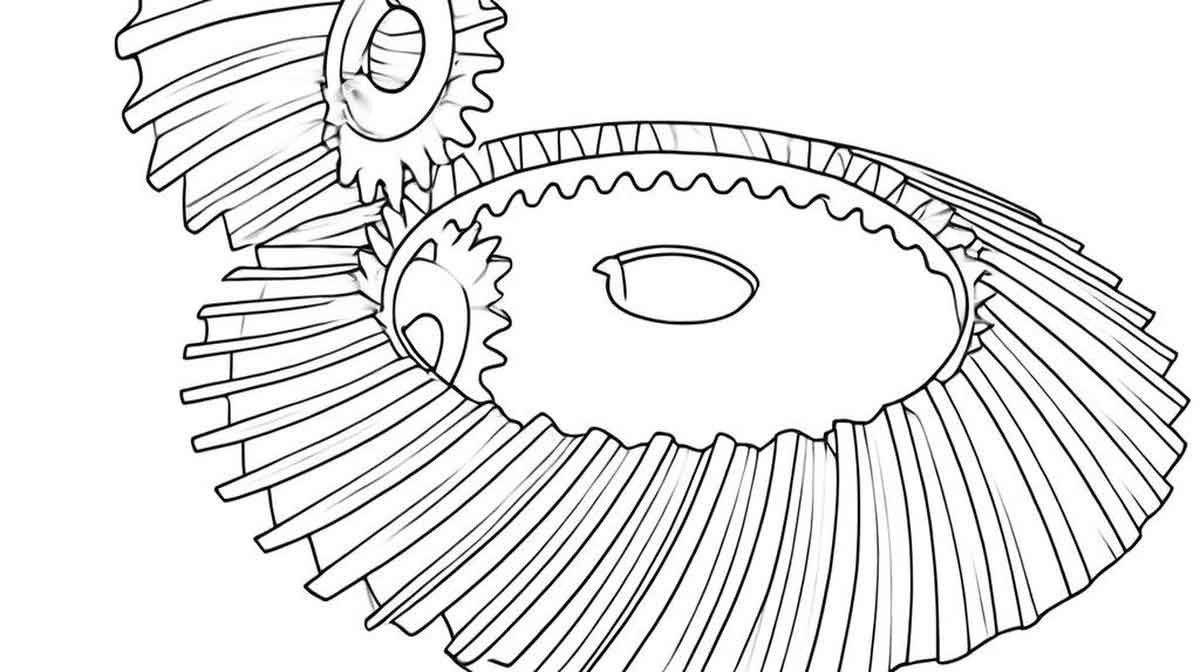
The design and manufacturing of spiral bevel gears have long been a focal point in mechanical engineering due to their critical role in transmitting motion and power between intersecting or offset shafts. Traditional spiral bevel gears, such as circular-arc or logarithmic spiral types, face challenges in mass production due to complex geometries and high manufacturing costs. This study introduces a novel equal-distance spiral bevel gear optimized for metal powder injection molding (MIM), enabling high-precision modeling, efficient performance analysis, and cost-effective batch production.
1. Design Parameters of Equal-Distance Spiral Bevel Gears
The geometric parameters of the proposed equal-distance spiral bevel gear pair were derived from Gleason弧齿锥齿轮 standards and existing literature. Key design parameters are summarized in Table 1.
Table 1: Geometric parameters of the equal-distance spiral bevel gear pair
| Parameter | Pinion | Gear |
|---|---|---|
| Hand of Spiral | Left | Right |
| Number of Teeth (NN) | 16 | 23 |
| Shaft Angle (ΣΣ) | 90° | 90° |
| Pitch Cone Angle (δδ) | 34.824° | 55.176° |
| Module (mm) | 0.905 mm | 0.905 mm |
| Midpoint Spiral Angle (ββ) | 30° | 30° |
| Face Width (bb) | 5 mm | 5 mm |
| Pressure Angle (αα) | 20° | 20° |
2. Mathematical Modeling of Tooth Surfaces
2.1 Spherical Involute as Tooth Profile
The tooth profile of the spiral bevel gear adopts a spherical involute, generated by the pure rolling of a plane QQ on a base cone KK. The parametric equations of the spherical involute in the coordinate system (O−XYZ)(O−XYZ) are derived using coordinate transformation theory:{X=l(sinδbcosψcost+sinψsint),Y=l(sinδbcosψsint−sinψcost),Z=lcosδbcosψ,⎩⎨⎧X=l(sinδbcosψcost+sinψsint),Y=l(sinδbcosψsint−sinψcost),Z=lcosδbcosψ,
where ll is the cone distance, δbδb is the base cone angle, tt is the rolling angle, and ψ=tsinδbψ=tsinδb.
2.2 Equal-Distance Conical Spiral as Tooth Trace
The tooth trace follows an equal-distance conical spiral curve, defined by combining Archimedean spiral motion with vertical linear motion. The parametric equations are:{x=p2πφsinδcosφ,y=p2πφsinδsinφ,z=p2πφcosδ,⎩⎨⎧x=2πpφsinδcosφ,y=2πpφsinδsinφ,z=2πpφcosδ,
where pp is the lead, δδ is the cone angle, and φφ is the rotation angle. The lead pp is calculated based on the midpoint spiral angle βn=30∘βn=30∘, resulting in p1=63.26 mmp1=63.26mm (pinion) and p2=90.93 mmp2=90.93mm (gear).
2.3 Synthesis of Tooth Surface
The tooth surface is synthesized by distributing spherical involutes along the equal-distance spiral. The coordinates of discrete points on the tooth surface are computed in MATLAB using stepwise parameter variations. These points are then imported into UG NX for reverse engineering, generating a high-precision 3D model (Figure 1).
3. Dynamic Meshing Performance Analysis
Finite element analysis (FEA) in ANSYS Workbench evaluates the meshing behavior of the spiral bevel gear pair under operational conditions. Key steps include:
- Mesh Generation: Hexahedral elements (Solid186) ensure computational efficiency and accuracy.
- Material Properties: Fe8Ni alloy (Table 2) is selected to match MIM-processed gears.
- Boundary Conditions: A 3000 RPM rotational speed is applied to the pinion, while a 15 N·m torque is imposed on the gear.
Table 2: Material properties of Fe8Ni alloy
| Property | Value |
|---|---|
| Density (ρρ) | 7600 kg/m³ |
| Elastic Modulus (EE) | 190 GPa |
| Poisson’s Ratio (νν) | 0.28 |
Results:
- Contact Stress: The elliptical contact pattern (Figure 2) aligns with Hertzian contact theory, confirming stable load distribution.
- Transmission Error: Fluctuations remain below 4×10⁻⁴ rad4×10−4rad, indicating high transmission stability.
- Speed Consistency: The driven gear’s speed deviates by <0.2% from the theoretical value (218.55 rad/s).
4. Metal Powder Injection Molding (MIM) Process
The MIM process enables mass production of spiral bevel gears with complex geometries. Key stages include:
4.1 Feedstock Preparation
- Powder: Fe8Ni alloy (average particle size: 3.95 µm, tap density: 4.35 g/cm³).
- Binder: 90% POM + 6% HDPE + 4% SA (by volume).
- Mixing: Conducted at 175–185°C for 30 minutes to avoid thermal degradation.
4.2 Injection Molding and Sintering
- Injection Parameters: Temperature = 190°C, Pressure = 50 MPa, Speed = 50 mm/s.
- Debinding: Catalytic debinding in HNO₃ at 120°C, followed by thermal debinding at 600°C.
- Sintering: Performed at 1260°C under N₂ + Ar atmosphere to achieve >98% theoretical density.
The final MIM-produced spiral bevel gear (Figure 3) demonstrates dimensional accuracy and smooth demolding, validating the feasibility of MIM for small-cone-angle gears.
5. Conclusions
- The mathematical model combining spherical involutes and equal-distance spirals ensures precise 3D modeling of spiral bevel gears.
- Dynamic simulations confirm stable meshing performance with minimal transmission error (<4×10⁻⁴ rad).
- MIM enables cost-effective, batch-compatible production of spiral bevel gears, reducing lead times by 40% compared to traditional machining.
This work establishes a systematic framework for designing, analyzing, and manufacturing high-performance spiral bevel gears, bridging the gap between theoretical modeling and industrial scalability.