
In the realm of mechanical power transmission, herringbone gears hold a position of significant importance, particularly in heavy-duty industrial applications. Their unique double-helical structure offers distinct advantages over their single helical counterparts, including superior load-carrying capacity, enhanced operational stability, and reduced axial thrust. These attributes make herringbone gears indispensable in demanding sectors such as marine propulsion, power generation, and heavy machinery. The effective design, analysis, and manufacturing of these complex components are fundamentally dependent on the availability of highly accurate digital models. Conventional computer-aided design (CAD) methodologies for gear modeling often fall short in achieving the necessary geometric fidelity, especially concerning the involute tooth profile and the critical fillet region at the tooth root. Inaccuracies in these areas can propagate into significant errors during subsequent finite element analysis (FEA), dynamic simulation, and stress evaluation, potentially compromising the reliability of the entire design process. This article delves into an advanced approach for the precise, parameterized three-dimensional modeling and virtual assembly of herringbone gears, utilizing a powerful CAD platform as the foundational tool.
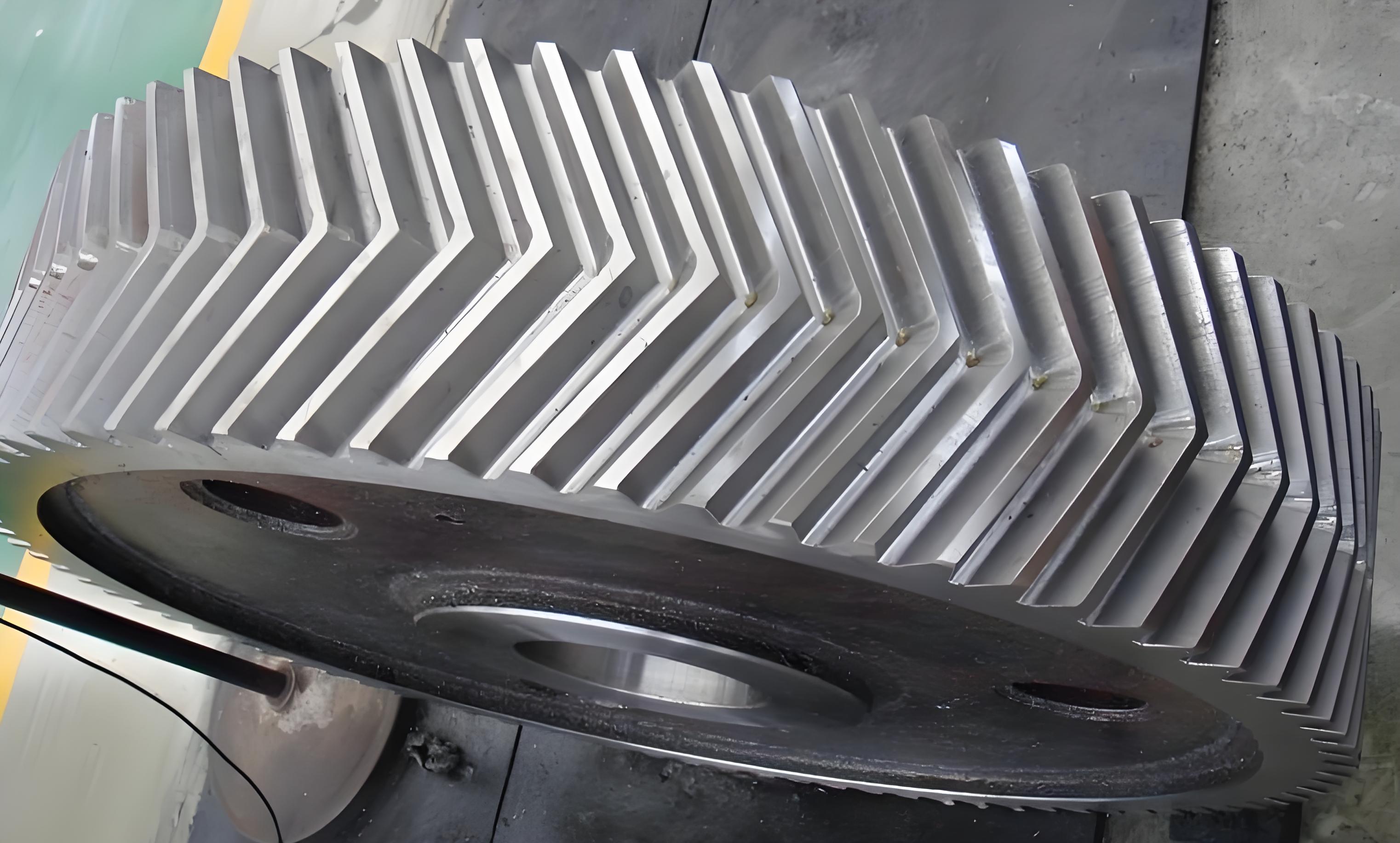
The geometric essence of a herringbone gear is defined by a set of fundamental parameters. Accurate modeling begins with the precise mathematical definition of these parameters and their interrelationships. The primary geometric dimensions of a herringbone gear are governed by six core parameters: the number of teeth (Z), the normal module (m_n), the normal pressure angle (α_n), the helix angle (β), the profile shift coefficient (x_n), and the addendum modification coefficient. Additional structural parameters, such as bore diameter and web thickness, define the gear body’s form. A clear tabulation of these parameters is essential for systematic design.
| Parameter Name | Symbol (Used in Modeling) | Typical Value / Variable |
|---|---|---|
| Normal Module | m_n | 9 mm |
| Number of Teeth | Z | 49 |
| Normal Pressure Angle | α_n | 20° |
| Helix Angle | β | 25° |
| Normal Addendum Coefficient | h*_an | 1.0 |
| Normal Dedendum/Clearance Coefficient | c*_n | 0.25 |
| Normal Profile Shift Coefficient | x_n | 0 |
| Face Width (per helix) | b | 250 mm |
| Total Gear Width | B | 590 mm |
The transition from basic parameters to a three-dimensional solid model requires the calculation of derived dimensions and the application of precise geometric curves. The following relationships are crucial for defining the gear’s key diameters and angles:
$$d = \frac{m_n \cdot Z}{\cos(\beta)} \quad \text{(Pitch Diameter)}$$
$$\alpha_t = \arctan\left(\frac{\tan(\alpha_n)}{\cos(\beta)}\right) \quad \text{(Transverse Pressure Angle)}$$
$$d_b = d \cdot \cos(\alpha_t) \quad \text{(Base Diameter)}$$
$$m_t = \frac{m_n}{\cos(\beta)} \quad \text{(Transverse Module)}$$
$$d_f = m_n \cdot \left( \frac{Z}{\cos(\beta)} – 2h^{*}_{an} – 2c^{*}_{n} + 2x_n \right) \quad \text{(Root Diameter)}$$
$$d_a = m_n \cdot \left( \frac{Z}{\cos(\beta)} + 2h^{*}_{an} + 2x_n \right) \quad \text{(Tip Diameter)}$$
$$\text{inv}(\alpha_t) = \tan(\alpha_t) – \alpha_t \cdot \frac{\pi}{180} \quad \text{(Involute Function)}$$
The accuracy of the tooth form is paramount. The working flank of a standard gear is an involute curve, while the tooth root features a trochoidal or fillet curve generated by the cutting tool’s tip radius. Using approximated splines or arbitrary arcs for these curves, as is common in rudimentary modeling, introduces significant error. For high-fidelity models of herringbone gears, exact mathematical equations must be employed.
Involute Curve Equation (in parametric form, referenced to gear center):
The coordinates (x, y) of a point on the involute are given by:
$$x = \left[ \frac{d_b}{2} \cdot \left( \cos(\theta) + \theta \cdot \sin(\theta) \right) \right]$$
$$y = \left[ \frac{d_b}{2} \cdot \left( \sin(\theta) – \theta \cdot \cos(\theta) \right) \right]$$
where $\theta$ is the roll angle parameter, ranging from the start of the active profile to the tip circle intersection.
Tooth Root Fillet Curve Equation:
The fillet is traced by the cutting tool’s corner. Its coordinates, considering a rack-type cutter with tip radius $\rho_0$, are derived from the tool’s relative motion:
$$\rho_0 = c^{*}_{n} \cdot m_n$$
The coordinates of the fillet center relative to the gear center change with rotation. The resulting fillet point (x, y) for a given tool position angle $\phi$ is:
$$x = \left( \frac{d}{2} – x_c – \rho_0 \cos(\eta) \right) \cos(\phi) + \left( x_c \tan(\alpha_t) + \rho_0 \sin(\eta) \right) \sin(\phi)$$
$$y = \left( \frac{d}{2} – x_c – \rho_0 \cos(\eta) \right) \sin(\phi) – \left( x_c \tan(\alpha_t) + \rho_0 \sin(\eta) \right) \cos(\phi)$$
where $x_c$ is a coordinate related to the cutter offset, and $\eta$ is an angular parameter for the fillet arc. Integrating these precise equations into the CAD environment via parametric relations is the cornerstone of accurate herringbone gear modeling.
Parametric modeling is a transformative methodology that associates geometric features with driving dimensions and mathematical relations. For herringbone gears, this approach allows a single model template to generate an entire family of gears by simply changing the input parameters listed in Table 1. The implementation typically follows a structured workflow within a feature-based CAD system.
| Step | Action | Description & Key Tools |
|---|---|---|
| 1. Parameter & Relation Setup | Define variables (Z, m_n, β, etc.) and input the derived equations (d, d_b, α_t, etc.) as “Relations”. | CAD Parameters Table, Relation Editor. |
| 2. Gear Tooth Profile Creation | Create datum curves using the exact involute and fillet equations. Sketch reference circles (tip, pitch, root). Mirror for the opposite flank. | Curve from Equation, Sketch, Mirror. |
| 3. Helical Trajectory Definition | Create a datum curve representing the helical path. For a herringbone gear, this involves a ‘V-shaped’ path or two symmetric helical paths. | Sketched Datum Curve, Projected Curve. |
| 4. Single Tooth Formation | Use a swept protrusion feature. The tooth profile (Step 2) is swept along the helical trajectory (Step 3). | Variable Section Sweep, Helical Sweep. |
| 5. Full Gear Generation | Pattern the single tooth feature around the gear axis. The number of instances equals Z, with an angular increment of 360°/Z. | Axis Pattern, Circular Pattern. |
| 6. Gear Body Completion | Add features like the hub, bore, keyway, spokes, and undercuts (for machining clearance between helices). | Extrude, Revolve, Cut, Chamfer. |
The power of this method lies in its full associativity. Modifying a primary parameter, such as the normal module (m_n) or the number of teeth (Z), automatically triggers the recalculation of all dependent relations (like pitch diameter), updates the defining curves (involute and fillet), and regenerates the entire three-dimensional solid model of the herringbone gear. This capability is invaluable for design iteration, optimization, and creating standardized gear libraries.
Creating accurate individual components is only half the challenge. Ensuring that they assemble correctly and function as intended in a virtual environment is critical. Virtual assembly is a simulation-based process that allows engineers to build, analyze, and validate product assemblies digitally before physical prototyping. For complex mating components like herringbone gears, this process is essential to verify proper meshing and to avoid interference, which can lead to premature failure, noise, and vibration.
Assembling a pair of herringbone gears requires precise alignment. Simple coincident or surface alignment constraints are often insufficient to guarantee correct conjugate action at the pitch line. A robust assembly methodology must be employed.
| Step | Procedure | Purpose & Outcome |
| 1. Assembly Setup | Create assembly file. Establish fixed datum planes and axes representing the theoretical centers of the two gears. | Provides a global reference frame for component placement. |
| 2. Center Distance Constraint | Constrain the distance between the two central axes using the calculated center distance (a). The formula is: $$a = \frac{m_n (Z_1 + Z_2)}{2 \cos(\beta)}$$ | Positions the gear shafts at the correct theoretical center distance for proper meshing. |
| 3. Initial Component Placement | Insert the first herringbone gear. Constrain its axis to the first assembly axis and its mid-plane to an assembly datum plane using a “Cylindrical” or “Pin” joint type. | Fixes the first gear in space, allowing only rotation about its axis. |
| 4. Second Gear Placement | Insert the second herringbone gear. Similarly, constrain its axis to the second assembly axis and its mid-plane to the assembly datum plane. | Fixes the second gear’s position and orientation, but the angular phase between the two gears is still undefined, likely causing interference. |
| 5. Meshing Alignment (Key Step) | Use the mechanism/dragging utility. Manually rotate one gear so that the “tooth space centerline” of one gear aligns with the “tooth tip centerline” of the mating gear. Capture this position as a “snapshot”. | This critical step establishes the correct angular phasing between the two herringbone gears, ensuring the teeth mesh properly at the pitch point, thereby eliminating initial interference. |
| 6. Kinematic Joint Definition | Define a “Gear Pair” connection in the mechanism module. Select the two gear axes and specify the gear ratio (Z2/Z1). | Establishes the kinematic relationship for motion simulation. The software uses the snapshot position as the initial, non-interfering mesh state. |
| 7. Interference Check & Motion Analysis | Run a global interference check and a kinematic motion analysis over a full rotation cycle. | Validates that the assembly is free from collisions (interference) and simulates the correct rotational motion of the herringbone gear pair. |
This virtual assembly approach, combining precise geometric constraints with an initial meshing alignment step, effectively eliminates the trial-and-error process often associated with gear assembly in CAD. It ensures that the digital prototype of the herringbone gear drive is kinematically accurate and ready for downstream analysis.
The advantages of employing precise, parameterized modeling and virtual assembly for herringbone gears are substantial and far-reaching.
1. Foundation for High-Fidelity Analysis: The geometrically accurate model, especially the true involute and correctly generated root fillet, is crucial for reliable engineering analysis. When this model is used in Finite Element Analysis (FEA) for tooth root bending stress or contact stress analysis, the results are significantly more trustworthy than those from models with approximated geometry. Similarly, for dynamic analysis and multi-body system simulation, the exact mass properties and contact kinematics derived from the precise model lead to more realistic predictions of vibration, noise, and system response. Accurate models of herringbone gears are indispensable for these advanced simulations.
2. Design Efficiency and Innovation: The parametric nature of the model dramatically accelerates the design process. Exploring “what-if” scenarios—such as evaluating the impact of a different helix angle on axial load cancellation or adjusting the profile shift for balanced strength—becomes a matter of changing a few parameters and regenerating the model and assembly instantly. This facilitates optimization and encourages innovative design exploration for herringbone gears.
3. Manufacturing and Inspection Preparation: The digital model serves as a direct reference for Computer-Aided Manufacturing (CAM) programming. Tool paths for machining the complex herringbone tooth form, whether by hobbing, shaping, or grinding, can be generated directly from the solid model. Furthermore, the model defines the nominal geometry for Coordinate Measuring Machine (CMM) inspection, ensuring that manufactured herringbone gears conform to the design intent.
| Aspect | Conventional Approximate Modeling | Precision Parametric Modeling |
|---|---|---|
| Tooth Profile Accuracy | Uses splines to approximate involute; fillet often a guessed arc. | Uses exact mathematical equations for involute and tool-generated fillet. |
| Model Flexibility | Model is static; changes require manual re-drawing. | Fully driven by parameters; changes auto-propagate. |
| Analysis Suitability | Poor foundation for stress/dynamic analysis due to geometric inaccuracies. | Provides a high-quality foundation for FEA, CFD, and dynamics. |
| Assembly Reliability | High risk of undetected interference due to profile inaccuracies and poor phasing. | Virtual assembly with precise phasing reliably produces interference-free meshing. |
| Development Time for Variants | Long, as each new size requires a new model. | Very short, only parameters need to be changed. |
In conclusion, the integration of precision geometry, parametric design principles, and virtual assembly techniques represents a best-practice methodology for the digital development of herringbone gears. This approach directly addresses the limitations of conventional modeling by ensuring geometric accuracy from the tooth tip to the root fillet. By creating a fully associative and parameter-driven model, designers gain unprecedented control and flexibility. Finally, employing a systematic virtual assembly process guarantees kinematically correct and interference-free mating of gear pairs. The resultant high-fidelity digital prototype forms a robust and reliable foundation for all subsequent engineering activities—from advanced structural and dynamic analysis to the generation of manufacturing instructions—ultimately leading to the creation of more reliable, efficient, and optimized herringbone gear transmissions for the world’s most demanding applications. The focus on accuracy in modeling herringbone gears is therefore not merely a step in the process but a fundamental contributor to product performance and success.