
In the realm of gear transmission, miter gears, which are straight bevel gears with a shaft angle of 90 degrees, hold significant importance due to their simplicity, cost-effectiveness, and adaptability. Compared to curved-tooth bevel gears, miter gears may exhibit slightly lower load-carrying capacity, but their low processing cost, straightforward equipment requirements, and rapid design variations make them extensively applicable in medium and small power scenarios. Even in heavy-duty transmission fields, where large-scale processing equipment for curved-tooth bevel gears is limited, miter gears play a crucial role. The planing method is a universal technique for manufacturing miter gears, and in many industrial contexts, it remains the primary approach. However, due to insufficient systematic and in-depth research on their forming characteristics and processing principles, numerous challenges persist. Conventionally processed miter gears have tooth profiles that approximate straight lines, leading to heightened sensitivity of the contact zone to manufacturing, installation errors, and deformations. This makes it difficult to accurately determine adjustment parameter corrections, adversely affecting both quality and processing efficiency. Therefore, a thorough exploration of the forming process, quality prediction, and control for miter gears is essential. This article delves into the principles of planing processing for miter gears, utilizing computer simulation to forecast and control machining quality, validated through cutting tests.
The prediction and analysis of meshing quality for miter gears can be effectively achieved through computer simulation of the gear processing and meshing processes. This approach, successfully applied to Gleason spiral bevel gears, serves as a powerful tool for ensuring gear quality and enhancing production efficiency. However, for miter gears, such work has been relatively scarce. Building upon the analytical methods used for spiral bevel gears, this discussion focuses on planed miter gears. It not only aids in accurately predicting contact quality before cutting but also provides crucial guidance for selecting reasonable cutting adjustment parameters. The core of this methodology lies in simulating the formation of tooth surfaces during planing and analyzing their meshing behavior under working conditions.
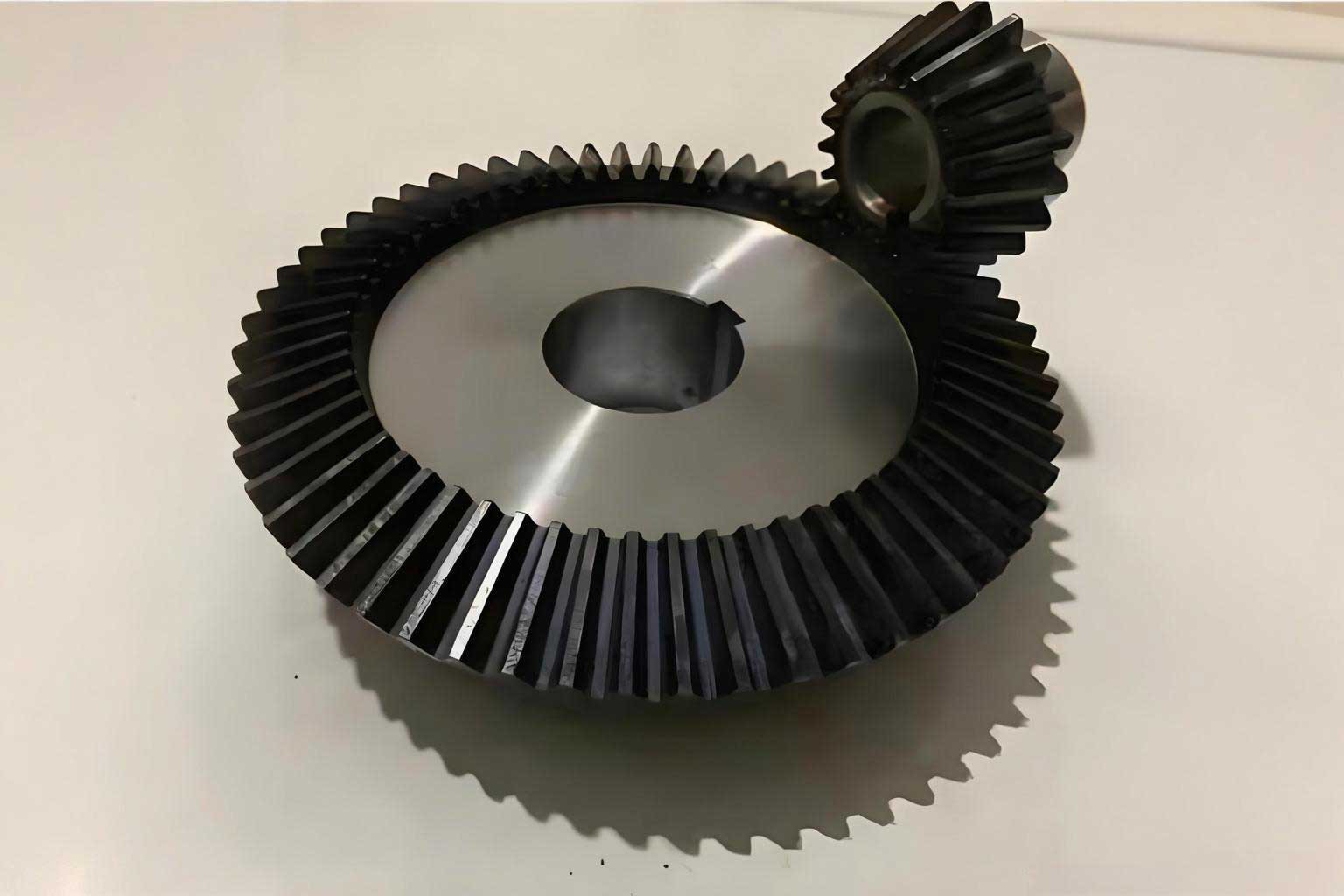
The formation of tooth surfaces for both the pinion and gear in miter gears is based on the principle of a flat-top generating gear. In the double-tool roll-planing method, the planing tools perform cutting motions on the tool posts of the machine’s cradle. The tool tips move along the root cone generatrix of the miter gear. The trajectory of the tool’s cutting edge corresponds to the tooth of a flat-top generating gear. The workpiece, i.e., the miter gear, engages in a generating motion with the machine cradle (along with the tools), enveloping to form the tooth profile. To mathematically describe this, coordinate systems are established for both the pinion and gear.
For the gear (large wheel) and pinion (small wheel), rectangular coordinate systems \(\Sigma_g (O_g – X_g, Y_g, Z_g)\) and \(\Sigma_p (O_p – X_p, Y_p, Z_p)\) are defined, respectively. The origins \(O_g\) and \(O_p\) are on the cradle axis. The coordinate planes \(Y_gO_gZ_g\) and \(Y_pO_pZ_p\) coincide with the tool tip plane and are perpendicular to the cradle axis. The \(Y_g\) and \(Y_p\) axes lie in the horizontal cross-section of the cradle, with \(Z_g\) pointing toward the back of the cradle and \(X_g\) pointing toward the workpiece side. Any point on the generating surface can be determined by position parameters \(L_g\) (or \(L_p\)) and \(H_g\) (or \(H_p\)). Here, \(L\) represents the distance along the tooth length direction from the point to the midpoint of the tooth, and \(H\) is the distance along the tooth height direction from the point to the tool tip. Let \(\phi_g\) (or \(\phi_p\)) be the tool position polar angle. When \(\phi\) is fixed, the tool motion trajectory defines the generating surface at that instant. As \(\phi\) varies, a family of surfaces parameterized by \(\phi\) is formed, which envelops the machined tooth surface.
In the coordinate system \(\Sigma_g\), the equation of the generating surface for the gear can be written as:
$$
\vec{R_g} = \begin{bmatrix}
X_g \\
Y_g \\
Z_g
\end{bmatrix} = \begin{bmatrix}
(R_{g0} + \Delta X_g) \cos \phi_g – (L_g \sin \alpha_{gt} + H_g \cos \alpha_{gt}) \sin \phi_g \\
(R_{g0} + \Delta X_g) \sin \phi_g + (L_g \sin \alpha_{gt} + H_g \cos \alpha_{gt}) \cos \phi_g \\
L_g \cos \alpha_{gt} – H_g \sin \alpha_{gt} + \Delta Z_g
\end{bmatrix}
$$
Similarly, for the pinion in \(\Sigma_p\):
$$
\vec{R_p} = \begin{bmatrix}
X_p \\
Y_p \\
Z_p
\end{bmatrix} = \begin{bmatrix}
(R_{p0} + \Delta X_p) \cos \phi_p – (L_p \sin \alpha_{pt} + H_p \cos \alpha_{pt}) \sin \phi_p \\
(R_{p0} + \Delta X_p) \sin \phi_p + (L_p \sin \alpha_{pt} + H_p \cos \alpha_{pt}) \cos \phi_p \\
L_p \cos \alpha_{pt} – H_p \sin \alpha_{pt} + \Delta Z_p
\end{bmatrix}
$$
Where:
- \(R_{g0}, R_{p0}\): Midpoint cone distances for gear and pinion.
- \(\Delta X_g, \Delta X_p\): Horizontal wheel offset correction values.
- \(\Delta Z_g, \Delta Z_p\): Machine center adjustment values.
- \(\alpha_{gt}, \alpha_{pt}\): Tool profile angles for gear and pinion.
- \(\phi_g, \phi_p\): Tool position polar angles.
The generating surface, as the first surface, and the machined tooth surface, as the second surface, must satisfy the conjugate meshing equation during cutting. The condition for conjugation is given by the equation of meshing: \(\vec{V} \cdot \vec{n} = 0\), where \(\vec{V}\) is the relative velocity at the point of contact and \(\vec{n}\) is the normal vector to the surface. For the gear and pinion, this leads to separate algebraic equations.
For the gear:
$$
f_g(\phi_g, L_g, H_g) = \vec{V}_{gc} \cdot \vec{n}_g = 0
$$
Where \(\vec{V}_{gc}\) is the relative velocity between the generating surface and the gear workpiece, and \(\vec{n}_g\) is the normal to the generating surface.
For the pinion:
$$
f_p(\phi_p, L_p, H_p) = \vec{V}_{pc} \cdot \vec{n}_p = 0
$$
Here, \(\vec{V}_{pc}\) is the relative velocity for the pinion.
Detailed expressions can be derived based on kinematics. The relative velocity depends on the roll ratio \(i_g\) (or \(i_p\)), which is the ratio of the cradle rotation to the workpiece rotation. For the gear:
$$
\vec{V}_{gc} = \vec{\omega}_{gc} \times \vec{R_g} – \vec{\omega}_g \times \vec{R_g}
$$
Where \(\vec{\omega}_{gc}\) is the angular velocity of the generating cradle and \(\vec{\omega}_g\) is the angular velocity of the gear workpiece. Similarly for the pinion.
The normal vector \(\vec{n}\) is obtained from the partial derivatives of \(\vec{R}\) with respect to the parameters. For the gear generating surface:
$$
\vec{n}_g = \frac{\partial \vec{R_g}}{\partial L_g} \times \frac{\partial \vec{R_g}}{\partial H_g}
$$
This yields:
$$
\vec{n}_g = \begin{bmatrix}
-\cos \alpha_{gt} \sin \phi_g \\
\cos \alpha_{gt} \cos \phi_g \\
-\sin \alpha_{gt}
\end{bmatrix}
$$
Substituting into the meshing equation, for the gear:
$$
f_g = \left[ \left( \frac{1}{i_g} – 1 \right) Y_g + \Delta X_g \sin \phi_g \right] \cos \alpha_{gt} \cos \phi_g – \left[ \left( \frac{1}{i_g} – 1 \right) X_g – \Delta X_g \cos \phi_g \right] \cos \alpha_{gt} \sin \phi_g – \left( \frac{1}{i_g} \right) (Z_g – \Delta Z_g) \sin \alpha_{gt} = 0
$$
Simplifying, we get:
$$
f_g = \cos \alpha_{gt} \left[ \left( \frac{1}{i_g} – 1 \right) (X_g \sin \phi_g – Y_g \cos \phi_g) – \Delta X_g \right] – \frac{1}{i_g} (Z_g – \Delta Z_g) \sin \alpha_{gt} = 0
$$
Similarly, for the pinion:
$$
f_p = \cos \alpha_{pt} \left[ \left( \frac{1}{i_p} – 1 \right) (X_p \sin \phi_p – Y_p \cos \phi_p) – \Delta X_p \right] – \frac{1}{i_p} (Z_p – \Delta Z_p) \sin \alpha_{pt} = 0
$$
These equations, along with the surface equations, define the meshing surfaces. By eliminating \(\phi_g\) and \(\phi_p\), we can obtain parametric equations for the tooth surfaces of the gear and pinion in terms of \(L\) and \(H\). This forms the basis for simulating the tooth geometry of miter gears.
To predict the quality of miter gears, we analyze the contact pattern and motion curves during meshing. The contact pattern, or contact imprint, indicates the area of contact between mating teeth under load, while motion curves reflect transmission errors. Due to the complexity of tooth geometry, processing methods, and assembly structures, these are critical metrics for assessing gear performance.
Using conjugate meshing theory, we can compute the contact and transmission processes for a pair of locally conjugate tooth surfaces. The methodology involves:
- Calculating the tooth surface coordinates for both gear and pinion based on the cutting parameters.
- Determining the relative position and orientation of the gears under working conditions, accounting for misalignments.
- Solving for points of contact by enforcing continuity of position and normal vectors.
- Evaluating transmission error as the deviation from ideal uniform motion.
The transmission error \(\Delta \theta\) is defined as:
$$
\Delta \theta = \theta_2 – \frac{N_1}{N_2} \theta_1
$$
Where \(\theta_1\) and \(\theta_2\) are the rotations of pinion and gear, and \(N_1\), \(N_2\) are their tooth numbers. For ideal gears, \(\Delta \theta = 0\).
Contact patterns are visualized by projecting contact points onto the tooth surface. The extent of the pattern indicates load distribution. For miter gears, a centered contact pattern with slight bias toward the toe is often desired to compensate for deflections under load.
Crowning, or barreling, of the tooth surfaces is commonly employed to improve the load capacity and insensitivity to errors in miter gears. When the generating cone (cutting) and working cone differ, their apexes do not coincide, introducing longitudinal curvature correction. This results in crowned teeth. However, excessive crowning can lead to undercutting (root cutting) or thinning of the tooth tip. Therefore, it is necessary to predict and control these phenomena.
The condition for undercutting in miter gears can be derived from the geometry of the generating process. Undercut occurs when the tool removes material from the dedendum of the tooth, weakening it. Mathematically, undercutting is indicated when the curvature of the generating surface exceeds that of the tooth surface at the root. For the pinion, the condition can be expressed as:
$$
\left[ \frac{\partial \vec{R_p}}{\partial \phi_p} \times \frac{\partial \vec{R_p}}{\partial L_p} \right] \cdot \frac{\partial \vec{R_p}}{\partial H_p} = 0
$$
This equation defines the boundary of undercutting on the pinion tooth surface. By solving it along with the meshing equation, we can determine the curve on the pinion surface where undercut begins. To avoid undercutting, this curve must lie outside the effective tooth area.
In practice, a more operational criterion involves the crowning coefficient \(K_c\), defined as the ratio of the apex shift to the cone distance. The likelihood of undercutting increases with \(K_c\). Additionally, positive addendum modification (profile shift) is often used to prevent undercutting, but excessive shift can cause tooth tip pointing (thinning).
Tooth tip pointing is assessed by calculating the tip thickness at the small end of the pinion. For the pinion, the tip thickness \(s_a\) at the small end should satisfy:
$$
s_a \geq k m
$$
Where \(m\) is the module at the small end, and \(k\) is a factor typically between 0.25 and 0.4, depending on application requirements. The tip thickness is computed by finding the coordinates of the tip points on both the drive and coast sides of the tooth in a coordinate system fixed to the gear.
Let \(\vec{P}_{a,drive}\) and \(\vec{P}_{a,coast}\) be the position vectors of the tip points on the drive and coast sides, respectively. Then:
$$
s_a = \| \vec{P}_{a,drive} – \vec{P}_{a,coast} \|
$$
These points are obtained by solving for the intersection of the tooth surface with the tip cone.
To illustrate the application of these principles, consider a pair of miter gears with the following design parameters:
| Parameter | Symbol | Pinion | Gear |
|---|---|---|---|
| Module | \(m\) | 4 mm | 4 mm |
| Pressure Angle | \(\alpha\) | 20° | 20° |
| Number of Teeth | \(N\) | 20 | 20 |
| Addendum | \(h_a\) | 4 mm | 4 mm |
| Dedendum | \(h_f\) | 4.8 mm | 4.8 mm |
| Pitch Diameter | \(d\) | 80 mm | 80 mm |
| Cone Distance | \(R\) | 56.57 mm | 56.57 mm |
| Face Width | \(b\) | 20 mm | 20 mm |
For processing, we assume a crowning coefficient \(K_c = 0.02\). The main machine adjustment parameters are calculated as follows:
| Adjustment Item | Pinion | Gear |
|---|---|---|
| Axial Installation Distance | 55.0 mm | 55.0 mm |
| Machine Center to Back | 0.0 mm | 0.0 mm |
| Cradle Angle (Installation Angle) | 45.0° | 45.0° |
| Upper Tool Post Angle | 20.5° | 20.0° |
| Lower Tool Post Angle | 19.5° | 20.0° |
| Upper Tool Position | 60.0 mm | 60.0 mm |
| Lower Tool Position | 60.0 mm | 60.0 mm |
| Roll Ratio | 1.0 | 1.0 |
| Upper Tool Profile Angle | 20.5° | 20.0° |
| Lower Tool Profile Angle | 19.5° | 20.0° |
Using a computer program (e.g., developed in MATLAB or similar), we simulate the tooth surfaces, meshing, and contact. The predicted contact patterns on the gear tooth are shown conceptually below. The contact area should be centered slightly toward the toe for optimal performance. The transmission error curve should be smooth and minimal.
For the given parameters with \(K_c = 0.02\), the simulation indicates no undercutting on the pinion. The root cut boundary curve lies outside the active tooth area. The tip thickness at the small end is computed as \(s_a = 1.2\) mm, which is acceptable since \(m = 4\) mm and \(k = 0.25\) gives a minimum of 1.0 mm.
Now, consider a case with increased crowning, \(K_c = 0.05\). The adjustment parameters change accordingly:
| Adjustment Item | Pinion | Gear |
|---|---|---|
| Axial Installation Distance | 54.5 mm | 54.5 mm |
| Machine Center to Back | 0.5 mm | 0.5 mm |
| Cradle Angle | 44.5° | 44.5° |
| Upper Tool Post Angle | 21.0° | 20.0° |
| Lower Tool Post Angle | 19.0° | 20.0° |
| Upper Tool Position | 61.0 mm | 61.0 mm |
| Lower Tool Position | 59.0 mm | 59.0 mm |
| Roll Ratio | 1.02 | 0.98 |
| Upper Tool Profile Angle | 21.0° | 20.0° |
| Lower Tool Profile Angle | 19.0° | 20.0° |
Simulation for this case shows that undercutting occurs on the pinion. The root cut boundary curve intersects the tooth flank, indicating material removal from the root. This demonstrates the need for careful selection of the crowning coefficient in miter gears to balance improved contact against manufacturing defects.
To validate the theoretical analysis and simulation, cutting tests were conducted on a planing machine. The test conditions were as follows:
- Workpiece: Miter gear pair with design parameters as in Table 1.
- Machine: Y2350A bevel gear planing machine.
- Tools: Standard planing tools with profile angles as per adjustment parameters.
- Adjustment parameters: Those from Table 2 for \(K_c = 0.02\).
The gears were cut, and the contact pattern was inspected using blue marking compound under light load. The observed contact imprint on the gear tooth showed a centered pattern with slight toe bias, closely matching the simulated pattern from the computer program. This confirms the accuracy of the prediction methodology for miter gears.
Additionally, no undercutting was observed on the pinion, and the tooth tips were sufficiently thick. The transmission error measured via rotational encoders exhibited minimal fluctuations, indicating smooth meshing. These results underscore the effectiveness of using computer simulation to forecast and control the quality of planed miter gears.
In summary, the double-tool roll-planing method is a versatile and widely used technique for manufacturing miter gears. By leveraging computer simulation of the forming and meshing processes, we can predict and control the contact quality and transmission performance of miter gears before actual cutting. This approach not only ensures high-quality gears but also enhances processing efficiency by reducing trial-and-error adjustments. Crowning is a valuable modification for miter gears to improve their insensitivity to errors and load distribution. However, the crowning coefficient must be optimized to avoid undercutting and tooth tip pointing. The derived mathematical models, including surface equations, meshing conditions, and criteria for undercutting and tip thickness, provide a comprehensive framework for quality prediction. Practical tests have verified the correctness of this approach, making it a reliable tool for engineers working with miter gears. Future work could extend these methods to other types of bevel gears or incorporate more dynamic factors such as thermal effects and advanced materials.
Throughout this discussion, the term miter gears has been emphasized to highlight the specific application of straight bevel gears in right-angle drives. The principles outlined here are fundamental to achieving precision in miter gears production, ensuring they meet the demands of various industrial applications. By integrating simulation-based prediction into the manufacturing process, we can advance the reliability and performance of miter gears in power transmission systems.